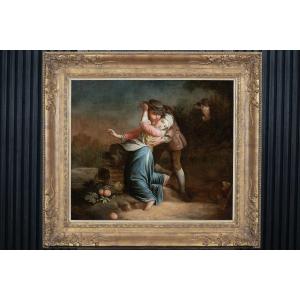


Flemish School (c. 1680–1730) - Moralising Genre Scene
Moralising Genre Scene
Flemish School (c. 1680–1730)
Artist: Flemish School (c. 1680–1730)
Title: Moralising Genre Scene
Medium: Oil on canvas
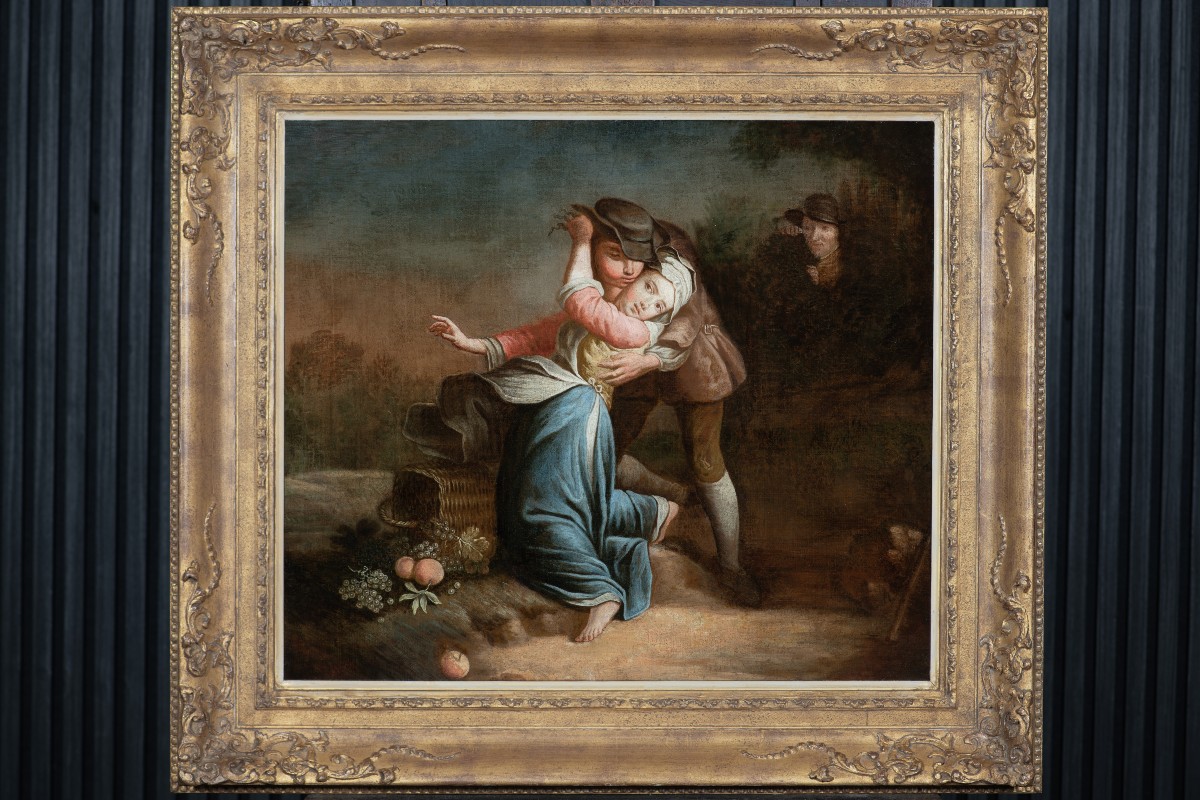
Dimensions: 61.5 × 70 cm (framed: 84 × 93 cm)
Signature: Unsigned
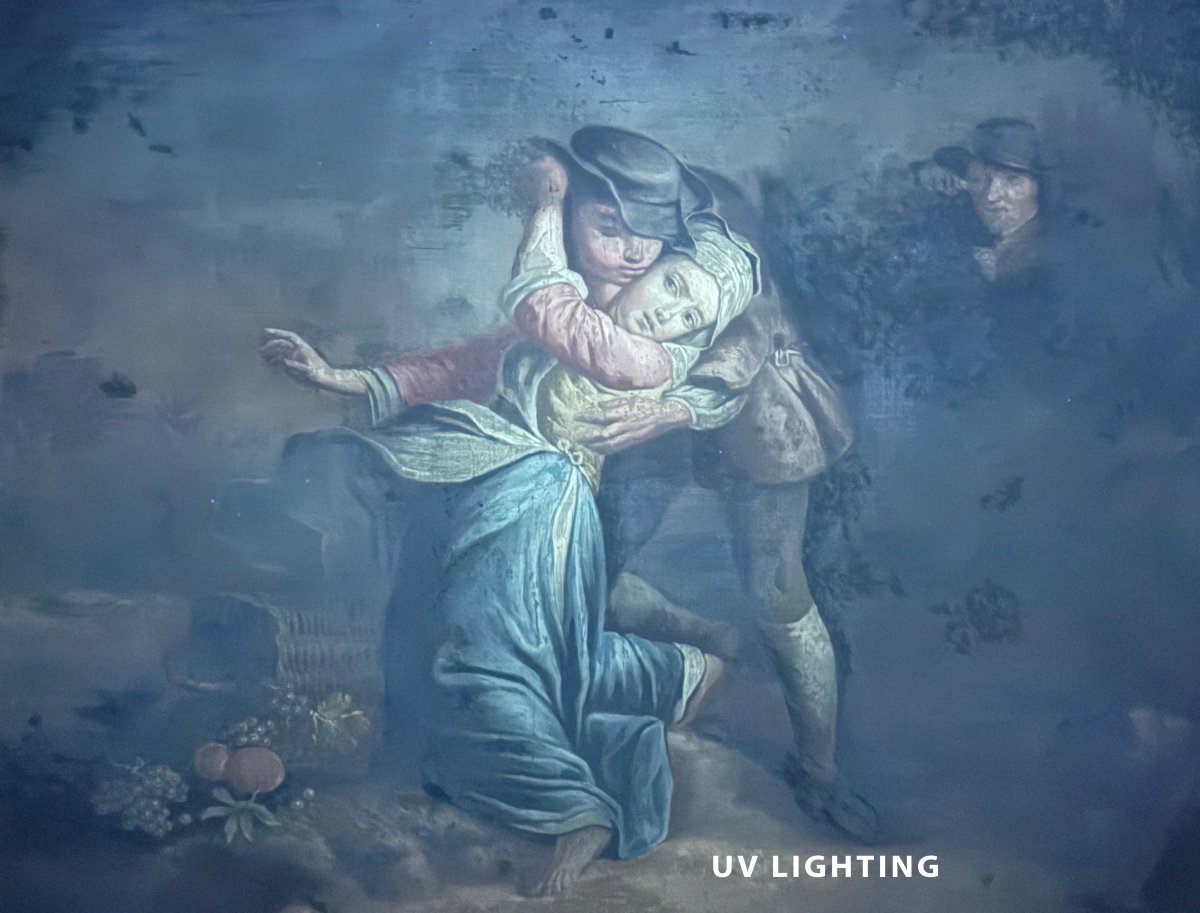
Condition: Relined canvas; retouching visible under UV light; presented in a gilt Baroque frame
Provenance: Undocumented
Object Description
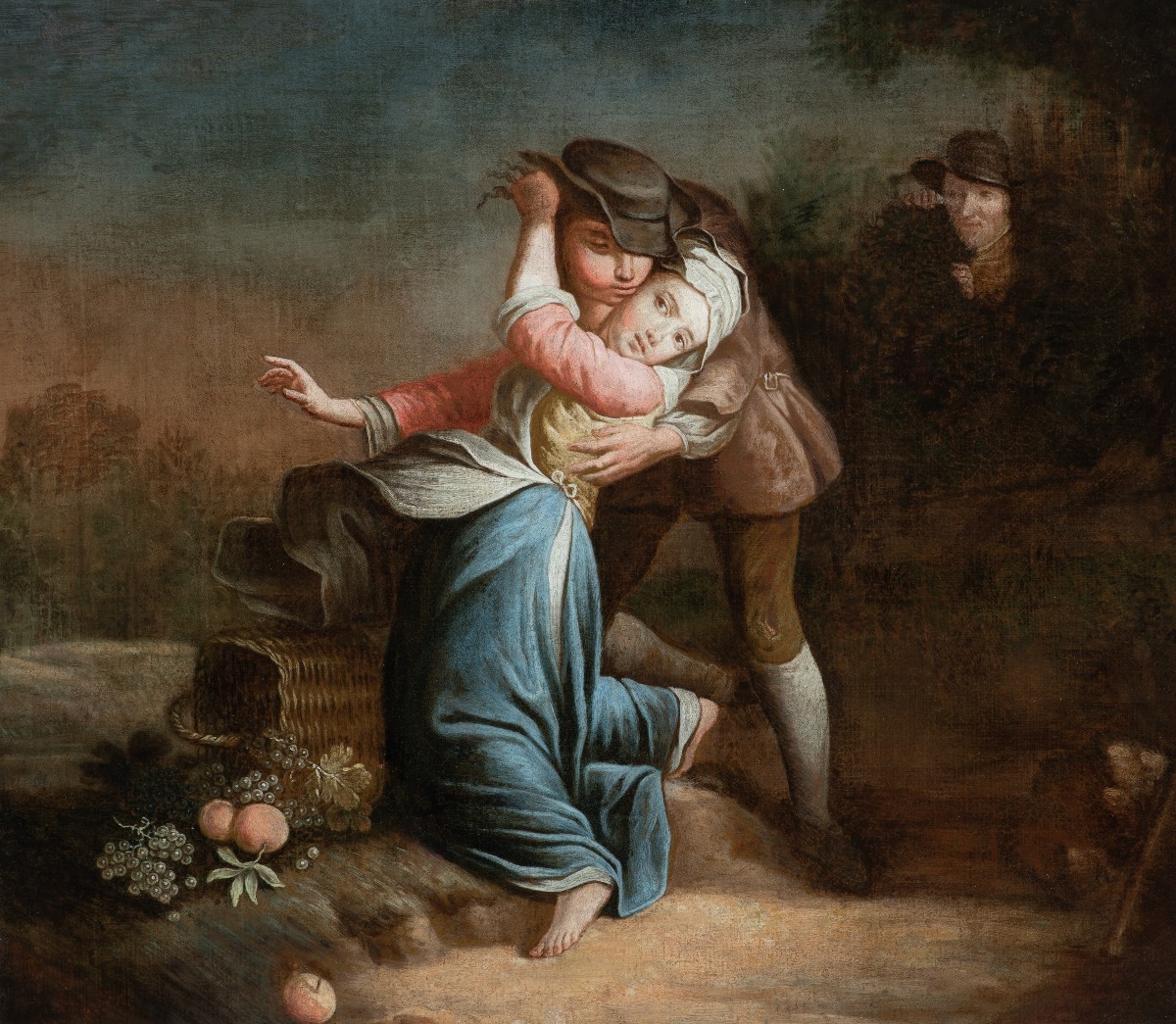
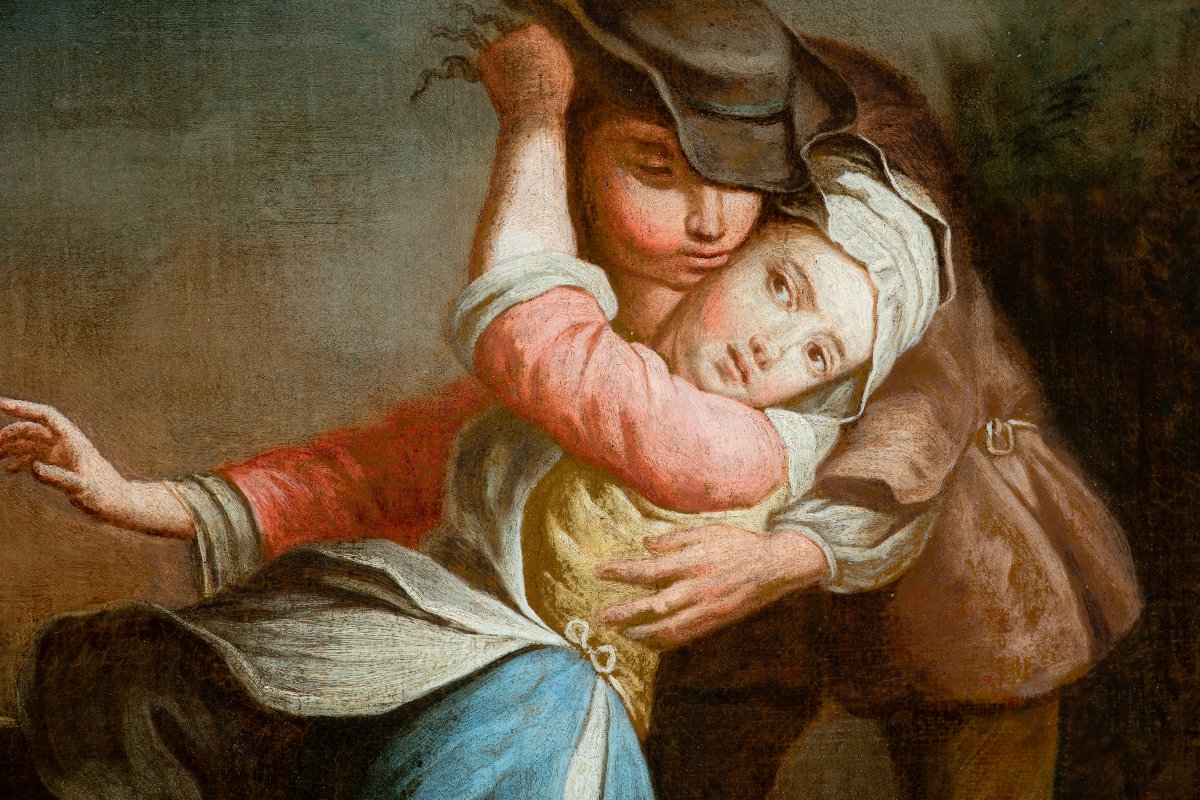
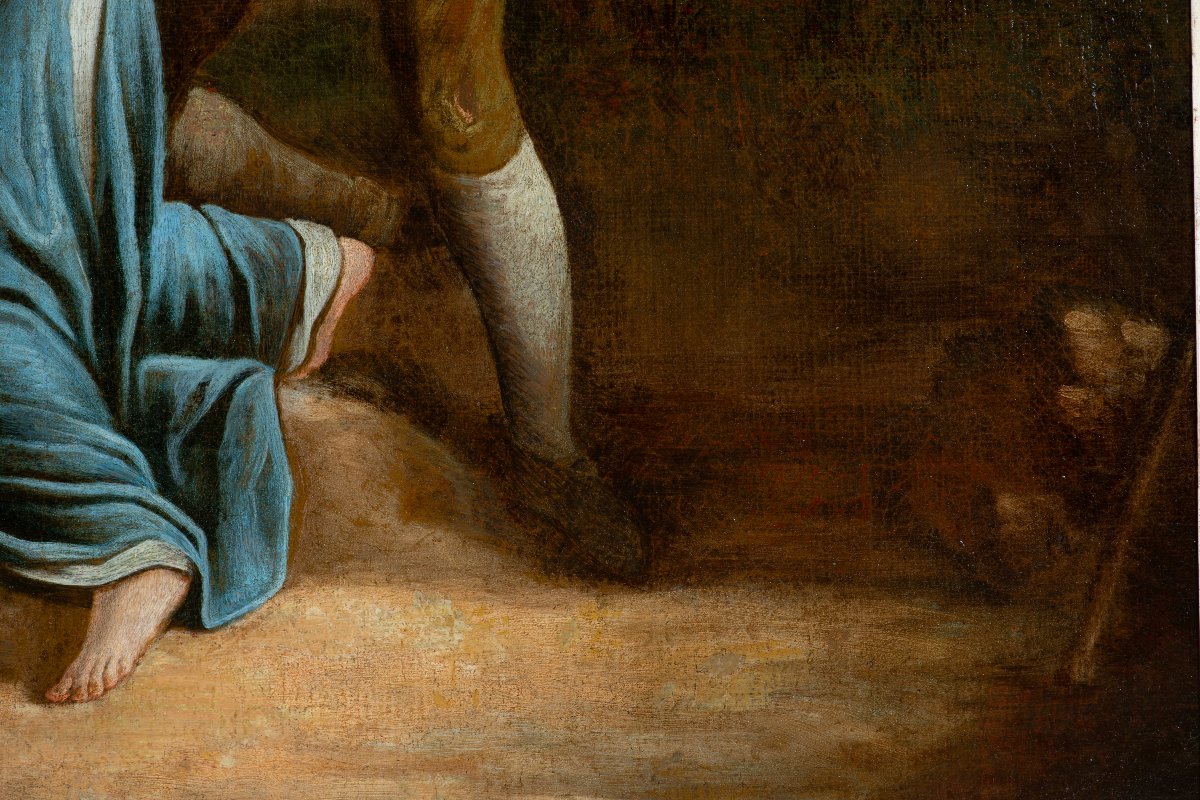
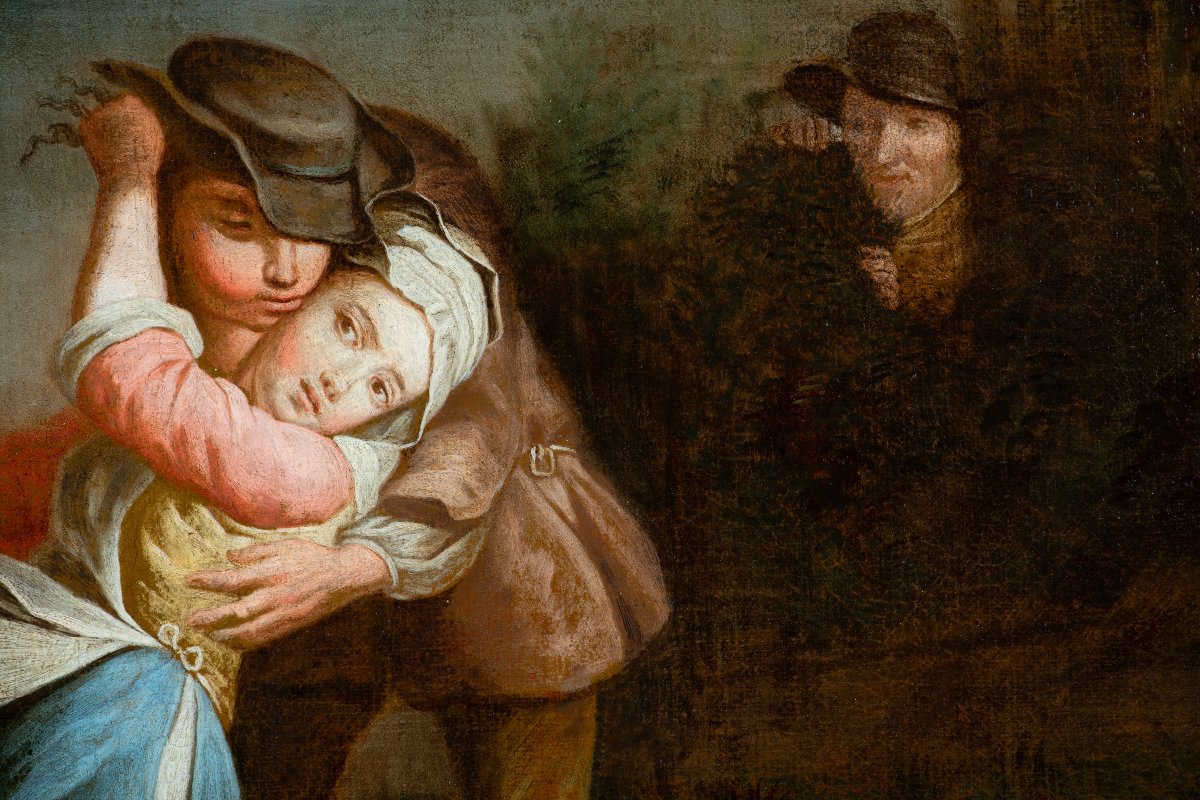
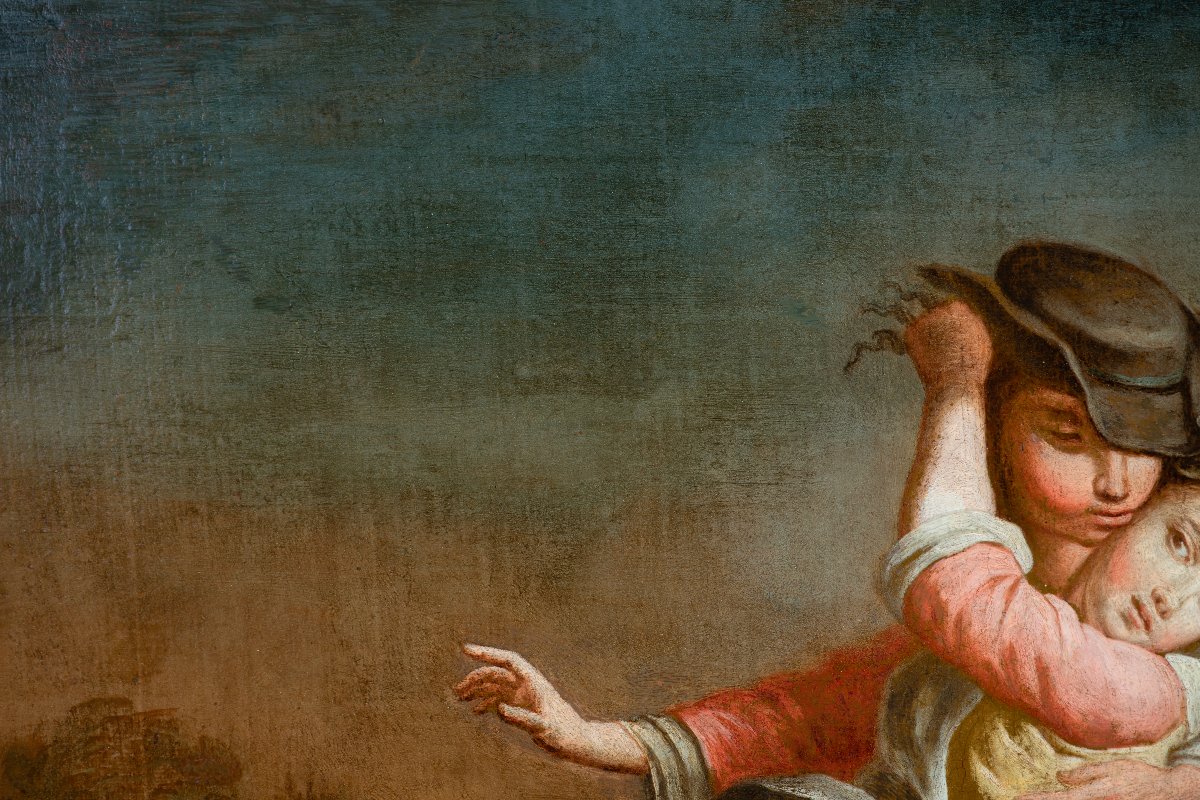
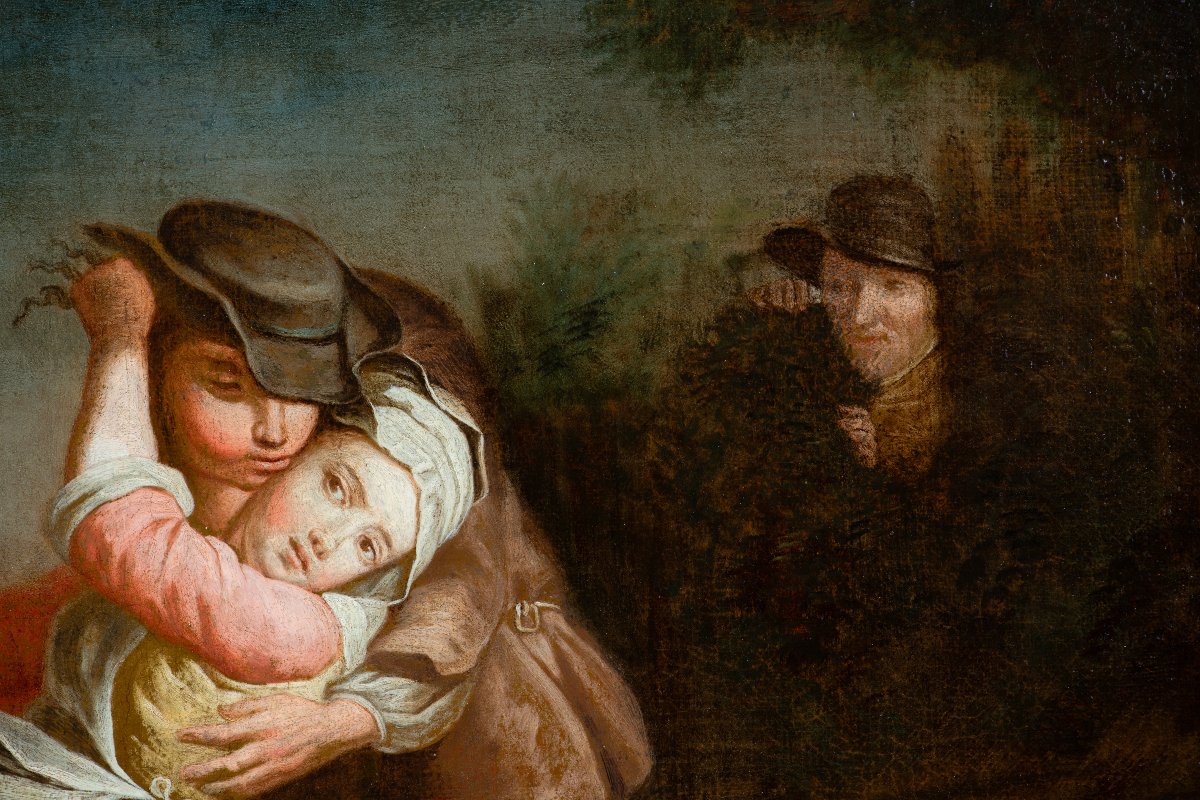
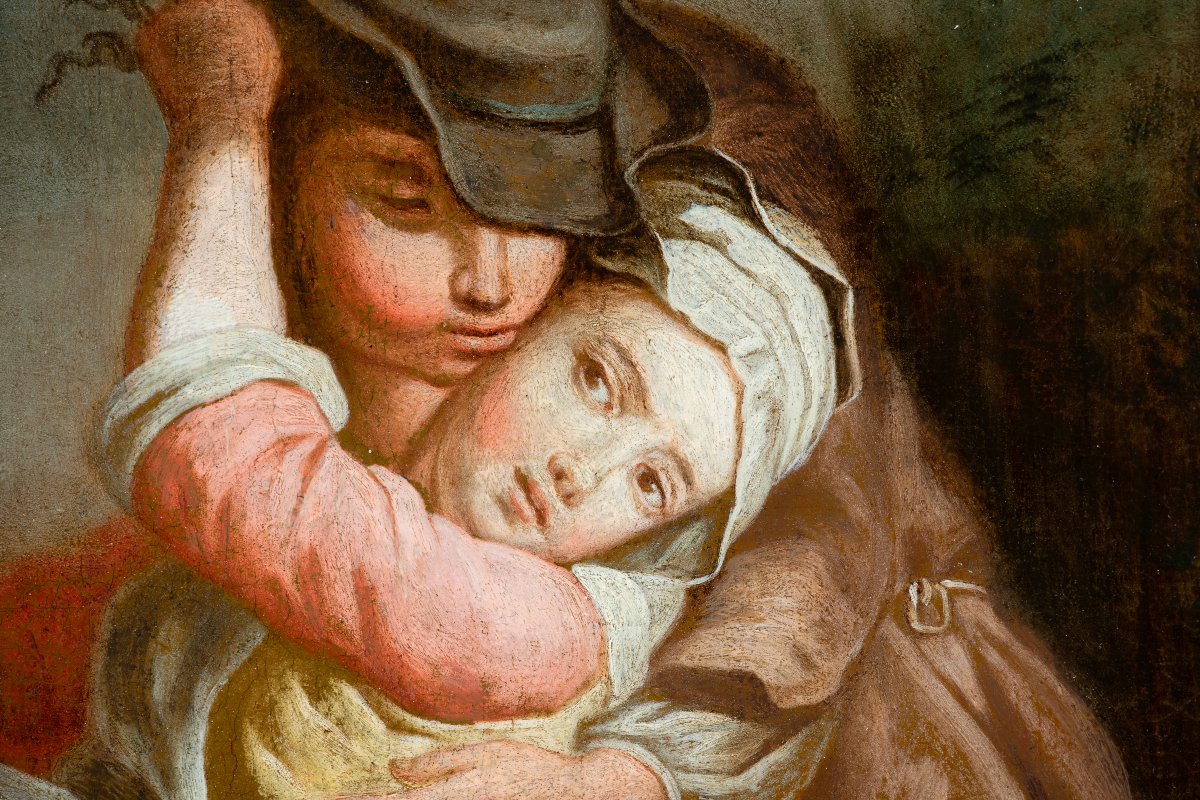
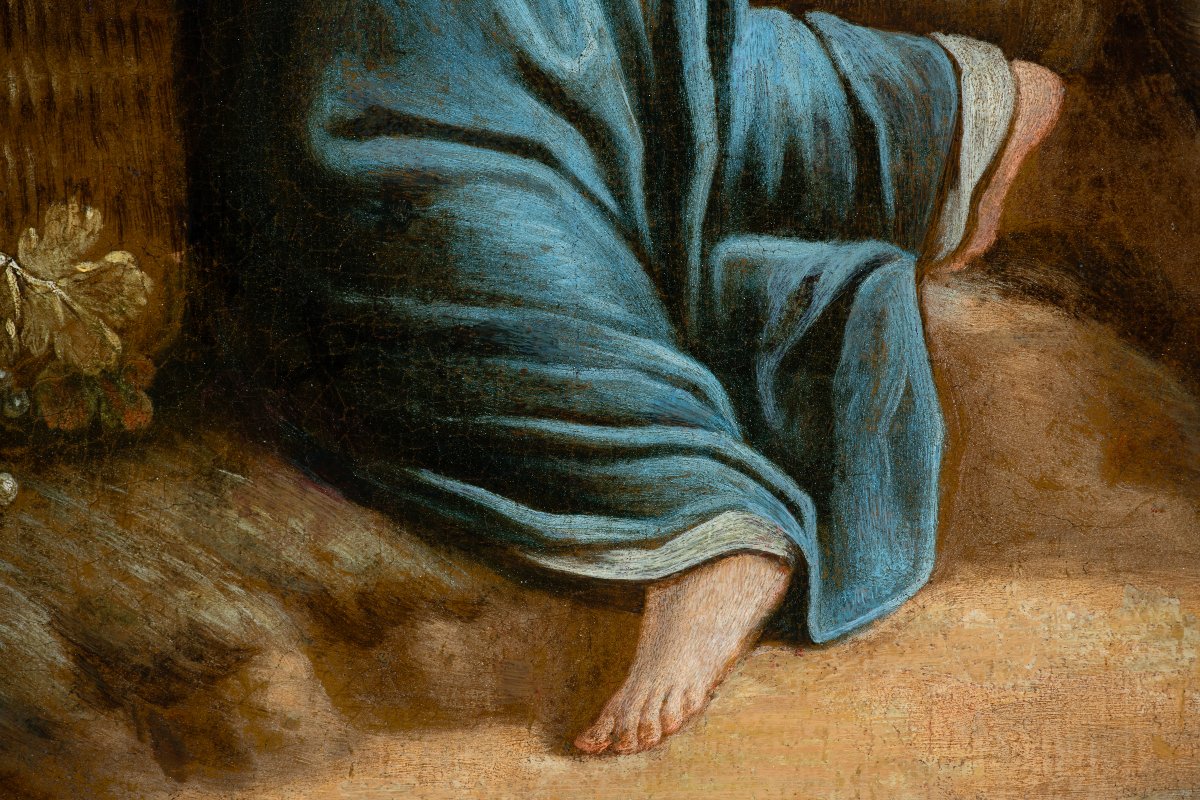
The painting depicts an outdoor scene with three figures in a twilit landscape. At centre, a young man in peasant clothing — brown doublet, dark hat, stockings and boots — seizes a seated woman from behind. She resists with an outstretched left arm, her head tilted back against the man’s shoulder. She wears a pink bodice over a white shirt, a full blue skirt and a white headcloth that has become partially unfastened. Her feet are bare. Her face shows downcast or closed eyes.
To the right of the picture plane, half concealed behind dark foliage, a third figure appears: a man wearing a hat who observes the scene. His position and bearing suggest a deliberate role as witness or accomplice.
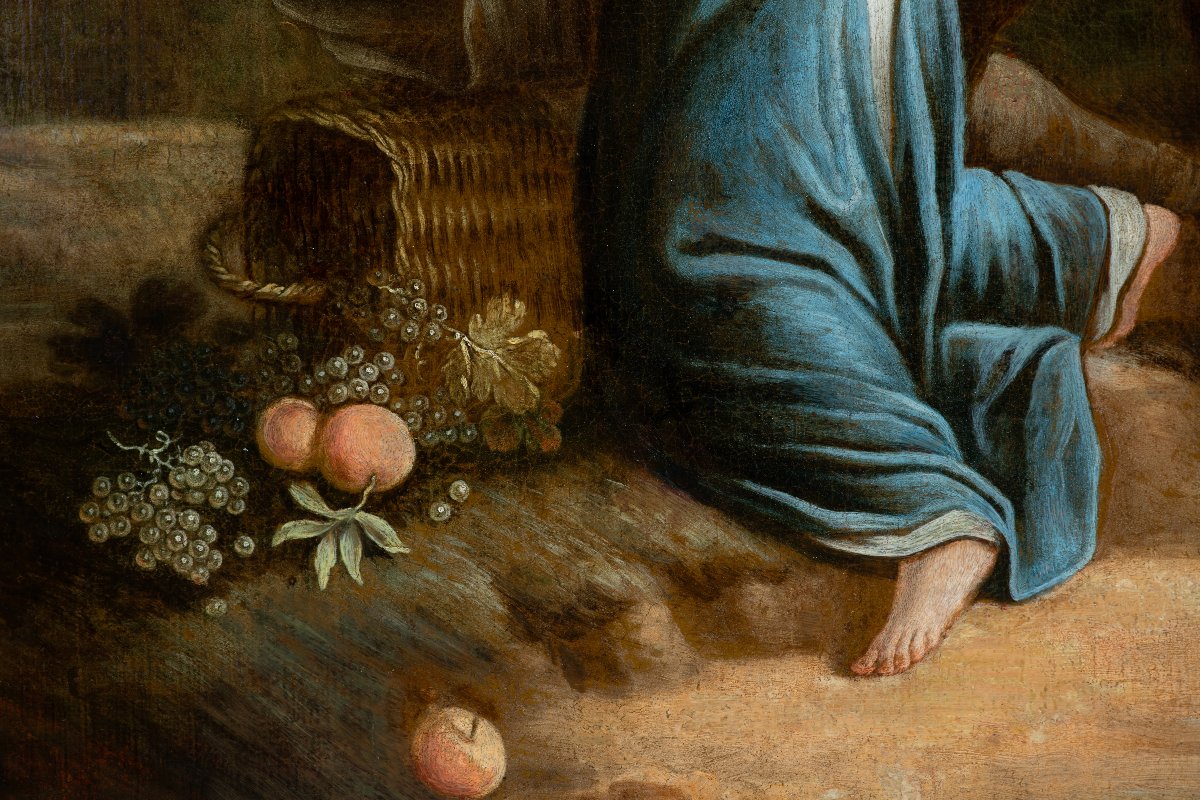
At lower left in the foreground lies a wicker basket with scattered fruit: dark grape clusters, peaches or apricots, and possibly an apple. The fruits display individually distinguishable berries and a subtle waxy sheen on the peaches. The background landscape is treated atmospherically, with a grey-blue clouded sky and schematic architectural forms — possibly ruins or a tower — on the left horizon.
Technique and Material Analysis
The work is executed in oil on canvas. The canvas weave is visible in the thinner paint passages, particularly in the sky and the dark zones at right. The paint structure combines smoothly modelled flesh tones with broader, more summary passages in the landscape and clothing. The fall of the blue skirt shows a degree of volumetric rendering, built up through successive layers from darker to lighter blue. The fruit is treated with greater care: the grapes are constructed with individual touches, the peaches show a thin glaze layer.
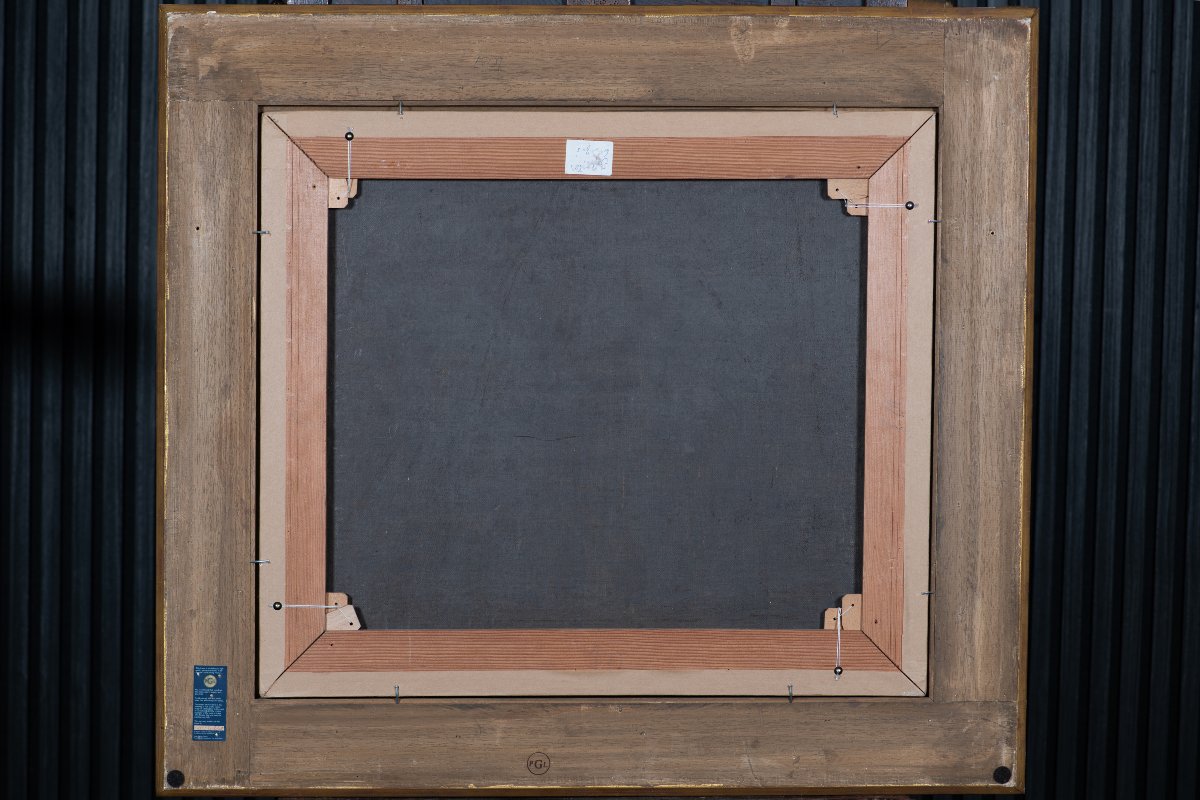
The canvas has been relined. A fine, regular craquelure pattern is observable across the entire surface, consistent with the presumed age of the work. In the sky and the dark passages at left, some wear is perceptible. Retouching is present, principally in the background areas. The varnish layer shows a slight yellowing.
Composition and Formal Analysis
The composition is organised around a diagonal axis running from the fruit still life at lower left to the interlocked upper bodies of the two central figures. The woman’s outstretched arm opens the picture plane to the left and leads the eye towards the empty space of the landscape. The third figure at right, framed by dark foliage, functions as a visual counterweight.
The lighting concentrates illumination on the central figure group, particularly on the flesh tones and the white and pink garments, while the background and lateral areas recede into increasing darkness. The cool blue of the skirt contrasts with the warm palette of browns, ochres and muted greens of the surroundings. The foreground still life of basket and fruit anchors the composition in the lower register and reinforces spatial layering.
Stylistic and Art-Historical Context
The work fits within the tradition of the moralising genre piece in Northern Europe, in which everyday scenes — often with erotic or didactic undertones — served as vehicles for implicit commentary on human behaviour. The triangular composition of aggressor, victim and observing third figure reinforces the narrative and moralising character of the representation.
The presence of fruit in the foreground — grapes, peaches — functions within seventeenth- and early eighteenth-century visual language as a symbolic register referring to fertility, carnal desire and transience. The overturned basket may be read as a loss of order or innocence.
Stylistically, the painting displays characteristics consistent with the late Flemish genre tradition, at the boundary with the Dutch and early French schools. The subdued, predominantly warm palette with concentrated colour accents in blue and pink, the relatively smooth modelling of flesh tones, and the atmospheric treatment of the landscape situate the work in the transitional period between Flemish Baroque and early Rococo genre painting. The figure treatment reveals a competent but undistinguished hand: the anatomy shows slight irregularities in the proportions of the male figure, and the woman’s outstretched arm is somewhat stiffly rendered. The physiognomic types are generic in character.
The attribution to the Flemish school, c. 1680–1730, rests on the combination of these formal and technical characteristics. A more precise attribution to an individual hand cannot be established on the basis of the available material.
Comparable Artists
David Teniers the Younger, Gonzales Coques, Joos van Craesbeeck, Jan Steen (Dutch), Louis Le Nain (French).
Conclusion
The present work is situated, on stylistic and technical grounds, within the Flemish school, c. 1680–1730. The subject — a pastoral scene of unwanted advances, with fruit symbolism and an observing third figure — belongs to the widespread tradition of the moralising genre piece in the Southern and Northern Netherlands. The execution indicates a competent hand working within the convention of late Flemish genre painting, without an individual attribution being possible. The canvas is relined and shows wear and retouching consistent with the presumed age. The work is presented in a gilt Baroque frame.
Period: 17th century
Style: Louis 14th, Regency
Condition: Fully restored
Material: Oil painting
Width: 94cm
Height: 84cm
Reference (ID): 1703145
Availability: In stock