



Hans Rottenhammer (1564-1625) (follower Of The 17th/18th Centuries) - Mary And Child In A Garland
Key facts
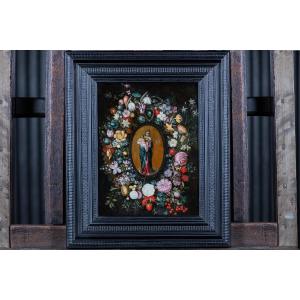
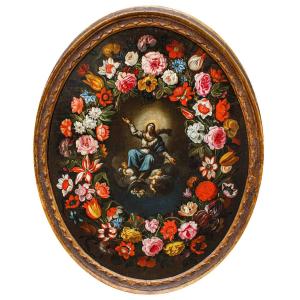
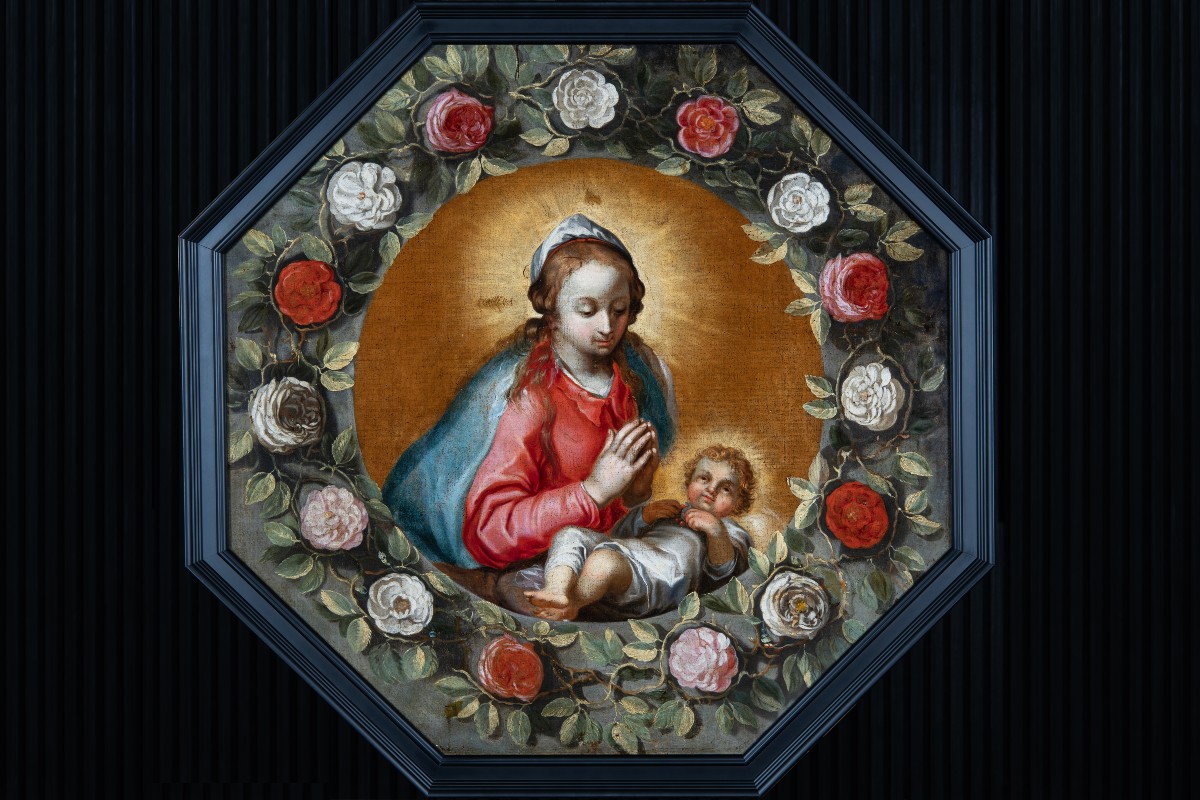
Follower of Hans Rottenhammer (1564–1625), late 17th or early 18th century. Virgin and Child within a Flower Garland. Oil on canvas. Dimensions 93.5 × 93.5 cm (including the octagonal frame 102.5 × 102.5 cm). Unsigned. From a Dutch private collection, via the antiques trade.
Object description
Set within an octagonal format, the composition presents a central tondo with a devotional scene, encircled by a luxuriant floral garland. At the centre the Virgin is shown half-length, hands clasped in prayer and head slightly bowed. She wears a red robe and a blue mantle draped over her shoulders, with a light veil. Before her, the Christ Child lies on a dark cushion, partly covered by a white cloth. The Child holds a small object—possibly a rosary or berries—in one hand. Both figures bear a subtle halo against a warm golden-brown background. The broad garland framing the scene comprises a varied arrangement of white and red roses with carefully described green foliage, set against a neutral, dark ground.
Technique and material analysis
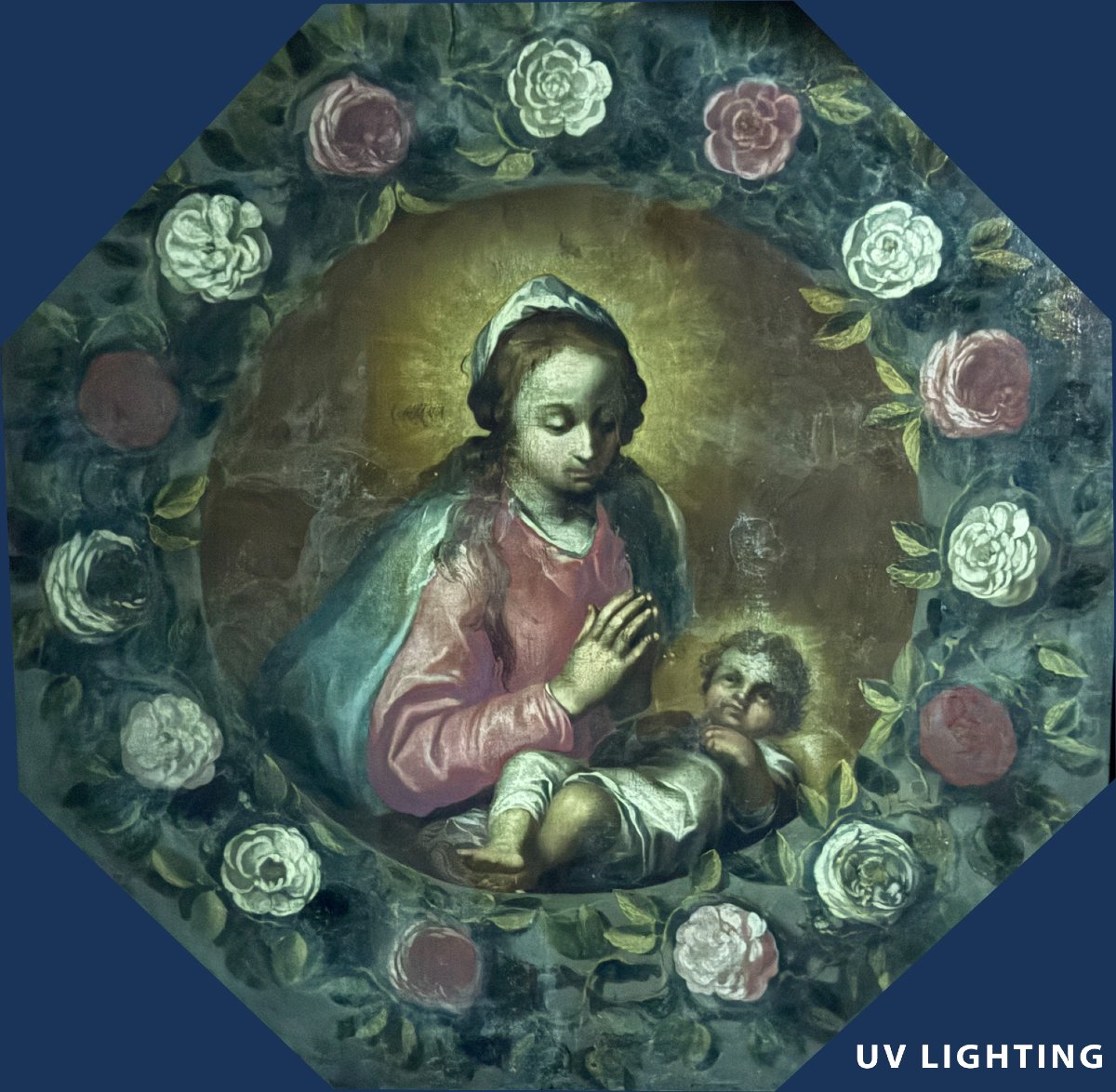
Executed in oil on canvas, the support has an old lining. The paint surface shows an overall craquelure pattern and evidence of historic paint losses. Material observation indicates the presence of both older and more recent retouching. The paint build-up is layered, with fine brushwork in the facial features and botanical details. The object was recently cleaned and finished with a new, even varnish layer.
Composition and formal analysis
The composition is governed by strict central organisation within the octagonal shape. The floral garland functions as a frame-within-a-frame, reinforcing focus on the principal group while suggesting spatial layering. Light appears deliberately directed toward the centre, so that the Virgin and Child stand out clearly against the darker periphery. The palette is dominated by the primary accents of red and blue in the drapery, harmonising with the pink and white tones of the surrounding wreath.
Stylistic and art-historical context
The painting is situated within the Baroque tradition and relates to the genre of garland paintings, in which a devotional image is combined with still-life elements. Its formal characteristics and iconographic arrangement point to a follower of Hans Rottenhammer, active in the late 17th or early 18th century. The work reflects the influence of the refined cabinet pictures for which Rottenhammer is known, often produced in collaboration with specialist flower painters.
Artist
Hans Rottenhammer (1564–1625) was a German artist who formed a significant bridge between German traditions and the Italian Baroque. After an extended stay in Venice and Rome, he settled in Augsburg. He specialised in small-scale mythological and religious scenes, frequently painted on copper. His style combines Venetian colourism with the graphic precision associated with Northern European and German traditions.
Comparable artists
Jan Brueghel the Elder, Daniel Seghers, Peter Paul Rubens, Hendrick van Balen.
Conclusion
A representative devotional picture of the late 17th or early 18th century, stylistically indebted to the tradition associated with Hans Rottenhammer. The octagonal format and the integration of figurative and botanical elements are characteristic of Baroque practice. The object appears materially stable, with historical ageing and earlier restorations remaining visible beneath a recent conservation treatment.
Period: 17th century
Style: Other Style
Condition: Fully restored
Material: Oil painting
Width: 102,5cm
Height: 102,5cm
Depth: 8cm
Reference (ID): 1715726
Availability: In stock