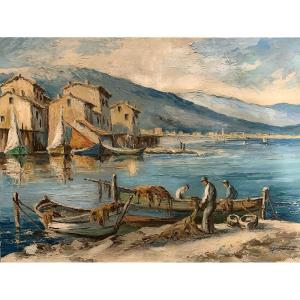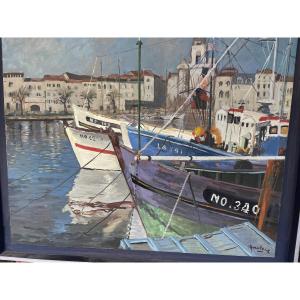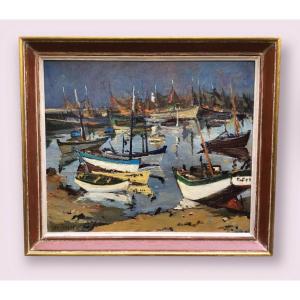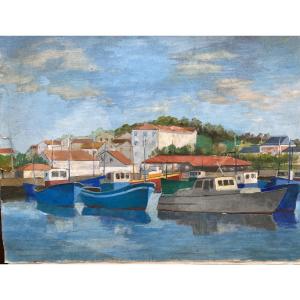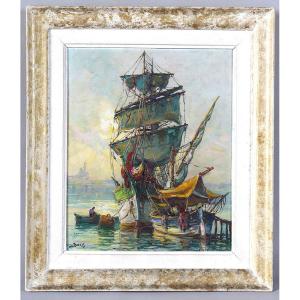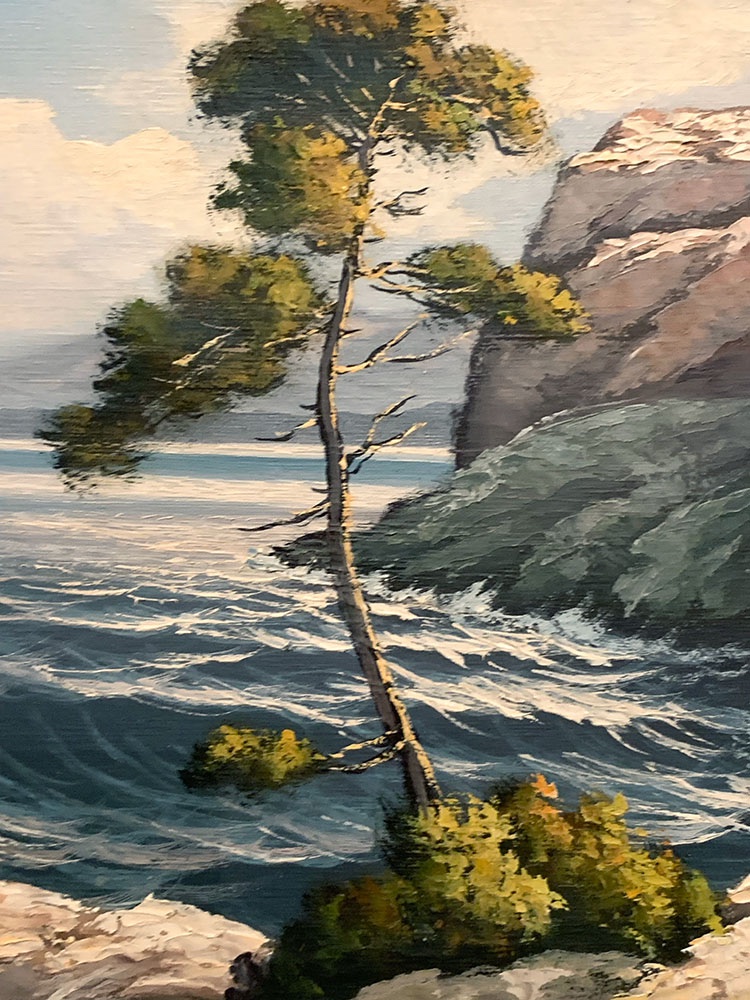


Marine, Raymond Normand 1919/2000, Landscape Of The Côte Bleue, In Provence
Artist: Marine, Raymond Normand
Signed: at the bottom Raymond Normand, listed and listed painter.
Oil painting on canvas, in very good condition.
Subject: Seascape, landscape of the Côte Bleue in Provence.
Period: circa 1950/60.
Dimensions: with frame 46 x 56 cm - canvas 33 x 41 cm (6F).
Frame: painted wooden frame, original to the painting, in good condition with minor wear.
Raymond NORMAND 1919 / 2000:
Born on November 14, 1919 in Auby, between Valenciennes and Douai, into a mining family, son of Maria Duhem and Just Normand, who was wounded during the First World War.
Raymond Normand spent his childhood in Flers-sur-Escrebieux until the age of ten. A childhood marked by illness, osteomyelitis, which confined him to bed for two long years.
In 1937, and for these health reasons, his parents decided to settle in Marseille where Raymond Normand joined the School of Fine Arts; There he took sculpture and drawing classes and became friends with the sculptor César.
His talent was noticed, and he was selected for the French Academy in Rome, housed since its creation in 1666 by Louis XIV in the prestigious Villa Medici, which overlooks the Eternal City from the heights of the Pincian Hill.
After the Second World War, he worked for farmers in Lambesc, where his passion for nature and his vocation as a landscape and animal painter were awakened. At the same time, he discovered, fascinated, the work of Vincent Van Gogh, whose influence is evident in some of his paintings.
In 1950, he settled with his parents in Ventabren, at Trou-du-Loup, in the shadow of the ruins of the castle of the Lords of Baux, in a Virgilian countryside bathed in Mediterranean light.
He lived there very simply, close to nature, surrounded by olive trees, goats, and cats, according to an ideal of life that fame would not alter. The house he built with his father was extremely rustic and for a long time lacked running water and electricity.
A cistern collected rainwater, and they used candles for light.
They rose and went to bed with the sun, in complete harmony with nature. Day after day, year after year, the artist crisscrossed the surrounding countryside, setting up his easel in the picturesque spots it offered in abundance along its rivers and in its villages: Grans, Lambesc, Ventabren, the Arc, or the Touloubre.
His style became more defined, and his work diversified. He worked in oil with a brush or palette knife and mastered the techniques of wash, charcoal, dry or oil pastel, and India ink. His method, which operates with small, rounded strokes, is akin to pointillism, the resulting effect being impressionistic.
Raymond Normand, a landscape and animal painter, also excelled in the art of portraiture and self-portraiture. Before passing away at the age of 81, and following a family dispute, Raymond Normand had drawn up a will in which he bequeathed his entire body of work to the municipality of Ventabren (1400 canvases and drawings) as well as his real estate and 150,000 euros.
After a lengthy legal battle initiated by the artist's nephews, the Court of Cassation finally recognized the municipality of Ventabren as the painter's sole heir, in accordance with his last wishes. An article in the newspaper La Provence, dated August 31, 2000, discussed "the uncertain fate of the assets bequeathed by the painter," who died on March 12, 2000.
"What will become of the house and the impressive number of canvases it contains?" the newspaper wondered. Twelve years later, the question remains.
The canvases are no longer in the house (which, along with its land, has been rendered unsaleable by a subsequent amendment to the Local Urban Development Plan). They are stored in two rooms of the wine cooperative where they risk being lost to oblivion unless the townspeople object.
It would be desirable for not only the residents of Ventabren but also visitors to be able to admire the paintings and drawings of an artist as talented as he was generous to his adopted village.
For the time being, the municipality remains completely silent on the matter. Painter born and active in Spain at the end of the 19th century, specializing in still-life paintings of flowers, post-impressionist.
Source: Bénézit.
Sold with invoice.
Painting on display at our gallery in L'Isle-sur-la-Sorgue (France) on weekends.
Free shipping within France.
For international shipping: quote available upon request.
A1756
Oil painting on canvas, in very good condition.
Subject: Seascape, landscape of the Côte Bleue in Provence.
Period: circa 1950/60.
Dimensions: with frame 46 x 56 cm - canvas 33 x 41 cm (6F).
Frame: painted wooden frame, original to the painting, in good condition with minor wear.
Raymond NORMAND 1919 / 2000:
Born on November 14, 1919 in Auby, between Valenciennes and Douai, into a mining family, son of Maria Duhem and Just Normand, who was wounded during the First World War.
Raymond Normand spent his childhood in Flers-sur-Escrebieux until the age of ten. A childhood marked by illness, osteomyelitis, which confined him to bed for two long years.
In 1937, and for these health reasons, his parents decided to settle in Marseille where Raymond Normand joined the School of Fine Arts; There he took sculpture and drawing classes and became friends with the sculptor César.
His talent was noticed, and he was selected for the French Academy in Rome, housed since its creation in 1666 by Louis XIV in the prestigious Villa Medici, which overlooks the Eternal City from the heights of the Pincian Hill.
After the Second World War, he worked for farmers in Lambesc, where his passion for nature and his vocation as a landscape and animal painter were awakened. At the same time, he discovered, fascinated, the work of Vincent Van Gogh, whose influence is evident in some of his paintings.
In 1950, he settled with his parents in Ventabren, at Trou-du-Loup, in the shadow of the ruins of the castle of the Lords of Baux, in a Virgilian countryside bathed in Mediterranean light.
He lived there very simply, close to nature, surrounded by olive trees, goats, and cats, according to an ideal of life that fame would not alter. The house he built with his father was extremely rustic and for a long time lacked running water and electricity.
A cistern collected rainwater, and they used candles for light.
They rose and went to bed with the sun, in complete harmony with nature. Day after day, year after year, the artist crisscrossed the surrounding countryside, setting up his easel in the picturesque spots it offered in abundance along its rivers and in its villages: Grans, Lambesc, Ventabren, the Arc, or the Touloubre.
His style became more defined, and his work diversified. He worked in oil with a brush or palette knife and mastered the techniques of wash, charcoal, dry or oil pastel, and India ink. His method, which operates with small, rounded strokes, is akin to pointillism, the resulting effect being impressionistic.
Raymond Normand, a landscape and animal painter, also excelled in the art of portraiture and self-portraiture. Before passing away at the age of 81, and following a family dispute, Raymond Normand had drawn up a will in which he bequeathed his entire body of work to the municipality of Ventabren (1400 canvases and drawings) as well as his real estate and 150,000 euros.
After a lengthy legal battle initiated by the artist's nephews, the Court of Cassation finally recognized the municipality of Ventabren as the painter's sole heir, in accordance with his last wishes. An article in the newspaper La Provence, dated August 31, 2000, discussed "the uncertain fate of the assets bequeathed by the painter," who died on March 12, 2000.
"What will become of the house and the impressive number of canvases it contains?" the newspaper wondered. Twelve years later, the question remains.
The canvases are no longer in the house (which, along with its land, has been rendered unsaleable by a subsequent amendment to the Local Urban Development Plan). They are stored in two rooms of the wine cooperative where they risk being lost to oblivion unless the townspeople object.
It would be desirable for not only the residents of Ventabren but also visitors to be able to admire the paintings and drawings of an artist as talented as he was generous to his adopted village.
For the time being, the municipality remains completely silent on the matter. Painter born and active in Spain at the end of the 19th century, specializing in still-life paintings of flowers, post-impressionist.
Source: Bénézit.
Sold with invoice.
Painting on display at our gallery in L'Isle-sur-la-Sorgue (France) on weekends.
Free shipping within France.
For international shipping: quote available upon request.
A1756
650 €
Period: 20th century
Style: Design 50's and 60's
Condition: Perfect condition
Material: Oil painting
Width: 56 cm
Height: 46 cm
Reference (ID): 1700771
Availability: In stock
Print