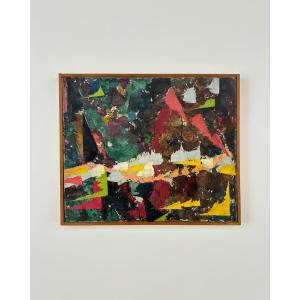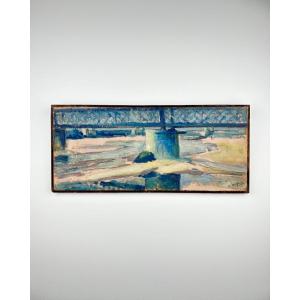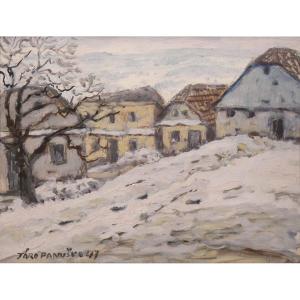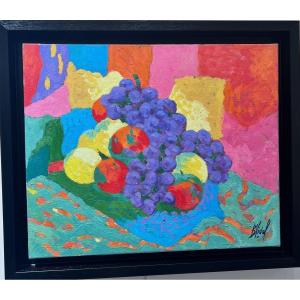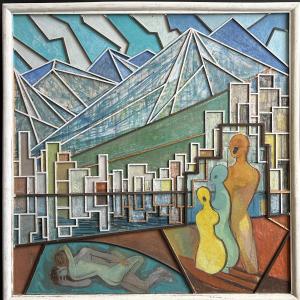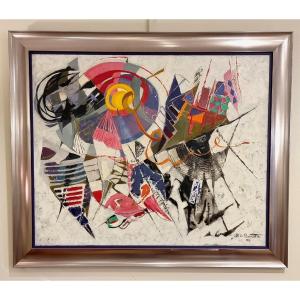


Frédéric Fiebig (1885-1953), Composition, Oil On Cardboard Mounted On Canvas
Artist: Frédéric Fiebig
Frédéric FIEBIG
1885, Talsi (Latvia) – 1953, Sélestat (Bas-Rhin)
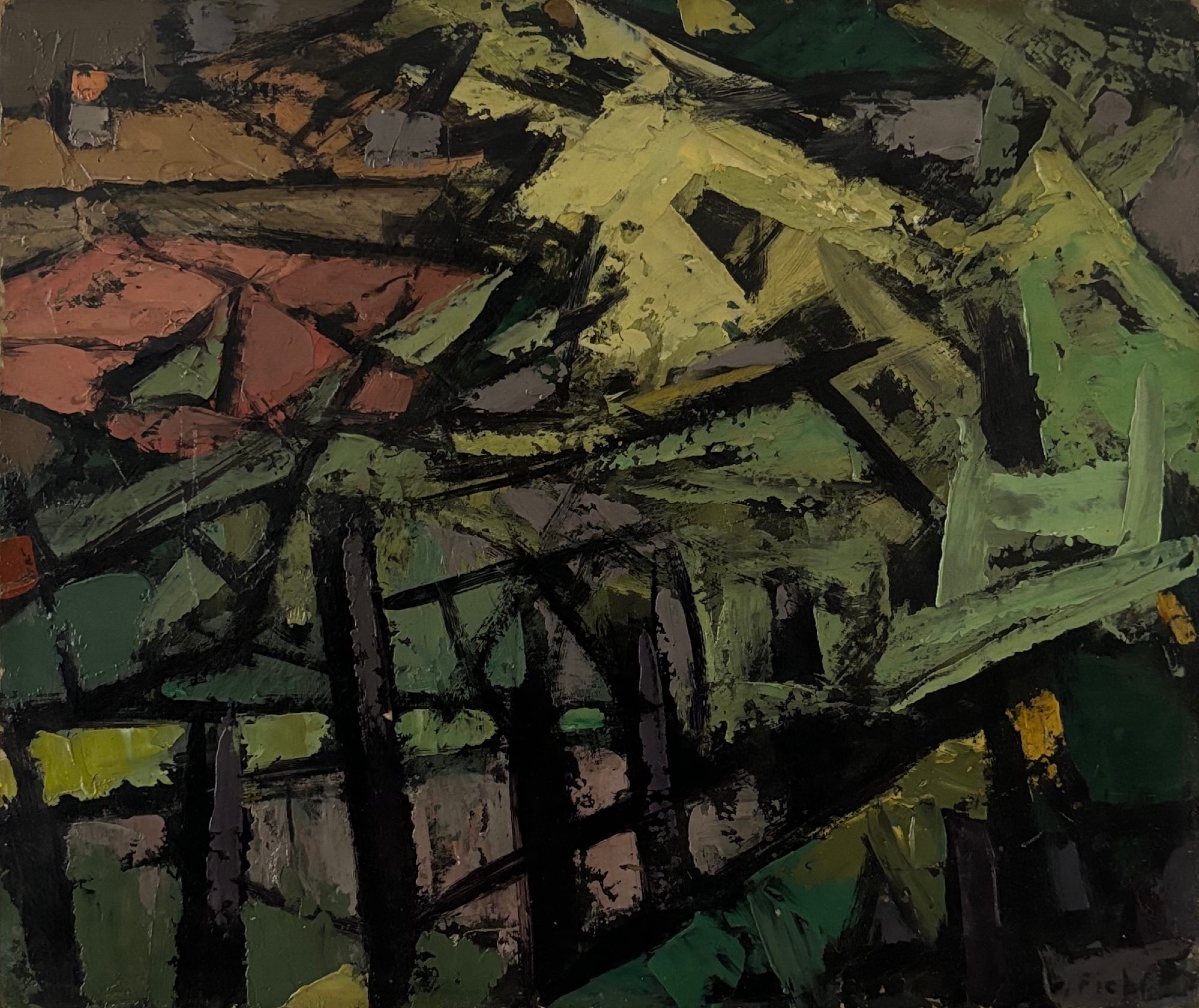
Composition
oil on cardboard mounted on canvas
35 x 41 cm
later-added signature lower right
certificate of authenticity on the reverse, signed by the artist’s daughter, Raya Fiebig (1919–2007)
frame : 46 x 52.5 cm
Latvian painter of German origin, Frédéric Fiebig began his artistic training at the Imperial School for the Promotion of the Arts in Saint Petersburg. Dissatisfied with the academic approach, he moved to Paris in 1907, where he attended the Académie Julian and immersed himself in the artistic movements of the time, particularly Impressionism, Fauvism, and Cubism. Fiebig soon developed a personal style, oscillating between Post-Impressionism and Expressionism. His works, praised by critics including Guillaume Apollinaire, Francis Carco, and André Salmon, depict urban and natural landscapes transformed by his perception, reflecting a keen sensitivity to light and form. He exhibited in numerous Parisian salons and internationally, in cities such as Barcelona, London, and New York, and in 1912 he held a solo exhibition at the Bernheim-Jeune gallery.
After traveling to Italy and southern France, Fiebig returned to Paris. Seeking a healthier climate for his son Éric, who suffered from severe heart problems, he moved with his family in 1929 to Sélestat, in Alsace. This period marked a turning point: Éric’s death in 1932 plunged the painter into irreparable grief. He withdrew to a cabin on the Taennchel massif, living as a hermit for an entire year. During this time, he produced hundreds of small-format works on recycled cardboard, which earned him immediate critical and commercial recognition. However, the Second World War increased his isolation. He faced the deportation of his children’s mother and the temporary arrest of his daughter. Nearly blind, he ceased painting in 1946 and died in Sélestat in 1953, leaving behind an underrecognized artistic legacy that his daughter Raya would later work to restore.
Despite these hardships, Fiebig created a rich and expressive oeuvre, characterized by a spiritual quest and a profound connection to nature. His style is distinguished by his mastery of the palette knife technique, which he adopted in the 1920s. This approach gives his works a unique expressive density, emphasizing the geometric structure of landscapes and architectural forms. He applied paint in thick, vibrant layers, structuring his compositions around recurring triangular forms—roofs, rocks, foliage—that became his visual signature. The academician Maurice Rheims noted that Fiebig was the only artist in France to have unknowingly participated in the Die Brücke movement.
Public collections
Museum of Modern and Contemporary Art of Strasbourg
Unterlinden Museum, Colmar
Latvian National Museum of Art, Riga, Latvia
Talsi Regional Museum, Latvia
1885, Talsi (Latvia) – 1953, Sélestat (Bas-Rhin)
Composition
oil on cardboard mounted on canvas
35 x 41 cm
later-added signature lower right
certificate of authenticity on the reverse, signed by the artist’s daughter, Raya Fiebig (1919–2007)
frame : 46 x 52.5 cm
Latvian painter of German origin, Frédéric Fiebig began his artistic training at the Imperial School for the Promotion of the Arts in Saint Petersburg. Dissatisfied with the academic approach, he moved to Paris in 1907, where he attended the Académie Julian and immersed himself in the artistic movements of the time, particularly Impressionism, Fauvism, and Cubism. Fiebig soon developed a personal style, oscillating between Post-Impressionism and Expressionism. His works, praised by critics including Guillaume Apollinaire, Francis Carco, and André Salmon, depict urban and natural landscapes transformed by his perception, reflecting a keen sensitivity to light and form. He exhibited in numerous Parisian salons and internationally, in cities such as Barcelona, London, and New York, and in 1912 he held a solo exhibition at the Bernheim-Jeune gallery.
After traveling to Italy and southern France, Fiebig returned to Paris. Seeking a healthier climate for his son Éric, who suffered from severe heart problems, he moved with his family in 1929 to Sélestat, in Alsace. This period marked a turning point: Éric’s death in 1932 plunged the painter into irreparable grief. He withdrew to a cabin on the Taennchel massif, living as a hermit for an entire year. During this time, he produced hundreds of small-format works on recycled cardboard, which earned him immediate critical and commercial recognition. However, the Second World War increased his isolation. He faced the deportation of his children’s mother and the temporary arrest of his daughter. Nearly blind, he ceased painting in 1946 and died in Sélestat in 1953, leaving behind an underrecognized artistic legacy that his daughter Raya would later work to restore.
Despite these hardships, Fiebig created a rich and expressive oeuvre, characterized by a spiritual quest and a profound connection to nature. His style is distinguished by his mastery of the palette knife technique, which he adopted in the 1920s. This approach gives his works a unique expressive density, emphasizing the geometric structure of landscapes and architectural forms. He applied paint in thick, vibrant layers, structuring his compositions around recurring triangular forms—roofs, rocks, foliage—that became his visual signature. The academician Maurice Rheims noted that Fiebig was the only artist in France to have unknowingly participated in the Die Brücke movement.
Public collections
Museum of Modern and Contemporary Art of Strasbourg
Unterlinden Museum, Colmar
Latvian National Museum of Art, Riga, Latvia
Talsi Regional Museum, Latvia
2 500 €
Period: 20th century
Style: Modern Art
Condition: Good condition
Material: Oil painting on cardboard
Length: 35 cm
Width: 41 cm
Reference (ID): 1698174
Availability: In stock
Print