THIS OBJECT WAS SOLD
Claude Venard (1913-1999) Oil On Canvas Still Life
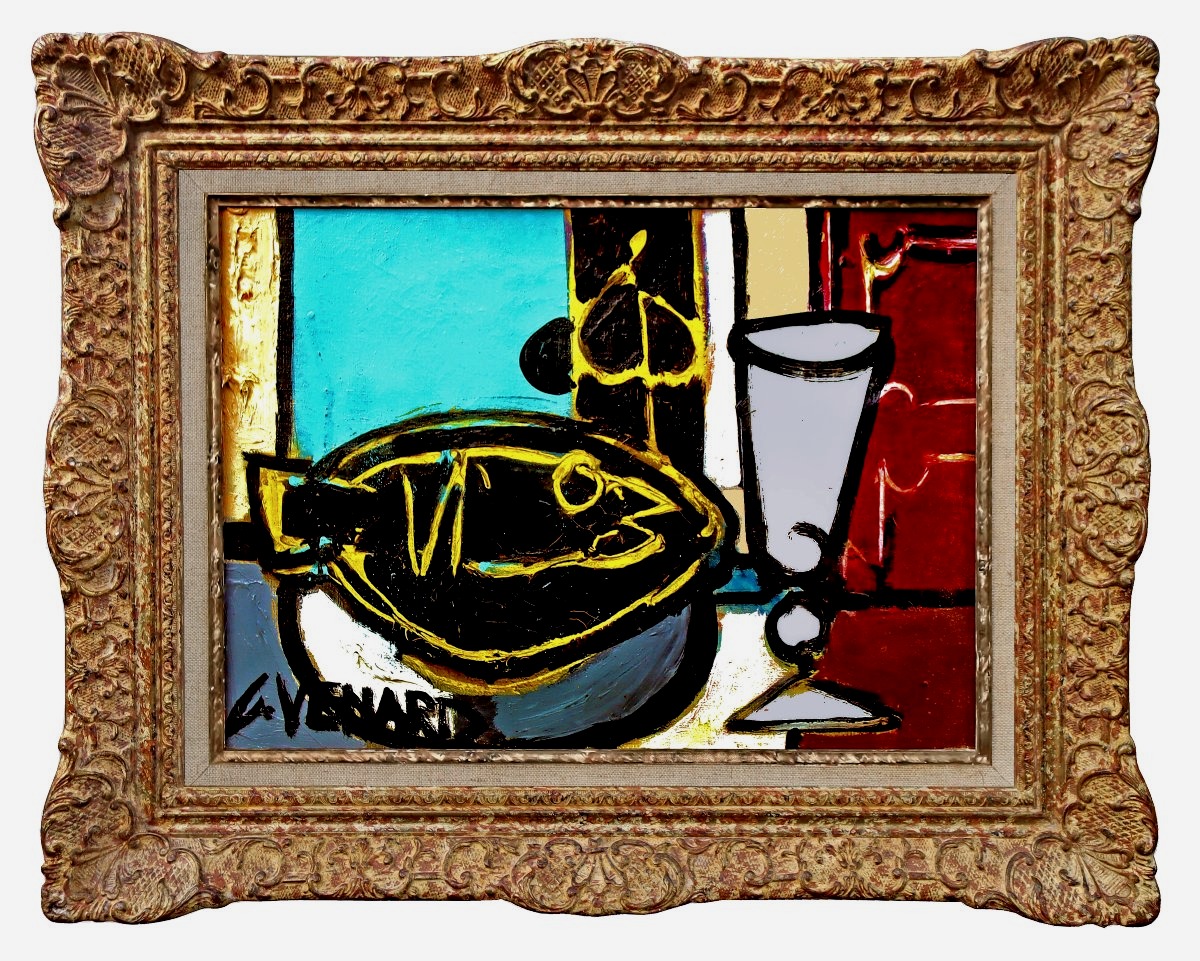
Oil painting on canvas circa 1960, signed C. VENARD (Claude Vénard 1913-1999), depicting a still life with a glass and a fish, executed in the post-Cubist style, brilliantly combining abstraction and naturalism, enlivened by vibrant and intense colors, rhythmically rendered with rich impasto. Good overall condition, 56 cm x 44 cm / visible area: 41 cm x 27 cm. See attached document for two auction results for works of similar subject and size (source: Drouot).
Claude Venard, born March 21, 1913, in Paris, a student of the École des Arts Appliqués, a painter of the School of Paris, and a friend of Braque, Picasso, and Giacometti, has been described as a Cubist painter. He is famous among enthusiasts of the School of Paris. His post-Cubist style employs a palette of raw tones in a rich and creamy impasto. The year 1936 marked a turning point in his career: he participated in the exhibition of the group Les Forces Nouvelles, which also included Pierre Tal-Coat, André Marchand, Roger Humblot, and Francis Gruber. Claude Venard remained faithful, in fact, for most of his life to an instinctive post-Cubism. From his first exhibition at the Salon d'Automne and the Salon des Tuileries in Paris in 1937, to the Salon des Indépendants in 1953, Claude Venard's undeniable talent was revealed, and the great critics of the time, such as Salmon, Apollinaire, Prévert, and Cocteau, who became his friends and wrote his prefaces, ranked him among the leading names of the young generation of the School of Paris. His growing renown has led to his work being featured in major private collections and numerous museums worldwide, including the Whitney Museum in New York, the Tate Gallery, the Tokyo Museum, the Buenos Aires Museum, the Dallas Museum of Art, the Musée d'Art Moderne in Paris, and many others. With his inventive spirit, Claude Venard playfully blends forms, rhythms, colors, and light, searching for the perfect tone to express, in the manner of the Futurist painters, a dynamic and energetic sensation and a simultaneity of emotions—a vision of the world and its colors perceived through a kaleidoscope. An epicurean, a lover of life and its pleasures, Claude Venard, a painter of happiness, remains faithful to the human figure, particularly to that of the sensual and seductive woman who dominates much of his work. The stylized sailboats, the sometimes gigantic fish lying in his settings, reveal Claude Venard's keen attraction and fascination for the sea which he discovered, felt, visualized and deeply loved during his journeys aboard his various boats across the Atlantic and the Mediterranean.
Claude Venard, born March 21, 1913, in Paris, a student of the École des Arts Appliqués, a painter of the School of Paris, and a friend of Braque, Picasso, and Giacometti, has been described as a Cubist painter. He is famous among enthusiasts of the School of Paris. His post-Cubist style employs a palette of raw tones in a rich and creamy impasto. The year 1936 marked a turning point in his career: he participated in the exhibition of the group Les Forces Nouvelles, which also included Pierre Tal-Coat, André Marchand, Roger Humblot, and Francis Gruber. Claude Venard remained faithful, in fact, for most of his life to an instinctive post-Cubism. From his first exhibition at the Salon d'Automne and the Salon des Tuileries in Paris in 1937, to the Salon des Indépendants in 1953, Claude Venard's undeniable talent was revealed, and the great critics of the time, such as Salmon, Apollinaire, Prévert, and Cocteau, who became his friends and wrote his prefaces, ranked him among the leading names of the young generation of the School of Paris. His growing renown has led to his work being featured in major private collections and numerous museums worldwide, including the Whitney Museum in New York, the Tate Gallery, the Tokyo Museum, the Buenos Aires Museum, the Dallas Museum of Art, the Musée d'Art Moderne in Paris, and many others. With his inventive spirit, Claude Venard playfully blends forms, rhythms, colors, and light, searching for the perfect tone to express, in the manner of the Futurist painters, a dynamic and energetic sensation and a simultaneity of emotions—a vision of the world and its colors perceived through a kaleidoscope. An epicurean, a lover of life and its pleasures, Claude Venard, a painter of happiness, remains faithful to the human figure, particularly to that of the sensual and seductive woman who dominates much of his work. The stylized sailboats, the sometimes gigantic fish lying in his settings, reveal Claude Venard's keen attraction and fascination for the sea which he discovered, felt, visualized and deeply loved during his journeys aboard his various boats across the Atlantic and the Mediterranean.
Explore similar pieces and discover your ideal find:
abstract paintings