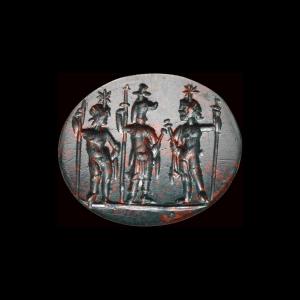


"A Roman Heliotrope Gnostic Intaglio — Anubis With The Dioscuri"
11 × 13 × 2 mm (0.43 × 0.51 × 0.08 in)Mounting on request
Roman period, 2nd-3rd century A.D.
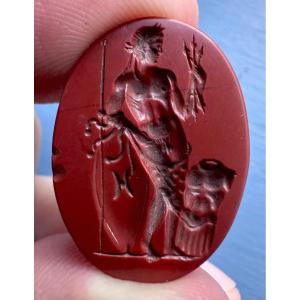
Rare Roman gnostic intaglio in heliotrope (bloodstone) depicting a tripartite composition of magico-religious character: in the centre, the god Anubis in Roman military attire, flanked by the Dioscuri.
Anubis, the jackal-headed Egyptian funerary deity, appears here in his Romanised form, crowned and armed. He wears a cuirass, caligae (military boots), and a sword, holding a spear in his right hand. His head, in profile, faces right. This militarised iconography of Anubis is extremely rare and evokes the god's power over the malevolent forces threatening the deceased in the afterlife.
On either side stand the Dioscuri, Castor and Pollux, divine twins and sons of Zeus. Depicted nude in the Hellenistic tradition, each holds a spear in his left hand while his right hand rests on his hip, supporting drapery. A star surmounts each head — their characteristic attribute. One of the two also carries a sword. Both figures look towards the centre, creating a perfectly balanced symmetrical composition.
This syncretic association belongs to the Gnostic tradition of Greco-Egyptian origin, blending Egyptian funerary beliefs, astrology, and protective magic. Heliotrope, renowned for its apotropaic virtues, enhanced the talismanic power of the object.
Militarised Anubis: An Extremely Rare Iconography
The representation of Anubis as a Roman warrior constitutes an exceptional iconography in ancient glyptics. In classical Egyptian tradition, Anubis generally appears as an embalmer or guide of souls (psychopomp), wearing a loincloth or nude.
Militarised Anubis — bearing cuirass, sword, and shield — is attested only in very rare cases, primarily on magical gems from the Roman imperial period. This iconographic transformation reflects the evolution of the god's role: from simple guardian of necropolises, he becomes an active combatant against demonic forces threatening the deceased during their journey to the afterlife.
This conception fits within the context of Greco-Roman syncretism, where Egyptian deities were reinterpreted through the lens of Roman culture while retaining their original eschatological dimension.
The Dioscuri in Gnostic Tradition
Castor and Pollux, the Dioscuri, were venerated throughout the Mediterranean world as saving deities. Their association with stars — they form the constellation Gemini — gave them a cosmic and astrological dimension.
In the Gnostic context, the Dioscuri embodied the fundamental duality of existence (mortality/immortality, matter/spirit) and served as celestial guides for the soul of the deceased. Their presence alongside Anubis reinforces the eschatological dimension of the amulet: the three deities unite their powers to protect and guide the soul in the afterlife.
Heliotrope: The Quintessential Magical Stone
Heliotrope (from Greek helios, sun, and trepein, to turn), also called bloodstone, is a variety of green chalcedony punctuated with red inclusions resembling drops of blood. In Antiquity, this stone was renowned for its powerful magical and medicinal virtues.
Ancient lapidaries attributed to it the power to render invisible, stop haemorrhages, predict the future, and protect against the evil eye. It was particularly prized for carving magical gems and Gnostic amulets.
The intaglio shows slight wear marks consistent with its ancient use as a worn amulet. The carving remains legible and iconographic details are well preserved. The chromatic variety of the heliotrope, with its characteristic inclusions, remains attractive.
Literature
BONNER, C., Studies in Magical Amulets, Chiefly Graeco-Egyptian, Ann Arbor, 1950
MICHEL, S., Die Magischen Gemmen im Britischen Museum, Londres, 2001
ZWIERLEIN-DIEHL, E., Antike Gemmen und ihr Nachleben, Berlin, 2007
MASTROCINQUE, A., Les intailles magiques du département des Monnaies, Médailles et Antiques, Paris, 2014
DASEN, V. & NAGY, Á.M., Le serpent léontocéphale Chnoubis et la magie de l'époque romaine impériale, Kernos, 2012
Each piece of jewellery is delivered with an authentification certificate signed by Bianca Massard and Gabriele Vangelli de Cresci experts, including additional documentation if existing and exhaustive description of the piece.
Pictures are part of the description and show state of conservation of the item. For additional pictures please contact us.










 Le Magazine de PROANTIC
 TRÉSORS Magazine
 Rivista Artiquariato