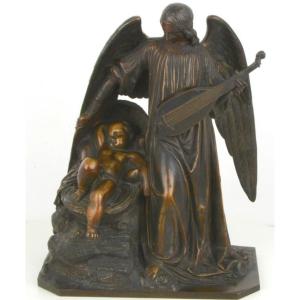
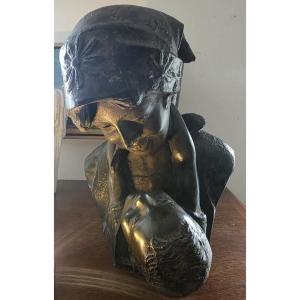
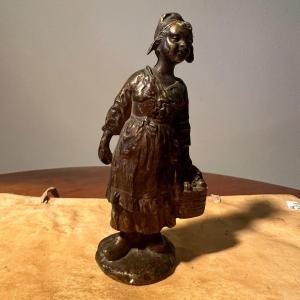
Paul-albert Bartholomé (1848-1928) - "the Sorrow"
Artist: Paul-albert Bartholomé (1848-1928)
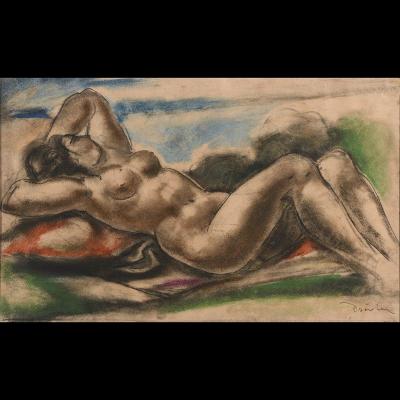
Bronze sculpture with a gold patina. Sand cast. Signed "A. Bartholomé" on the plinth to the right. Foundry mark "Siot-Paris" on the back of the plinth. Bears a reference: "V916" on the back of the plinth. Height: 24.5 cm. Width: 7 cm. Depth: 10 cm. About the work: After ten years of work, the war memorial in Père-Lachaise Cemetery, the work of sculptor Paul-Albert Bartholomé, was inaugurated on November 1, 1899. The event was a huge public success, bringing together more than 100,000 visitors on the day of the inauguration, and aroused the enthusiasm of the press. Le Petit Parisien thus hailed "this magnificent work, which will remain one of the purest jewels of our modern sculpture," while Le Figaro described it as "one of the most striking and grandiose works of art produced by the French school in many years." The renown of this monument prompted the artist to disseminate some of its figures in bronze, stone, or terracotta editions, notably The Weeping Woman, Sorrow, and The Kneeling Woman. Biography: Born in Thiverval (Yvelines) – Died in Paris. This sculptor began his career as a painter. He studied under Barthélemy Menn in Geneva and then under Jean-Léon Gérôme at the École des Beaux-Arts in Paris. Between 1879 and 1886, he regularly submitted works to the Salon. During this period, he produced several pastel nudes, the model being Suzanne Valadon, to whom he introduced Degas, who became his best friend. After the death of his wife, Prospérie de Fleury, he turned to sculpture and created a bronze monument of intense dramatic power for her tomb. Degas encouraged him to continue in this direction. Success came quickly, and he received honors and official commissions. His most famous work is the War Memorial (which the artist called "Gateway to the Afterlife") at the entrance to Père-Lachaise Cemetery (Paris), on which he worked from 1889 to 1899. Nearly 100,000 visitors filed past on All Saints' Day in 1899 for the unveiling of this monument. Many of his smaller works are often replicas or inspired by sculptures detached from this monument, such as "The Weeping Woman" or "The Dead Child." He won the Grand Prize for Sculpture at the 1900 Universal Exhibition. In 1912, his monument to Jean-Jacques Rousseau for the Panthéon received critical acclaim. After participating for many years in the Salon of the Société Nationale des Beaux-Arts, he became its president in 1918. He worked until the end of his life in the studios he had set up on rue Raffet (Paris XVI), where Degas regularly stayed. Galerie Paris Manaus
1 980 €
Period: 20th century
Style: Other Style
Condition: Perfect condition
Material: Bronze
Width: 7 cm
Height: 24,5 cm
Depth: 10 cm
Reference (ID): 1696404
Availability: In stock
Print