Important Painting, Evening Or Lost Illusions, By Charles Gleyre, Orientalist Style
Artist: Suiveur De Charles Gleyre (1806-1874)
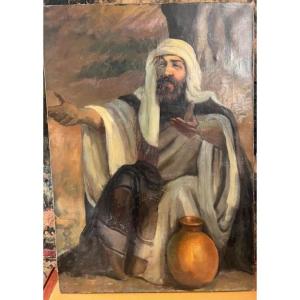
Le soir, or les illusiins perdues Lost Illusions, is a famous painting housed in the Louvre, commissioned by Charles Gleyre after the 1843 Salon for prominent figures of the time.
Painted at the beginning of Gleyre's second stay in Italy (1843-1850), it was based on a hallucination he reportedly experienced on the evening of March 21, 1835, on the banks of the Nile near Abydos, during his trip to Egypt.
Our painting is unsigned; I am selling it as a follower of Charles Gleyre. However, in my opinion, it is contemporary with the artist, but our copy is unsigned.
I leave further research to the experts. The canvas measures 60cm x 120cm and is in good condition, unlined.
The colors and details are superb.
The frame is contemporary.
Shipping is available in custom-made wooden crates with insurance included: France €120
Europe €250
Other €350
*Charles Gleyre (1806-1874), of Swiss origin, arrived in Paris in 1825 and became a student at the École des Beaux-Arts.
After graduating, he continued his training as a painter in the studio of Louis Hersent.
Following a trip to Italy and then a long stay in the Orient, he achieved his first success at the 1843 Salon with *Le Soir ou Les Illusions Perdues* (Evening, or Lost Illusions).
His works, characterized by dense colors and mythological and mystical symbols, foreshadowed a Romanticism and a style recognized by his peers. Appointed director of Paul Delaroche's studio upon his death, he trained nearly 500 artists there, including Gérôme, Renoir, Bazille, Monet, and Sisley, the future Impressionists. Charles Gleyre, associated with so-called "academic" art, a movement that long inspired contempt, was consequently completely denigrated by museums and critics. Yet, he was a major figure in academic painting in Paris and left his mark on the 19th century with his talent. On May 5, 1874, Charles Gleyre died in Paris of a stroke. He was buried in Montparnasse Cemetery, but a week later, his body was requested by the Vaud State Council for burial in the cemetery of Chevilly, his birthplace in Switzerland.
Painted at the beginning of Gleyre's second stay in Italy (1843-1850), it was based on a hallucination he reportedly experienced on the evening of March 21, 1835, on the banks of the Nile near Abydos, during his trip to Egypt.
Our painting is unsigned; I am selling it as a follower of Charles Gleyre. However, in my opinion, it is contemporary with the artist, but our copy is unsigned.
I leave further research to the experts. The canvas measures 60cm x 120cm and is in good condition, unlined.
The colors and details are superb.
The frame is contemporary.
Shipping is available in custom-made wooden crates with insurance included: France €120
Europe €250
Other €350
*Charles Gleyre (1806-1874), of Swiss origin, arrived in Paris in 1825 and became a student at the École des Beaux-Arts.
After graduating, he continued his training as a painter in the studio of Louis Hersent.
Following a trip to Italy and then a long stay in the Orient, he achieved his first success at the 1843 Salon with *Le Soir ou Les Illusions Perdues* (Evening, or Lost Illusions).
His works, characterized by dense colors and mythological and mystical symbols, foreshadowed a Romanticism and a style recognized by his peers. Appointed director of Paul Delaroche's studio upon his death, he trained nearly 500 artists there, including Gérôme, Renoir, Bazille, Monet, and Sisley, the future Impressionists. Charles Gleyre, associated with so-called "academic" art, a movement that long inspired contempt, was consequently completely denigrated by museums and critics. Yet, he was a major figure in academic painting in Paris and left his mark on the 19th century with his talent. On May 5, 1874, Charles Gleyre died in Paris of a stroke. He was buried in Montparnasse Cemetery, but a week later, his body was requested by the Vaud State Council for burial in the cemetery of Chevilly, his birthplace in Switzerland.
8 500 €
Period: 19th century
Style: Orientalism
Condition: Good condition
Material: Oil painting
Length: 116
Width: 76
Reference (ID): 1687289
Availability: In stock
Print