





André - Antoine Ravrio - Mythological Empire Clock " Venus Guided By Love " - Circa 1805
See our website for more detailed photos: LINK
We send this article worldwide, professionally packaged, with registered and fully insured shipping at a fair price.
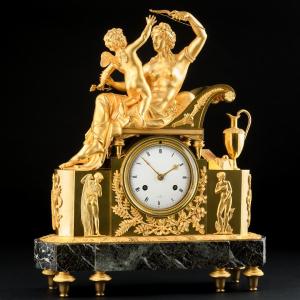
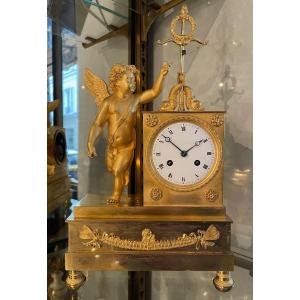
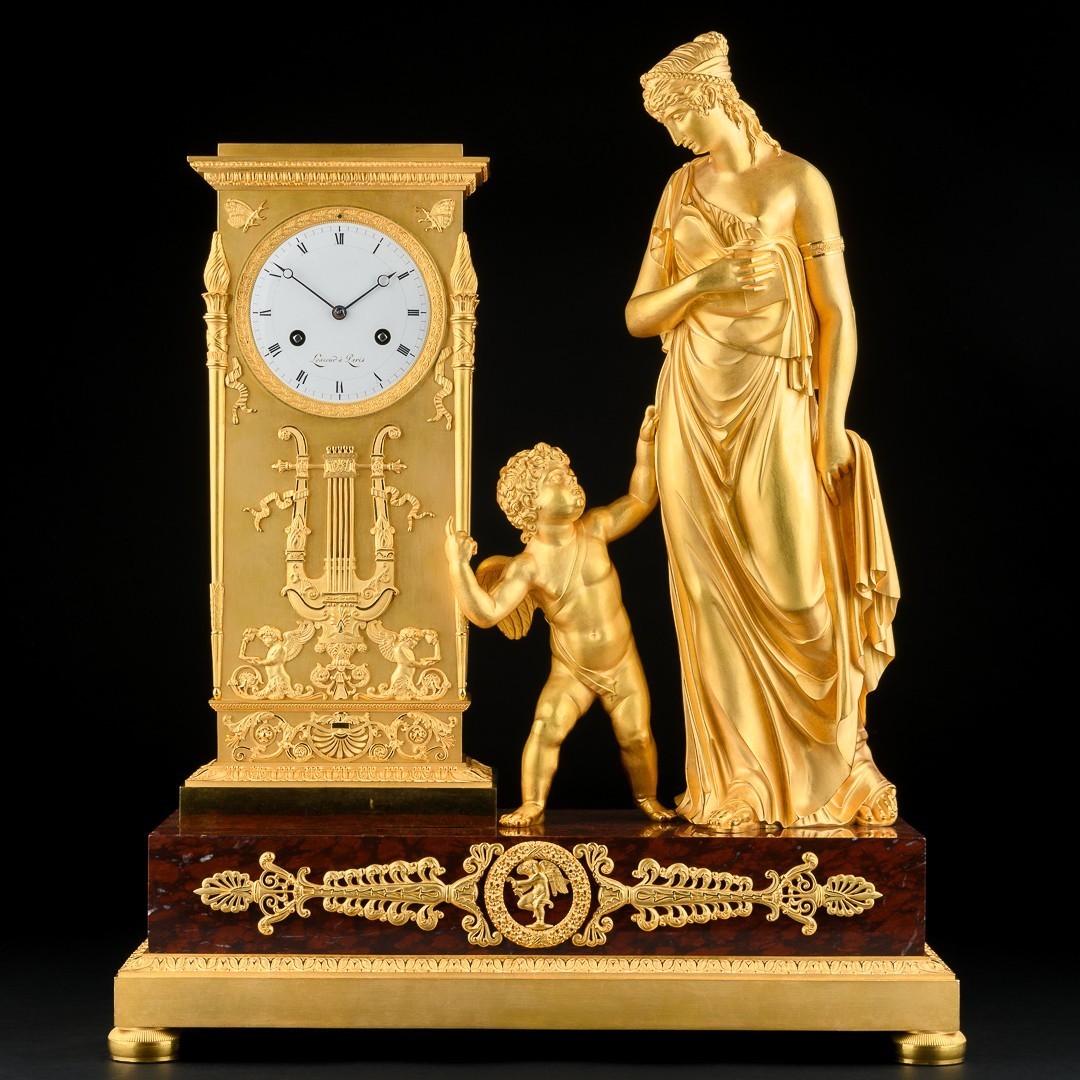
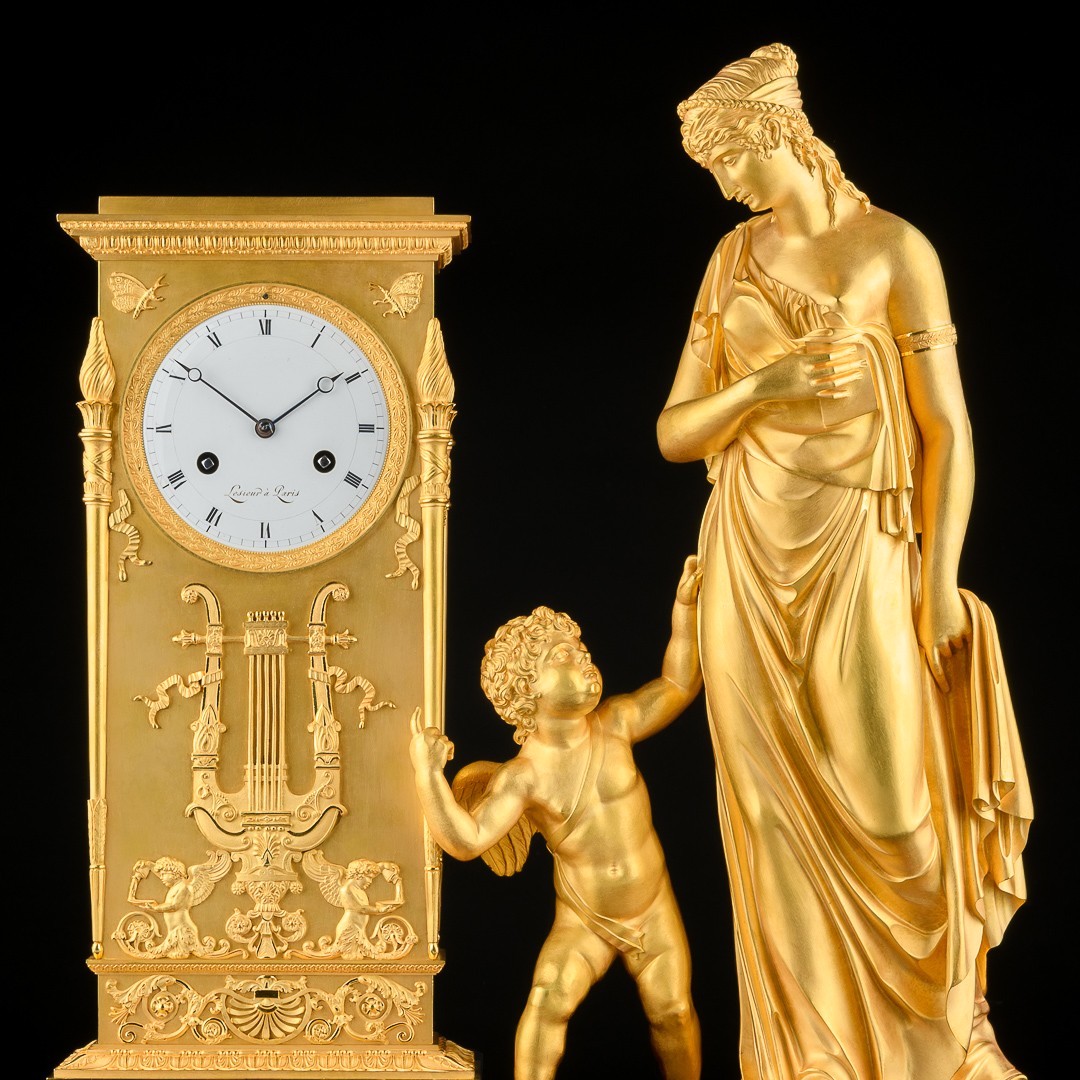
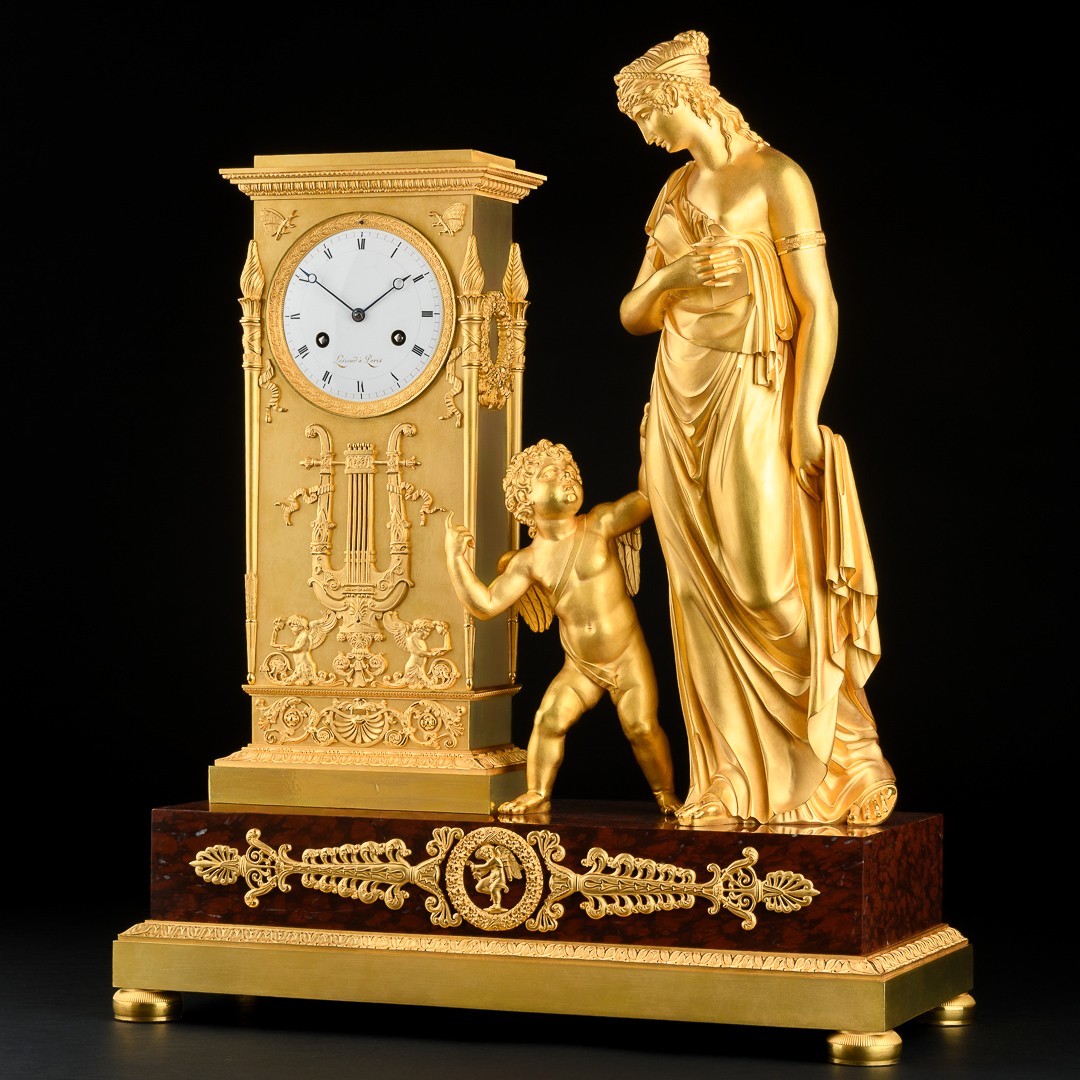
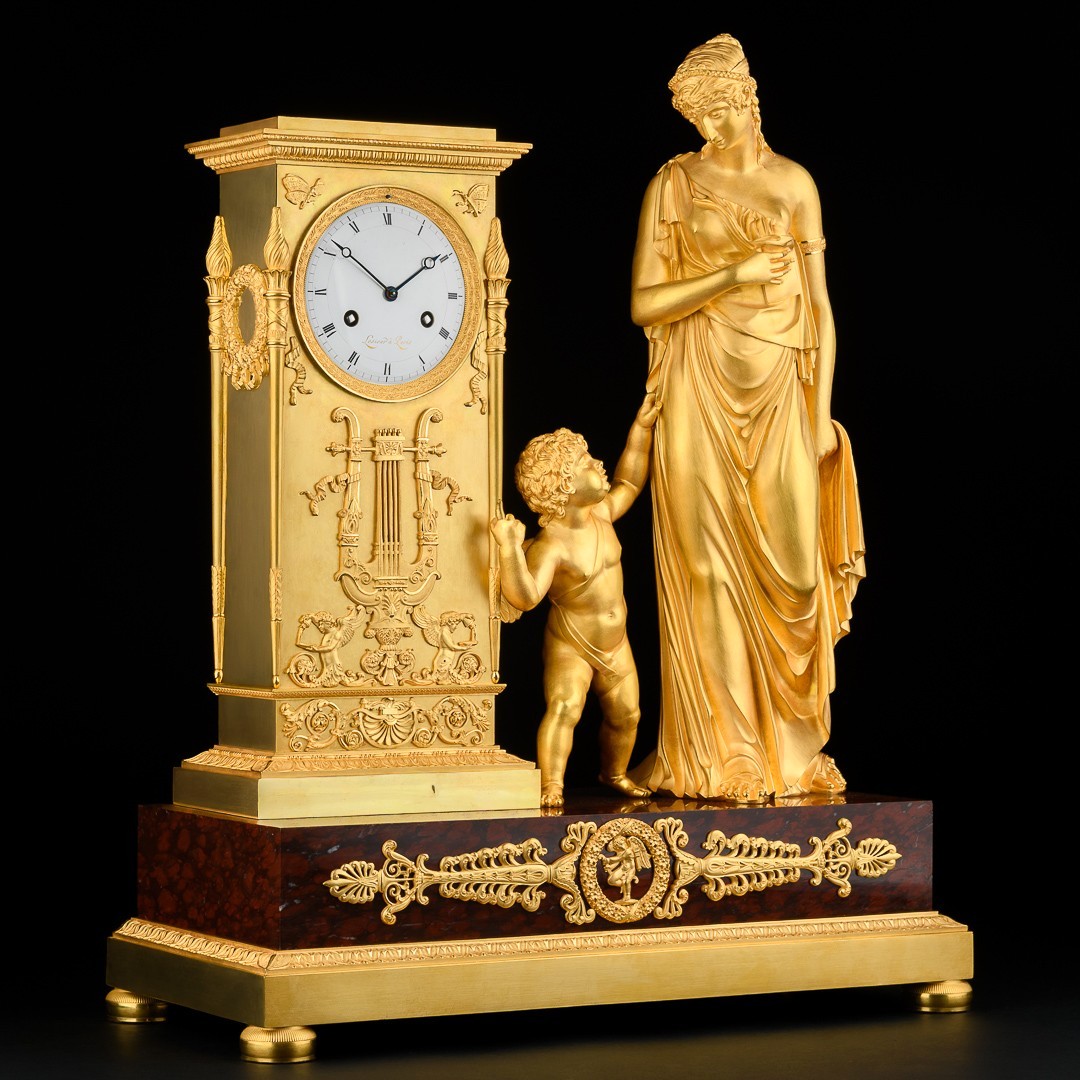
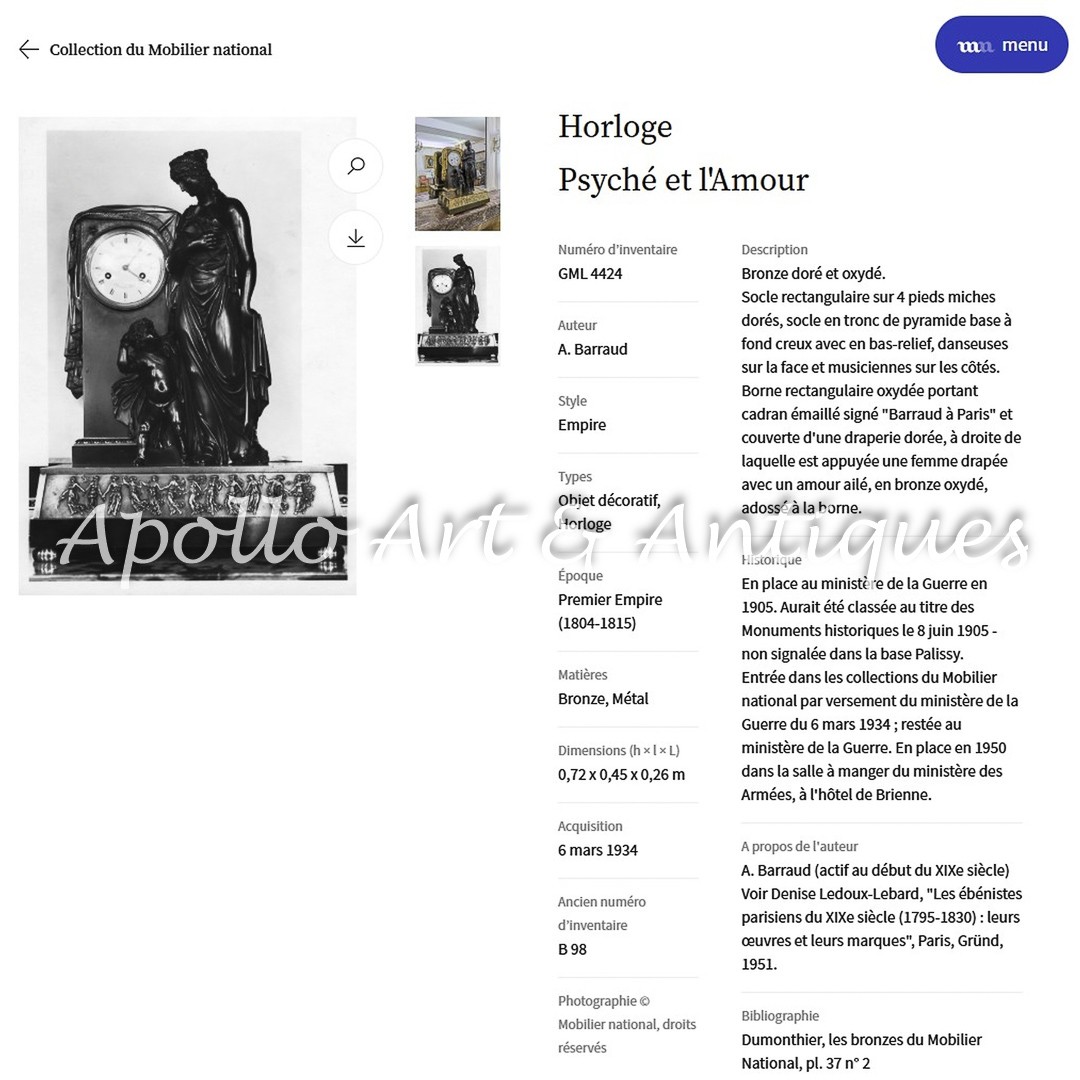
An exceptionally rare French Empire gilt-bronze mantel clock representing Venus Guided by Love, a refined mythological composition attributed to the celebrated bronzier André-Antoine Ravrio (1759–1814). This magnificent mantel clock is distinguished by its breathtaking and superbly detailed sculptures of Venus and Cupid, exemplifying Ravrio’s mastery in bronze work, celebrated for its unparalleled beauty and realism. The clock is fitted with a movement signed “Lesieur à Paris”, placing it among the finest Parisian productions of the early Empire period. Only a handful of related models are known, all of great rarity and differing in details of the base and overall proportions, generally on a considerably smaller scale. These include a version in the collection of the Mobilier National in Paris, and another formerly preserved in the collection of Léon-Napoléon-Louis-Michel Ney, Prince of Moskowa (1870–1928).
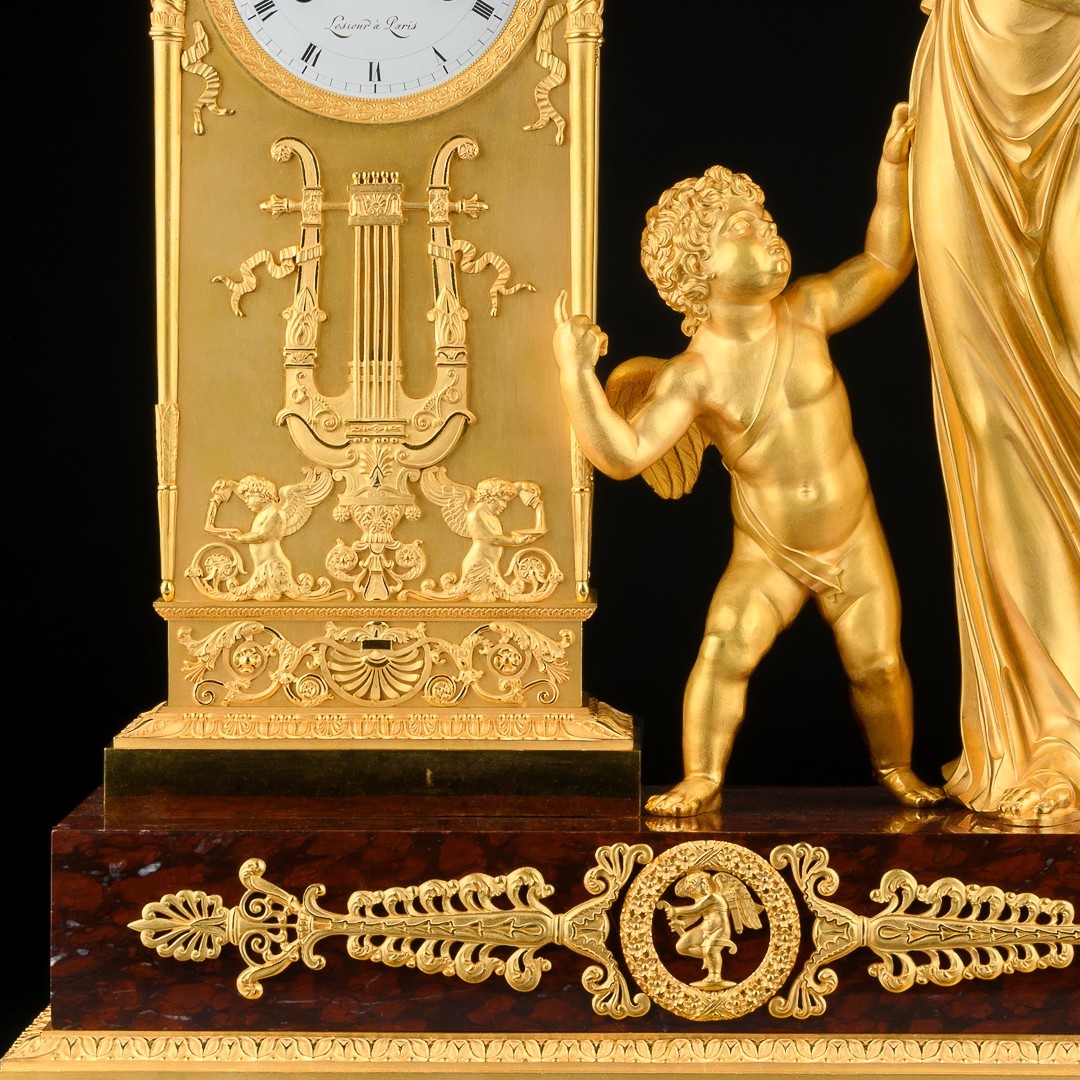
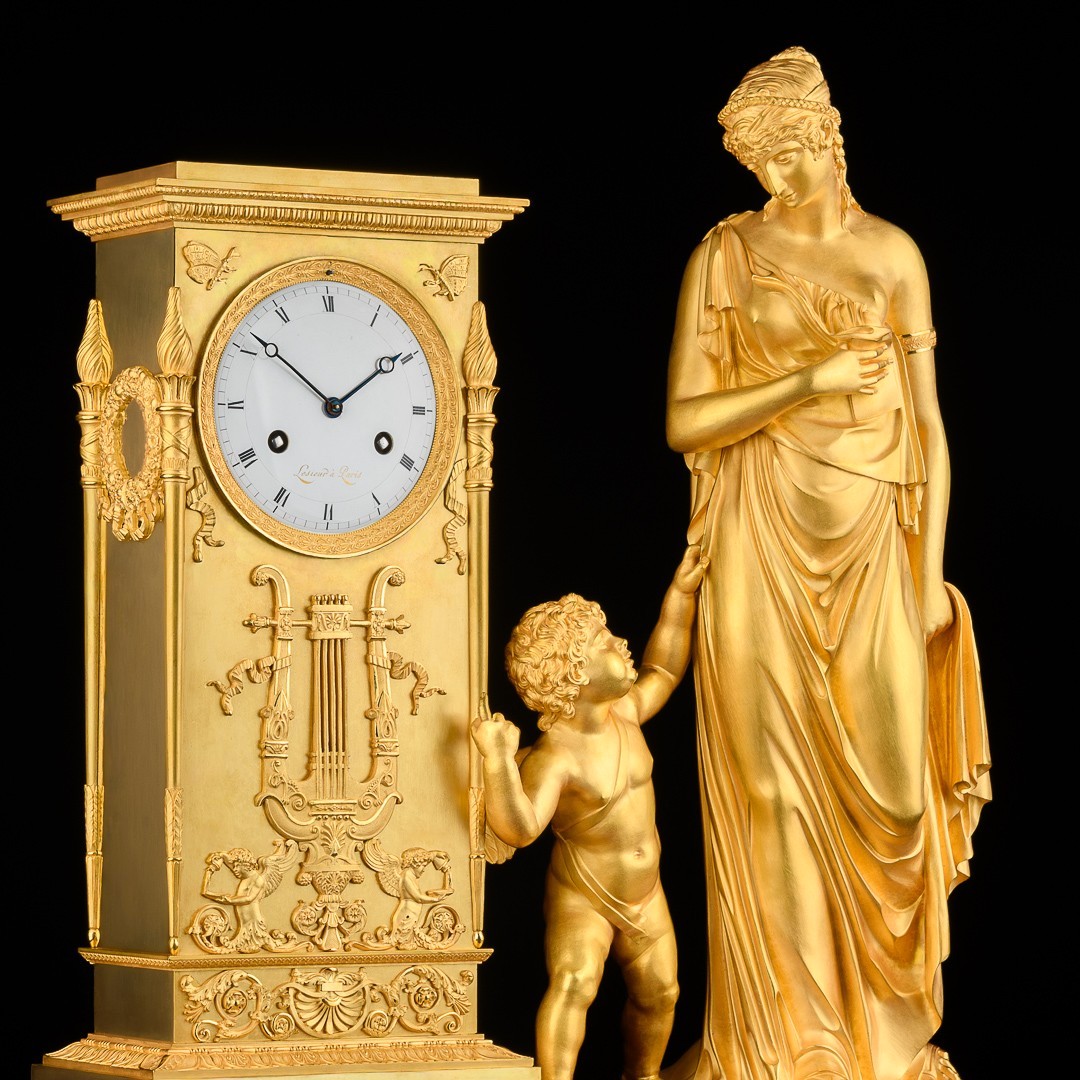
The circular white enamel dial, signed “Lesieur à Paris”, displays Roman numerals for the hours with finely engraved minute divisions. It is set within a pedestal flanked by four ribbon-bound torches, the façade enriched with delicately chiseled reliefs of butterflies, a stylised lyre and putti pouring water from a ewer. Both sides are adorned with wreaths of ribbon-tied flowers. Beside the pedestal stands an exquisite sculptural group depicting Venus, draped in the antique manner, accompanied by a winged Cupid who indicates the time with his finger. Cupid turns tenderly towards Venus, whose serene expression reinforces the poetic dialogue between love, beauty, and the passage of time.
The originality and quality of this composition firmly place it among the most accomplished mythological figural clocks of the early Empire period. The iconography, drawn from classical mythology, subtly evokes the inevitability of time even over beauty itself. The ensemble is supported by a finely proportioned quadrangular base in Italian griotte rouge marble, decorated with a frieze of chiseled palmettes and Cupid with bow and arrows. The clock rests on a gilt-bronze counter-plinth and four flattened ball feet enriched with gadrooned friezes.
The movement is signed both on the dial and on the backplate “LESIEUR”. According to Tardy, Lesieur was established by 1806 in the Vieille rue du Temple in Paris and worked between 1812 and 1820 from the rue de la Verrerie. Although little is recorded about his life, he is generally identified as François-Eugène Lesieur, whose posthumous inventory dated 29 August 1848 is preserved in the National Archives in Paris. Lesieur was a highly respected Parisian clockmaker, responsible for several complex and important clocks, including a mantel clock displaying the signs of the zodiac at the Hôtel de l’Intendance de la Généralité de Metz. He also supplied movements for a wide range of prestigious clocks, from a late Louis XVI Sèvres porcelain lyre clock to Empire figural clocks, including an example depicting Jason and the Golden Fleece, now housed in the Château de Malmaison in the former apartments of Joséphine de Beauharnais.
Expertly cleaned and in excellent condition, this remarkable clock retains its original and richly lustrous mercury gilding. The movement, fitted with an anchor escapement, wire suspension, and rack striking mechanism, strikes the hours and half-hours on a bell. In perfect working order, the clock is offered complete with its pendulum, bell, and key.
Origin: Paris, Empire period circa 1805-1810.
Dimensions: Height 61 cm (24″), Width 50 cm (19.7″), Depth 23 cm (9″).
André-Antoine Ravrio (1759-1814)
André-Antoine Ravrio ranks among the foremost Parisian bronziers of the late eighteenth century and the First Empire. He learned the art of bronze casting under the guidance of his father, André Ravrio, continuing a family tradition of fondeurs established as early as 1661. His exceptional talent was recognised at an early stage, and in 1774 he was personally recommended by Pierre-Philippe Thomire to the comte d’Artois. Ravrio was admitted as a maître-fondeur in 1777 and established his own workshop by 1790. His bronzes are universally regarded as among the finest productions of their time.
Although Ravrio achieved success during the reign of Louis XVI, his career reached its height under Napoleon Bonaparte. He participated in the first Exposition de l’Industrie in Paris in 1803 and, by 1806, had supplied numerous bronze furnishings for the apartments of Empress Joséphine at the Tuileries. His excellence was formally recognised in 1810 with his appointment as bronzier to the Emperor. In this capacity, Ravrio delivered some of the most accomplished Empire bronzes for the principal Imperial residences, including Fontainebleau, the Tuileries, Saint-Cloud, Compiègne, and Versailles.
As an official supplier to the Imperial Furniture Repository, Ravrio worked alongside leading contemporaries such as Pierre-Philippe Thomire and Claude Galle in the furnishing and redecoration of Napoleon’s residences. His work was also sought after by prominent figures of the period, notably several Marshals of the Empire, securing his position as one of the most important bronze makers of his generation.
Literature
- Collection of Mobilier National, Paris, inv. nr. GML 4424.
- Elke Niehüser, “French Bronze Clocks”, 1997, p.209, fig.276.
- H. Ottomeyer and P. Pröschel, “Vergoldete Bronzen”, Munich, 1986, p. 366, fig. 5.13.2.
- Tardy, “Dictionnaire des horlogers français”, p. 411.
We remain at your disposal via our website and WhatsApp. Fluent in French, English, German and Dutch, we will be delighted to assist with any enquiries or to arrange an appointment.
Period: 19th century
Style: Consulat, Empire
Condition: Perfect condition
Material: Bronze
Width: 50
Height: 61
Depth: 23
Reference (ID): 1682141
Availability: In stock