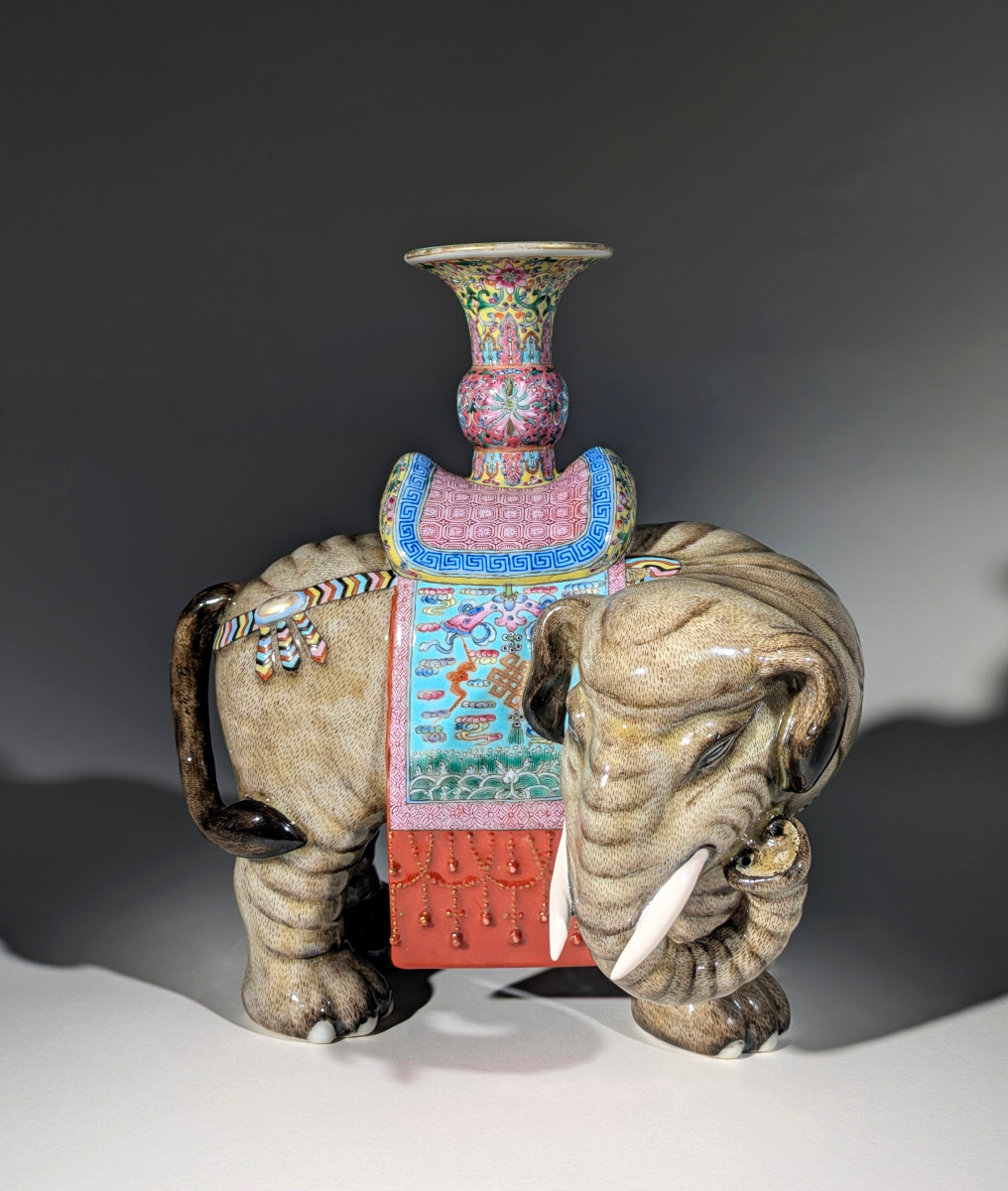
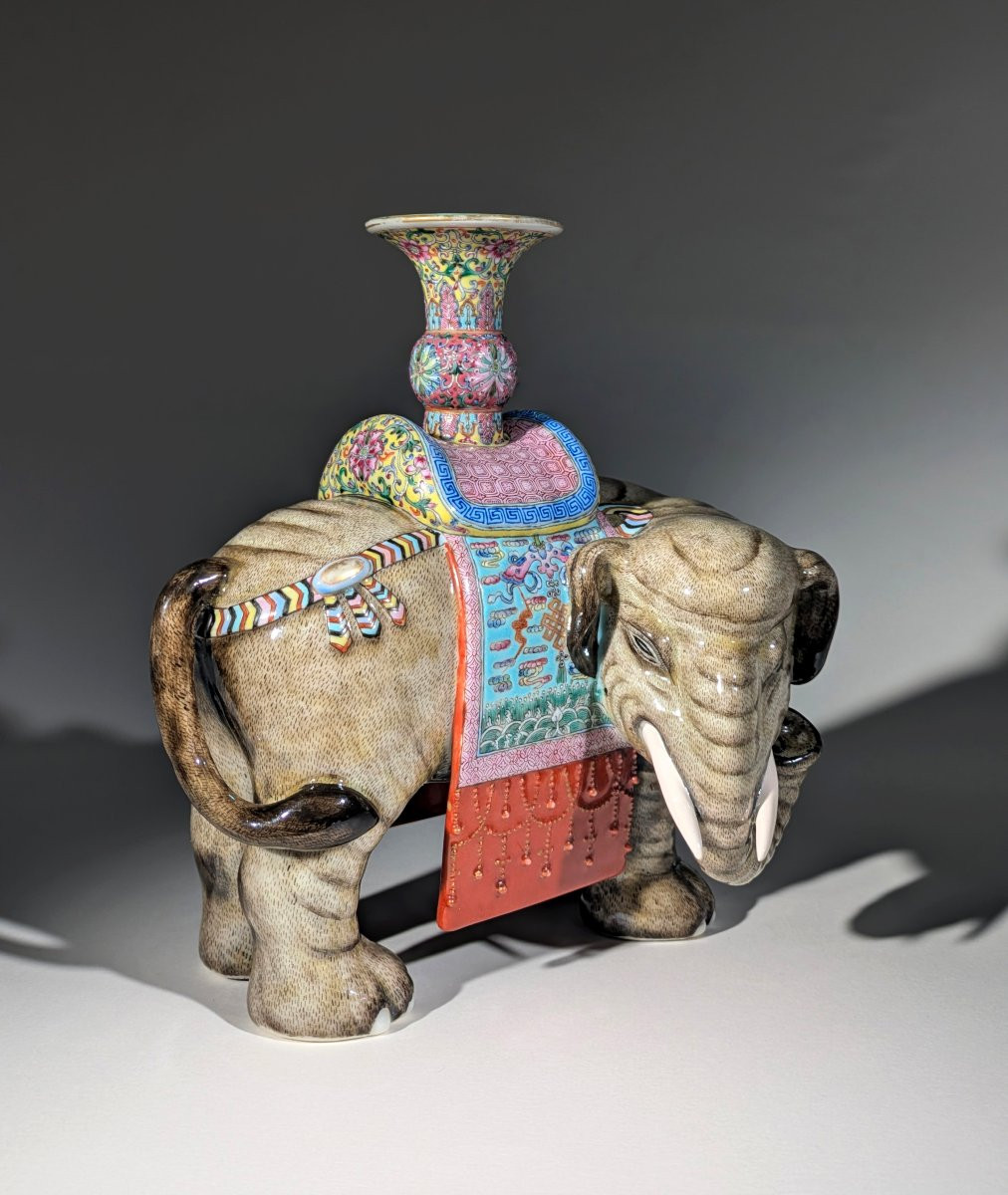
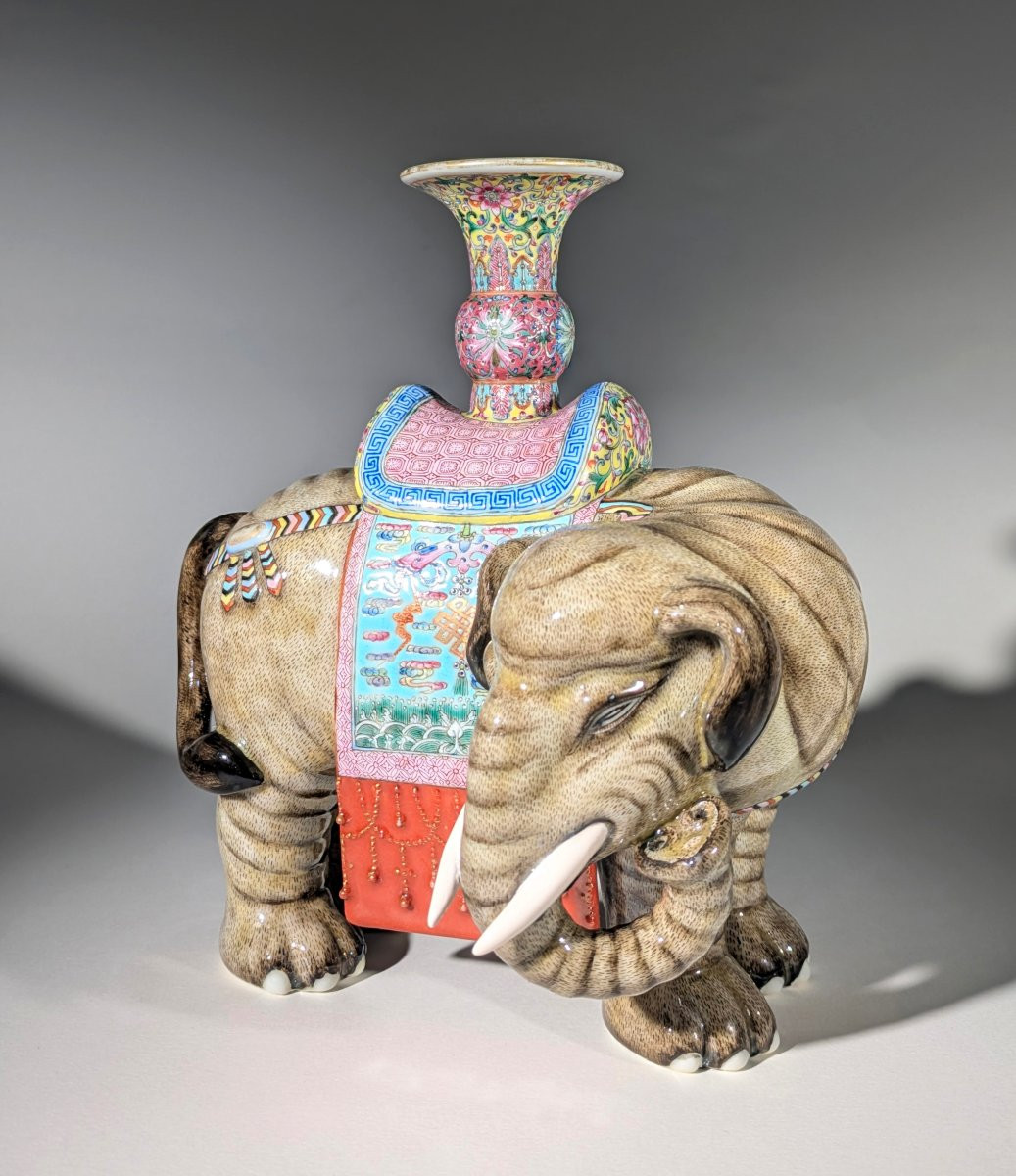
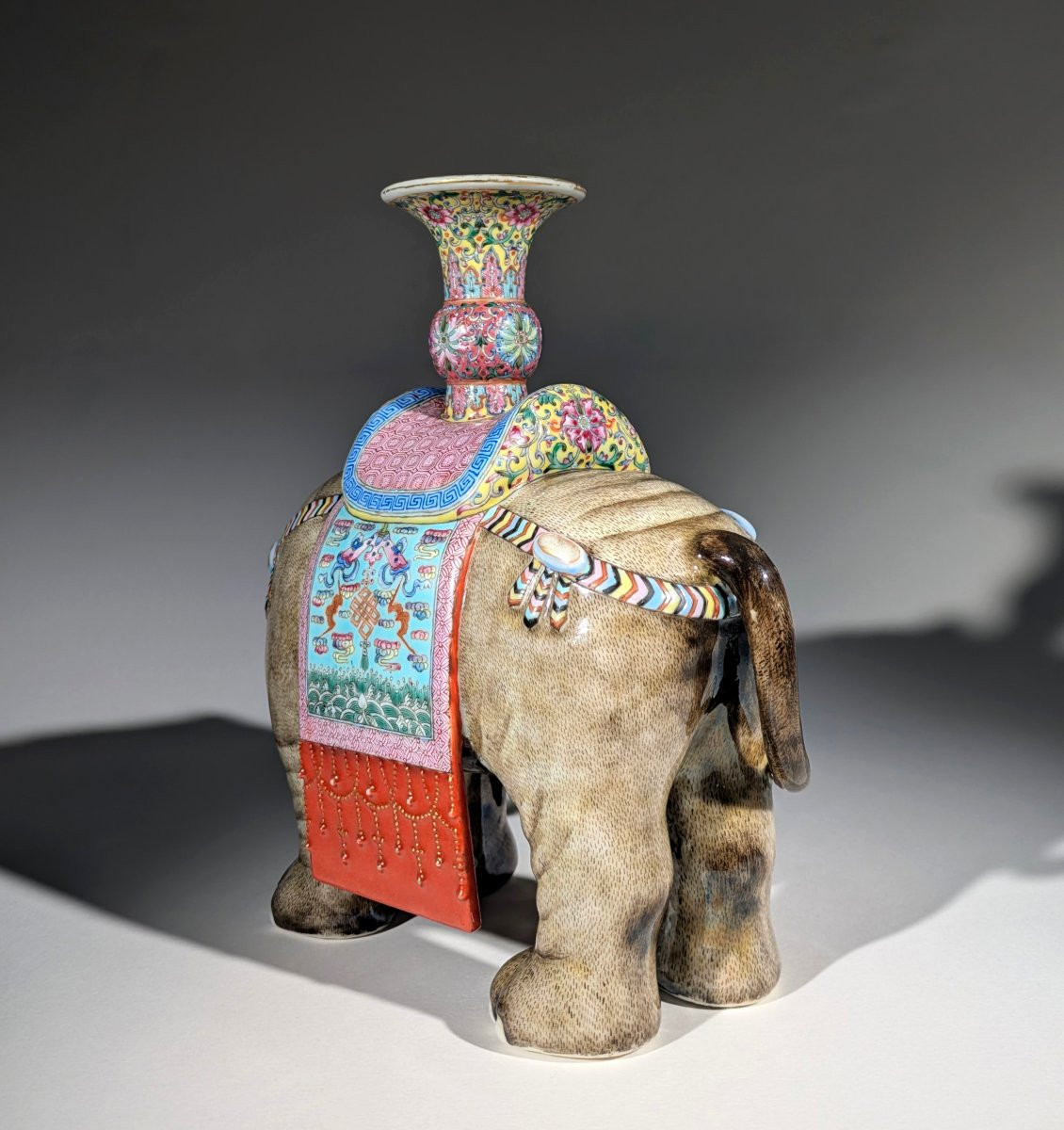
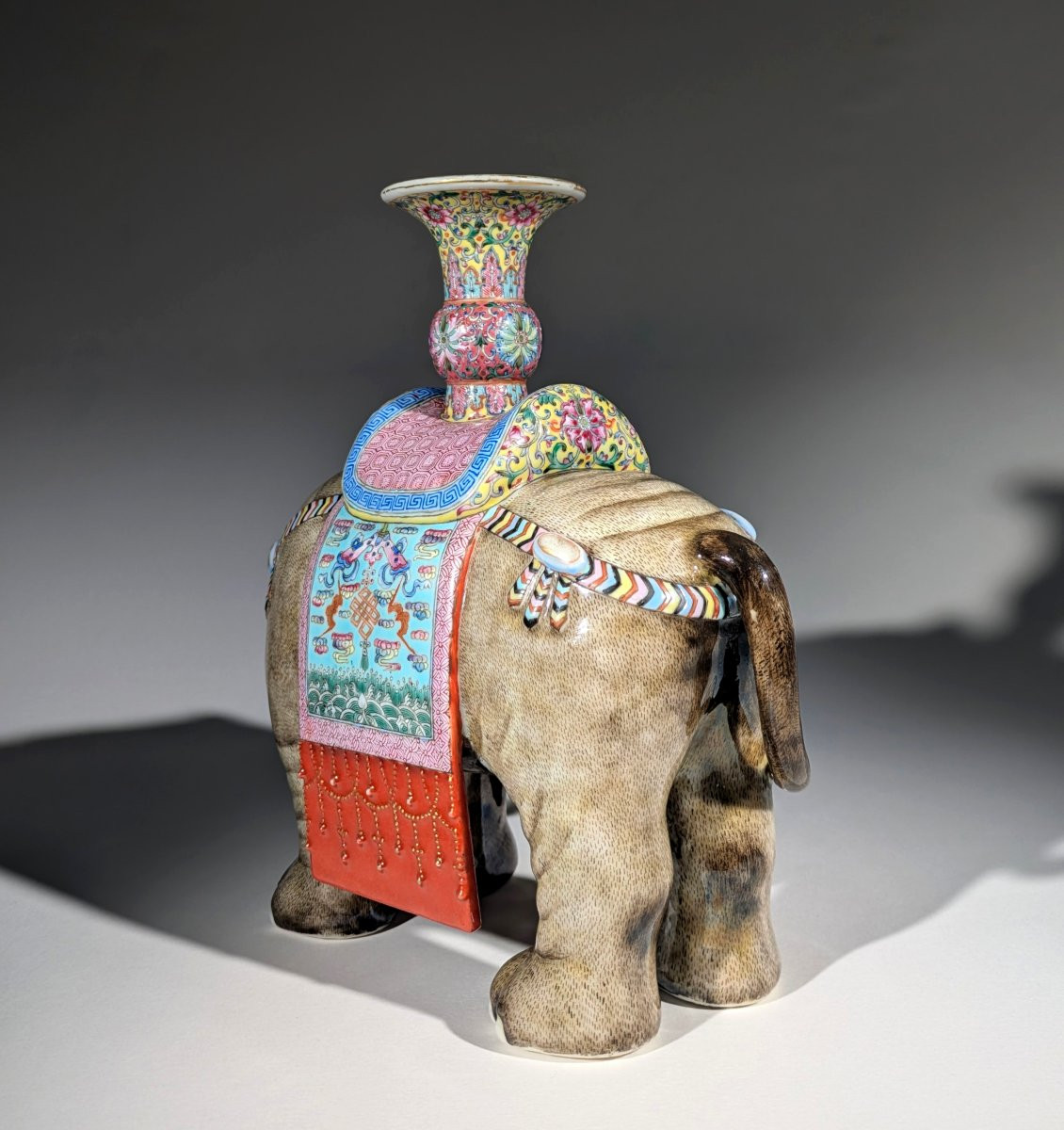
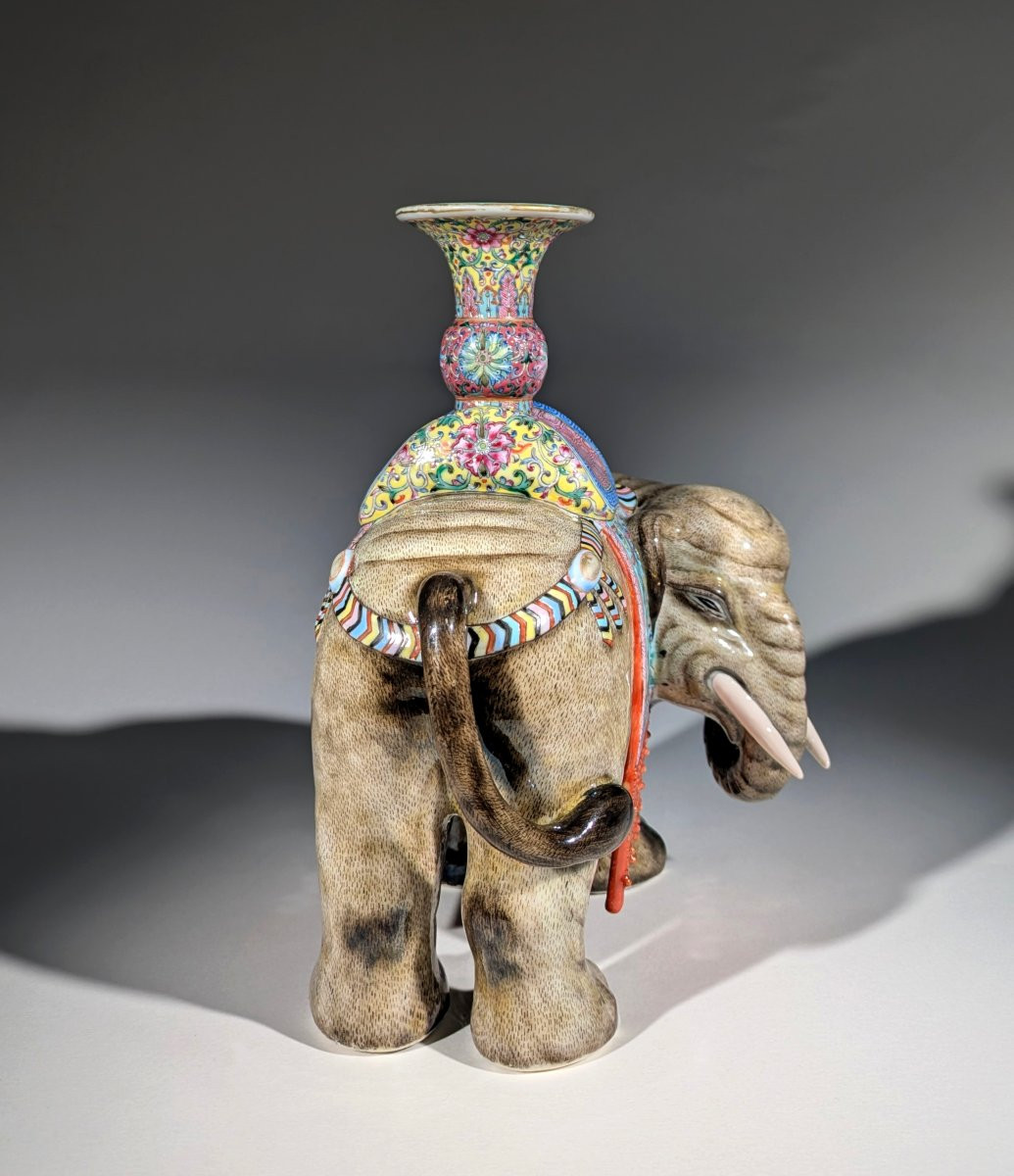
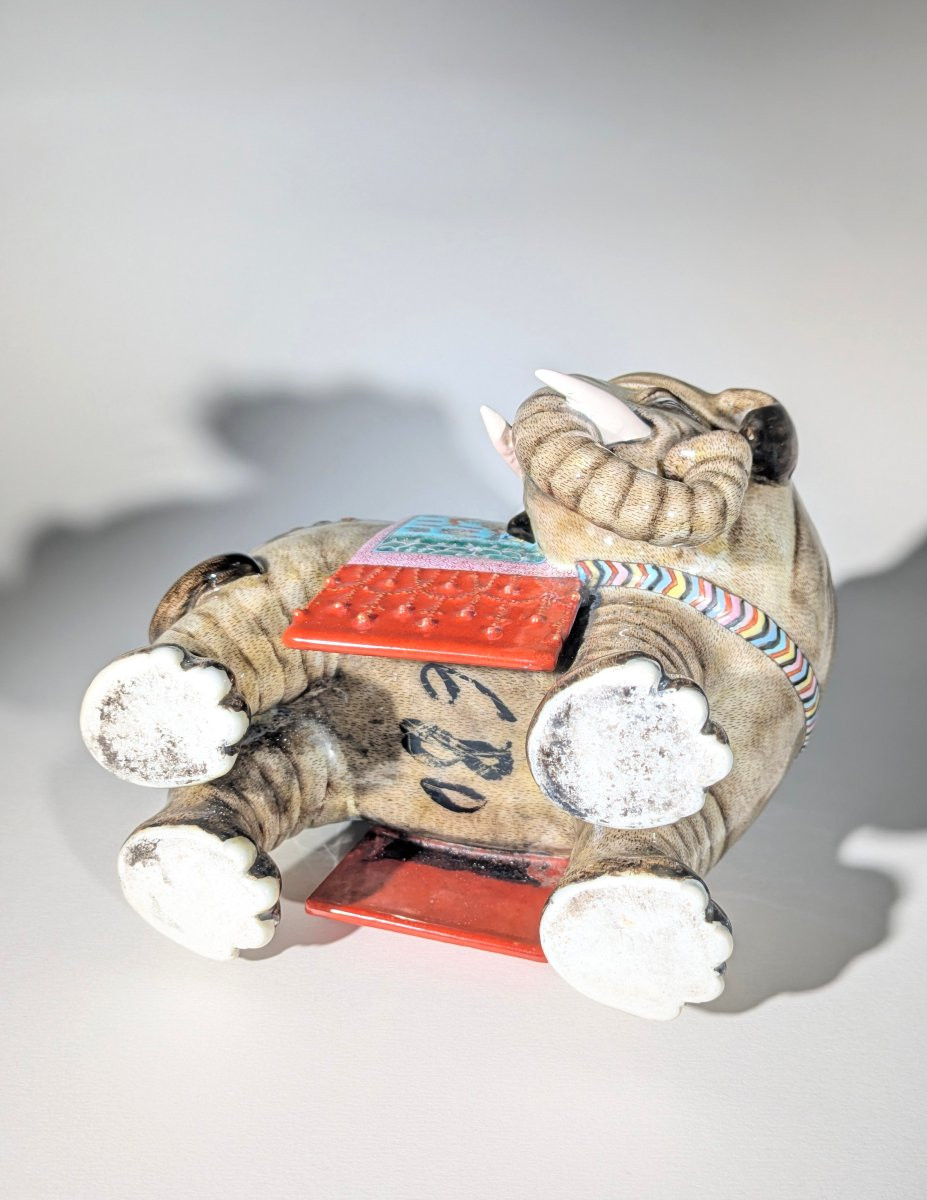
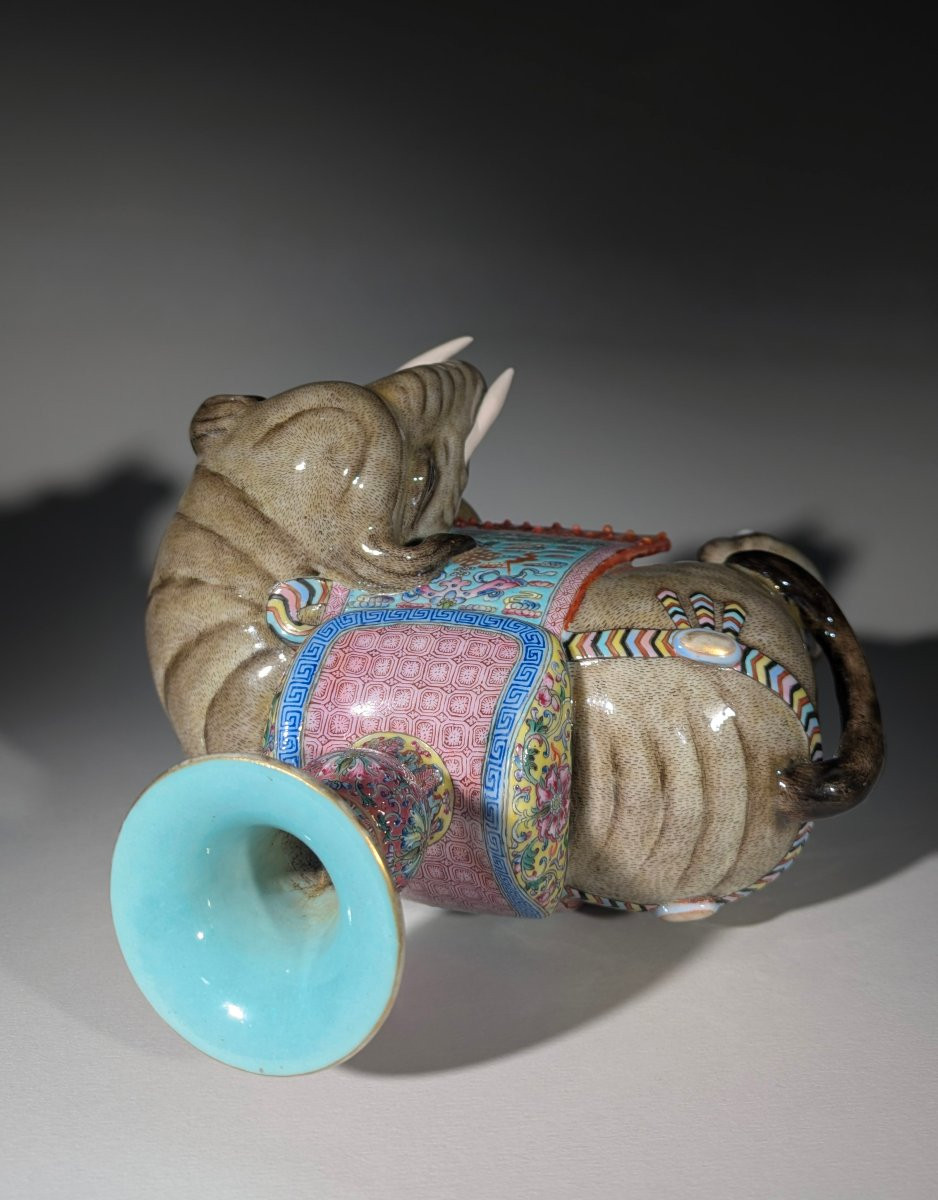
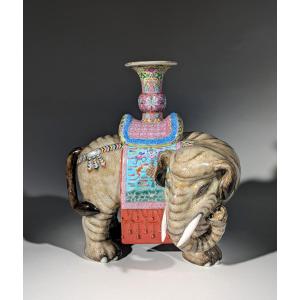


Zun Vase In The Shape Of A Peace Elephant, China, Qing Dynasty (1736-1795)
Yangcai ceramic, Famille rose in the shape of an elephant, Qianlong reign,
Zun vase in the form of an "Elephant of Peace" 18th century, Qing dynasty (1736-1795)
Dimensions: H. 27.5 cm; W. 25.5 cm; W. of vase: 6.5 cm
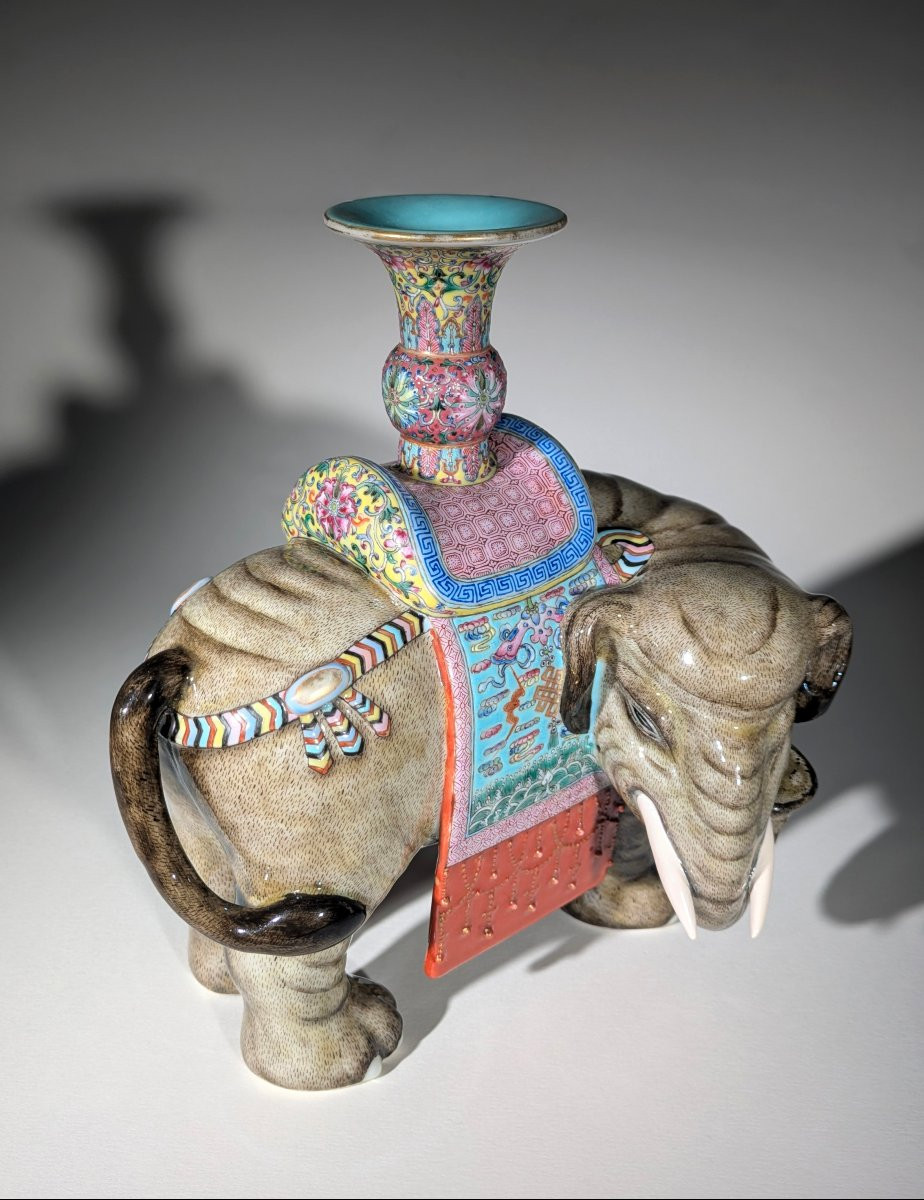
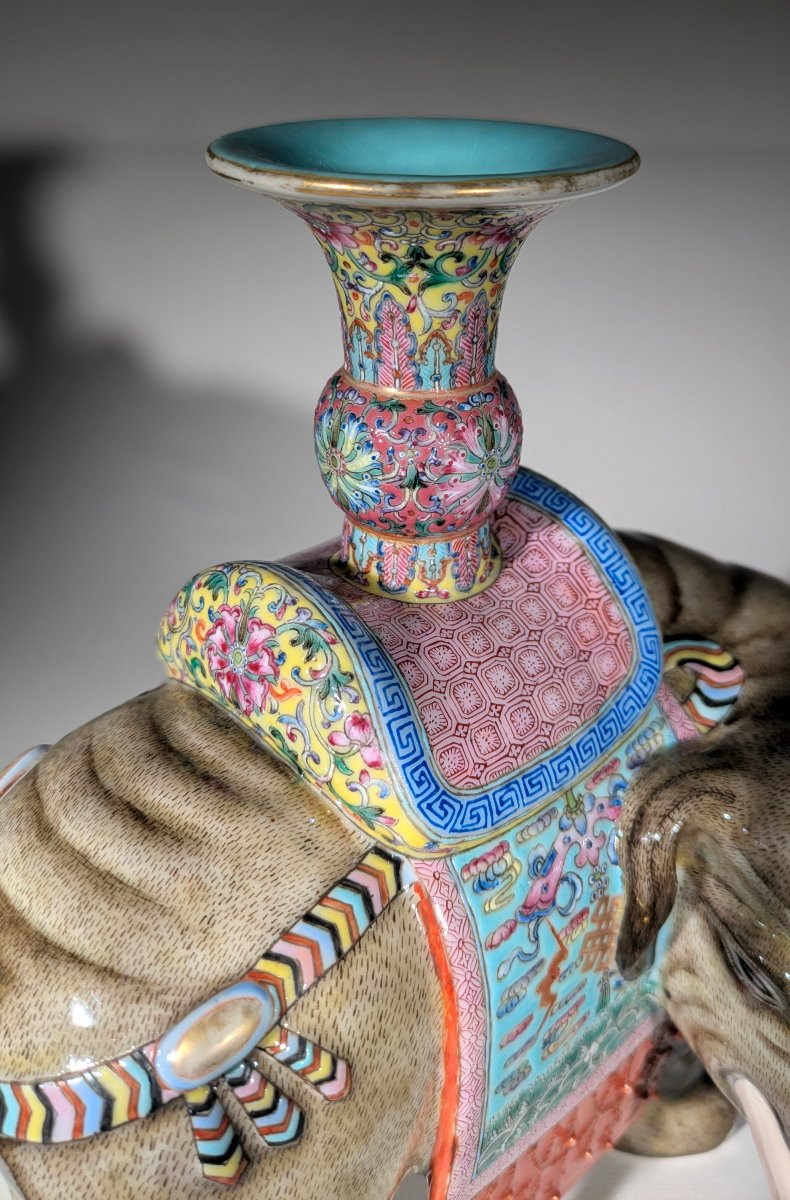
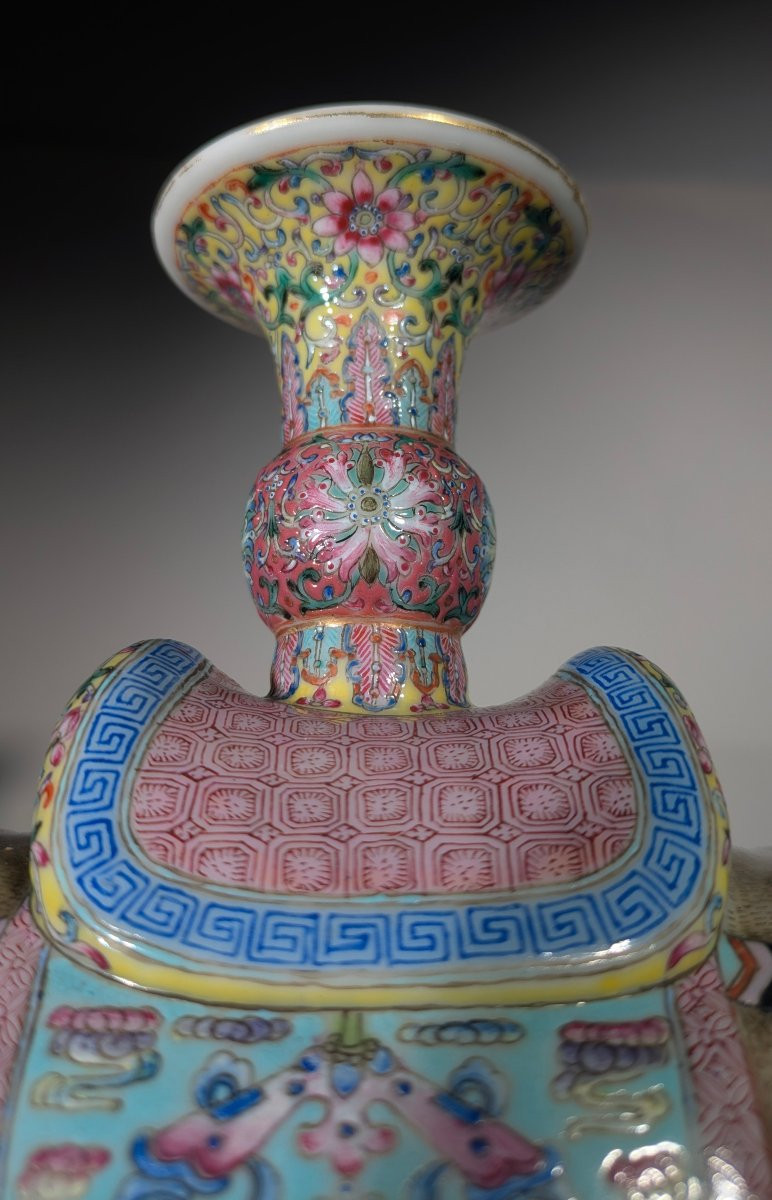
This object takes the form of an elephant with a Gu vase in the shape of a Zun on its back, with a turquoise interior background and swirling decorations of lotus flowers, acanthus leaf scrolls and pastel scrolls on a yellow background in the shape of C and S. (brocade motifs of flowers called "jin shang tian hua").
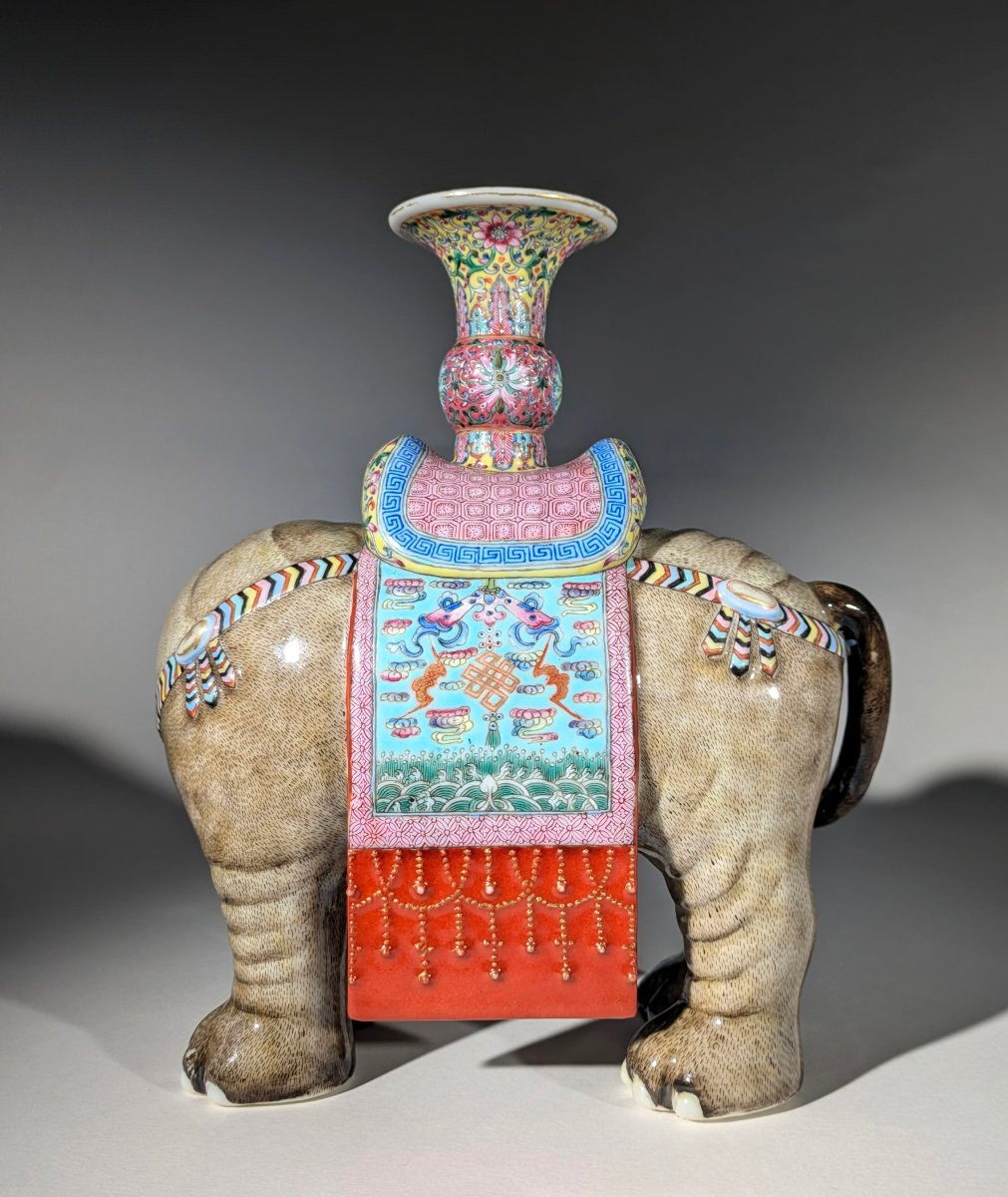
Pastel howdah with a frieze of blue Greek motifs and red Cassius yangcai motifs with a decoration in the Sgraffiato style.
A rug decorated with bats and clouds, a sound plate supporting an endless knot (a symbol of universal interdependence and the eternal cycle of life) floating above the waters against a green lake background. The saddle embroidery symbolizes the mountains of longevity in the seas of prosperity, while the auspicious chimes symbolize abundance and a time of peace. Polychrome glaze. The piece does not bear a reign mark, but its shape and decoration suggest it dates from the reign of the Qianlong Emperor (1736-1795). These very rare and precious porcelains were created thanks to the aesthetic tastes of the Qianlong Emperor and the high-quality work of Tang Ying, the supervisor of the imperial kilns.
The Western shading technique applied to the porcelain design lends a degree of three-dimensionality to the overall composition. The use of white pigments on the flowers and leaves creates highlights and shadows, giving an impression of perspective. Flowers such as chrysanthemums and anemones are Western compositions for a number of decorative motifs. The elephant stands upright with its head turned and eyes partially closed. Its trunk is pointing upwards with tusks on either side (the only invisible restoration on the object: tusks reattached, UV testing).
> Similar model at the National Palace Museum in Taiwan.
> For comparison, an elephant in the Palace Museum in Beijing, attributed to the Qianlong period like the lot shown here and decorated in the same color palette, except for the saddle, is illustrated in Yinliuzhai shuoci yizhu (Commentary on Porcelain from the Source Workshop), Beijing, 2005, p. 450, figs. 9-43.
> A pair of closely related elephants in the Copeland Collection at the Peabody Essex Museum, Salem, is illustrated in W. Sargent, *The Copeland Collection - Chinese and Japanese Ceramic Figures*, Milan, 1991, pp. 196-97, no. 9.
Famille rose porcelain, also called yangcai ("foreign colors"), features polychrome decoration dominated by pink tones. The decoration is applied overglaze, meaning after the porcelain has been first fired with a transparent glaze. The colors are fixed during a second firing, known as a low-fire firing (800°C). This type of decoration appeared during the reign of the Yongzhen Emperor (1723-1736) and developed further during the reign of the Qianlong Emperor (1736-1796). Its origins are closely linked to the history of trade between East and West in the 17th and 18th centuries. Indeed, it was a Dutch chemist named Andreas Cassius who, in 1650, discovered the chemical formula for obtaining pink enamels: it was mineral purple, subsequently called "Cassius purple," a precipitate obtained from gold salts. China quickly acquired this formula and then used the pink tones for porcelain intended for the domestic market, but also and especially for export products.
Zun vase in the form of an "Elephant of Peace" 18th century, Qing dynasty (1736-1795)
Dimensions: H. 27.5 cm; W. 25.5 cm; W. of vase: 6.5 cm
This object takes the form of an elephant with a Gu vase in the shape of a Zun on its back, with a turquoise interior background and swirling decorations of lotus flowers, acanthus leaf scrolls and pastel scrolls on a yellow background in the shape of C and S. (brocade motifs of flowers called "jin shang tian hua").
Pastel howdah with a frieze of blue Greek motifs and red Cassius yangcai motifs with a decoration in the Sgraffiato style.
A rug decorated with bats and clouds, a sound plate supporting an endless knot (a symbol of universal interdependence and the eternal cycle of life) floating above the waters against a green lake background. The saddle embroidery symbolizes the mountains of longevity in the seas of prosperity, while the auspicious chimes symbolize abundance and a time of peace. Polychrome glaze. The piece does not bear a reign mark, but its shape and decoration suggest it dates from the reign of the Qianlong Emperor (1736-1795). These very rare and precious porcelains were created thanks to the aesthetic tastes of the Qianlong Emperor and the high-quality work of Tang Ying, the supervisor of the imperial kilns.
The Western shading technique applied to the porcelain design lends a degree of three-dimensionality to the overall composition. The use of white pigments on the flowers and leaves creates highlights and shadows, giving an impression of perspective. Flowers such as chrysanthemums and anemones are Western compositions for a number of decorative motifs. The elephant stands upright with its head turned and eyes partially closed. Its trunk is pointing upwards with tusks on either side (the only invisible restoration on the object: tusks reattached, UV testing).
> Similar model at the National Palace Museum in Taiwan.
> For comparison, an elephant in the Palace Museum in Beijing, attributed to the Qianlong period like the lot shown here and decorated in the same color palette, except for the saddle, is illustrated in Yinliuzhai shuoci yizhu (Commentary on Porcelain from the Source Workshop), Beijing, 2005, p. 450, figs. 9-43.
> A pair of closely related elephants in the Copeland Collection at the Peabody Essex Museum, Salem, is illustrated in W. Sargent, *The Copeland Collection - Chinese and Japanese Ceramic Figures*, Milan, 1991, pp. 196-97, no. 9.
Famille rose porcelain, also called yangcai ("foreign colors"), features polychrome decoration dominated by pink tones. The decoration is applied overglaze, meaning after the porcelain has been first fired with a transparent glaze. The colors are fixed during a second firing, known as a low-fire firing (800°C). This type of decoration appeared during the reign of the Yongzhen Emperor (1723-1736) and developed further during the reign of the Qianlong Emperor (1736-1796). Its origins are closely linked to the history of trade between East and West in the 17th and 18th centuries. Indeed, it was a Dutch chemist named Andreas Cassius who, in 1650, discovered the chemical formula for obtaining pink enamels: it was mineral purple, subsequently called "Cassius purple," a precipitate obtained from gold salts. China quickly acquired this formula and then used the pink tones for porcelain intended for the domestic market, but also and especially for export products.
9 800 €
Period: 18th century
Style: Asian art
Condition: Excellent condition
Material: Porcelain
Length: 18,5cm
Height: 21cm
Depth: 14,5cm
Reference (ID): 1681393
Availability: In stock
Print