

Tokubei Ando (1842-1894) Known As Hiroshige III, Raisins Kai, Japanese Print
Artist: Tokubei Ando (1842-1894) Dit Hiroshige Iii
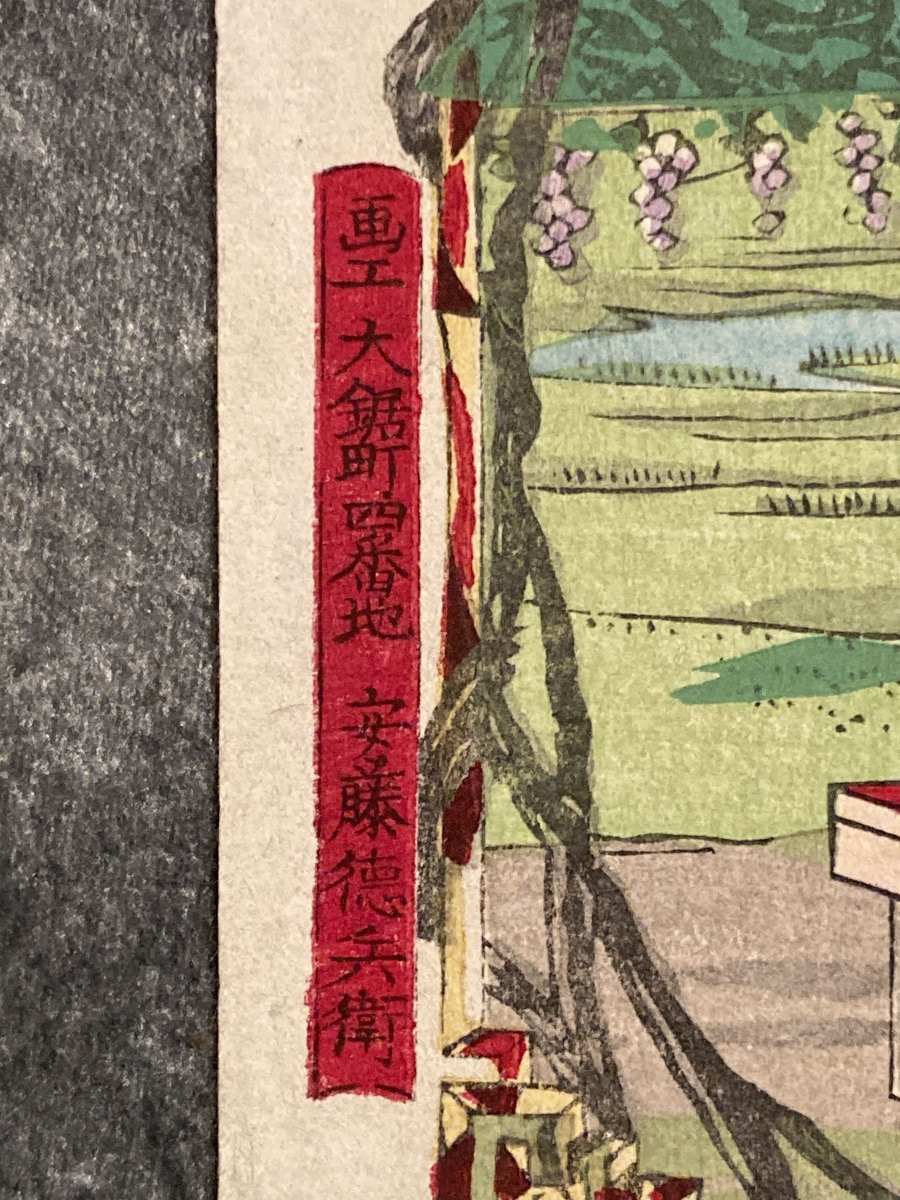
Tokubei ANDO (1842-1894) known as HIROSHIGE III 三代目 歌川広重
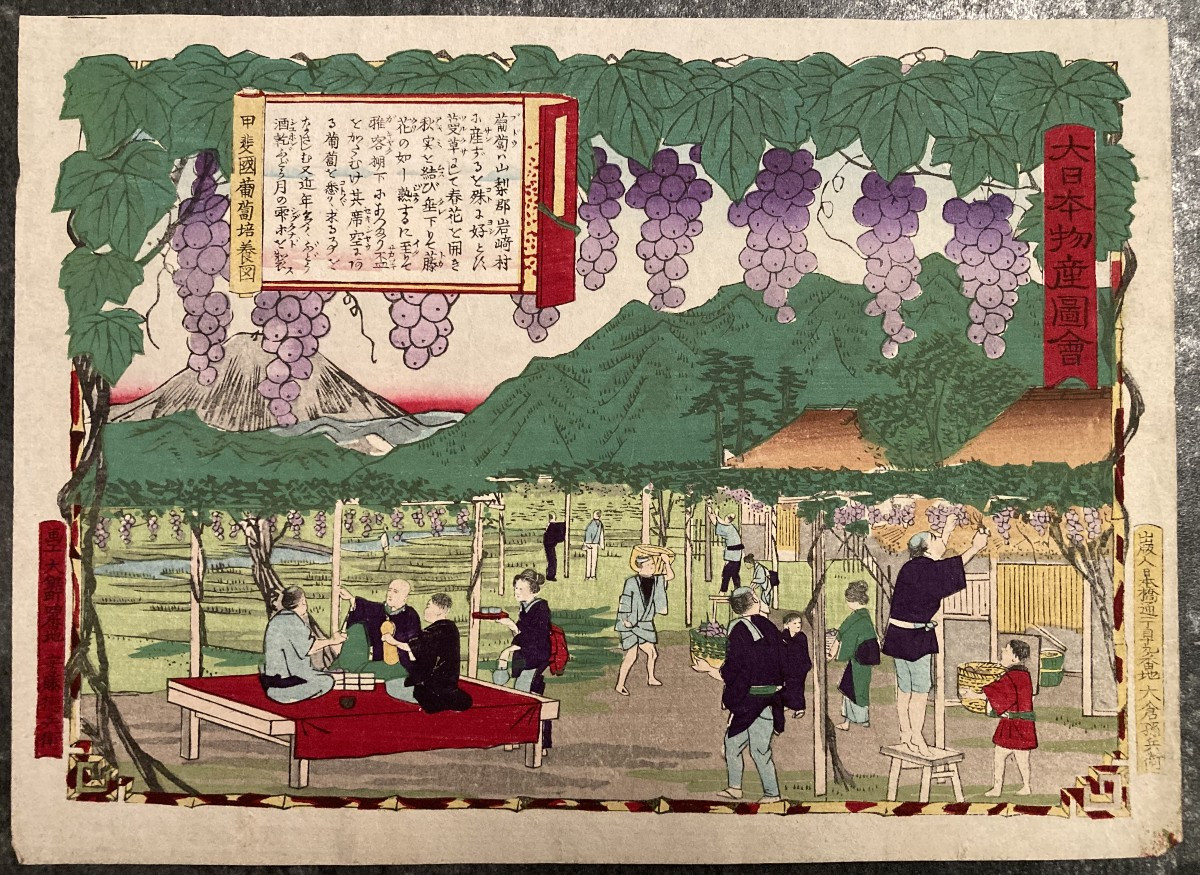
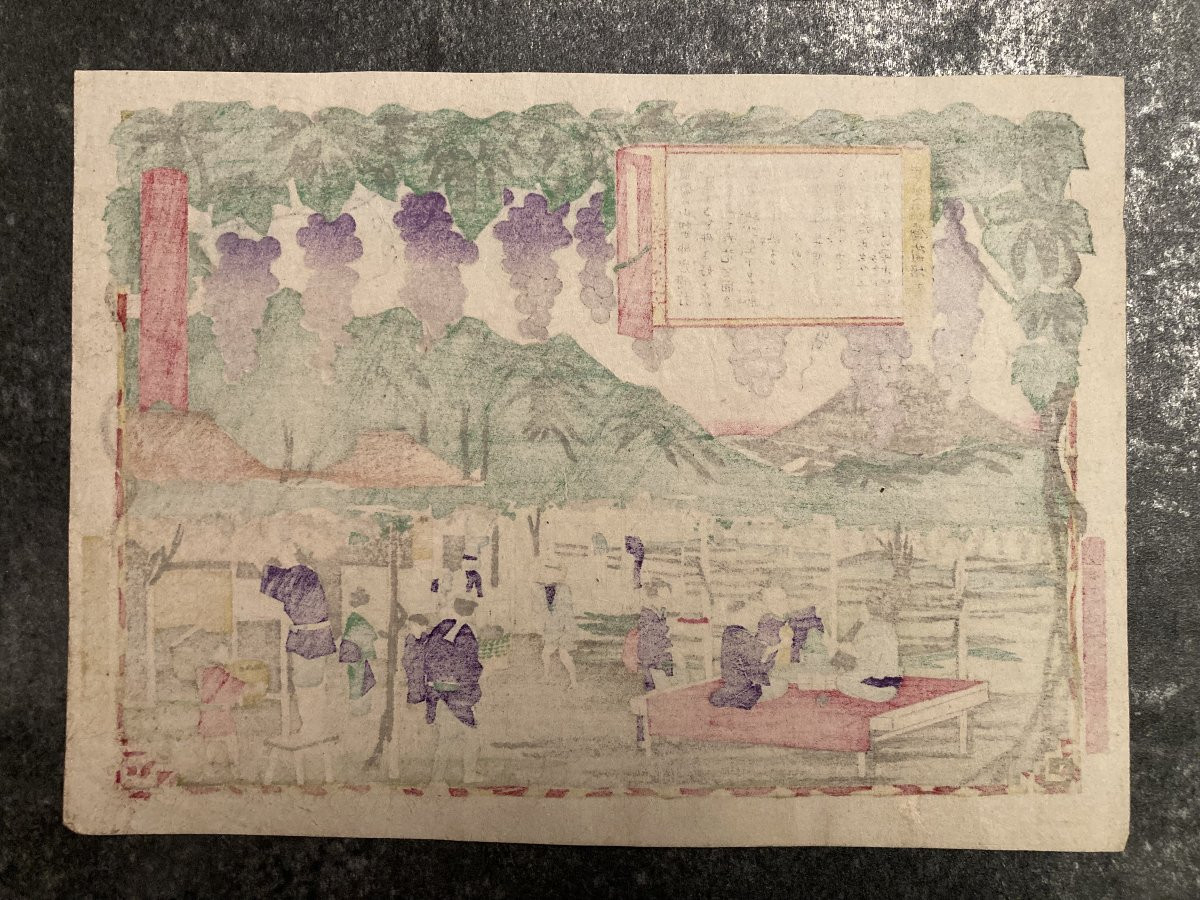
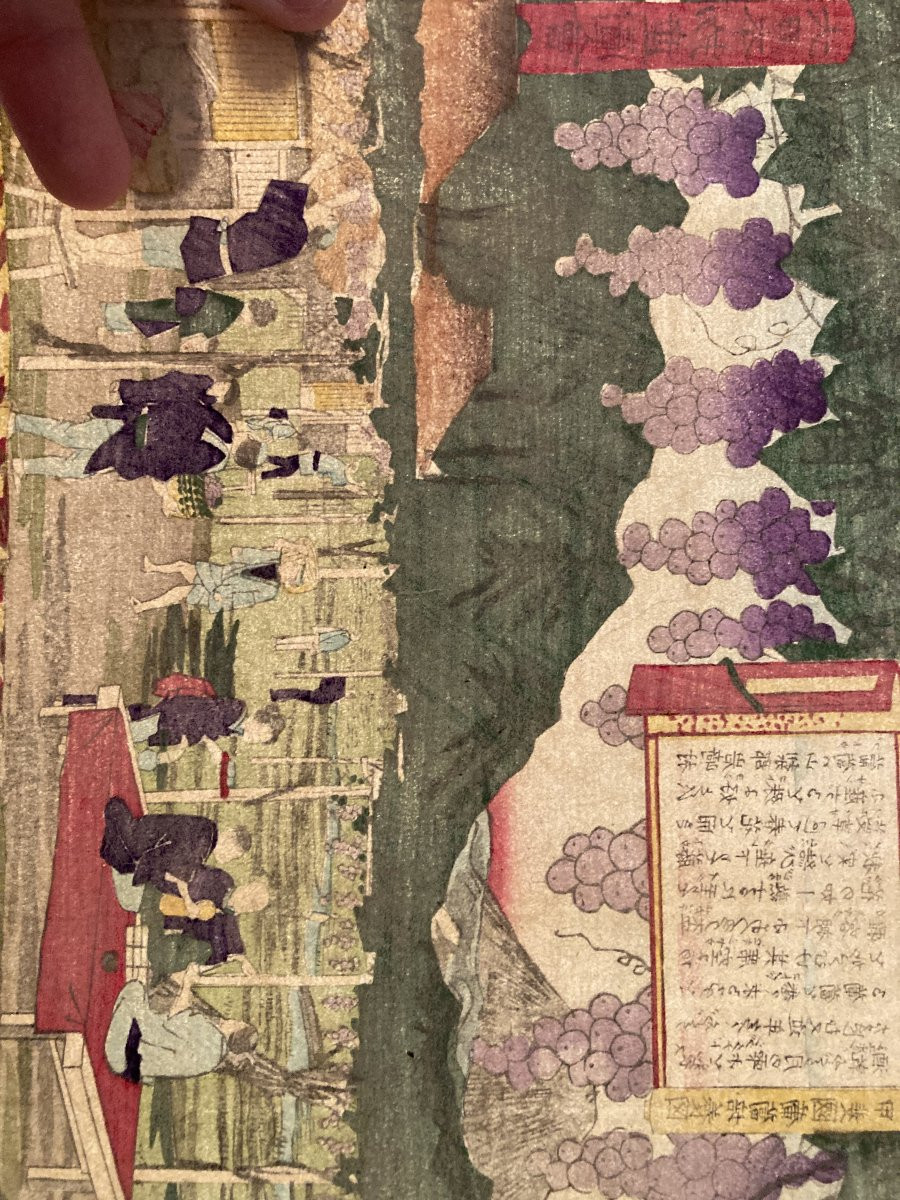
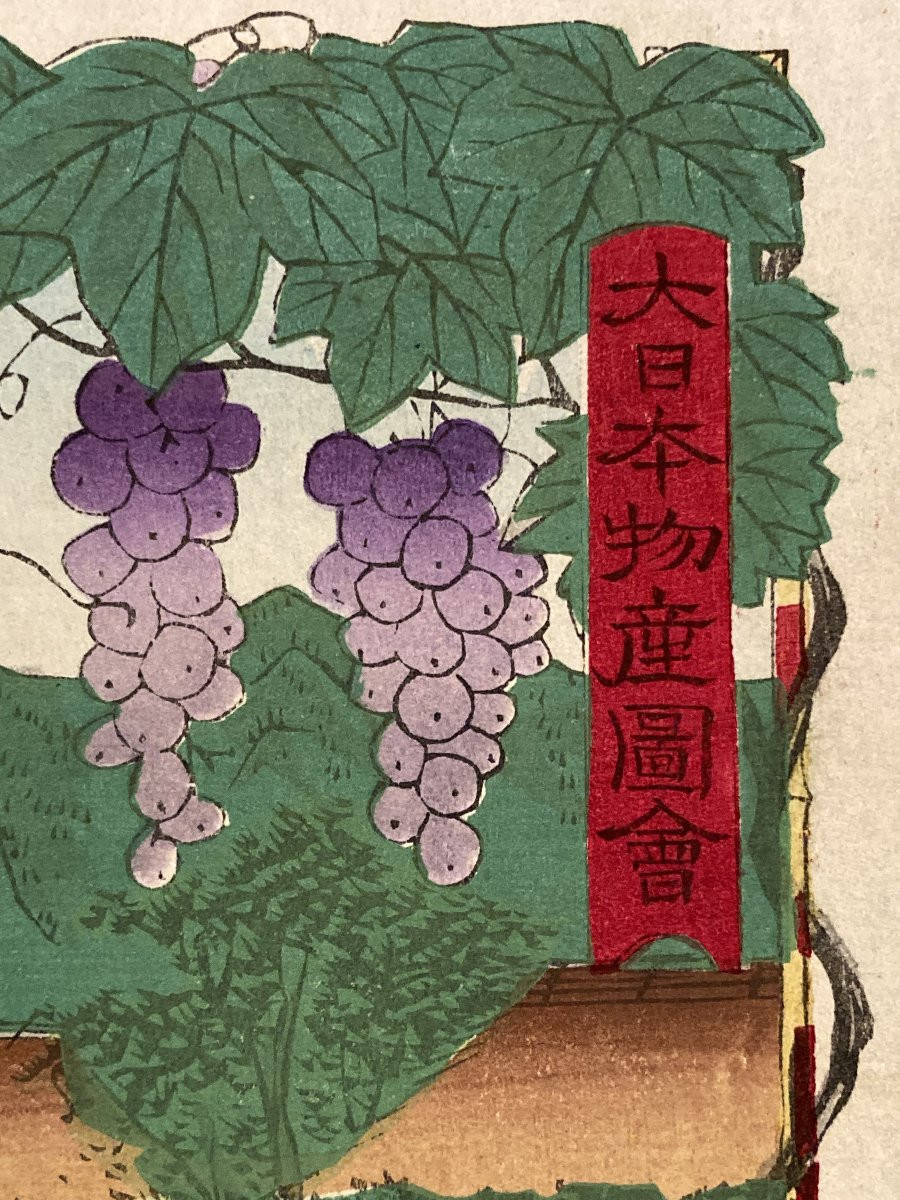
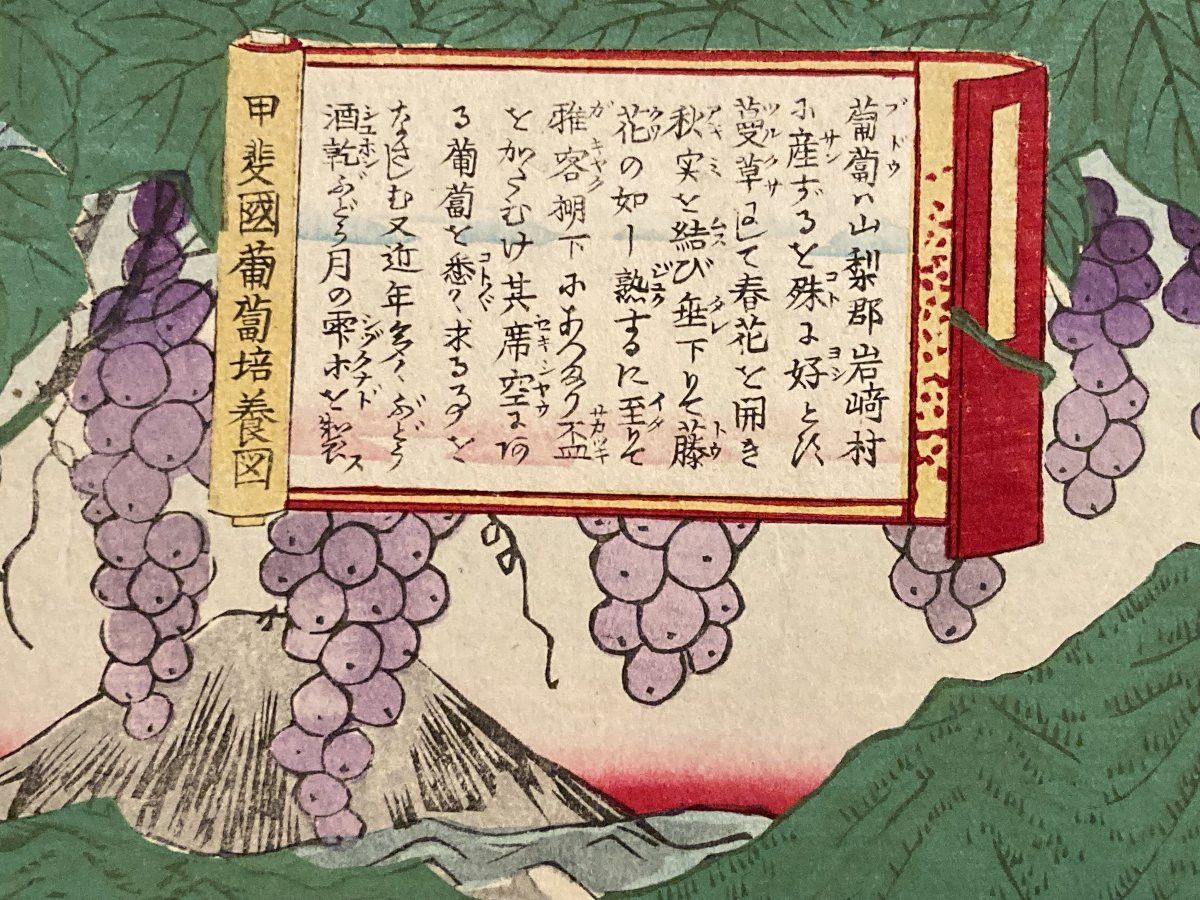
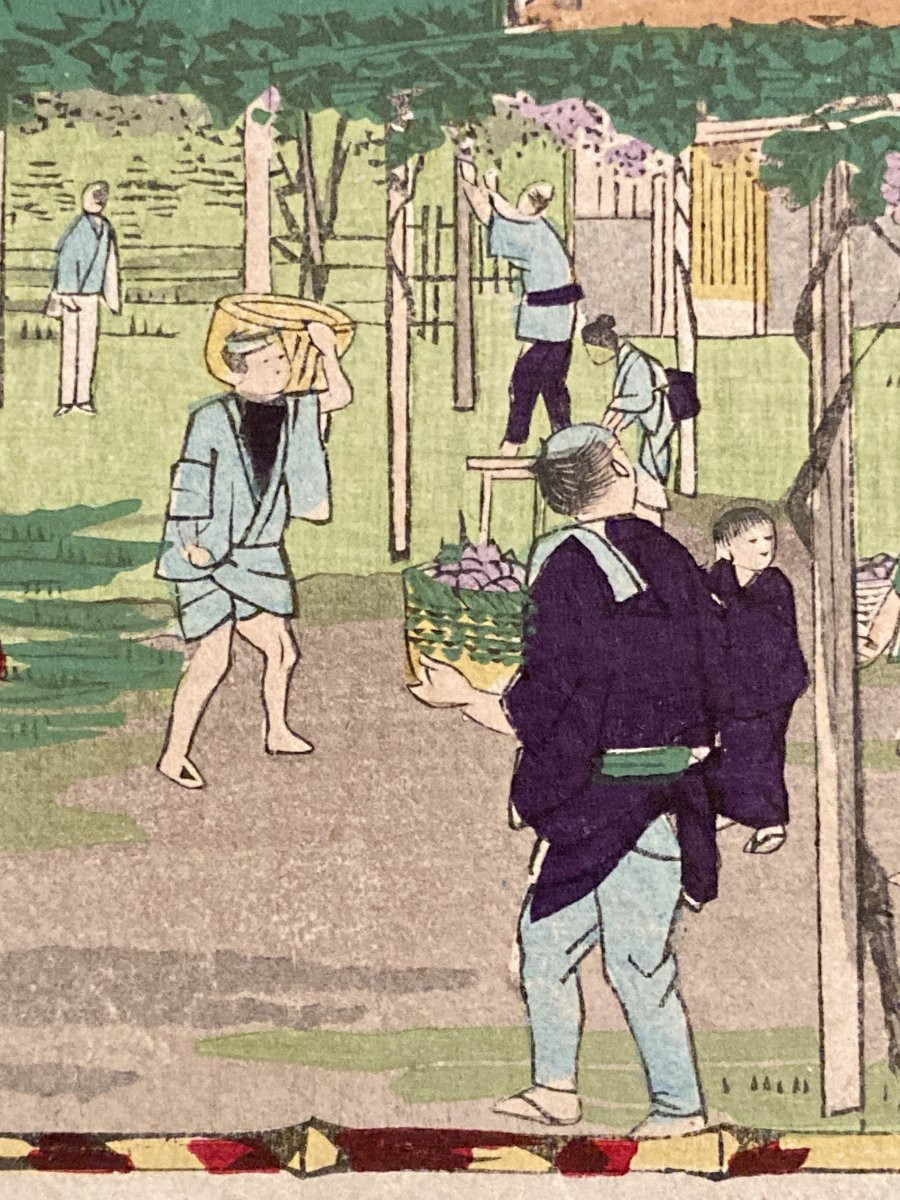
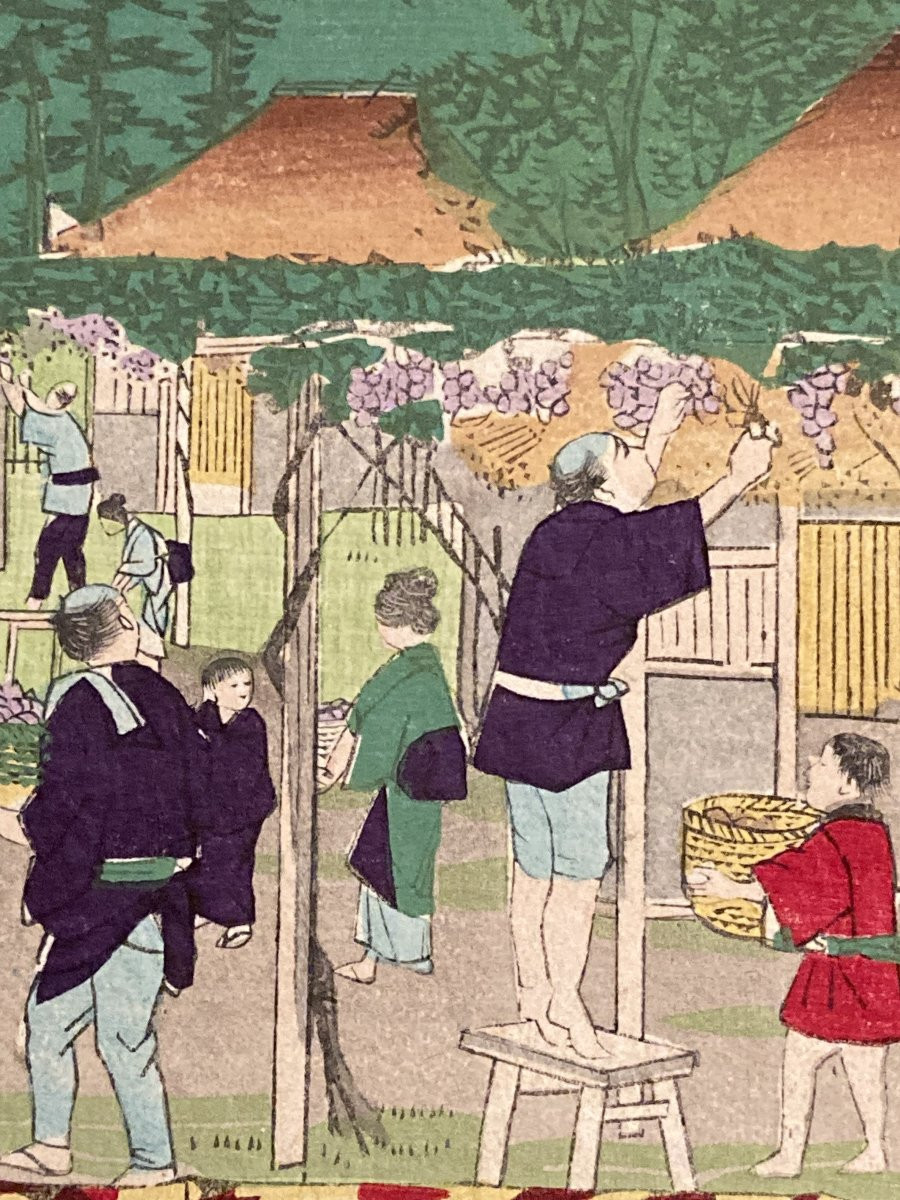
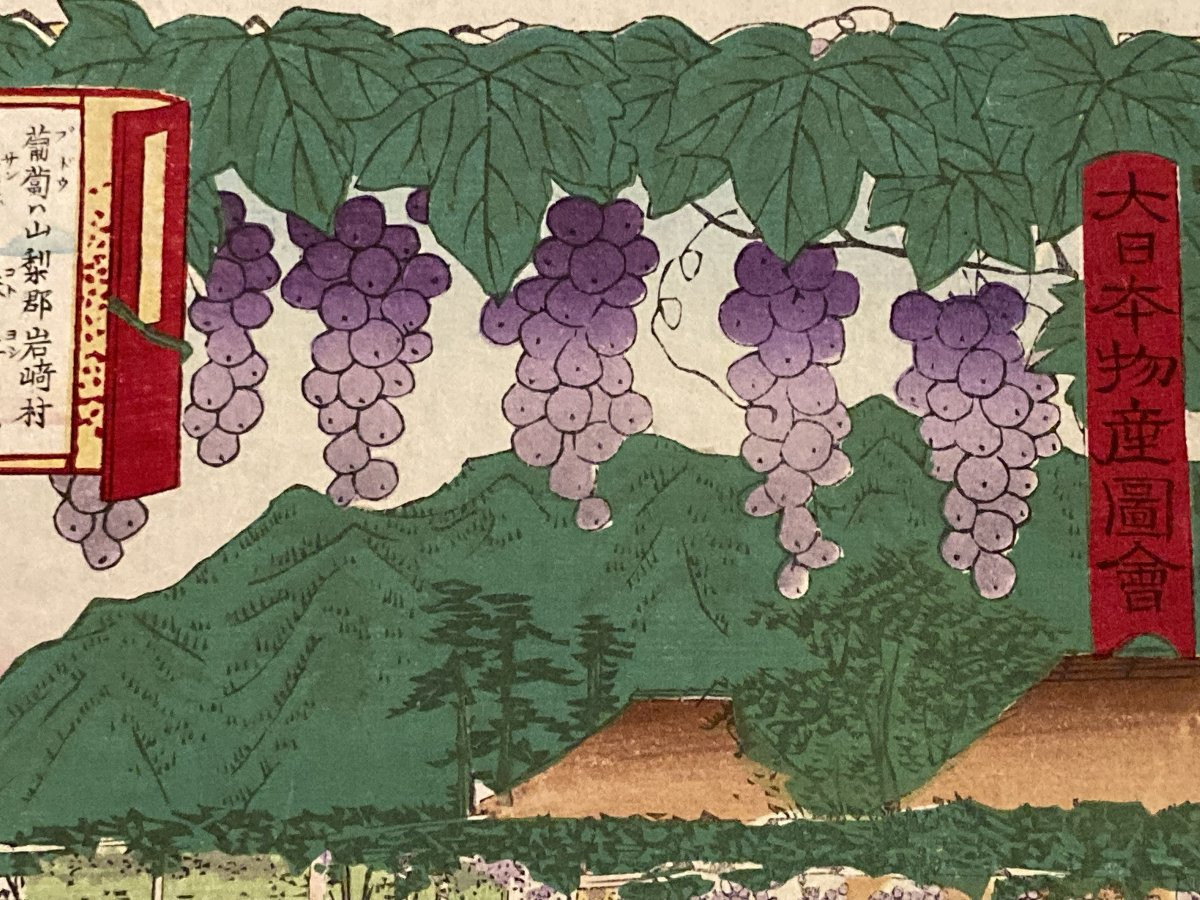
Kai Grapes, vine cultivation in the province of Kai (current Yamanashi prefecture)
Japanese print from the collection Products of Greater Japan 大日本物産圖會, Occupations of the Japanese だいにっぽんぶっさんずえ Dai Nippon bussan zue
1877
Laid paper
Tokyo
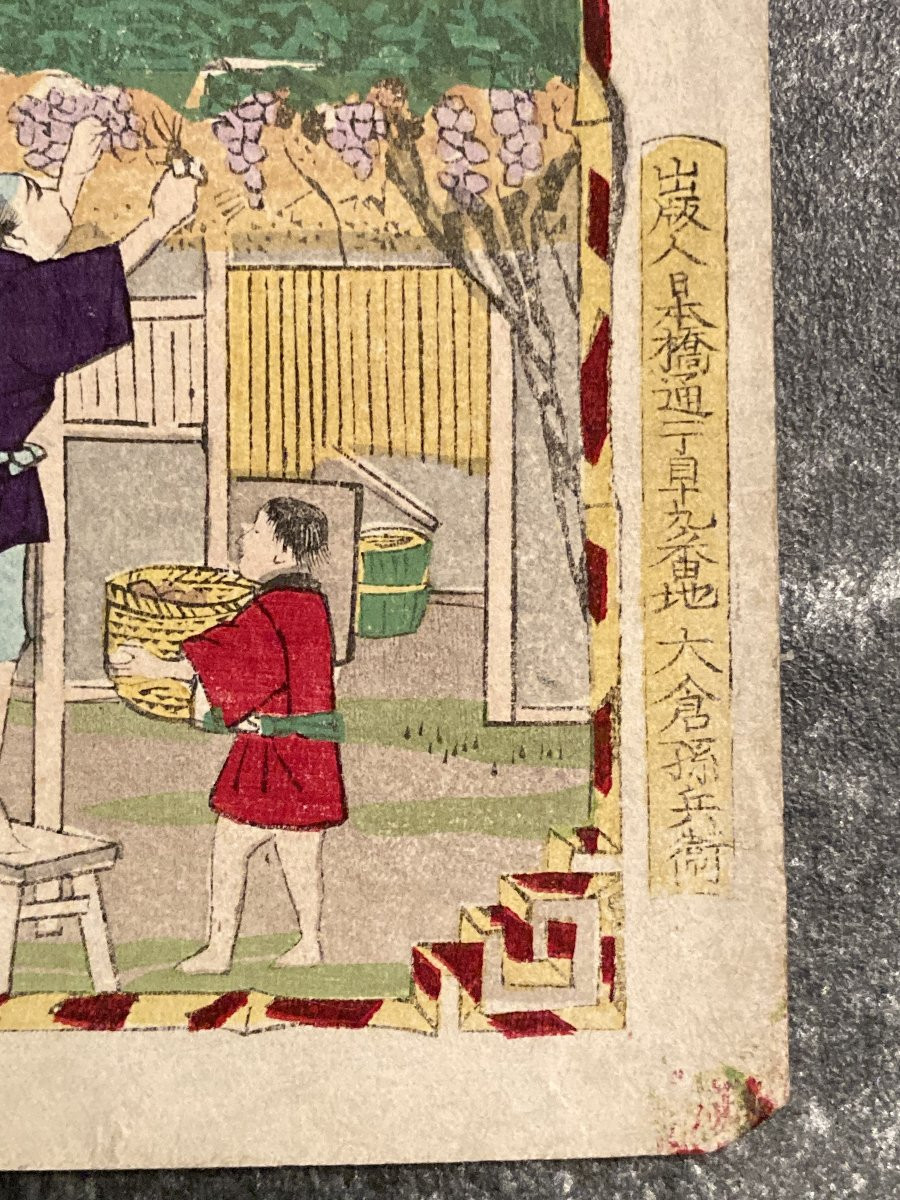
Publisher: Ōkura Magobei 大倉孫兵衛
Dimensions: 24.8 x 17.8cm (Chūban)
Superb Japanese print in bright colors and typical motifs of Hiroshige III's work representing culture A photograph of grapevines in the Kai province of Japan, circa 1870. Note the very subtle framing, with its bamboo effect, vines, and vine leaves, which demonstrates the master's virtuosity in depicting textures and materials. The print is beautifully fresh with well-defined details; the only minor flaws are slightly creased corners on the lower left and right.
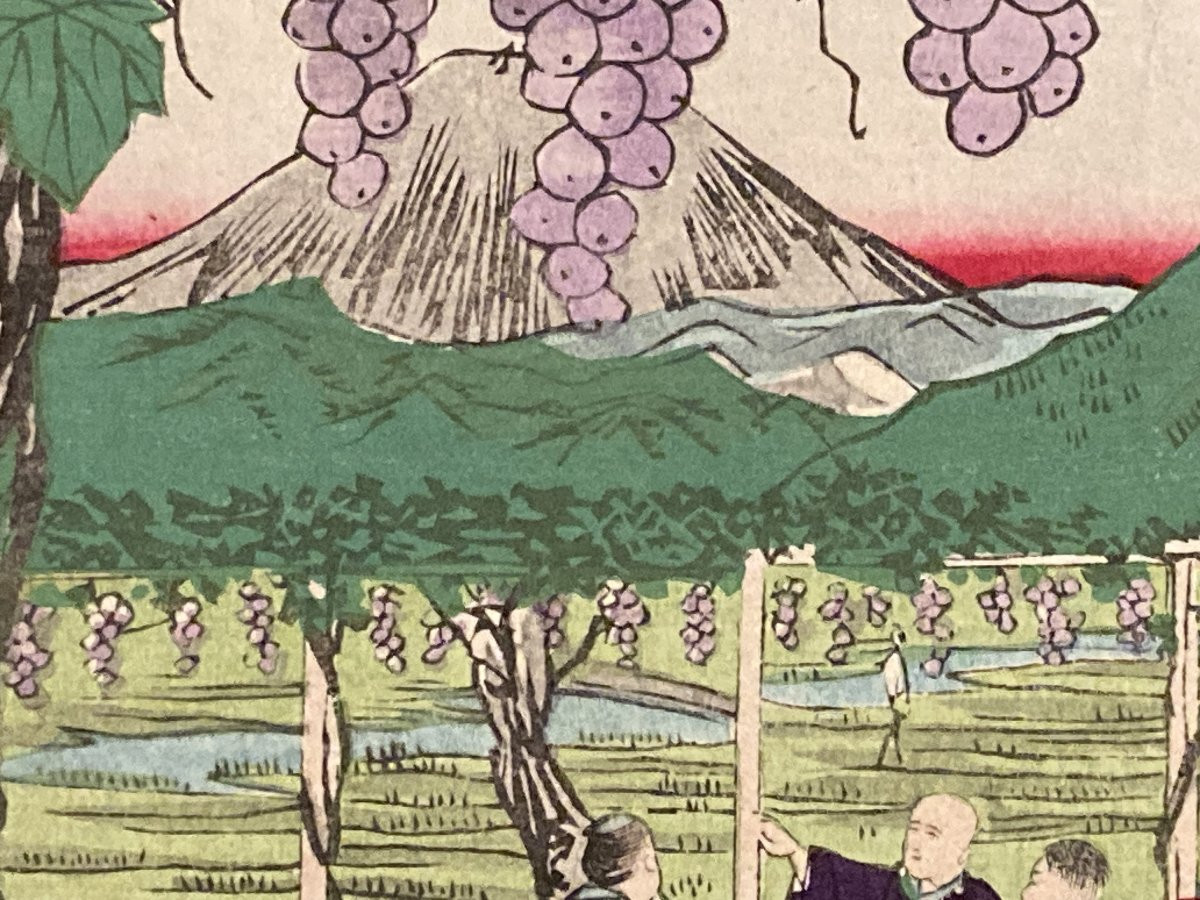
Nice treatment of the red gradient of the sky using Bokashi, a technique very specific to the great Japanese Ukiyo-e workshops.
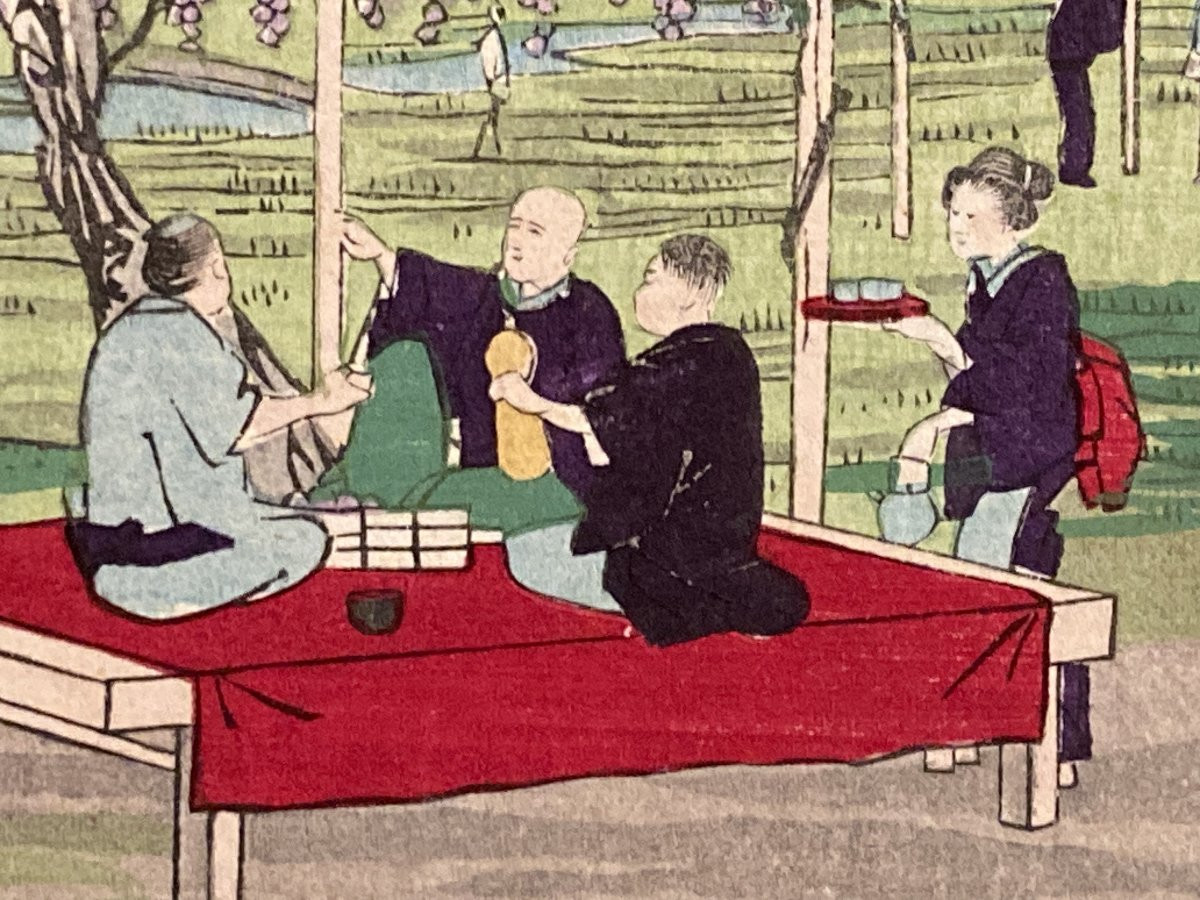
The grapes produced in the village of Iwasaki, Yamanashi Prefecture (Kai Province), are renowned for their exceptional quality. The vines flower in spring and bear fruit in autumn. When ripe, the bunches droop like a wisteria vine, an image echoed in our print: guests gather beneath the vine for banquets and pick the grapes that adorn its top. Winemaking began in the early Meiji era (1877, the 10th year of that era), and raisins are also produced here. Towards the end of the Edo period, a confection called Tsuki no Shizuku, made from syrup-coated raisins, was created and is still produced today.
According to an old legend, the monk Gyoki, from the Nara period (8th century), planted some grapevines in this province, which became particularly renowned for its viticulture; another legend recounts that the local inhabitants began cultivating them during the Kamakura period (12th-13th centuries). Many works from the Edo period praise the grapes of Kai Province, such as the collection from which our print comes. In 1870, the first wine produced in Japan was made in Kofu, and in the same year, the country's first private winery was established.
Utagawa Hiroshige III (三代目 歌川 広重) was a 19th-century Japanese painter. Born in 1842 and dying relatively young in 1894, his origins are unknown, and a family connection to Hiroshige Andō and Hiroshige II is highly unlikely. He was not part of the Utagawa school and never used that name. A master of printmaking, disciple and successor of Hiroshige Andō, he took over his master's workshop in 1865. He was, in fact, part of the last generation of ukiyo-e artists, along with Hōen, Kuniteru, Sahahide, and Kunisada II, whose works were chosen by the shogunal government to be exhibited at the 1867 Universal Exposition in Paris.
These works—the famous Japanese prints—were sold locally after the exposition and thus contributed to the first wave of Japonisme in Europe, which was sparked by this event. Like his contemporaries, Hiroshige III enjoyed depicting the innovations of his time with aniline dyes in very pronounced tones. He was very interested in railways (one of the first lines built in Japan connected Tokyo to Yokohama), and in the foreigners who settled in Yokohama from 1868 onwards, and he enjoyed depicting them at leisure, particularly in restaurants.
A valuable document held at the Tokyo National Library and recently made available to scholars is significant: the official records relating to one hundred prints commissioned by the shogunal government for the 1867 Paris Exposition. Fifty of these prints, collected in two albums, depict female figures in various professions, intended to illustrate Japanese customs, while the other half consists of landscapes, primarily views of Edo. The artists who shared this official commission, chosen from among the best of the time, all belonged to the last generation of ukiyo-e printmakers, including Hiroshige III, who created the collection from which our print is taken for this occasion.
Kai Grapes, vine cultivation in the province of Kai (current Yamanashi prefecture)
Japanese print from the collection Products of Greater Japan 大日本物産圖會, Occupations of the Japanese だいにっぽんぶっさんずえ Dai Nippon bussan zue
1877
Laid paper
Tokyo
Publisher: Ōkura Magobei 大倉孫兵衛
Dimensions: 24.8 x 17.8cm (Chūban)
Superb Japanese print in bright colors and typical motifs of Hiroshige III's work representing culture A photograph of grapevines in the Kai province of Japan, circa 1870. Note the very subtle framing, with its bamboo effect, vines, and vine leaves, which demonstrates the master's virtuosity in depicting textures and materials. The print is beautifully fresh with well-defined details; the only minor flaws are slightly creased corners on the lower left and right.
Nice treatment of the red gradient of the sky using Bokashi, a technique very specific to the great Japanese Ukiyo-e workshops.
The grapes produced in the village of Iwasaki, Yamanashi Prefecture (Kai Province), are renowned for their exceptional quality. The vines flower in spring and bear fruit in autumn. When ripe, the bunches droop like a wisteria vine, an image echoed in our print: guests gather beneath the vine for banquets and pick the grapes that adorn its top. Winemaking began in the early Meiji era (1877, the 10th year of that era), and raisins are also produced here. Towards the end of the Edo period, a confection called Tsuki no Shizuku, made from syrup-coated raisins, was created and is still produced today.
According to an old legend, the monk Gyoki, from the Nara period (8th century), planted some grapevines in this province, which became particularly renowned for its viticulture; another legend recounts that the local inhabitants began cultivating them during the Kamakura period (12th-13th centuries). Many works from the Edo period praise the grapes of Kai Province, such as the collection from which our print comes. In 1870, the first wine produced in Japan was made in Kofu, and in the same year, the country's first private winery was established.
Utagawa Hiroshige III (三代目 歌川 広重) was a 19th-century Japanese painter. Born in 1842 and dying relatively young in 1894, his origins are unknown, and a family connection to Hiroshige Andō and Hiroshige II is highly unlikely. He was not part of the Utagawa school and never used that name. A master of printmaking, disciple and successor of Hiroshige Andō, he took over his master's workshop in 1865. He was, in fact, part of the last generation of ukiyo-e artists, along with Hōen, Kuniteru, Sahahide, and Kunisada II, whose works were chosen by the shogunal government to be exhibited at the 1867 Universal Exposition in Paris.
These works—the famous Japanese prints—were sold locally after the exposition and thus contributed to the first wave of Japonisme in Europe, which was sparked by this event. Like his contemporaries, Hiroshige III enjoyed depicting the innovations of his time with aniline dyes in very pronounced tones. He was very interested in railways (one of the first lines built in Japan connected Tokyo to Yokohama), and in the foreigners who settled in Yokohama from 1868 onwards, and he enjoyed depicting them at leisure, particularly in restaurants.
A valuable document held at the Tokyo National Library and recently made available to scholars is significant: the official records relating to one hundred prints commissioned by the shogunal government for the 1867 Paris Exposition. Fifty of these prints, collected in two albums, depict female figures in various professions, intended to illustrate Japanese customs, while the other half consists of landscapes, primarily views of Edo. The artists who shared this official commission, chosen from among the best of the time, all belonged to the last generation of ukiyo-e printmakers, including Hiroshige III, who created the collection from which our print is taken for this occasion.
200 €
Period: 19th century
Style: Asian art
Condition: Excellent condition
Material: Paper
Width: 24,8cm
Height: 17,8cm
Depth: chūban
Reference (ID): 1678715
Availability: In stock
Print