

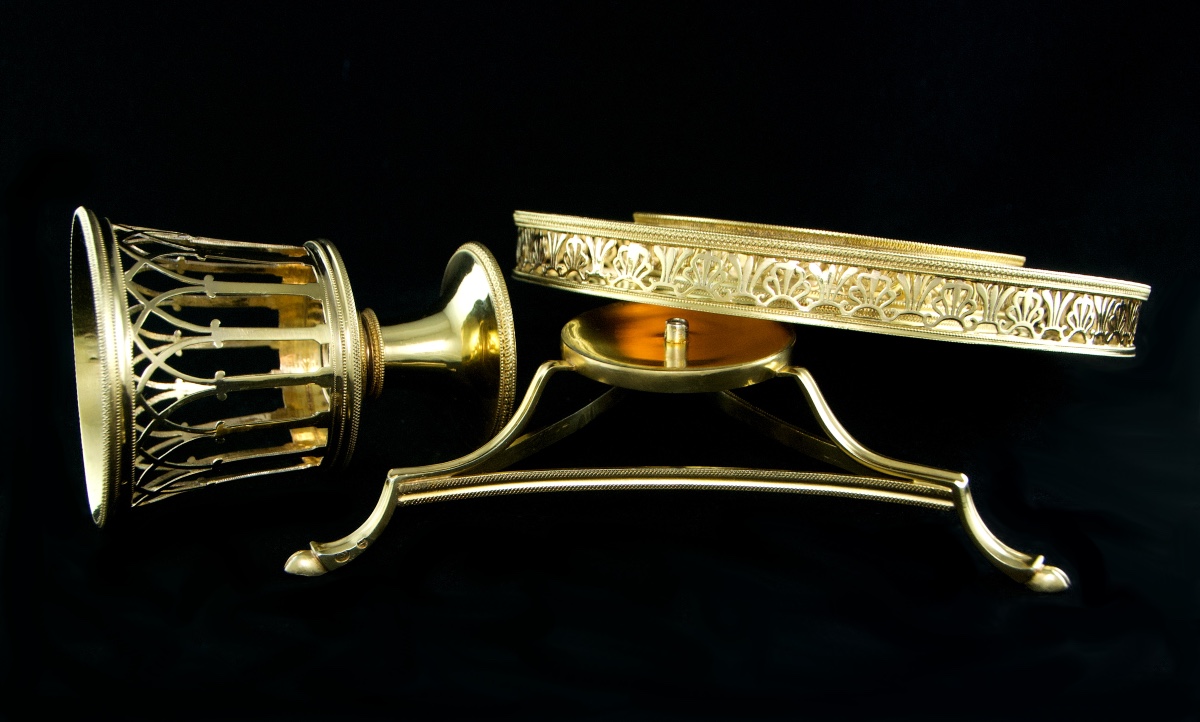


Louis XVI Period Centrepiece In Solid Silver Gilt, By C. N. Delanoy, Paris 1789
Artist: Claude-nicolas Delanoy
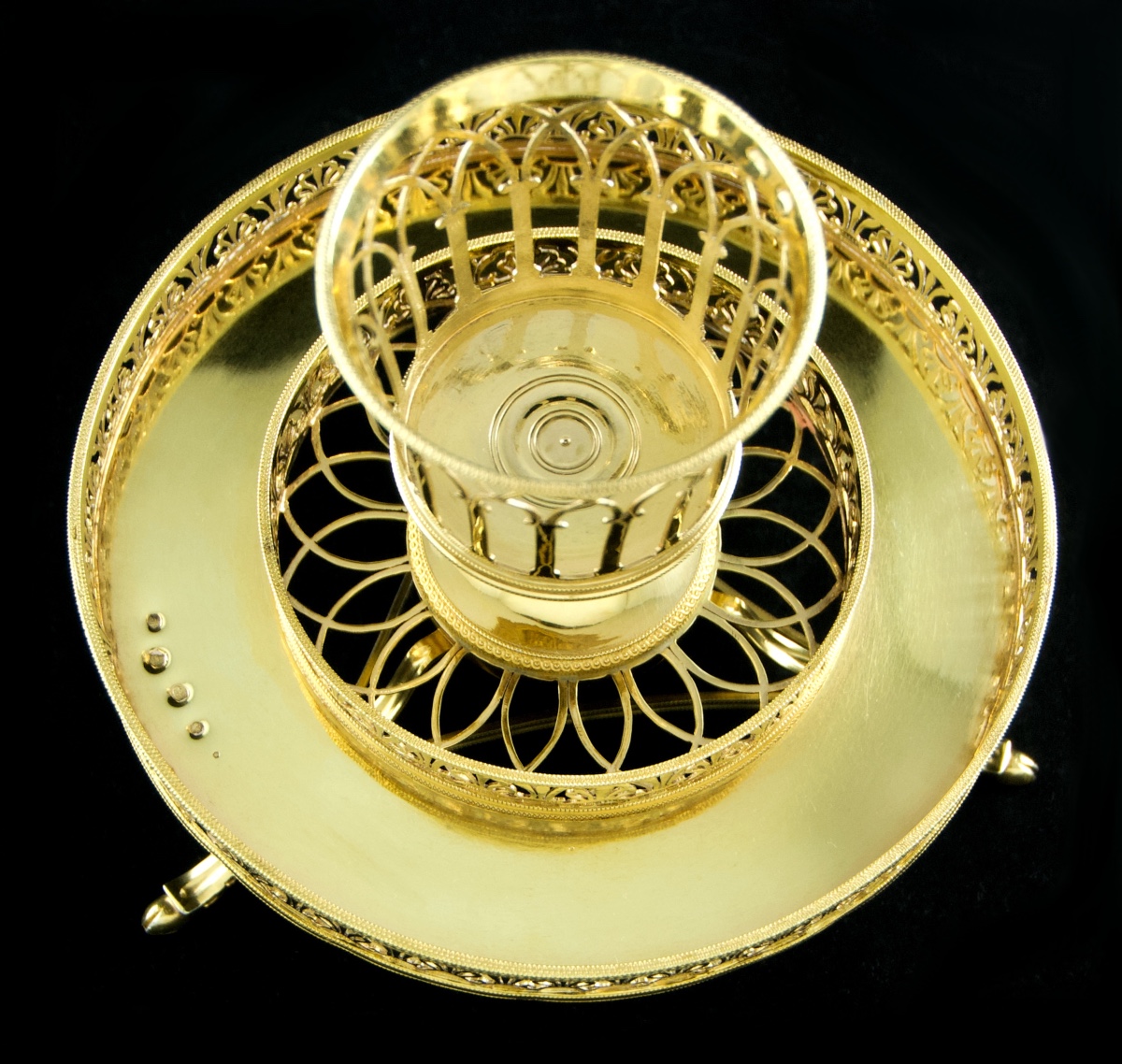
Magnificent solid silver (950/1000) centrepiece finely plated with gold, entirely pierced and chased.
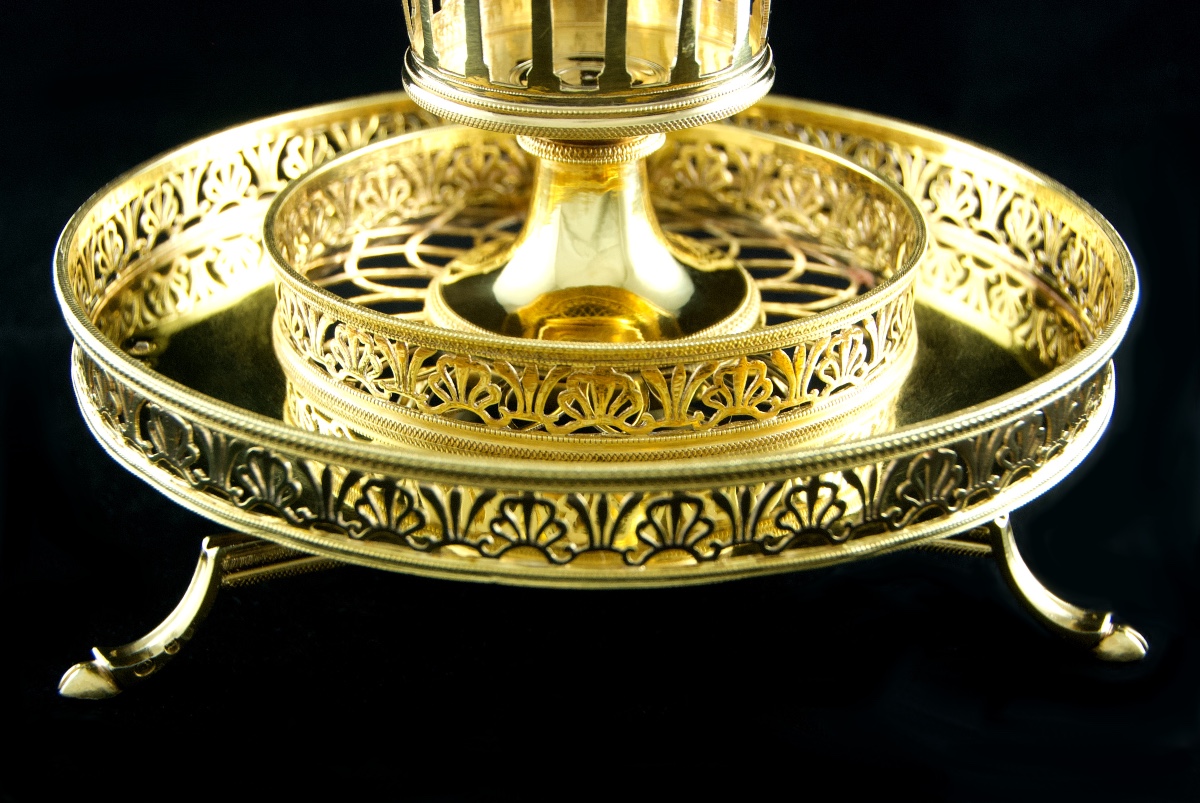
The double gallery tray presents an openwork décor of shells, palmettes and stylised scrolls. The borders of both galleries are chased with a frieze of palmettes framed by pearl borders, while the lower sections display respectively a band flanked by pearls and a scale frieze, and a band enriched with a double row of pearls.
At the centre, a radiating ogival motif forms the support for the basket.
The basket presents an exceptionally fine openwork of arcatures and pilasters. Its moulded rim and lower section show a succession of chased friezes of palmettes, pearls, scales and pointillé motifs, separated by polished or matt bands.
The interior, with a flat base adorned with light concentric rings in relief, stands on a circular pedestal decorated with a chased ring of palmettes and pearls, the base enriched with an interlace and pearl frieze.
The whole rests on a tripod support with fluted legs ending in hoof feet, joined by a fluted stretcher chased with scales.
Marks
Louis XVI period
From 1770 onwards the importance of the surtout increases considerably and it occupies almost the entire length of the table. Accessories previously placed upon it are now arranged around it. As Sandrine KRIKORIAN notes in her study of eighteenth century surtouts, cruet stands, spice boxes and similar elements alternate between the place settings and the surtout.
By its overall architecture and the sophistication of its workmanship this centrepiece belongs to the typology of small surtout elements that form modular ensembles. It is also possible that it serves to present a liqueur and its beakers which would allow it to function independently of other elements.
In the setting of a modern table it can stand alone perfectly and lends itself naturally to a floral arrangement in keeping with the tradition of the great eighteenth century and Empire surtouts.
Comparable examples are rare and none display piercing and chasing of such finesse and regularity which attest to a patron of the highest rank.
CLAUDE NICOLAS DELANOY
Admitted master in Paris 26 November 1766
Claude Nicolas DELANOY inscribes his maker’s mark on 10 December of the same year. His mark composed of the letters C N D beneath a sun is recorded by Henri NOCQ and appears on several fine pieces of late eighteenth century Parisian silver. His workshop is established rue Neuve Saint Médéric in the Marais district.
DELANOY belongs to the generation of goldsmiths who ensure the transition from the Rocaille to the Neoclassical taste. His refined production includes tableware such as beakers goblets sauceboats coffee pots and tureens as well as liturgical pieces including chalices and ciboria.
His work is distinguished by balanced design sober proportions and highly precise chasing often enriched with the beaded ornament characteristic of the 1770s to 1790s.
Pieces by DELANOY frequently bear the discharge marks of Jean François KALENDRIN registrar of the Paris Mint between 1782 and 1789 together with the jurande letters corresponding to this period. These stamps place his activity in the final years of the Ancien Régime and the earliest years of the Revolution.
Several works by DELANOY are preserved in major public collections including the Petit Palais in Paris as well as in important private collections such as the Diane Collection [1] dispersed at SOTHEBY’S Geneva in 2005 [2]. Works bearing the mark of Jean François KALENDRIN also appear in leading institutions including the Musée Cognacq Jay in Paris and the British Museum in London.
The œuvre of Claude Nicolas DELANOY illustrates with great elegance the Parisian taste under LOUIS XVI uniting neoclassical rigour purity of line and technical virtuosity.
[1] The Diane Collection formed by the Frère Bourgeois group is regarded as one of the most important collections of historic silver in Switzerland. It brings together major works dating from 1770 to 1820 by leading Parisian goldsmiths including Edmé François BALZAC, Jean Baptiste ODIOT, Henri AUGUSTE and Claude Nicolas DELANOY.
[2] SOTHEBY’S Geneva : Important European Silver from the Diane Collection, lot 114 : Large covered sugar bowl in silver by Claude Nicolas DELANOY Paris 1774 1775. Sold for 14 400 CHF.
A comparable example appears in the SOTHEBY’S Paris sale of 10 April 2008: Important European Silver Gold Boxes and Vertu, lot 112, estimated 5 / 8 000 euros and sold for 9 850 euros.
PUBLIC COLLECTIONS AND LISTED WORKS
Claude Nicolas DELANOY
Several boxes snuffboxes and nécessaires in gold and enamel today preserved in the Musée Cognacq Jay Paris dating between 1750 and 1792
One example in the British Museum London a gold and tortoiseshell box set with a cameo 1789
The double gallery tray presents an openwork décor of shells, palmettes and stylised scrolls. The borders of both galleries are chased with a frieze of palmettes framed by pearl borders, while the lower sections display respectively a band flanked by pearls and a scale frieze, and a band enriched with a double row of pearls.
At the centre, a radiating ogival motif forms the support for the basket.
The basket presents an exceptionally fine openwork of arcatures and pilasters. Its moulded rim and lower section show a succession of chased friezes of palmettes, pearls, scales and pointillé motifs, separated by polished or matt bands.
The interior, with a flat base adorned with light concentric rings in relief, stands on a circular pedestal decorated with a chased ring of palmettes and pearls, the base enriched with an interlace and pearl frieze.
The whole rests on a tripod support with fluted legs ending in hoof feet, joined by a fluted stretcher chased with scales.
Marks
- Maker’s mark : C N D beneath a sun, for Claude Nicolas DELANOY, on tray, feet and basket
- Charge mark A for the year 1789, on tray, feet and basket
- Discharge mark of Jean François KALENDRIN, on tray, feet and basket
- Jurande mark for 1788 1789, partially struck
- Petite garantie for the départements 1809 1819 on the basket
- Second coq first titre for the départements 1809 1819 on the tray and feet
- Vieillard 1819 1838 on the tray
- Crab mark départemental guarantee after 1838 on tray, pedestal and feet
- Départemental guarantee between 1809 and 1819 marked 95 on tray and feet
- Départemental guarantee between 1819 and 1838 marked 78 on tray
- Height 16 cm
- Diameter 19.2 cm
- Length 21 cm
Louis XVI period
From 1770 onwards the importance of the surtout increases considerably and it occupies almost the entire length of the table. Accessories previously placed upon it are now arranged around it. As Sandrine KRIKORIAN notes in her study of eighteenth century surtouts, cruet stands, spice boxes and similar elements alternate between the place settings and the surtout.
By its overall architecture and the sophistication of its workmanship this centrepiece belongs to the typology of small surtout elements that form modular ensembles. It is also possible that it serves to present a liqueur and its beakers which would allow it to function independently of other elements.
In the setting of a modern table it can stand alone perfectly and lends itself naturally to a floral arrangement in keeping with the tradition of the great eighteenth century and Empire surtouts.
Comparable examples are rare and none display piercing and chasing of such finesse and regularity which attest to a patron of the highest rank.
CLAUDE NICOLAS DELANOY
Admitted master in Paris 26 November 1766
Claude Nicolas DELANOY inscribes his maker’s mark on 10 December of the same year. His mark composed of the letters C N D beneath a sun is recorded by Henri NOCQ and appears on several fine pieces of late eighteenth century Parisian silver. His workshop is established rue Neuve Saint Médéric in the Marais district.
DELANOY belongs to the generation of goldsmiths who ensure the transition from the Rocaille to the Neoclassical taste. His refined production includes tableware such as beakers goblets sauceboats coffee pots and tureens as well as liturgical pieces including chalices and ciboria.
His work is distinguished by balanced design sober proportions and highly precise chasing often enriched with the beaded ornament characteristic of the 1770s to 1790s.
Pieces by DELANOY frequently bear the discharge marks of Jean François KALENDRIN registrar of the Paris Mint between 1782 and 1789 together with the jurande letters corresponding to this period. These stamps place his activity in the final years of the Ancien Régime and the earliest years of the Revolution.
Several works by DELANOY are preserved in major public collections including the Petit Palais in Paris as well as in important private collections such as the Diane Collection [1] dispersed at SOTHEBY’S Geneva in 2005 [2]. Works bearing the mark of Jean François KALENDRIN also appear in leading institutions including the Musée Cognacq Jay in Paris and the British Museum in London.
The œuvre of Claude Nicolas DELANOY illustrates with great elegance the Parisian taste under LOUIS XVI uniting neoclassical rigour purity of line and technical virtuosity.
[1] The Diane Collection formed by the Frère Bourgeois group is regarded as one of the most important collections of historic silver in Switzerland. It brings together major works dating from 1770 to 1820 by leading Parisian goldsmiths including Edmé François BALZAC, Jean Baptiste ODIOT, Henri AUGUSTE and Claude Nicolas DELANOY.
[2] SOTHEBY’S Geneva : Important European Silver from the Diane Collection, lot 114 : Large covered sugar bowl in silver by Claude Nicolas DELANOY Paris 1774 1775. Sold for 14 400 CHF.
A comparable example appears in the SOTHEBY’S Paris sale of 10 April 2008: Important European Silver Gold Boxes and Vertu, lot 112, estimated 5 / 8 000 euros and sold for 9 850 euros.
PUBLIC COLLECTIONS AND LISTED WORKS
Claude Nicolas DELANOY
- PETIT PALAIS Paris, silver gilt sauceboat, 1775 1776
- PETIT PALAIS Paris, three silver beakers, 1766 1767 and 1789
- BASILIQUE SAINT-SAUVEUR Rocamadour, silver chalice, 1789
Several boxes snuffboxes and nécessaires in gold and enamel today preserved in the Musée Cognacq Jay Paris dating between 1750 and 1792
One example in the British Museum London a gold and tortoiseshell box set with a cameo 1789
4 200 €
Period: 18th century
Style: Louis 16th, Directory
Condition: Good condition
Material: Vermeil
Length: 21 cm
Diameter: 19,2 cm
Height: 16 cm
Reference (ID): 1677452
Availability: In stock
Print