THIS OBJECT WAS SOLD
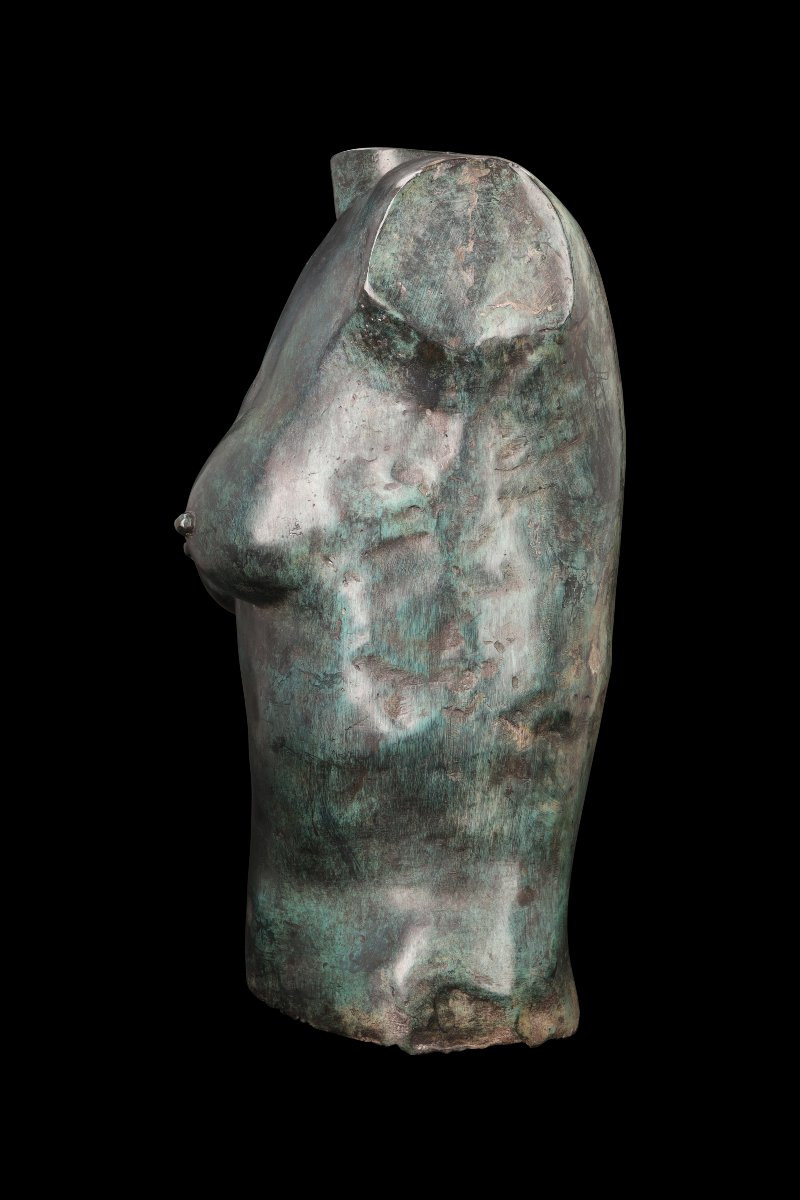
Patinated Brass Sculpture "woman's Bust"






Voici la traduction en anglais du texte que vous avez fourni :
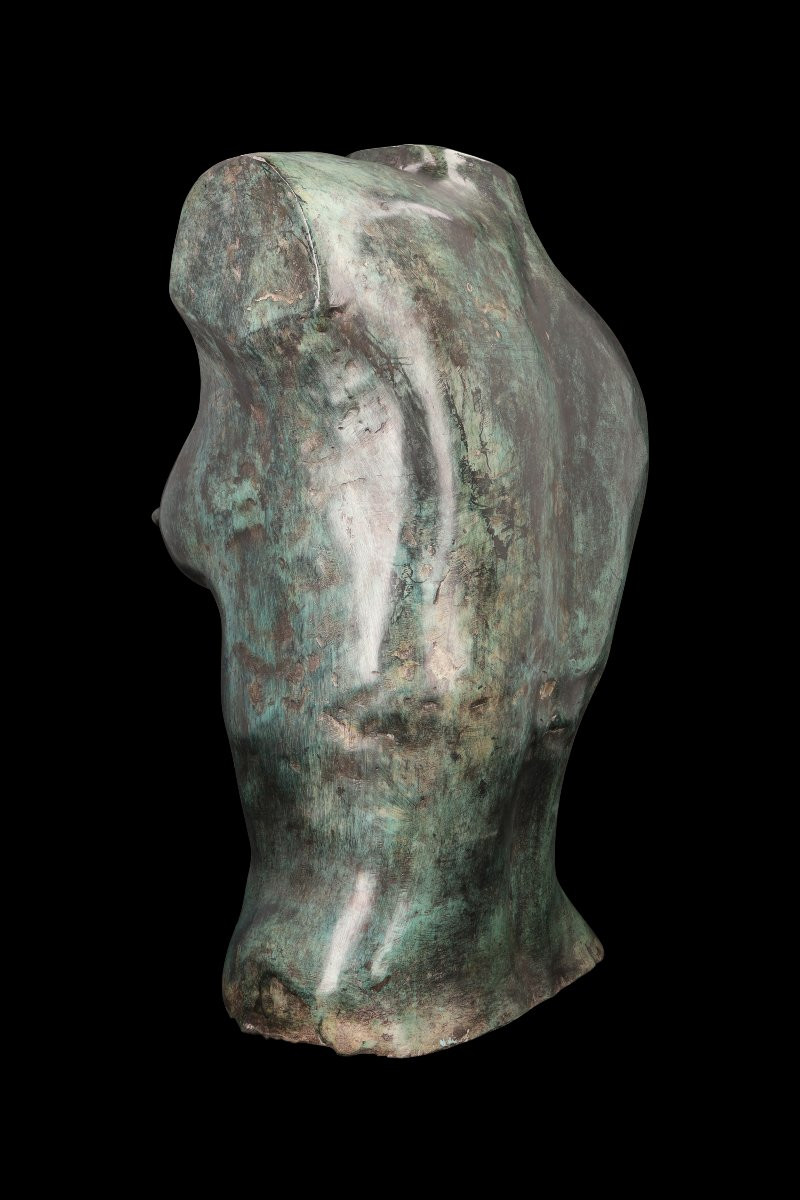
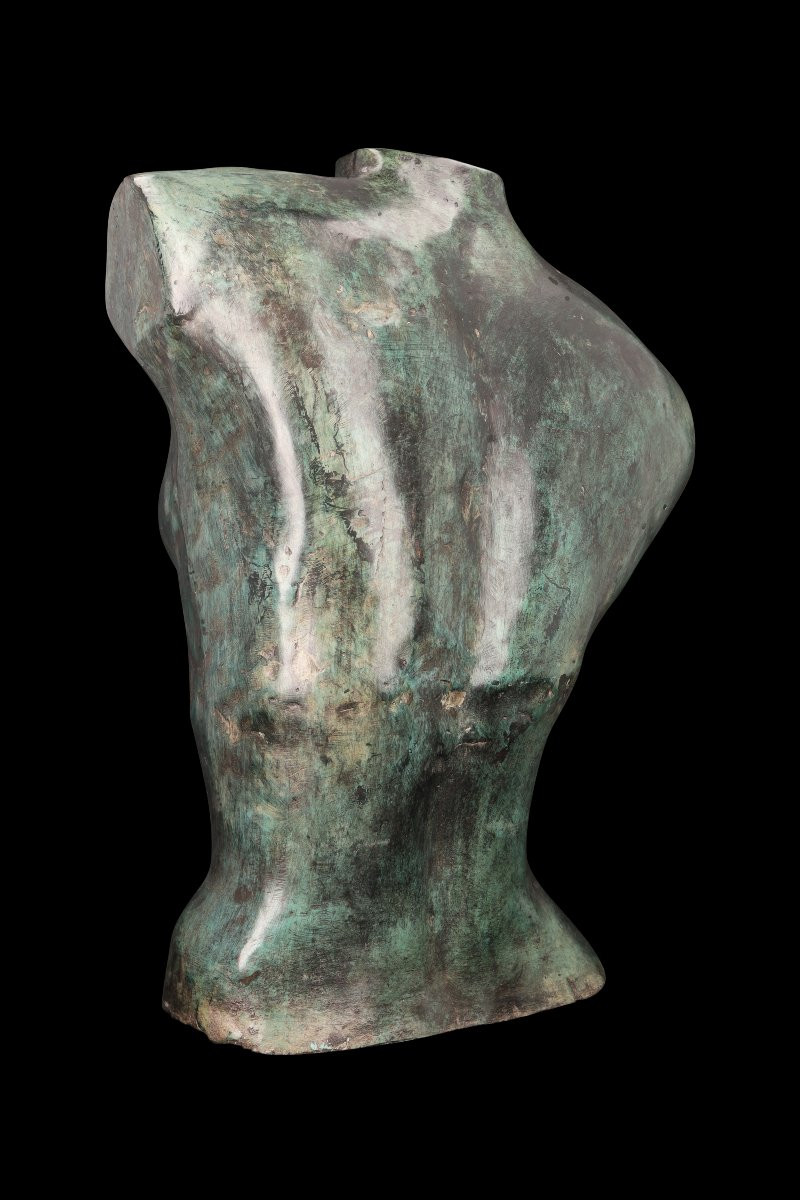
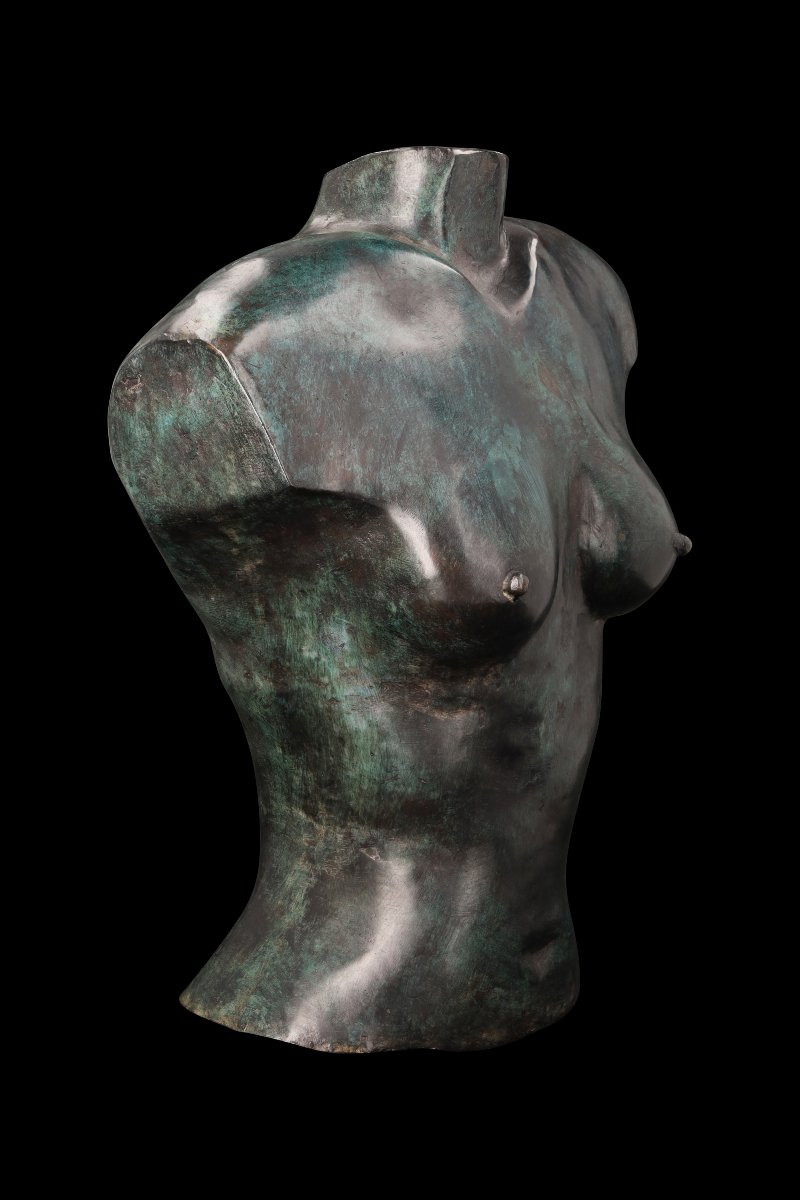
1. Artistic DescriptionThis sculpture, titled "Buste de Femme" (Bust of a Woman), is made of brass and features a rich dark and verdigris patina which attests to its age or is an intentional treatment to evoke the aesthetic of ancient bronze.
Subject and Form: The work represents a woman's torso, cut above the neck and below the waist. The head and arms are absent, which focuses attention on the mass and the line of the torso.
Surface Treatment: The surface is not polished or academically smooth; it is worked with subtle texturing and variations in plane, giving the impression of rapid modeling or molten material, typical of a rough lost-wax casting or a search for expressiveness.
Modeling and Anatomy: The artist has rendered the body forms in a synthetic and powerful manner.
The breasts are full and simple, with small, pronounced nipples.
The stomach is outlined by slight indentations, suggesting a soft abdomen without precise muscular details.
The back is treated with broad, slightly undulating planes, evoking the spine and dorsal musculature in an expressive rather than realistic way.
General Aesthetics: The absence of the head lends the work a universal and timeless character. The sculpture prioritizes the sensation of form and the force of the material over narrative or classical idealization. The rough appearance and heavy patina add a dimension of primitive or archaic nobility.
The "Buste de Femme" is strongly rooted in the Modern Sculpture movement and, more specifically, shows major affinities with Expressionism and the beginnings of Figurative Abstraction, bearing the influence of the sculptor Auguste Rodin and his successors.
2.1. Rejection of Classical Idealism and Primitivisme:
The classical model of beauty, which advocates for perfection and smooth execution, is abandoned.
Synthesis of Forms: The artist does not seek faithful and detailed reproduction (contrary to the 19th-century Academy) but a powerful synthesis of volumes. The body is reduced to its essential masses.
Fragment as Whole: The use of the fragment (the torso alone) as a finished work is a practice inherited from Rodin (such as The Walking Man or The Hand of God). This confers a dramatic tension and universality to the subject. The fragment is deemed more expressive and closer to life than the complete figure.
The surface treatment and modeling technique are essential markers of modernism.
Expressive Modeling: The artist leaves the trace of their gesture. The surfaces are rough, agitated by the planes and the accidents of the patina, which injects life and emotion directly into the material. One feels an energy, an impulse, as if the form were in the process of emerging from the raw matter. This choice is profoundly Expressionistic, where the artist's expression or feeling takes precedence over pure representation.
Authenticity of the Material: The choice of brass or bronze (with its green patina) and its unfinished appearance celebrates the material itself. It is the truth of the material that is highlighted, a common trait among modernists who valued the "frankness of the material" (like Henri Gaudier-Brzeska or Constantin Brâncuși, albeit in a more streamlined style).
This style finds its roots and peak in the period extending from the late 19th century to the mid-20th century.
Connection with Rodin: The manner of leaving the forms "sketched" or the brutal transitions of volume is a direct inheritance of the technique and philosophy of Auguste Rodin, who considered shadow and light on an uneven surface as a means of capturing movement and inner life.
Proximity to Artists like Maillol or Despiau (with a more expressive touch): Although the forms of this bust are less smooth and more "massive" than those of a classical Aristide Maillol, it shares the same focus on the monumental simplicity of the female body and the same rejection of anecdotal detail. However, the raw surface treatment brings it closer to a more expressive and visceral line of the 20th century.
In conclusion, the bust is modernist because it uses the fragment, rejects the ideal of perfect beauty, and makes execution and the texture of the material the main vehicles of artistic expression. Its rough modeling and synthetic forms place it resolutely within the orbit of Figurative Expressionism of the first half of the 20th century.
Explore similar pieces and discover your ideal find:
Other Sculptures