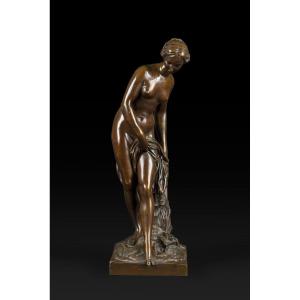
Art Deco Spelter Sculpture "bust Of A Woman"
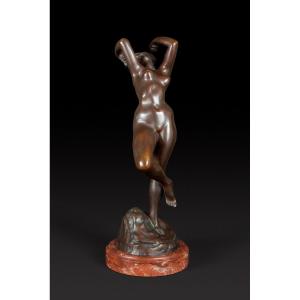
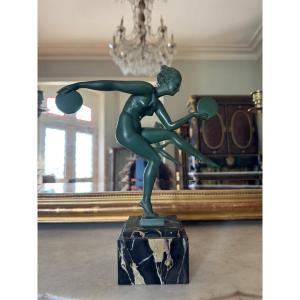
Subject and Composition: The work features a bust of a woman in full action, her arms raised toward the sky in a movement of exaltation. In her left hand, she holds a tambourine—a signature instrument in depictions of "exotic" dancers or music-hall performers of the interwar period. Her head is tilted back and her gaze is directed upward, expressing a sense of joie de vivre or a liberating trance.
Aesthetics and Modeling:
The Silhouette: The short "bob" hairstyle, typical of the 1920s, highlights the female emancipation of the era. Her attire is reduced to a stylized bra and arm cuffs, accentuating the scenic or festive nature of the figure.
Surface Treatment: The modeling is fluid and synthetic. Forms are streamlined to prioritize line and dynamism over realistic anatomical detail.
Materials and Patina: The use of spelter (régule) with a green patina—mimicking antique bronze—is characteristic of the high-quality mass artistic production of this period. The contrast with the cubic white onyx pedestal, itself resting on a black marble base, creates a play of textures and colors typical of Art Deco.
2. Artistic Context and Historical JustificationThe attribution of this work to the Art Deco movement is indisputable for several major stylistic and sociological reasons:
A. Themes of Dance and Emancipation In the 1920s, dance became the ultimate symbol of modernity (e.g., Josephine Baker or the Ballets Russes). This sculpture fits perfectly into this trend, celebrating the female body liberated from corsets, athletic, and joyful. The tambourine refers directly to the imagery of the music-hall revues that dominated the Parisian cultural scene.
B. Synthetic Forms (Straight Line vs. Curve) The work illustrates the transition between Art Nouveau (organic curves) and Art Deco. Here, although the body is curved, the overall composition leans toward geometrization: the bust emerges from a strictly cubic base, creating a sharp visual break. The treatment of the hair and clothing is simplified and almost graphic, which is the signature of the "Modern" style.
C. The Democratization of the Art Object The choice of spelter is solid historical evidence of the production context. While bronze was reserved for the elite, spelter allowed the rising middle class to access the aesthetic of the great sculptors of the time (such as Max Le Verrier, Fayral, or Derenne). This work is a direct witness to an era where decorative art was intended to be everywhere, from grand ocean liners to bourgeois interiors.
D. The "Garçonne" as an Aesthetic Ideal The "garçonne" (flapper) hairstyle visible here is the most infallible chronological argument. It marks a radical break from previous centuries and places the work precisely in the 1920–1930 decade. The proud and dynamic posture embodies the "New Woman"—independent and bold.
Conclusion: Through its geometric rigor (the base), its subject (the modern dancer), and its technique (patinated alloy), this work is an absolute standard of 1920s decorative statuary, representative of an era seeking to reconcile classical elegance with a new, vibrant energy.
Period: 20th century
Style: Art Deco
Condition: Good condition
Material: Gilt bronze
Height: 25
Reference (ID): 1677932
Availability: In stock