THIS OBJECT WAS SOLD
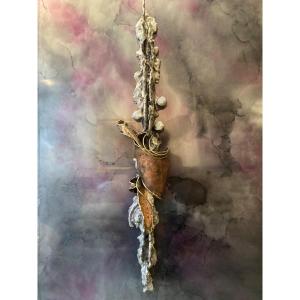
Wall Sculpture In Sandstone And Glass Stones "eagle" (ca. 1930) By Roger Guerin (1896-1954)


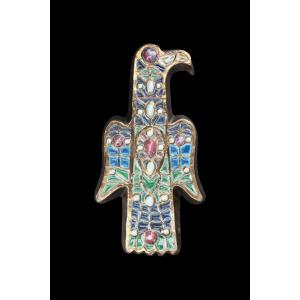


This piece is a stoneware wall sculpture, created by the Belgian artist Roger Guérin around 1930. It represents a stylized eagle (aquiliform), characterized by its symmetrical silhouette, its profile head, and its powerful geometry.
The material used is stoneware (a high-fired ceramic). The artist adorned the surface with a rich decoration, imitating the luxury of gold work. He uses enamels (fused glass) in different colors (blue, green, red, white/opaque) to fill cellular compartments. The structure of these compartments is delimited by golden lines, creating the visual effect of inlaid precious stones and pearls.
The Historical Reference: Visigothic Art:The work is not a purely Art Deco creation, but a modern reinterpretation of a much older style: the gold work of the "Barbarian" peoples of the Early Middle Ages (5th – 7th centuries). Guérin was clearly inspired by the aquiliform fibulae (eagle-shaped brooches) found particularly in Visigothic and Ostrogothic burials. The compartmentalized decoration is a direct homage to the cloisonné technique, which consisted of setting garnets or glass into gold to create bright, colorful motifs. The artist thus transposes the preciousness of metal and gems into enameled stoneware ceramic, lending his sculpture symbolic strength and historical resonance.
2. Artistic Movement: Art DecoThe sculpture fully belongs to the Art Deco (Decorative Art) movement that defined Europe between 1920 and 1940.
Motivation and Justification:
Its affiliation with Art Deco is motivated by several factors.
Firstly, the treatment of the eagle is characterized by stylization, the geometrization of forms, and rigid symmetry, all fundamental principles of the Art Deco style.
Secondly, Art Deco stands out for its eclecticism, drawing inspiration from various historical and archaic references (such as Egyptian Art, or here, the Art of the "Great Migrations") to forge a new aesthetic.
Finally, Guérin was a major figure in the Applied Arts of this period, utilizing high-quality stoneware (Bouffioulx Stoneware) to create luxury decorative objects, which is a key characteristic of Art Deco production.
Guérin's work is thus an Art Deco synthesis that borrows its archaic form (Visigothic) and subjects it to the modern principles of stylization and rigor of the 20th century.
3. Artist Biography: Roger Guérin (1896-1954):Roger Guérin was born in Jumet, Belgium, in 1896, and died in Bouffioulx in 1954. He is considered one of the major figures in Belgian art ceramics of the early 20th century.
His artistic education began at the École des Arts et Métiers (School of Arts and Crafts) in Maredsous, and continued at the Académie des Beaux-Arts in Saint-Gilles. However, his association with the Atelier des Grès de Bouffioulx (Bouffioulx Stoneware Workshop), near Charleroi, is what defined his career. Guérin specialized in the production of stoneware vases and sculptures.
He is particularly renowned for his mastery of high-firing (grand feu) and salt glazes, techniques that give his ceramics their earthy appearance, robustness, and unique texture. His works, often inspired by animal or mythological themes (notably his panthers, birds, and eagles), are strongly marked by the characteristic stylization of Art Deco, making him a leader in the Applied Arts in Belgium.
Guérin contributed to making Bouffioulx stoneware a quality export product, actively participating in international exhibitions of his time.
Explore similar pieces and discover your ideal find:
Other Sculptures