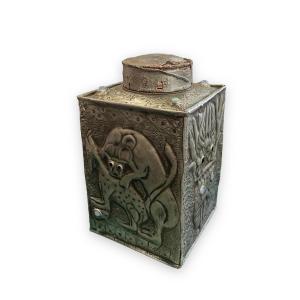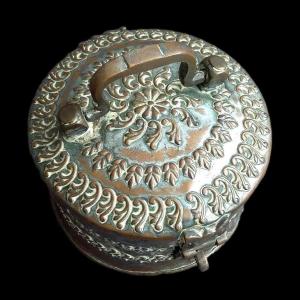


Betel Box, Tin-plated Copper With Repoussé Carving, Complete Set, Rajasthan, 19th Century
Complete Betel Box, Origin: North India, Rajasthan, 19th century.
This copper box, formerly tinned, is complete, comprising ten pieces for preparing betel.
The set is in very good condition and exceptionally beautiful.
The box is lavishly decorated with repoussé leaf friezes, as is the interior tray.
The handle and closure mechanisms are made of bronze.
While chewing betel for its stimulant properties is an integral part of many Asian cultures, preparation techniques vary regionally and evolved in the 20th century.
The areca nut is either minced or grated, often flavored with spices, then mixed with lime (calcium oxide) and, since the colonial period, sometimes with tobacco.
The mixture is usually wrapped in a "piper betle" leaf.
This is incorrectly called betel (in some languages, but not in local dialects, which differentiate between betel and areca nut, although the word "chew" is used there).
(indifferently for both products).
Lime acts as a catalyst. Areca contains arecoline, an alkaloid that promotes salivation.
The nut colors saliva red and teeth orange.
Traditionally, after about twenty minutes of chewing, the consumer spits out what remains of the quid.
Rajasthan is a state in northern India bordering Pakistan.
Its palaces and forts are vestiges of the many kingdoms that once fought over the region.
In its capital, Jaipur, the "Pink City," there are two buildings constructed in the 18th century: the City Palace and the Hawa Mahal, the "Palace of Winds," a former cloister housing the women of the royal harem.
It is adorned with a five-story pink sandstone facade.
Perched atop a nearby hill, Amber Fort was founded by a Rajput prince in the early 1600s.
Dimensions: Height: 17 cm - Diameter: 18.5 cm
FREE SHIPPING WITHIN FRANCE via Colissimo with signature required.
France €0 / Europe €15 / World €25
www.winsteinprovence.com
## Texts and photos Winstein, all rights reserved
This copper box, formerly tinned, is complete, comprising ten pieces for preparing betel.
The set is in very good condition and exceptionally beautiful.
The box is lavishly decorated with repoussé leaf friezes, as is the interior tray.
The handle and closure mechanisms are made of bronze.
While chewing betel for its stimulant properties is an integral part of many Asian cultures, preparation techniques vary regionally and evolved in the 20th century.
The areca nut is either minced or grated, often flavored with spices, then mixed with lime (calcium oxide) and, since the colonial period, sometimes with tobacco.
The mixture is usually wrapped in a "piper betle" leaf.
This is incorrectly called betel (in some languages, but not in local dialects, which differentiate between betel and areca nut, although the word "chew" is used there).
(indifferently for both products).
Lime acts as a catalyst. Areca contains arecoline, an alkaloid that promotes salivation.
The nut colors saliva red and teeth orange.
Traditionally, after about twenty minutes of chewing, the consumer spits out what remains of the quid.
Rajasthan is a state in northern India bordering Pakistan.
Its palaces and forts are vestiges of the many kingdoms that once fought over the region.
In its capital, Jaipur, the "Pink City," there are two buildings constructed in the 18th century: the City Palace and the Hawa Mahal, the "Palace of Winds," a former cloister housing the women of the royal harem.
It is adorned with a five-story pink sandstone facade.
Perched atop a nearby hill, Amber Fort was founded by a Rajput prince in the early 1600s.
Dimensions: Height: 17 cm - Diameter: 18.5 cm
FREE SHIPPING WITHIN FRANCE via Colissimo with signature required.
France €0 / Europe €15 / World €25
www.winsteinprovence.com
## Texts and photos Winstein, all rights reserved
290 €
Period: 19th century
Style: Asian art
Condition: Excellent condition
Material: Copper
Diameter: 18,5 cm - 7,5"
Height: 17 cm - 7"
Reference (ID): 1668965
Availability: In stock
Print