THIS OBJECT WAS SOLD
Chinese Cocoon-shaped Funerary Jar With Thermoluminescence (tl) Test
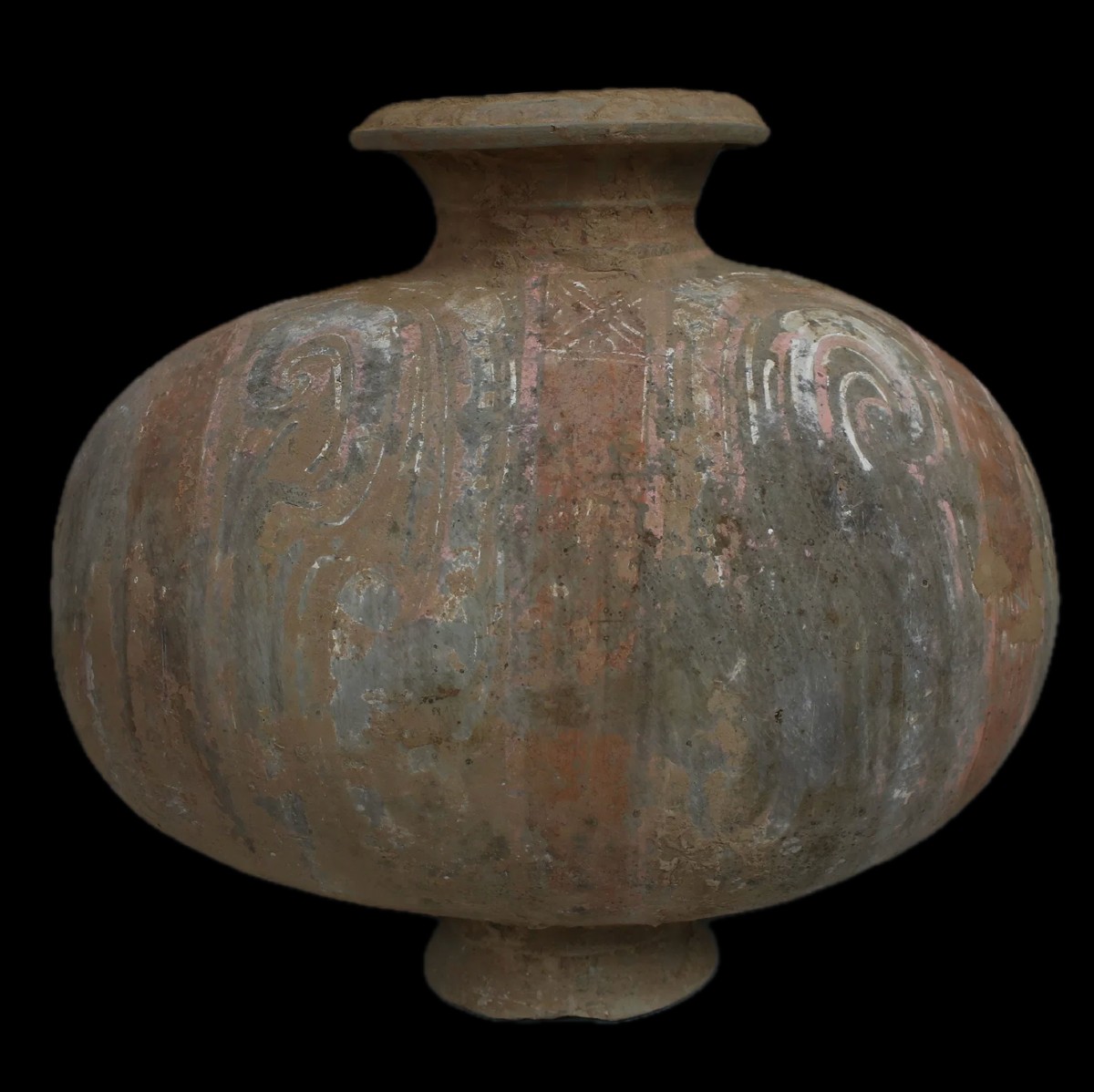


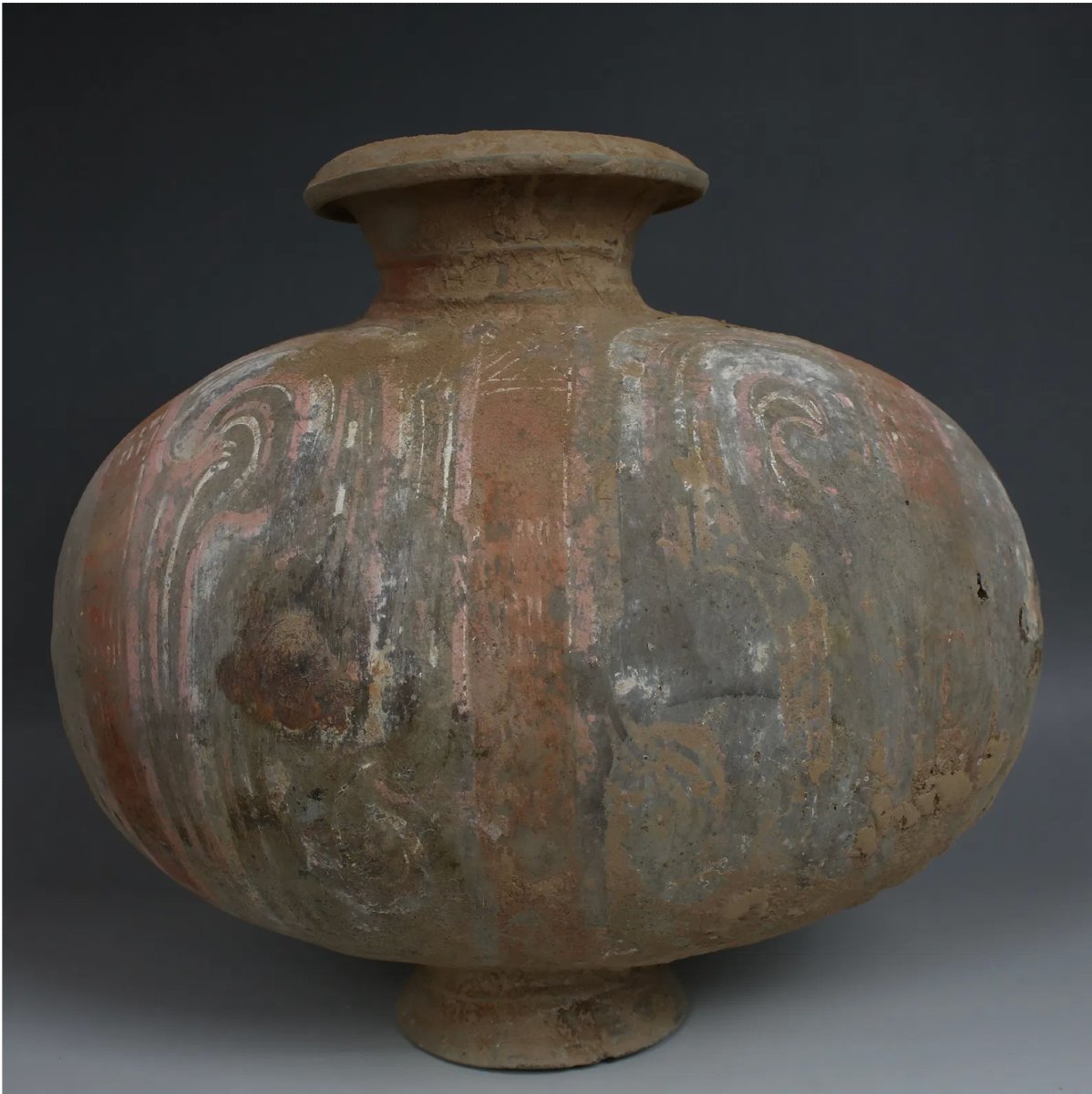

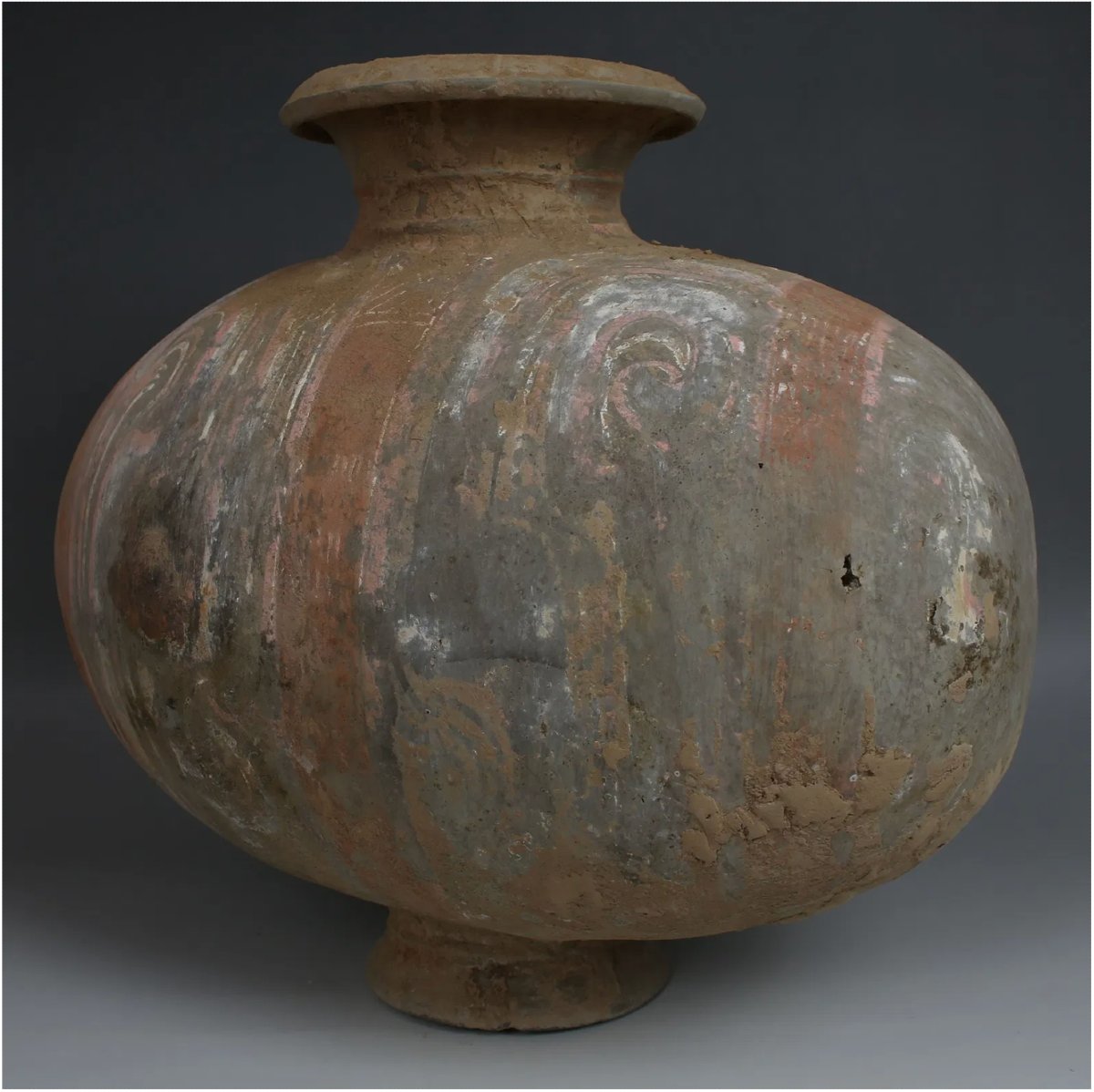
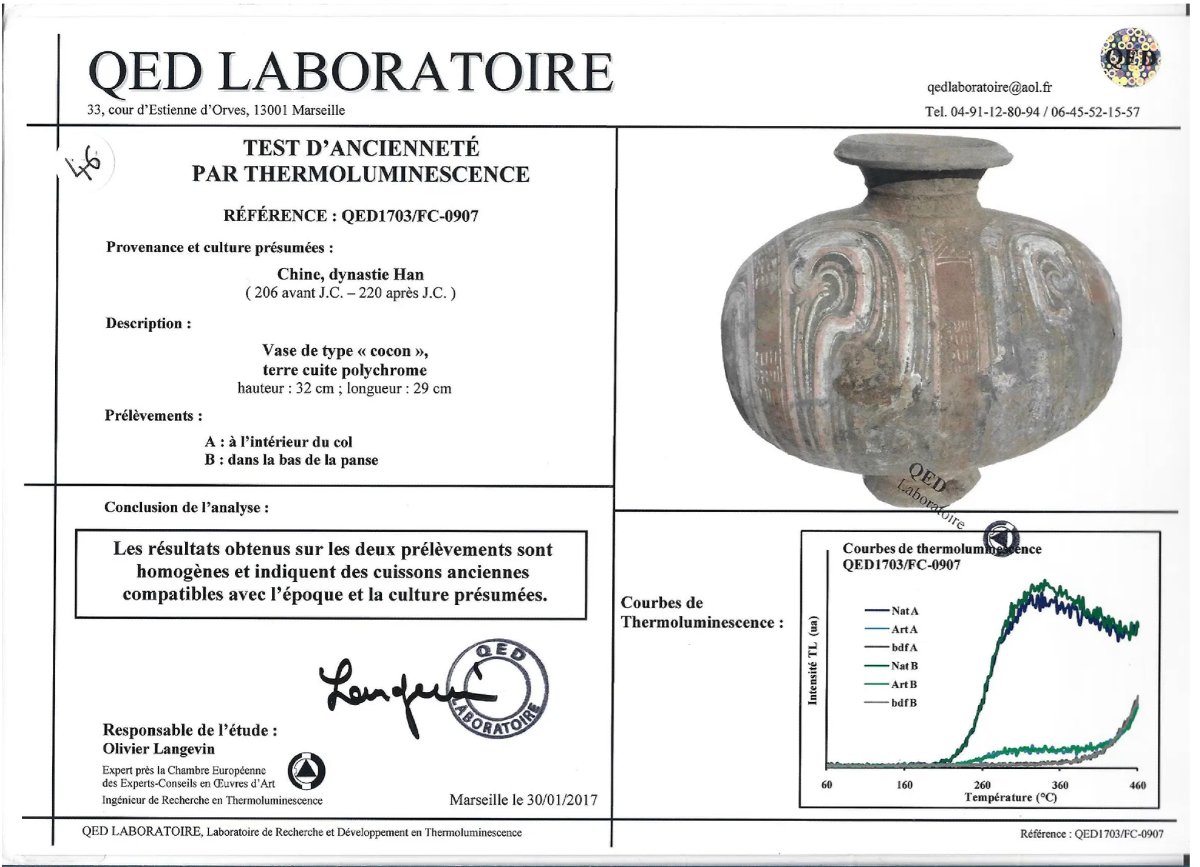


Impressive Chinese funerary jar in cocoon form, made of low-fired terracotta with cold-applied pigments, attributable to the Han dynasty and scientifically confirmed by a thermoluminescence test (QED Laboratory). Close visual inspection confirms full coherence with this attribution: the proportions, clay fabric, painting technique, cloud-scroll motifs, vertical bands, surface wear and burial encrustations all correspond to an authentic ancient funerary vessel, preserved as a single homogeneous piece rather than reconstructed from fragments.
The jar displays the classic Han “cocoon vessel” silhouette: a strongly swollen horizontal body, short neck and low annular foot, forming a compact, weighty volume characteristic of the type. The polychromy, although softened by time, still reveals a complex scheme: broad rectilinear bands alternating with spiralling cloud volutes painted in chalky white and rose tones on a grey-brown ground. A central vertical panel with faint geometric patterns (crosshatching, parallel strokes) structures the decorative field.
Wear patterns are deep, irregular and consistent with age: abrasions on the reliefs, pigments faded into matte films, grey halos in worn areas, and sharper surviving lines in protected zones. Earthy encrustations—especially on the lower body and around the foot—penetrate micro-fissures in the paint layer, indicating long-term burial. No evidence suggests modern reconstruction: lighter areas appear to be old fills and stabilisations rather than recent additions.
This is, in sum, an authentic and aesthetically strong example, fully documented and belonging to the canonical corpus of Han cocoon-shaped vessels.
CharacteristicsObject: Cocoon-shaped funerary jar with TL test
Material: Terracotta with cold-applied painted slip
Culture: Chinese
Period: Han Dynasty, 206 BC – AD 220
Dimensions: approx. 296 mm (h) × 330 mm (L) × 203 mm (D)
Condition: Good overall condition – complete structure; intact body, neck and foot; worn polychromy, abrasions, encrustations and small losses consistent with age
Provenance: Former French private collection (Toulouse), assembled in the 1980s
Museum Comparanda:
– Metropolitan Museum of Art, New York, 1994.605.31
– Maxwell Museum of Anthropology, MMA 2012.91.60
– Montreal Museum of Fine Arts, 2014.177
Scientific Analysis: Thermoluminescence test by QED Laboratory (Marseille), ref. QED1703/FC-0907, confirming ancient firing compatible with the Han period
Documentation: Certificate of authenticity + TL report provided
Cocoon-shaped jars are among the most emblematic ceramics of Western Han funerary culture. Their elongated, horizontally swollen shape is commonly interpreted as an abstraction of the silkworm cocoon—a reference to the silk industry, economic centre of the empire, and a symbol of transformation, rebirth and continuity.
Originally used as liquid containers (wine, millet beer), they soon became mingqi—funerary substitute objects meant to supply the deceased with the essential goods of an ongoing existence in the afterlife.
Typically made from grey or red terracotta, low-fired and painted after firing with mineral pigments, these vessels visually mimic more prestigious bronzes and lacquers. The painted decoration—cloud volutes (yunqi), vertical bands, ascending rhythms—reflects the Taoist cosmology of ascent, spiritual flux and the soul’s movement toward immortality.
The present example fits fully within this tradition: form, technique and decoration all align with the cosmological funerary ceramics of the Han worldview.
Formal & Material Analysis 1. Morphology– Low annular foot with faint turning striations, slightly worn edge
– Large horizontal ovoid body, symmetrical, with maximal diameter low on the vessel
– Cylindrical, slightly tapering neck; broad, nearly horizontal disk-like rim with ancient micro-chips
– Proportions producing the characteristic “cocoon” effect: long, low, visually weighty
– Reddish-brown to beige clay, compact with fine mineral inclusions
– Grey slip layer with micro-crackling, lightly powdery in places
– Burial encrustations embedded in the slip, not superficial
– Areas where earth and pigment have naturally blended during long-term burial
– Central vertical panel with attenuated geometric motifs
– Cloud-scrolls in chalky white and rose, ascending and spiralling
– Vertical bands, some filled with faded red
– Palette of white, rose, red-ochre, and grey
– No modern repainting detected; only natural differential preservation
– No structural fractures; vessel preserved as a single piece
– Patinated ancient chips; small stable losses
– One or two discreet old fills, neutral and non-invasive
– Natural alterations typical of excavated Han ceramics: pitting, slip delamination, soft streaks, accretions
– Gentle cleaning retained much of the original patina
This cocoon jar embodies several layers of significance:
– Typological value: exemplary model of Han funerary production
– Iconographic value: cloud-scroll and cosmic vertical imagery reflecting Taoist cosmology
– Aesthetic value: monumental volume, abstract rhythms, subdued but expressive polychromy
– Collectible value: directly comparable to examples held in major museums (Met, Maxwell, MBAM)
A visually powerful and intellectually rich object, equally at home in a collection of ancient ceramics, Asian funerary art, or modern abstract-inspired displays.
Provenance & Guarantees– French private collection (Toulouse), acquired in the 1980s
– Independent TL test by QED Laboratory, confirming ancient firing
– Certificate of authenticity based on TL analysis and museum comparanda
Together, these elements form a strong and coherent body of evidence for authenticity.
Expert ReportThis Han cocoon-shaped funerary jar is an authentic, complete and well-preserved example of its type. The decorative scheme of cloud scrolls and vertical bands remains readable, and the structural integrity is excellent. The thermoluminescence test confirms ancient firing, and no stylistic or physical anomalies contradict this result.
Comparable to examples in major public collections, the jar can be considered a reference-grade piece for a demanding private collection.
Explore similar pieces and discover your ideal find:
archeology