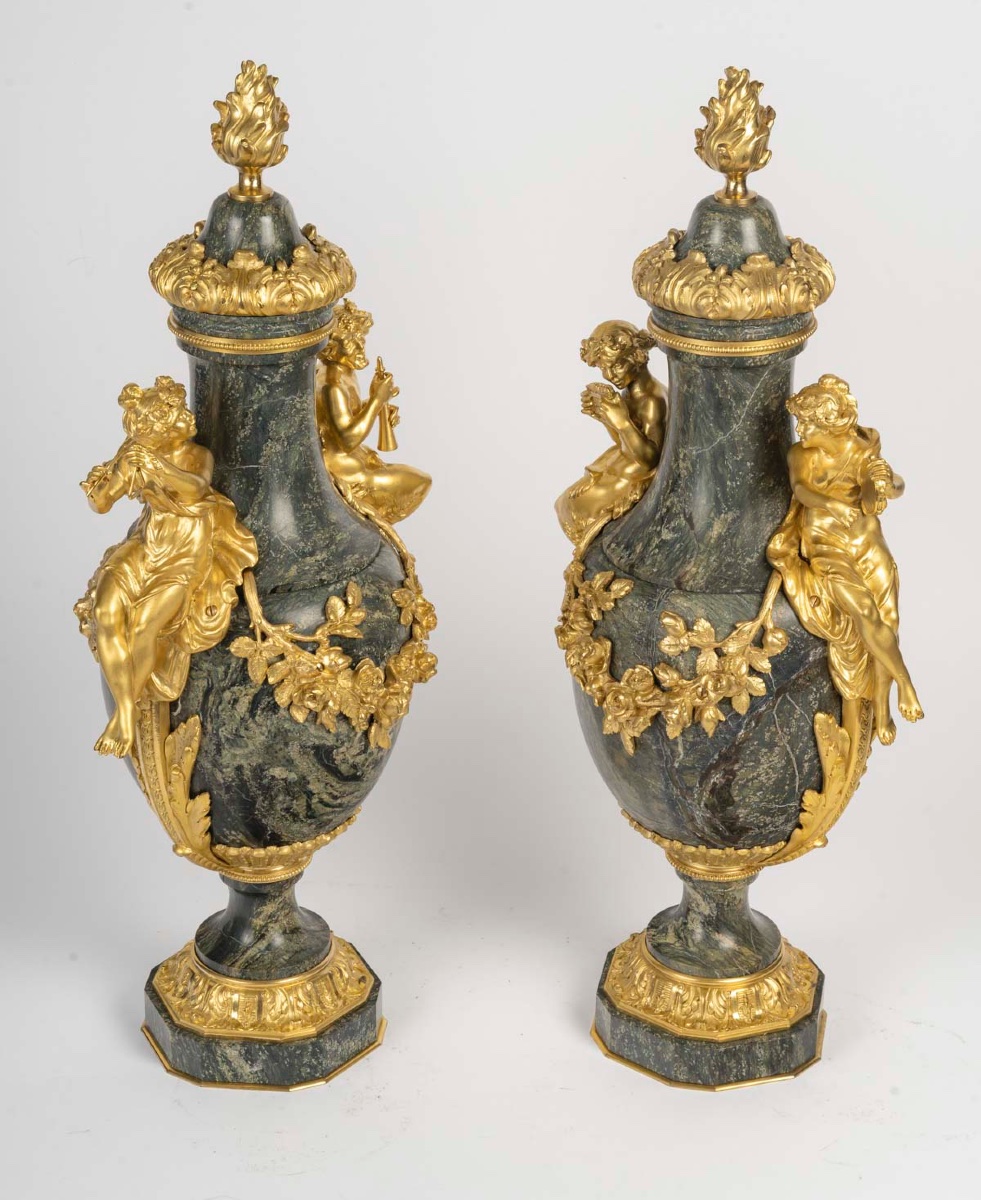




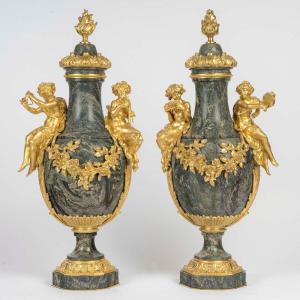


Pair Of Clodion-style Green Marble And Gilt-bronze Urns, 19th Century
Pair of Green Marble and Gilt-Bronze Cassolettes in the Manner of Clodion – Circa 1890
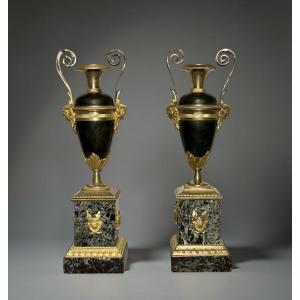
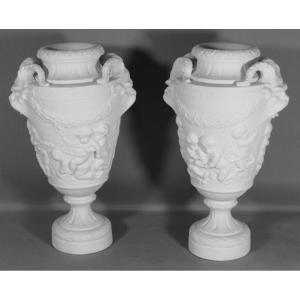
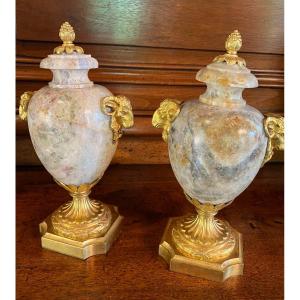
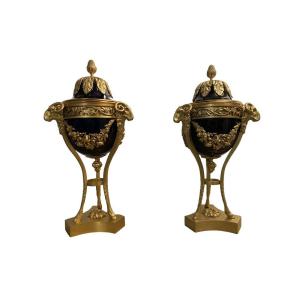
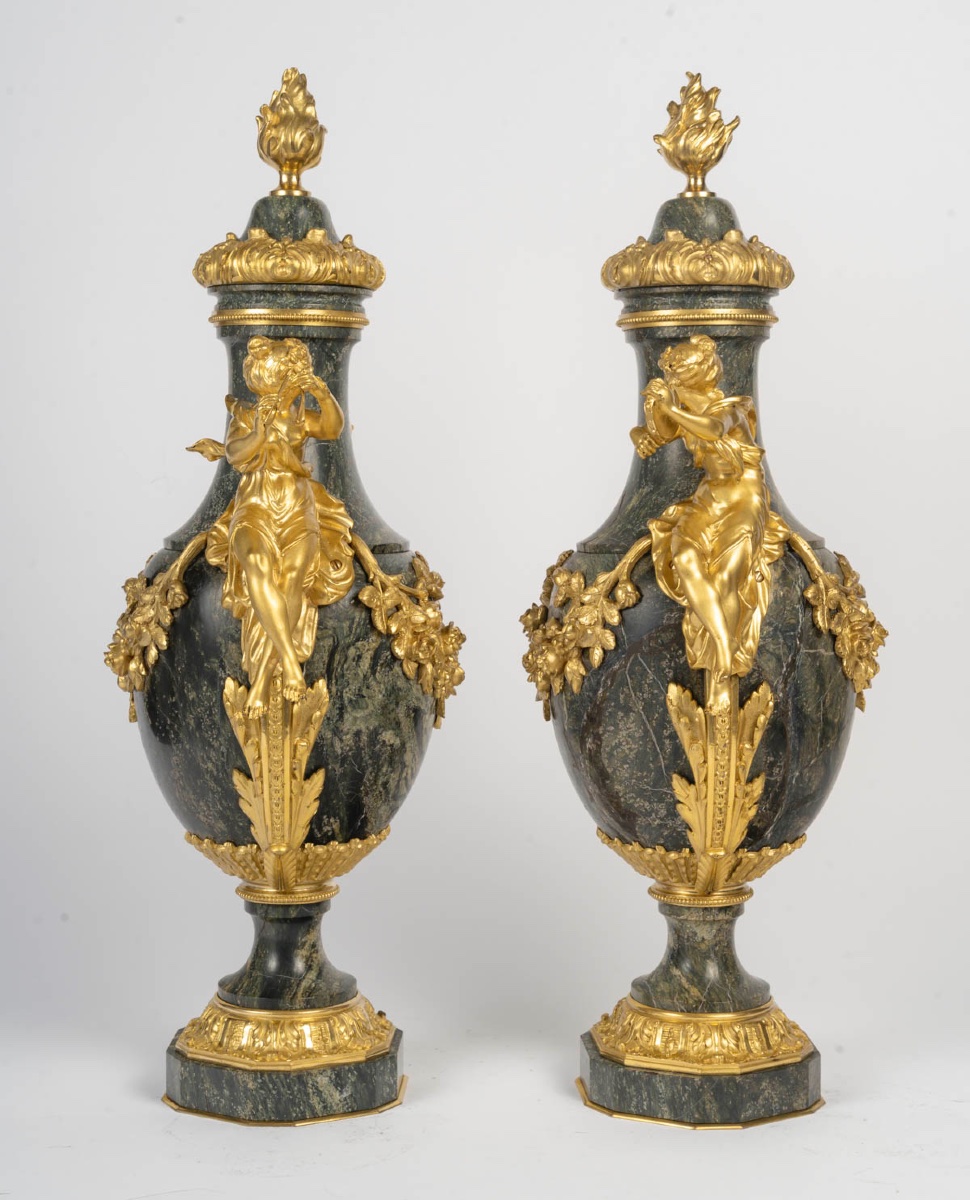
A remarkable pair of large covered cassolettes crafted from richly veined green marble and adorned with sumptuous finely chased and gilt-bronze mounts.
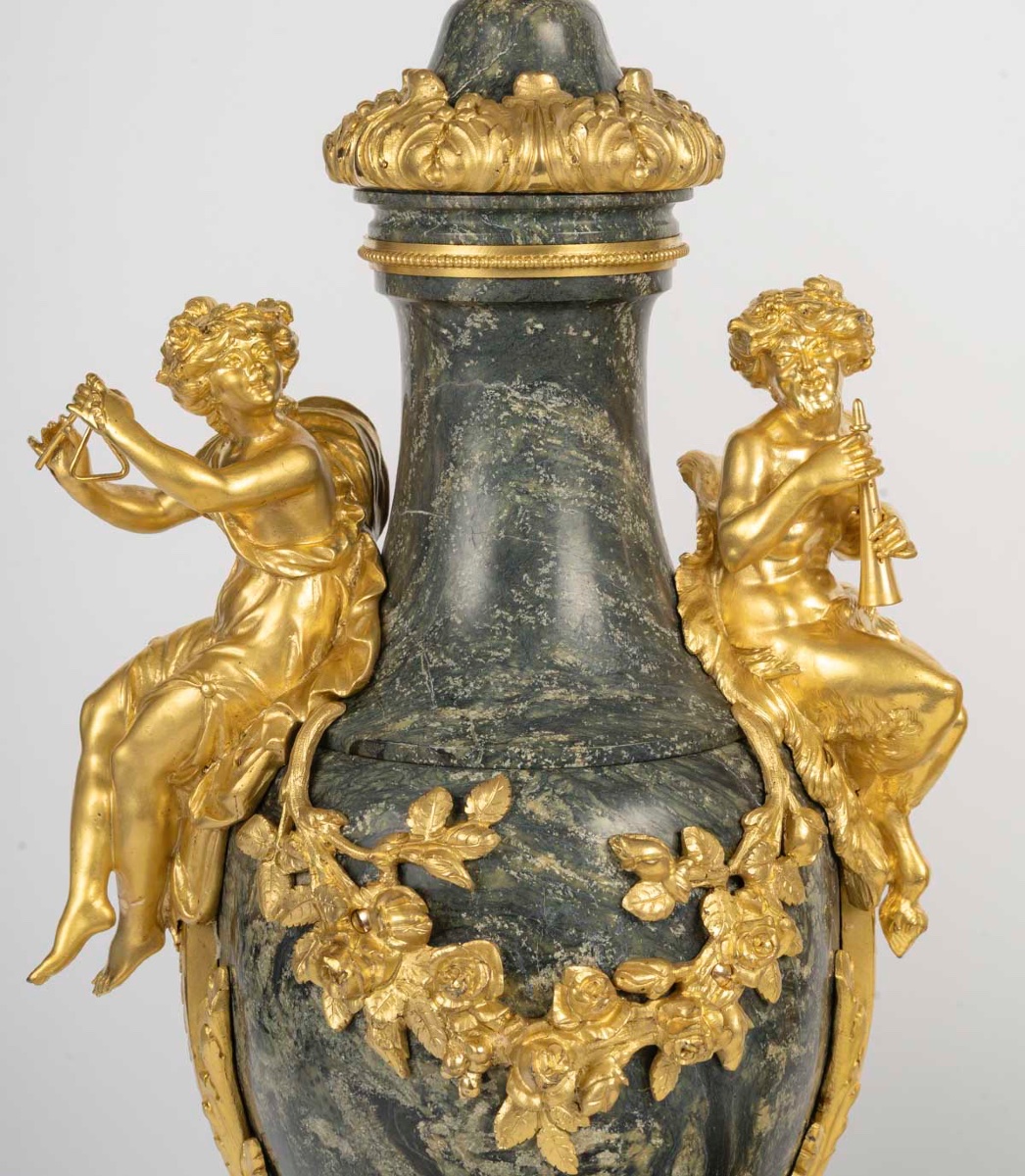
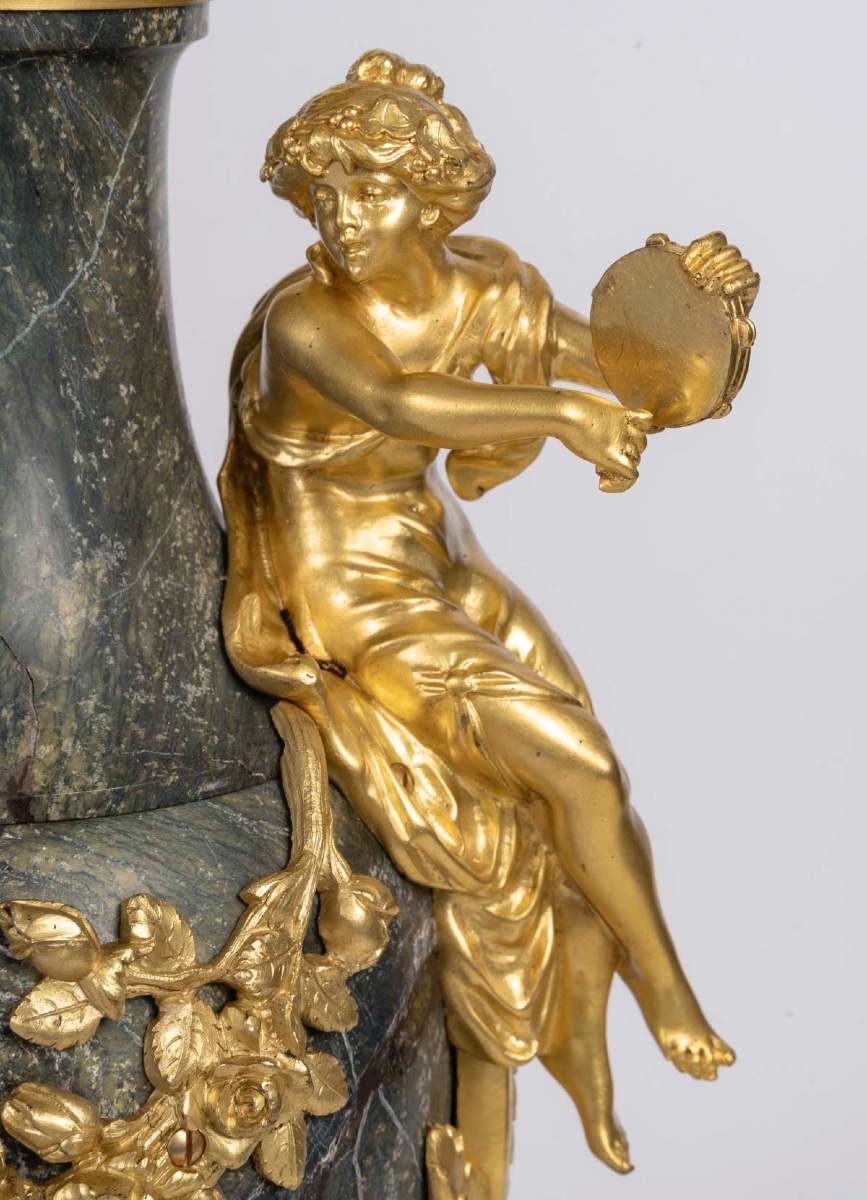
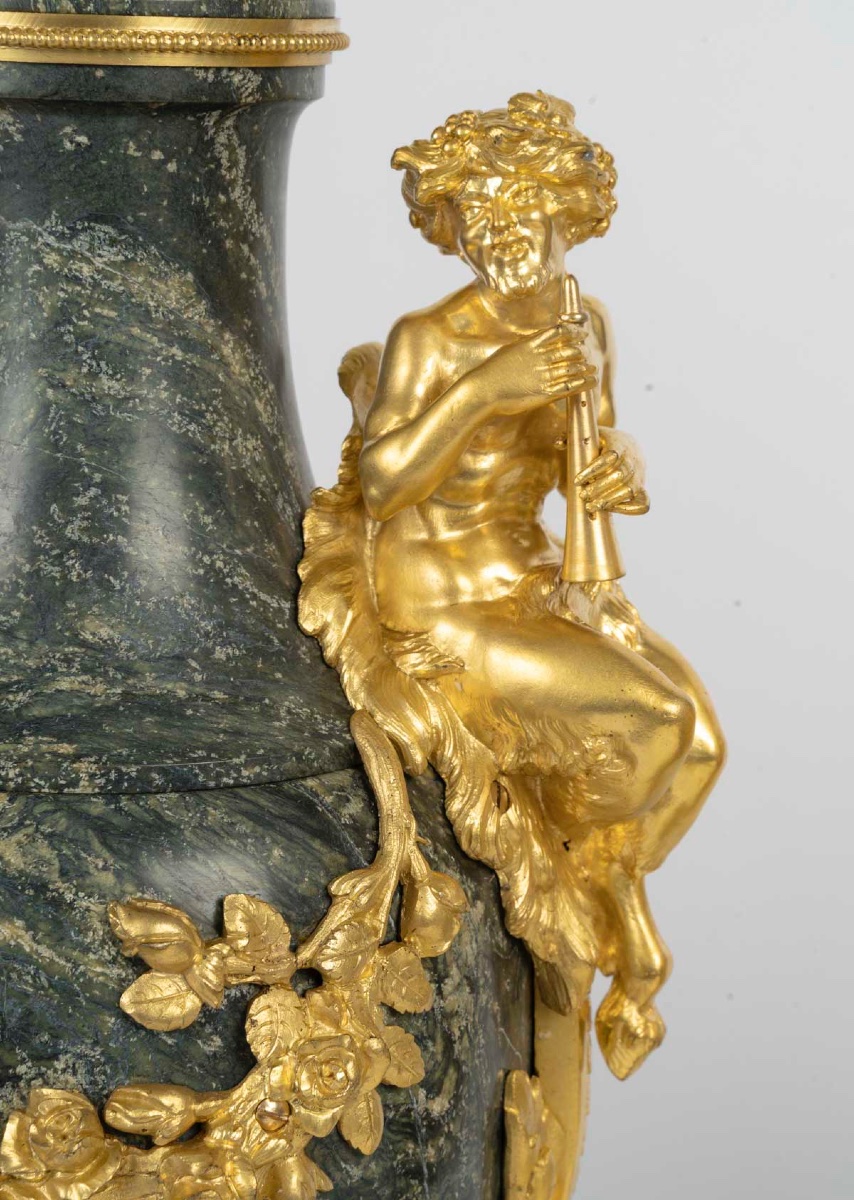
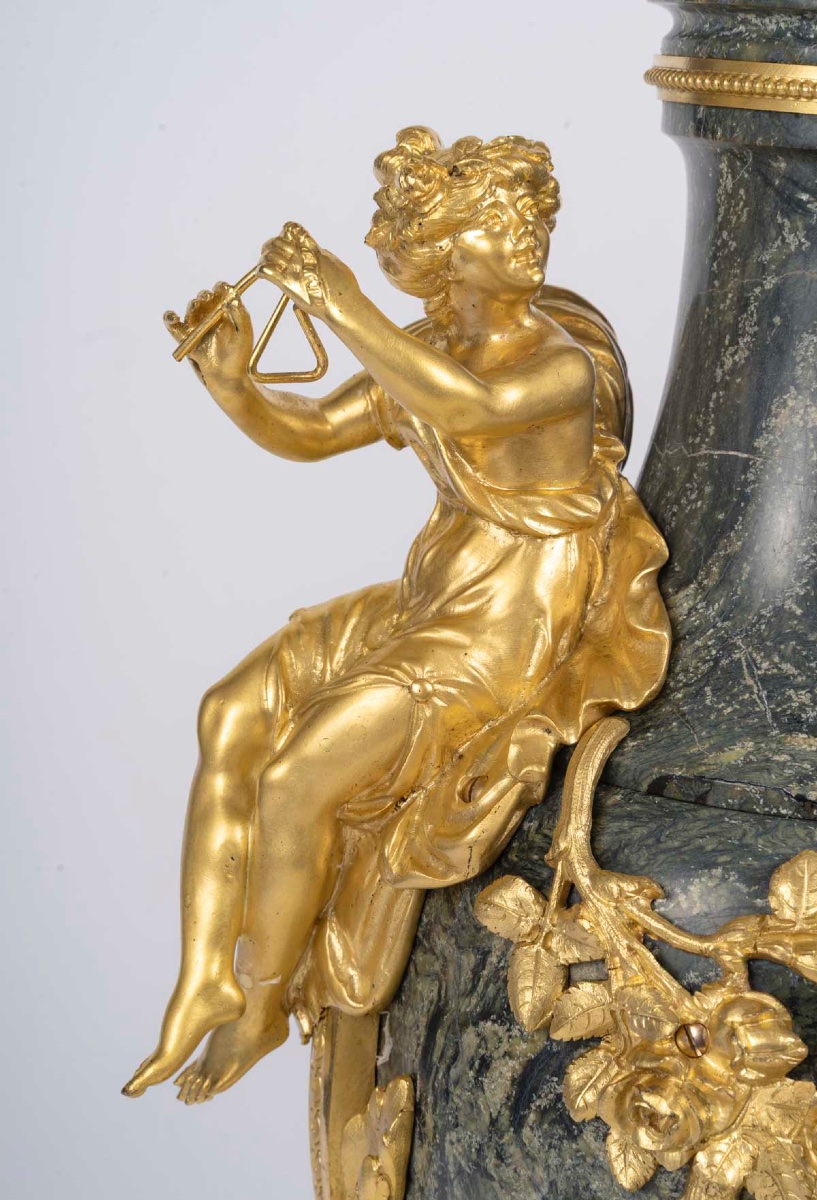
Of baluster form, each cassolette is flanked by two fully modelled gilt-bronze figures seated upon the shoulders of the vase. This particularly lively ensemble comprises two young women draped in the antique manner and two musical satyrs, identifiable by their expressive features and goat-like legs.
The four figures are depicted playing a triangle, flute, panpipes and tambourine. Their animated poses, sensuous modelling and joyful Bacchic character directly evoke the sculptural world of Claude Michel, known as Clodion.
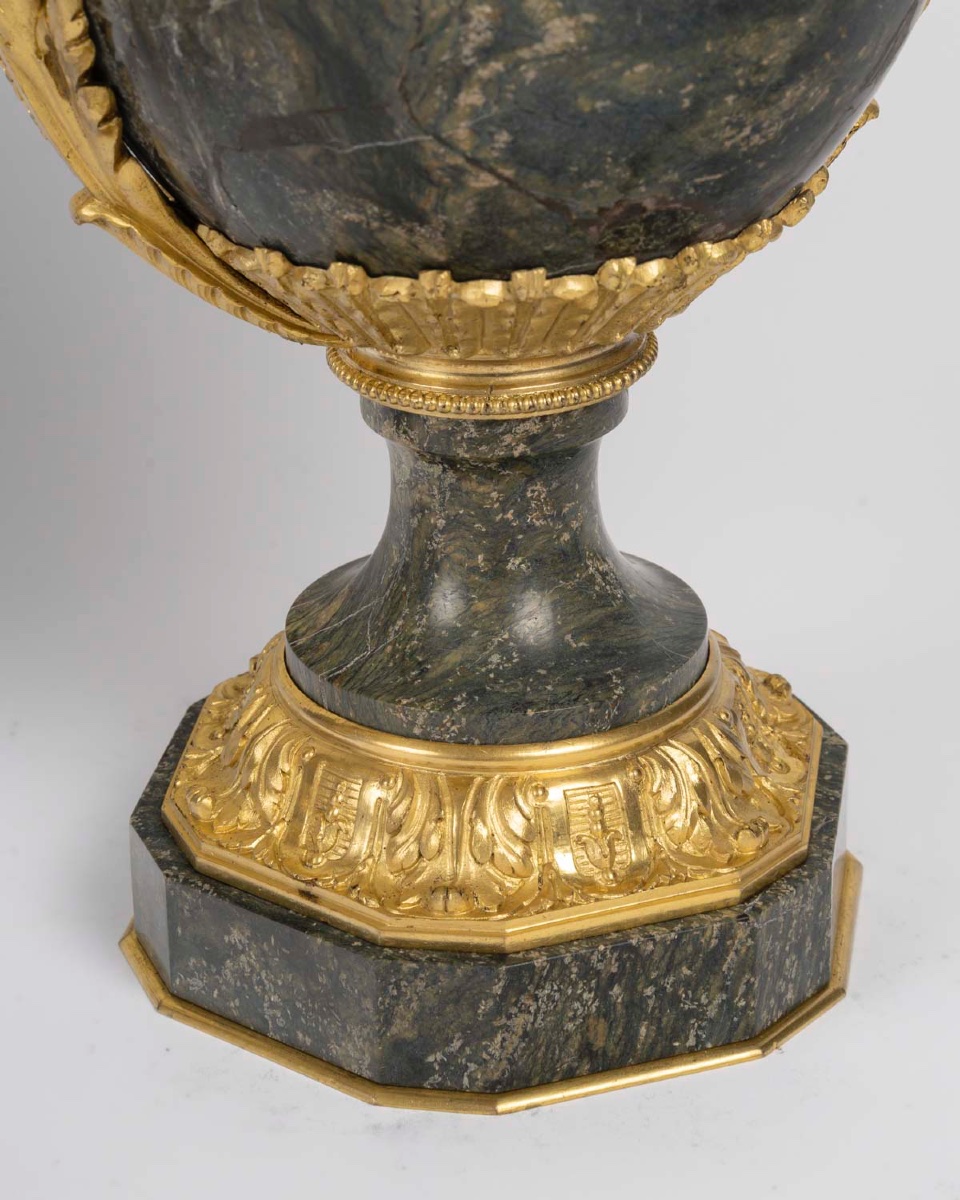
The bodies are embellished with generous garlands of roses, flowers and foliage suspended between the figures. The lower sections are embraced by long gilt-bronze leaves extending towards the marble socles.
Each cassolette stands on a square marble base enriched with a finely chased acanthus-leaf border. The removable covers are encircled by luxuriant foliate mounts and surmounted by flame-shaped finials. Beaded and moulded borders complete this exceptionally rich and harmonious composition.
The quality of the casting, precision of the chasing, sculptural treatment of the figures and brilliance of the gilding reflect fine French craftsmanship from the late 19th century, circa 1890.
About Clodion
Claude Michel, known as Clodion, was born in Nancy in 1738 and died in Paris in 1814. He trained in the workshop of his uncle, the sculptor Lambert Sigisbert Adam, and later studied under Jean-Baptiste Pigalle. He was awarded the Grand Prix for sculpture in 1759 and subsequently spent several years in Rome.
Clodion achieved international recognition for his terracotta groups inspired by classical antiquity. His distinctive repertoire is populated by Bacchantes, satyrs, fauns and children, frequently portrayed in dancing, musical or Bacchic scenes.
His works are celebrated for their graceful movement, sensuous modelling and finely rendered draperies. Highly prized during his lifetime, Clodion’s compositions enjoyed renewed popularity throughout the 19th century, inspiring numerous sculptors and bronze founders during the Second Empire and the Louis XVI Revival.
The two young women and two musical satyrs adorning these cassolettes belong fully to this decorative tradition. In the absence of a signature or an identified original model, the scholarly designation “in the manner of Clodion” remains more accurate than “after a model by Clodion.”
French work, circa 1890.
Dimensions of each cassolette:
Height: 57 cm (22.4 in)
Circumference of the body: 68 cm (26.8 in)
Bibliography
Anne L. Poulet and Guilhem Scherf, Clodion, 1738–1814, exhibition catalogue, Musée du Louvre, Paris, Réunion des musées nationaux, 1992.
Henri Thirion, Les Adam et Clodion, Paris, A. Quantin, 1885.
Clodion, Bacchante and Satyress Dancing with Children, 1773, terracotta, The Metropolitan Museum of Art, New York. The Metropolitan Museum of Art
After Clodion, Satyr Crowning a Bacchante, terracotta, Musée du Louvre, Paris. Musée du Louvre
Period: 19th century
Style: Louis 16th, Directory
Condition: Perfect condition
Material: Marble
Diameter: 68 cm
Height: 57 cm
Reference (ID): 1663218
Availability: In stock