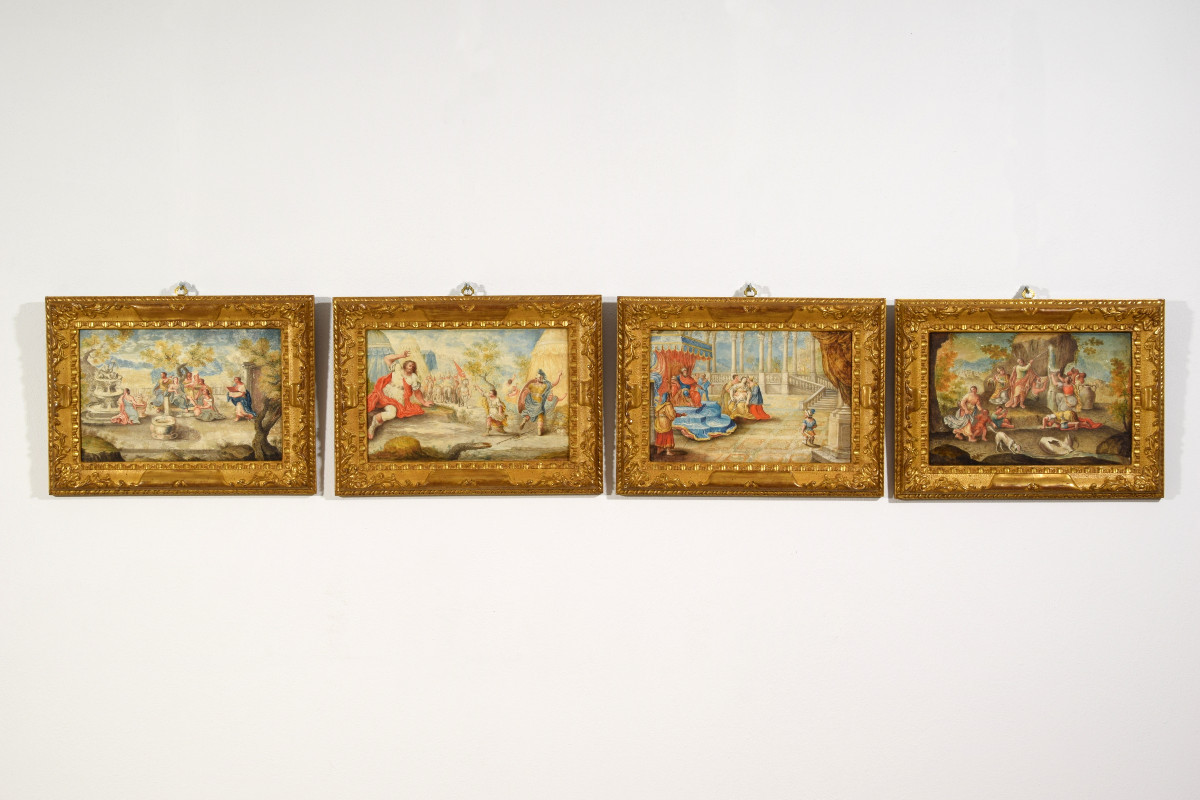
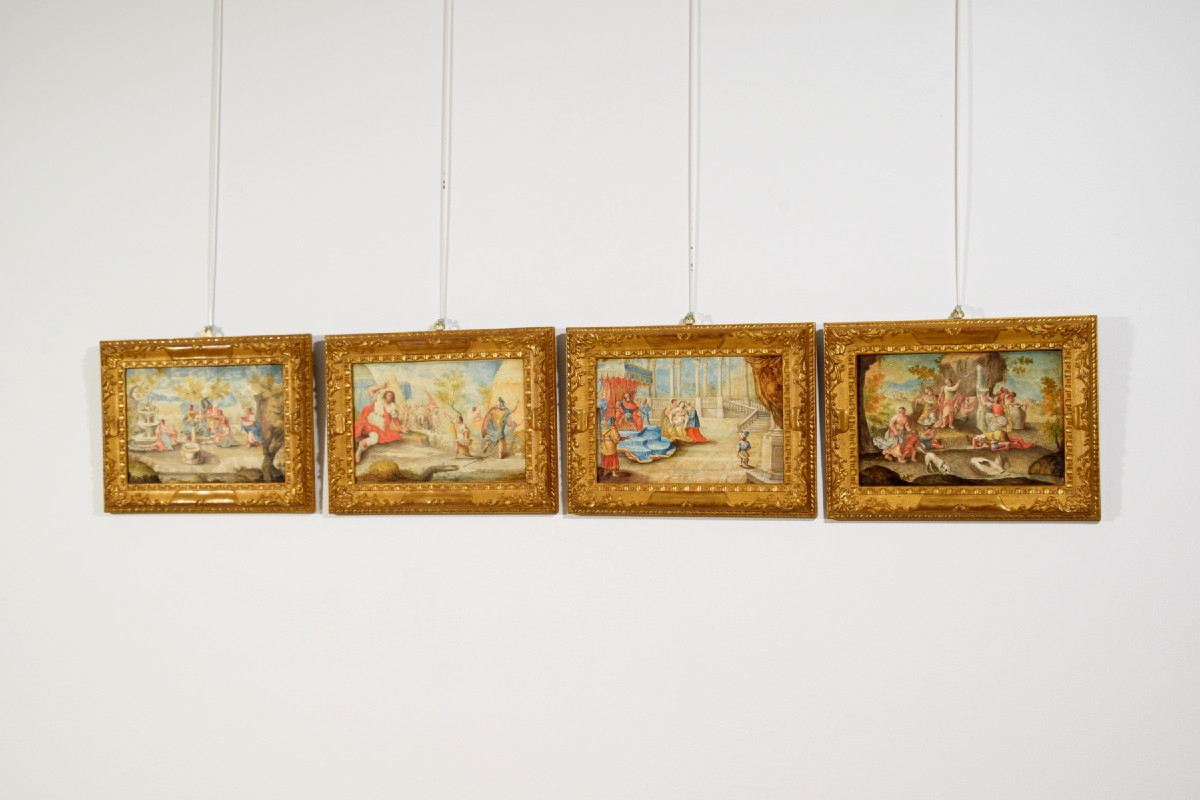


17th Century, Four French Paintings Depicting Biblical Subjects
Fourpaintings depicting biblical subjects, French school, 17th century, tempera onparchment mounted on wooden panel
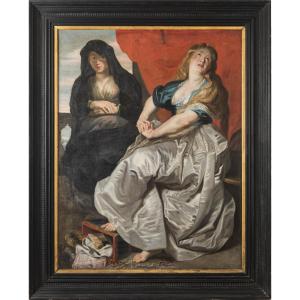
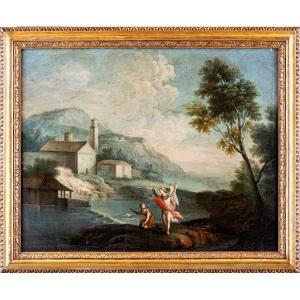
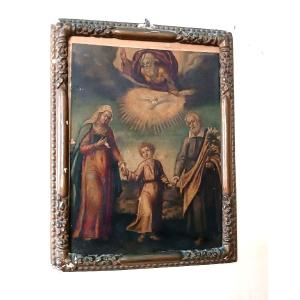
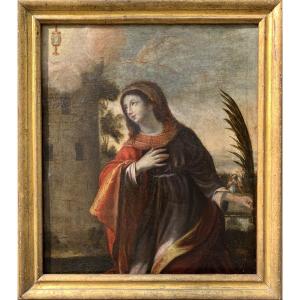
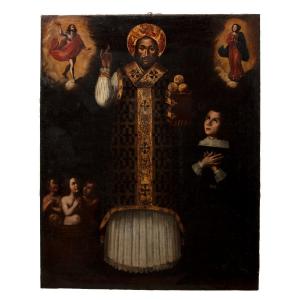
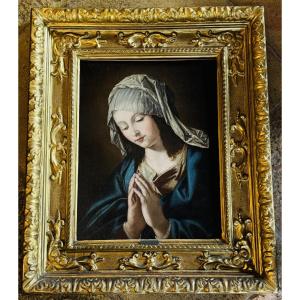
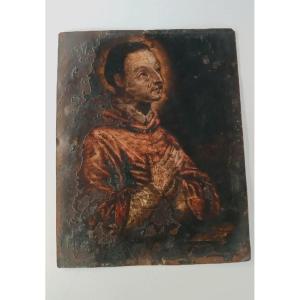
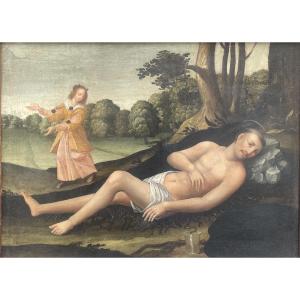
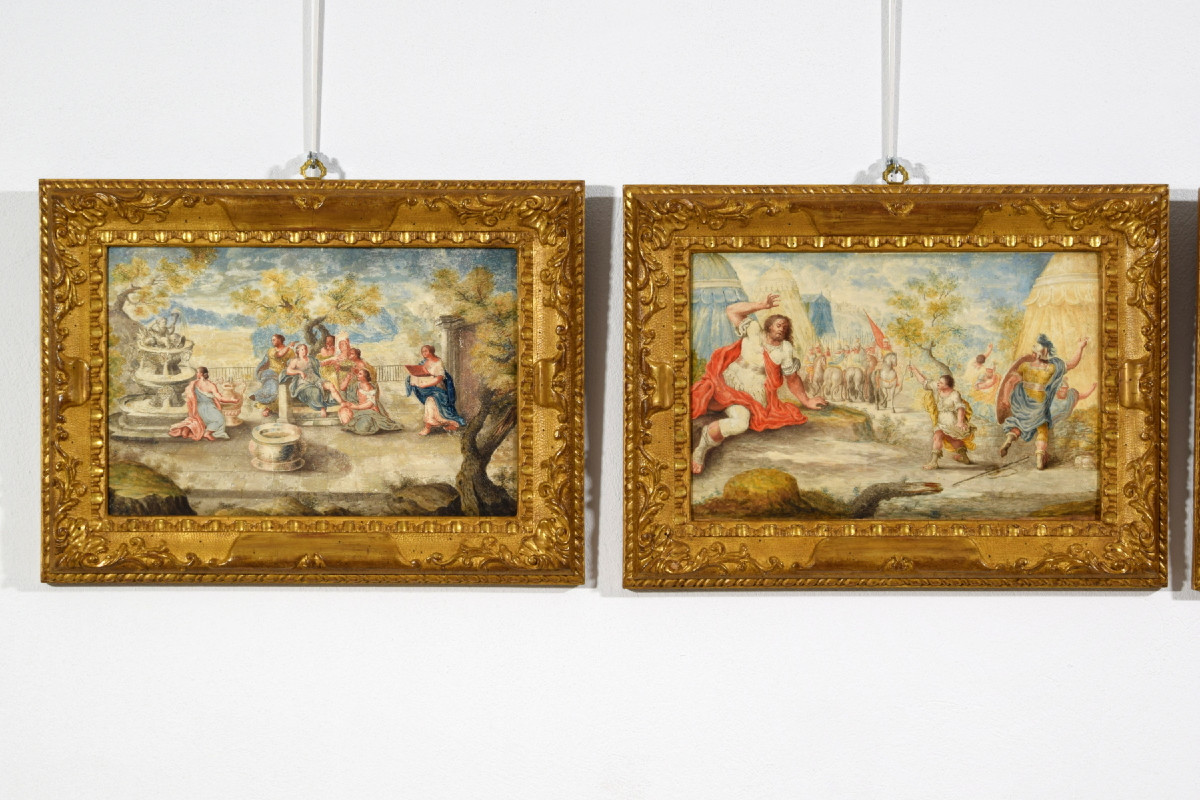
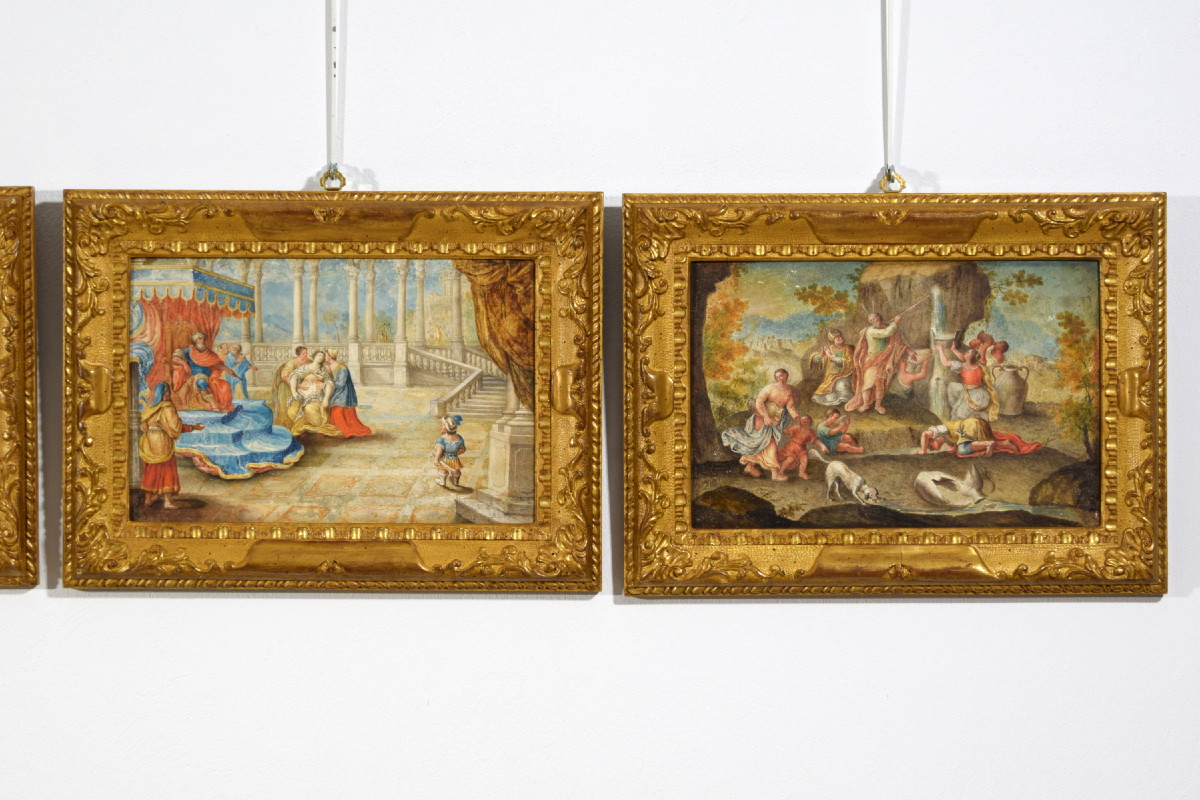
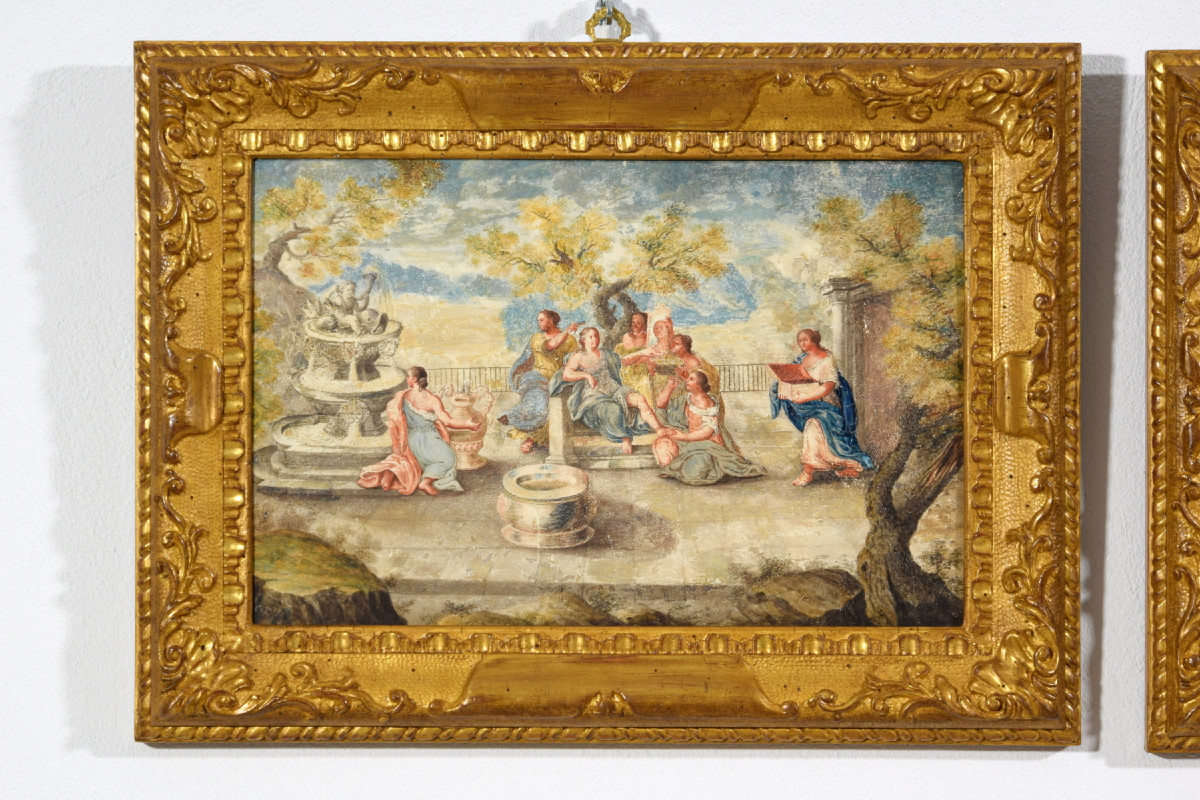
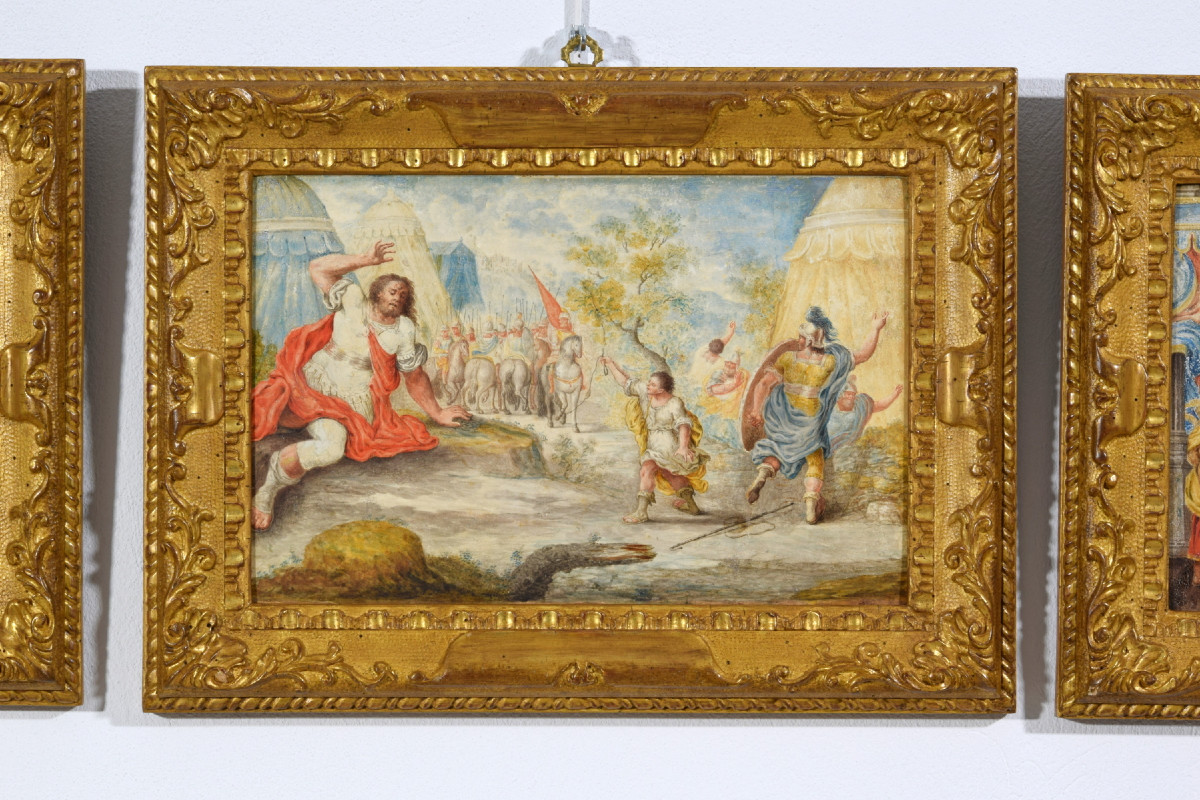
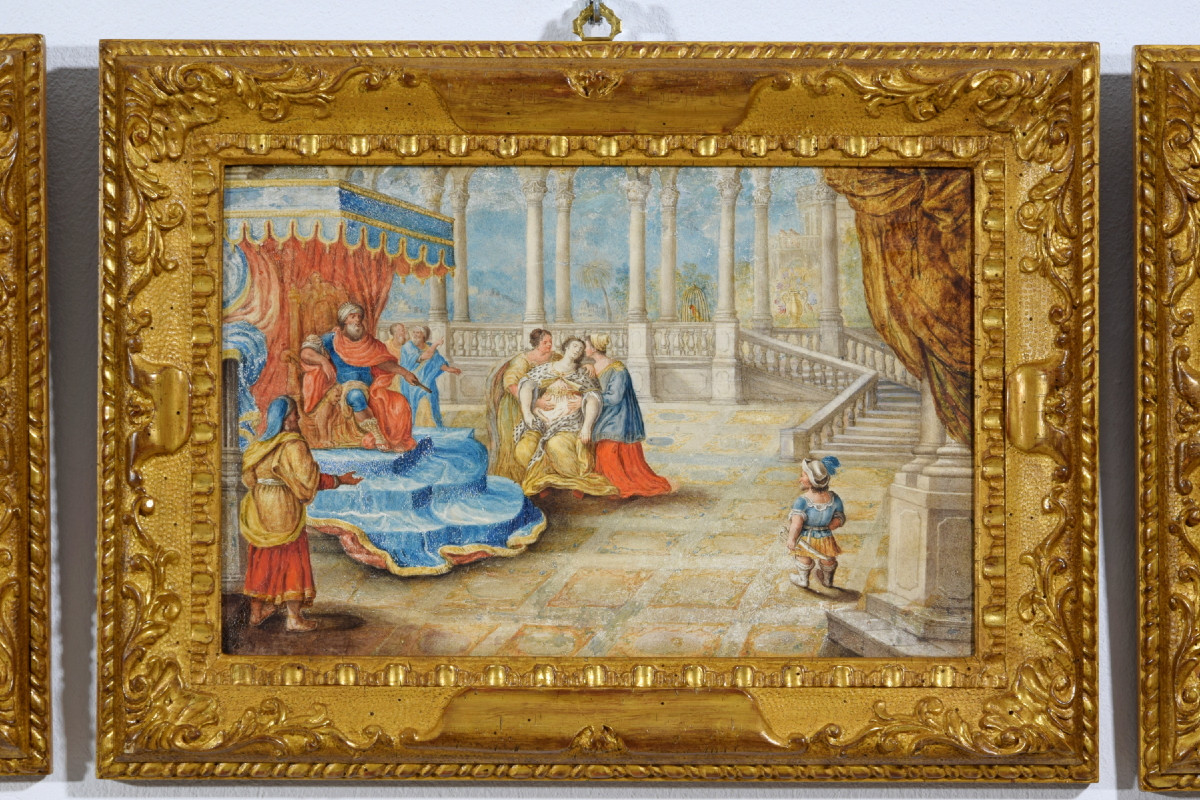
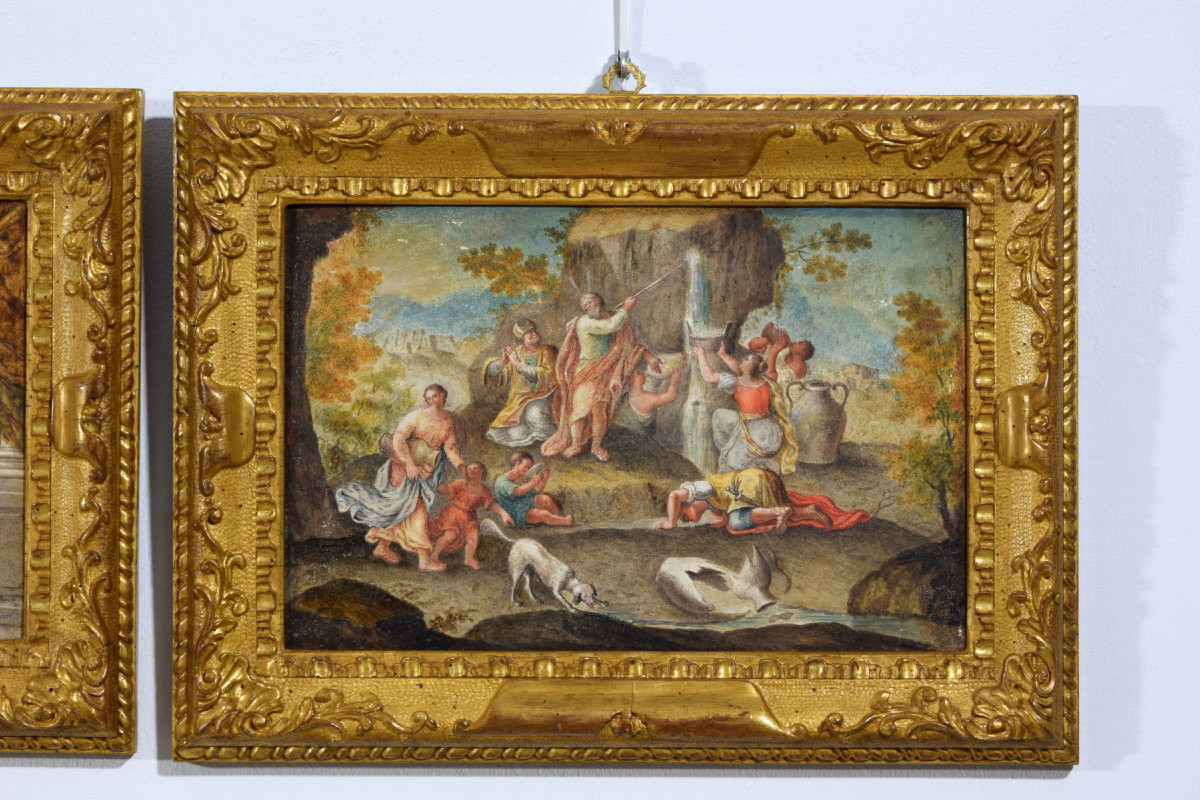
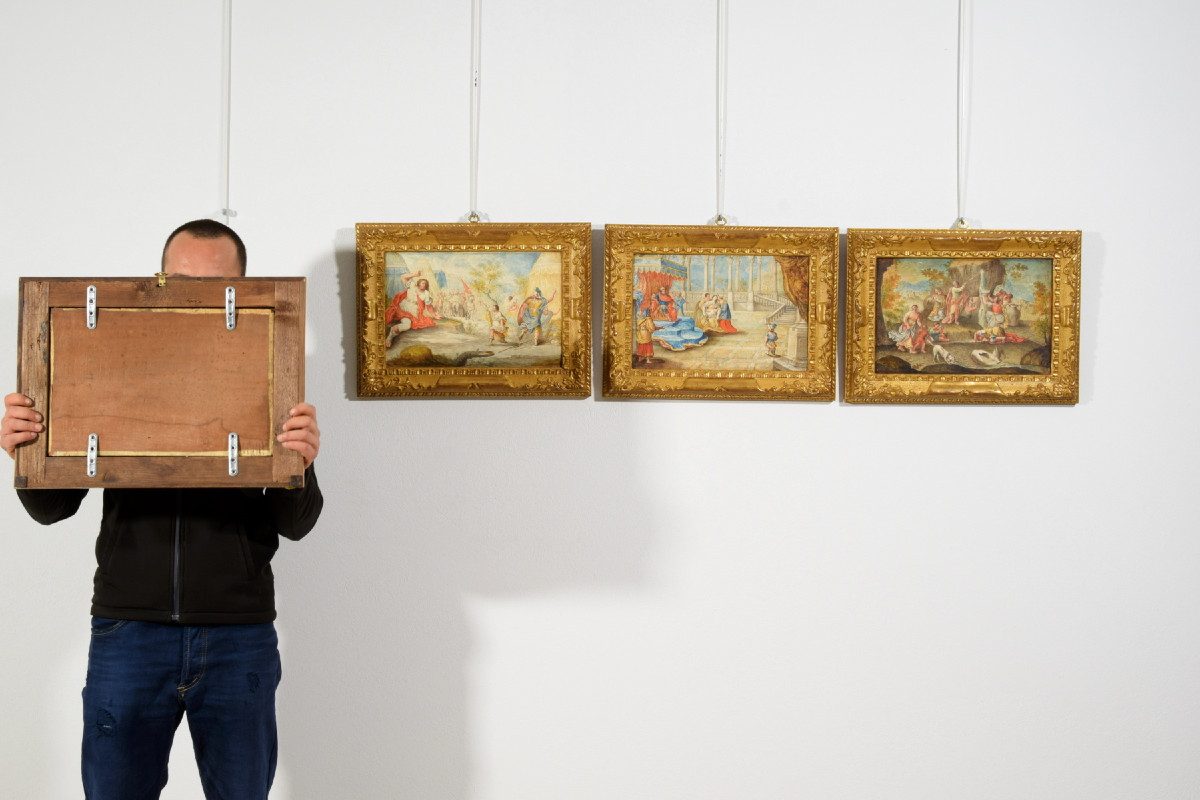
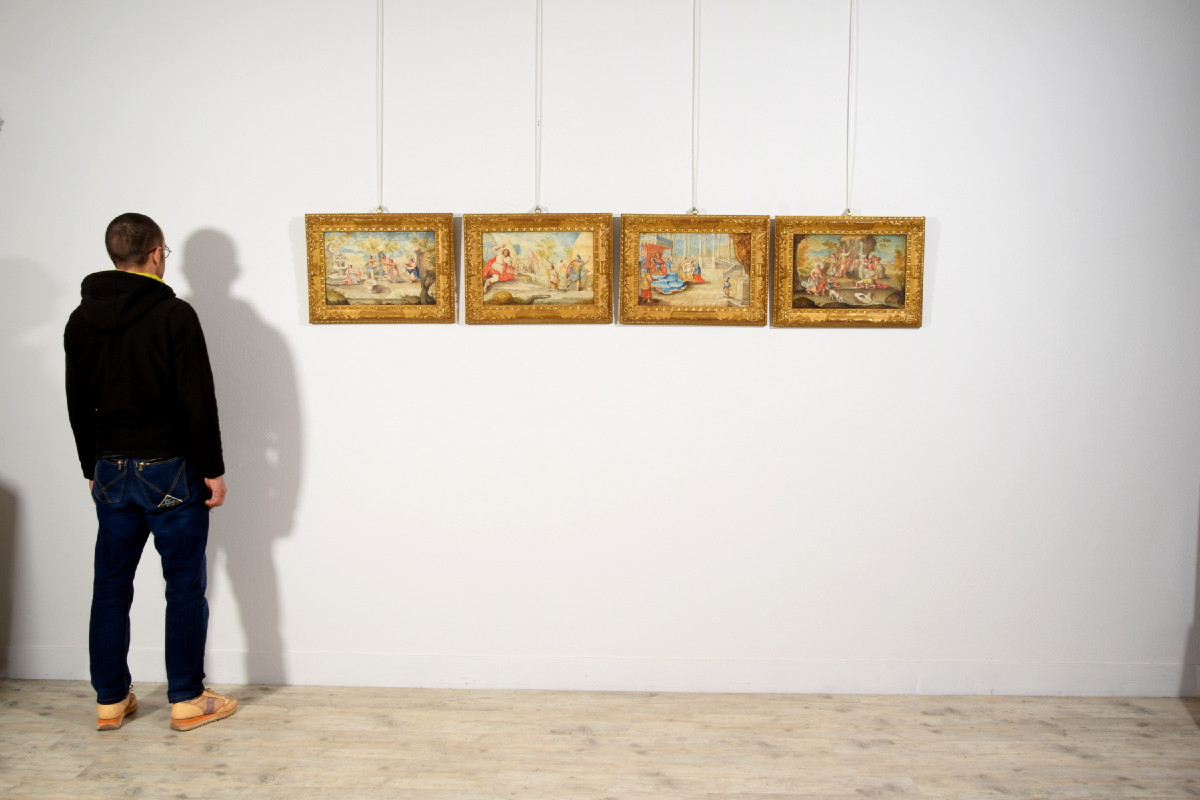
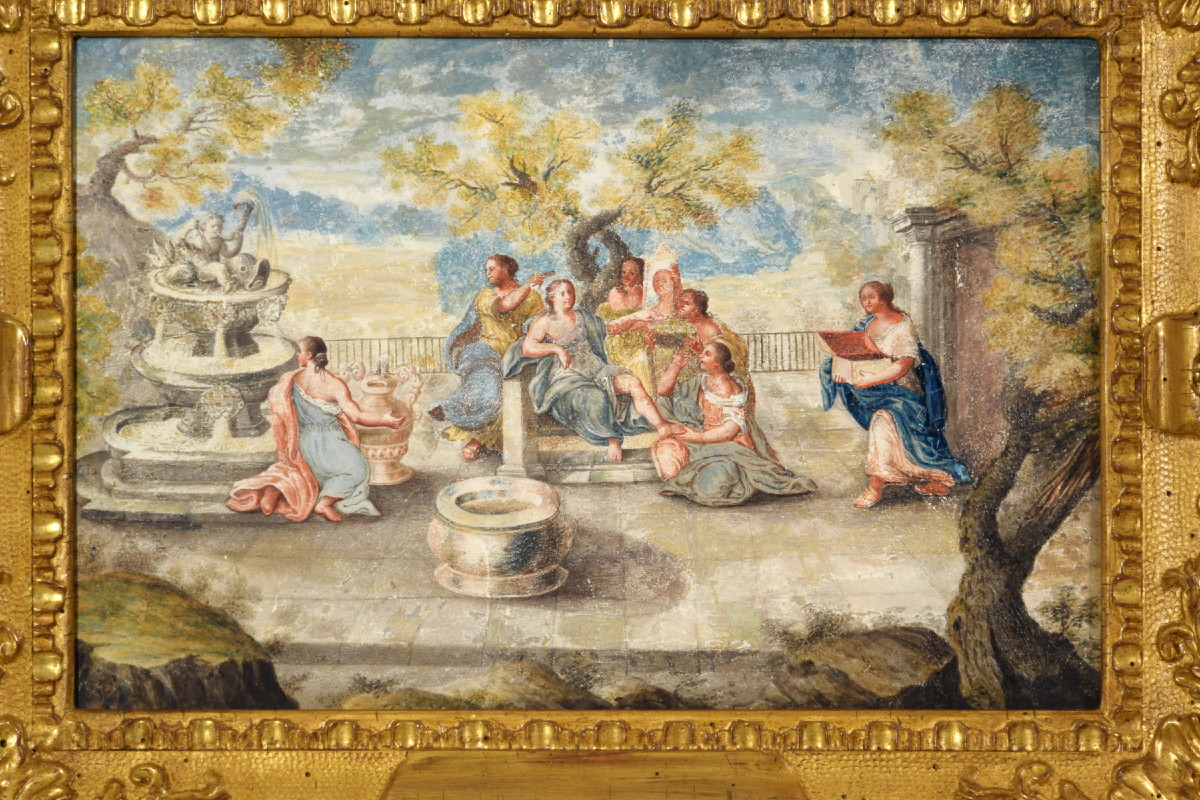
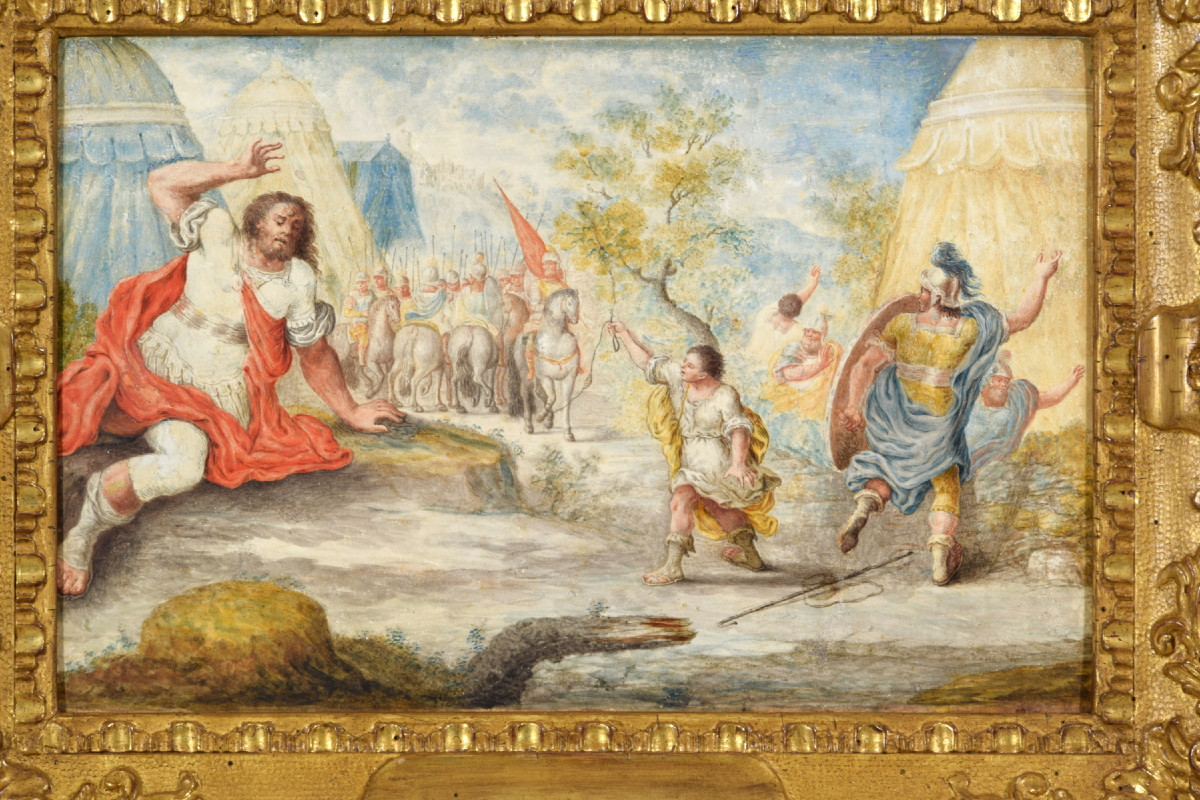
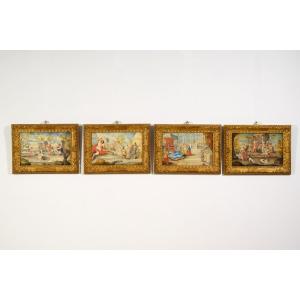
These fourpaintings were executed in tempera on parchment, mounted on wooden panels, inthe 17th century, most likely in France.They depict biblical scenes: Bathsheba at the Bath, David SlaysGoliath, Esther Before Ahasuerus, and Moses Striking Water fromthe Rock.The firstpainting on the left shows a scene set in an elegant garden, with a carvedBaroque fountain, leafy trees, and an architectural structure in thebackground. At the center, a group of women dressed in classical tunics gathersaround a seated female figure near a large basin: this is Bathsheba, surroundedby her attendants. The delicate colours—especially blues, pinks, andochres—create a luminous, serene atmosphere. The scene refers to the well-knownepisode in the Second Book of Samuel: King David, looking from the terrace ofhis palace, sees Bathsheba bathing and becomes captivated by her beauty. Theirencounter will lead to a forbidden relationship and dramatic events that willshape the history of Israel. This painting, however, chooses to depict themoment of the bath as a harmonious and tranquil scene, focusing on beauty andstillness before the turmoil to come.The secondpainting from the left portrays the decisive moment of the confrontationbetween the young David and the giant Goliath. In the foreground, Goliath isshown staggering and falling backward, struck on the forehead by the stonelaunched from David’s sling. His massive body and the red garment add dynamismto the scene. Opposite him, the young David still has his arm raised in thegesture of throwing. Around them, soldiers and camp tents create a vividmilitary setting. The scene draws on the First Book of Samuel, in which David,a simple shepherd, faces the Philistine champion Goliath armed only with asling and his faith. With a swift gesture, guided by trust in God, David bringsdown the giant, securing Israel’s victory and foreshadowing his future as king.The thirdpainting depicts Queen Esther at the dramatic climax of her encounter with KingAhasuerus. The scene unfolds in a sumptuous court environment, featuring acolonnade, a monumental staircase, and rich draperies. Ahasuerus, seated on thethrone beneath a red and blue canopy with lambrequins, extends his arm towardEsther, who faints from tension while two attendants support her. Court figuresand architectural elements fill the background, while vivid colours andmeticulous details enhance the theatricality of the moment. The episode refersto the Book of Esther: the young queen, risking her life, presents herselfbefore the king without having been summoned, to plead for her threatenedpeople. Overcome by emotion, she faints; the king, moved to compassion,receives her and extends his sceptre toward her, a gesture symbolizingclemency. The painting captures precisely this dramatic instant, embodyingcourage, intercession, and justice.Finally,the last painting depicts the famous biblical episode in which Moses bringsforth water from the rock to quench the thirst of the Israelites during theExodus in the desert. In the center, Moses—draped in a light mantle—strikes therock with his staff, while men, women, and children rush toward the miraculouswater, kneeling or reaching forward with containers. The setting is natural andluminous, with trees and mountains in the background and animals in theforeground such as a dog and a bird near the stream. The scene refers to theBook of Numbers (20:1–11) and the Book of Exodus (17:1–7), where Moses,following divine command, strikes the rock at Meribah to provide water for thepeople in distress. The miracle symbolizes faith in God and His providence,revealing Moses’ role as leader and mediator between God and the Israelites.The fourparchments, with their bright and lively colours, are highly decorative andvisually pleasing. In good condition, they are presented in Venetian-stylecarved and gilded wooden frames.
These fourpaintings were executed in tempera on parchment, mounted on wooden panels, inthe 17th century, most likely in France.They depict biblical scenes: Bathsheba at the Bath, David SlaysGoliath, Esther Before Ahasuerus, and Moses Striking Water fromthe Rock.The firstpainting on the left shows a scene set in an elegant garden, with a carvedBaroque fountain, leafy trees, and an architectural structure in thebackground. At the center, a group of women dressed in classical tunics gathersaround a seated female figure near a large basin: this is Bathsheba, surroundedby her attendants. The delicate colours—especially blues, pinks, andochres—create a luminous, serene atmosphere. The scene refers to the well-knownepisode in the Second Book of Samuel: King David, looking from the terrace ofhis palace, sees Bathsheba bathing and becomes captivated by her beauty. Theirencounter will lead to a forbidden relationship and dramatic events that willshape the history of Israel. This painting, however, chooses to depict themoment of the bath as a harmonious and tranquil scene, focusing on beauty andstillness before the turmoil to come.The secondpainting from the left portrays the decisive moment of the confrontationbetween the young David and the giant Goliath. In the foreground, Goliath isshown staggering and falling backward, struck on the forehead by the stonelaunched from David’s sling. His massive body and the red garment add dynamismto the scene. Opposite him, the young David still has his arm raised in thegesture of throwing. Around them, soldiers and camp tents create a vividmilitary setting. The scene draws on the First Book of Samuel, in which David,a simple shepherd, faces the Philistine champion Goliath armed only with asling and his faith. With a swift gesture, guided by trust in God, David bringsdown the giant, securing Israel’s victory and foreshadowing his future as king.The thirdpainting depicts Queen Esther at the dramatic climax of her encounter with KingAhasuerus. The scene unfolds in a sumptuous court environment, featuring acolonnade, a monumental staircase, and rich draperies. Ahasuerus, seated on thethrone beneath a red and blue canopy with lambrequins, extends his arm towardEsther, who faints from tension while two attendants support her. Court figuresand architectural elements fill the background, while vivid colours andmeticulous details enhance the theatricality of the moment. The episode refersto the Book of Esther: the young queen, risking her life, presents herselfbefore the king without having been summoned, to plead for her threatenedpeople. Overcome by emotion, she faints; the king, moved to compassion,receives her and extends his sceptre toward her, a gesture symbolizingclemency. The painting captures precisely this dramatic instant, embodyingcourage, intercession, and justice.Finally,the last painting depicts the famous biblical episode in which Moses bringsforth water from the rock to quench the thirst of the Israelites during theExodus in the desert. In the center, Moses—draped in a light mantle—strikes therock with his staff, while men, women, and children rush toward the miraculouswater, kneeling or reaching forward with containers. The setting is natural andluminous, with trees and mountains in the background and animals in theforeground such as a dog and a bird near the stream. The scene refers to theBook of Numbers (20:1–11) and the Book of Exodus (17:1–7), where Moses,following divine command, strikes the rock at Meribah to provide water for thepeople in distress. The miracle symbolizes faith in God and His providence,revealing Moses’ role as leader and mediator between God and the Israelites.The fourparchments, with their bright and lively colours, are highly decorative andvisually pleasing. In good condition, they are presented in Venetian-stylecarved and gilded wooden frames.
12 500 €
Period: 17th century
Style: Louis 14th, Regency
Condition: Good condition
Material: Parchment
Width: 52
Height: 38
Depth: 4
Reference (ID): 1660319
Availability: In stock
Print