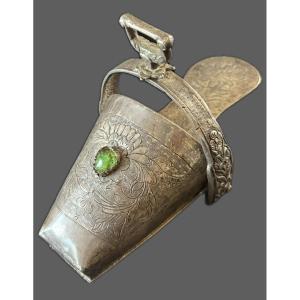


Silver Female Stirrup For Lateral Riding
Spain, second half of the 18th century (around 1760–1800)
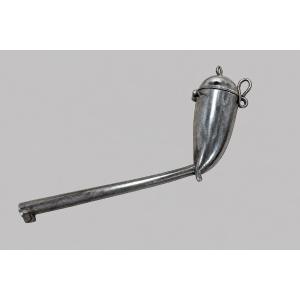
Silver chiseled and engraved, green stone cabochon
Length 21 cm — Weight: 384 g
This exceptional female stirrup in solid silver, intended for lateral mounting and ceremonial uses, has a typically Iberian angular facade, decorated with a naive floral decoration engraved freehand. The green stone cabochon, formerly set, refers directly to the decorative practices of Spanish goldsmithing of the 18th century. The high pivot mounted on an artisanal ball joint extends the tradition of closed calipers inherited from medieval and Moorish models. The whole shows an ancient patina and traces of pre-industrial tools characteristic of the time.
Several stylistic elements confirm a peninsular production:
– geometric facade specific to Iberian models;
– naive but balanced engraving, typical of Spanish rural workshops;
– green cabochon, widely used in Spanish female and religious goldsmithing;
– fine proportions, of a superior refinement to contemporary South American pieces.
In the 18th century, the ladies of the Spanish aristocracy - especially in Andalusia, Extremadura and Castile - used silver ceremonial harnesses, sometimes enriched with colored stones or glasses. The female equestrian accessories of this period are among the rarest objects of the Iberian material culture.
The Spanish public collections accessible online (Madrid, Toledo, Seville, Valladolid, Barcelona) do not list any female silver stirrup of comparable typology. This absence, far from contradicting the attribution, recalls the extreme rarity of these pieces, most often preserved in private aristocratic collections.
The well-known South American models (Brooklyn Museum, Buenos Aires) have a more rustic workmanship and do not include a cabochon, highlighting the uniqueness of this copy.
All the criteria confirm an authentic work of the 18th century:
– manual naive engraving;
– old cabochon set;
– artisanal pivot;
– deep patina and consistent wear;
– no tradition of modern copies known for this type;
– perfect Iberian stylistic consistency.
Conclusion
Spanish female stirrup from the second half of the 18th century, of exceptional rarity. The quality of the work, the presence of a cabochon and the Iberian tradition of women's riding make it a major piece of pality, worthy of the best collections of equestrian art and historical goldsmithing.
Silver chiseled and engraved, green stone cabochon
Length 21 cm — Weight: 384 g
This exceptional female stirrup in solid silver, intended for lateral mounting and ceremonial uses, has a typically Iberian angular facade, decorated with a naive floral decoration engraved freehand. The green stone cabochon, formerly set, refers directly to the decorative practices of Spanish goldsmithing of the 18th century. The high pivot mounted on an artisanal ball joint extends the tradition of closed calipers inherited from medieval and Moorish models. The whole shows an ancient patina and traces of pre-industrial tools characteristic of the time.
Several stylistic elements confirm a peninsular production:
– geometric facade specific to Iberian models;
– naive but balanced engraving, typical of Spanish rural workshops;
– green cabochon, widely used in Spanish female and religious goldsmithing;
– fine proportions, of a superior refinement to contemporary South American pieces.
In the 18th century, the ladies of the Spanish aristocracy - especially in Andalusia, Extremadura and Castile - used silver ceremonial harnesses, sometimes enriched with colored stones or glasses. The female equestrian accessories of this period are among the rarest objects of the Iberian material culture.
The Spanish public collections accessible online (Madrid, Toledo, Seville, Valladolid, Barcelona) do not list any female silver stirrup of comparable typology. This absence, far from contradicting the attribution, recalls the extreme rarity of these pieces, most often preserved in private aristocratic collections.
The well-known South American models (Brooklyn Museum, Buenos Aires) have a more rustic workmanship and do not include a cabochon, highlighting the uniqueness of this copy.
All the criteria confirm an authentic work of the 18th century:
– manual naive engraving;
– old cabochon set;
– artisanal pivot;
– deep patina and consistent wear;
– no tradition of modern copies known for this type;
– perfect Iberian stylistic consistency.
Conclusion
Spanish female stirrup from the second half of the 18th century, of exceptional rarity. The quality of the work, the presence of a cabochon and the Iberian tradition of women's riding make it a major piece of pality, worthy of the best collections of equestrian art and historical goldsmithing.
4 000 €
Period: 18th century
Style: Other Style
Condition: En l'etat
Material: Sterling silver
Reference (ID): 1656862
Availability: In stock
Print