



Craniometer
Artist: Michel De Spiegeleire
Craniometer created by Michel de Spiegeleire
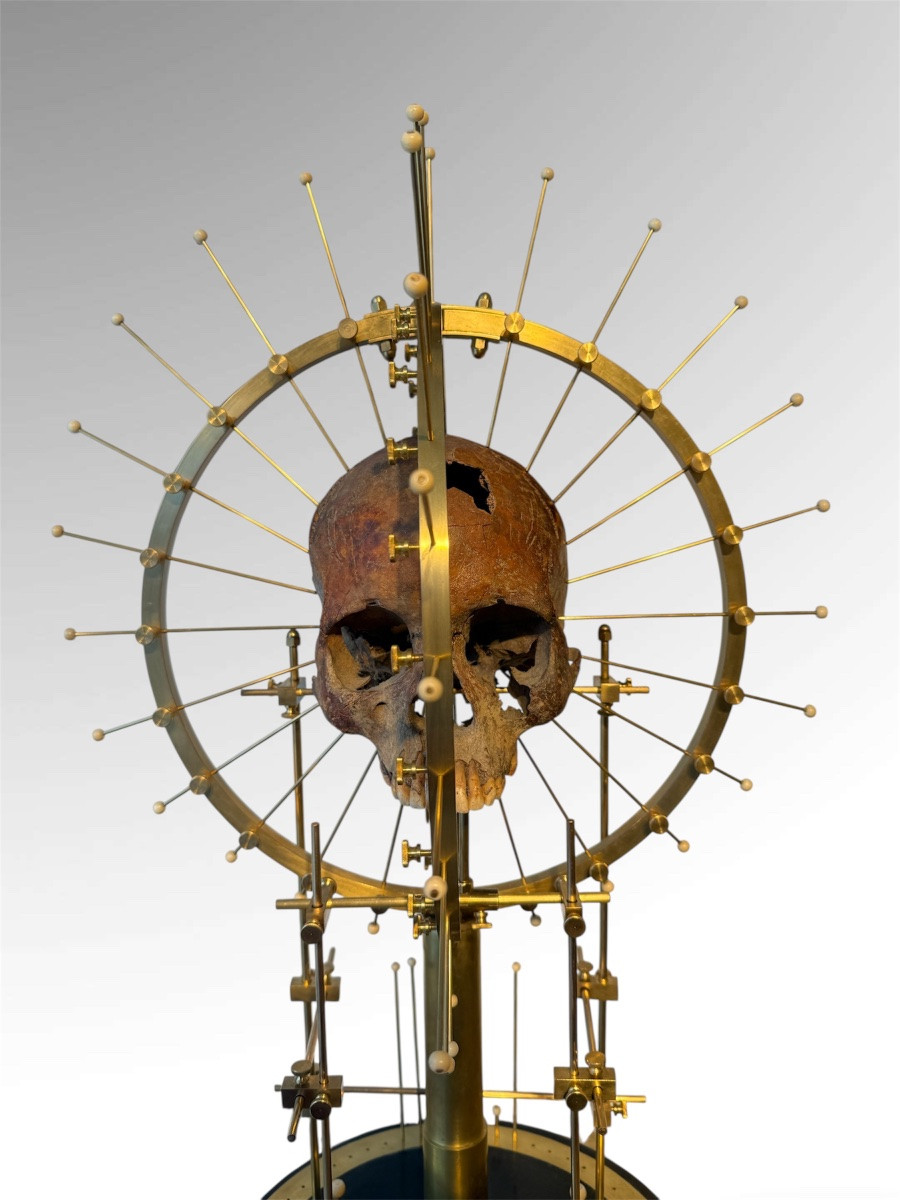
Here presented with an excavated skull
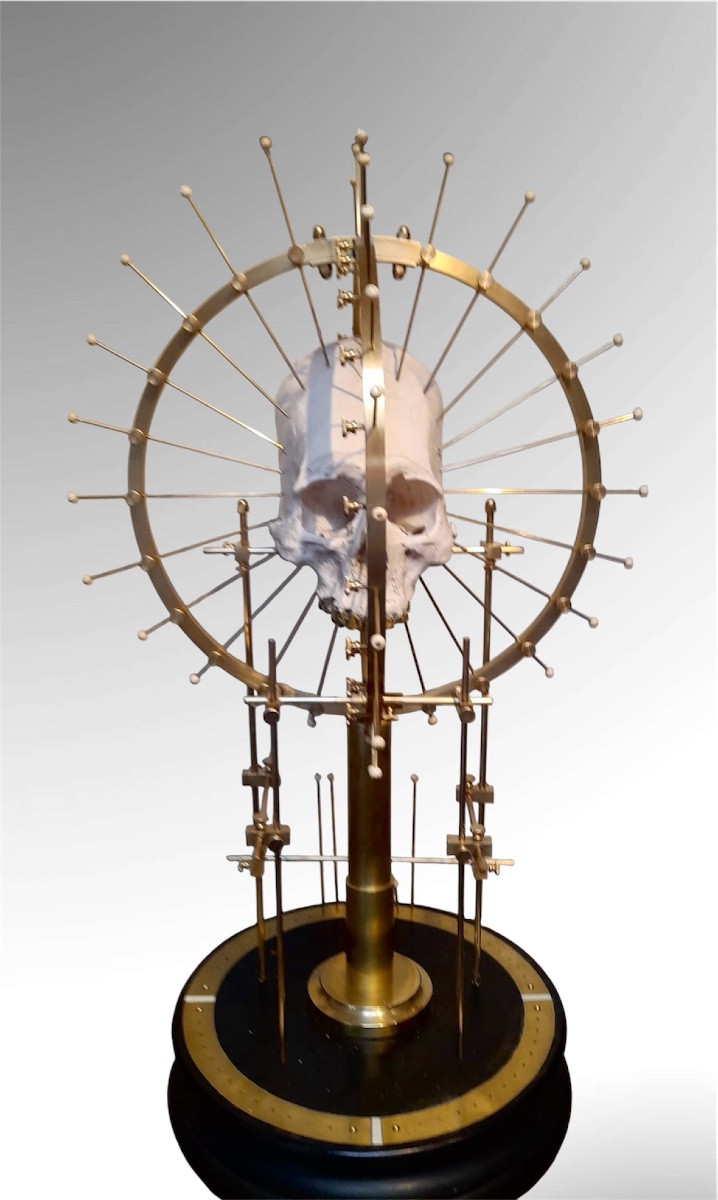
It can also be presented with a plaster cast of an elongated Paracas skull (see photo)
Either skull costs €450
On the surface, it was used to measure skulls. This tool was notably used in phrenology, a pseudoscientific theory from the 19th century that claimed to determine the character and mental faculties of an individual based on the shape of their skull. The craniometer allowed for precise measurements and comparative studies on skulls of different sizes.
In the 18th and 19th centuries, it was once believed that the shape and size of the skull indicated knowledge. This belief was called craniology. It was a pseudoscience in the sense of phrenology. The craniometer attempted to measure every tiny undulation in a skull. That's why there are so many of these prongs. They measure a quarter of an inch to three-quarters of an inch. Did craniology assign a moral character to skull size? That's a good way of putting it. A bigger skull was considered a better skull. So we don't know what qualities the craniometer was supposed to measure? That's a mystery. It all depends on where you thing to place the skull. I think the prongs are that length to accommodate different skull sizes. And you have to have a skull. You couldn't put a person in that instrument. So we don't know what qualities the craniometer was supposed to measure? That's a mystery.
Michel de Spiegeleere is the author of the exhibition "The Forbidden Collection" exhibited in the 90s with more than 200 crazy objects. Michel de Spiegeleer designed with Henri Verne (creator of Bob Morane), an exhibition and a book "The Forbidden Collection" featuring a fictional archaeologist Humbolt Fonteyne who would have discovered all sorts of strange objects and creatures, which were pure creations. There was a mummified conquistador found in the desert of New Mexico etc.
Here presented with an excavated skull
It can also be presented with a plaster cast of an elongated Paracas skull (see photo)
Either skull costs €450
On the surface, it was used to measure skulls. This tool was notably used in phrenology, a pseudoscientific theory from the 19th century that claimed to determine the character and mental faculties of an individual based on the shape of their skull. The craniometer allowed for precise measurements and comparative studies on skulls of different sizes.
In the 18th and 19th centuries, it was once believed that the shape and size of the skull indicated knowledge. This belief was called craniology. It was a pseudoscience in the sense of phrenology. The craniometer attempted to measure every tiny undulation in a skull. That's why there are so many of these prongs. They measure a quarter of an inch to three-quarters of an inch. Did craniology assign a moral character to skull size? That's a good way of putting it. A bigger skull was considered a better skull. So we don't know what qualities the craniometer was supposed to measure? That's a mystery. It all depends on where you thing to place the skull. I think the prongs are that length to accommodate different skull sizes. And you have to have a skull. You couldn't put a person in that instrument. So we don't know what qualities the craniometer was supposed to measure? That's a mystery.
Michel de Spiegeleere is the author of the exhibition "The Forbidden Collection" exhibited in the 90s with more than 200 crazy objects. Michel de Spiegeleer designed with Henri Verne (creator of Bob Morane), an exhibition and a book "The Forbidden Collection" featuring a fictional archaeologist Humbolt Fonteyne who would have discovered all sorts of strange objects and creatures, which were pure creations. There was a mummified conquistador found in the desert of New Mexico etc.
4 500 €
Period: 20th century
Style: Other Style
Condition: Good condition
Material: Brass
Width: 35 cm
Height: 70 cm
Reference (ID): 1627383
Availability: In stock
Print