THIS OBJECT WAS SOLD
Gerolamo Induno (milan 1825 – 1890), “maternal Joys,” 1870




Gerolamo Induno (Milan 1825 – 1890), “Maternal Joys,” 1870
Oil on canvas, 106 x 77 cm
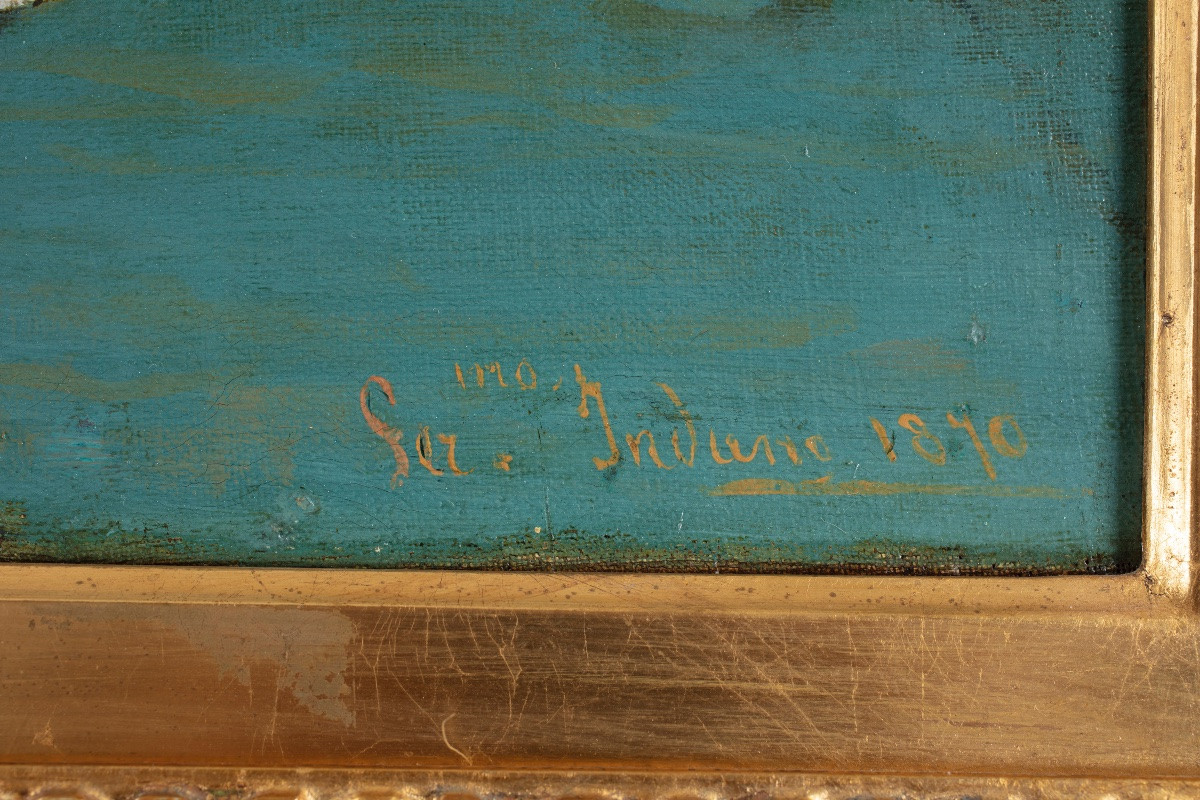
Signed “G. Induno” lower right.
The canvas "Maternal Joys" depicts a tender genre scene set in a refined mid-eighteenth-century domestic setting.
At the center of the composition stands a sumptuous canopied cradle, crafted of gilded wood and decorated with rocaille, where a baby rests sweetly. At the top and bottom are two sculpted angels, symbols of purity and protection, lending the scene a subtle spiritual dimension.
The child's mother, the noblewoman on the right, sits composedly, devoting herself to the typically feminine art of embroidery, a gesture that highlights her role as guardian of the home. Her powdered hair, velvet choker, and rich silk dress testify to her high social status, fitting in with the refined surroundings.
Leaning over the cradle, we can see the nurse, whose more sober and composed attire evokes a simple peasant tradition without detracting from her dignity. An embroidered apron cinches her waist, her neck is adorned with a "garnet necklace"; at the nape of her neck, silver pins are arranged "like the rays of a halo." Induno must have been inspired by Manzoni's description of Lucia Mondella's wedding day. The nurse raises her index finger to her lips, urging for silence so as not to awaken the dozing child.
The room is furnished with refinement and care, in full eighteenth-century style, as evidenced by the presence of a Rococo console table, on which rests a grandfather clock. The Persian rug, a small Chinese potiche, and the Japanese-style paper screen add an exotic and cultured touch. The presence of the latter reflects the interest in Japonisme which in the second half of the nineteenth century began to spread also in I The palette is warm and harmonious, favoring pale and golden hues, like the damask wallpaper on the walls; the wall mirrors reflect a natural, soft light that envelops and delicately shapes the volumes, instilling a sense of protection and familiar warmth in the viewer. The gold and ivory tones interact with the earthy nuances of the nurse's clothing while simultaneously highlighting the bright colors worn by the noblewoman; the result is a harmonious and balanced composition.
Induno's brushstrokes are uniform and measured, typical of 19th-century academic painting; a refined style that embellishes and smoothes the figures and highlights their details.
In conclusion, the work is a refined example of the artist's mastery, capable of combining formal elegance and narrative sensitivity.taly, influencing the furnishings and taste of the wealthier classes.
The palette is warm and harmonious, favoring pale and golden hues, like the damask wallpaper on the walls; the wall mirrors reflect a natural, soft light that envelops and delicately shapes the volumes, instilling a sense of protection and familiar warmth in the viewer. The gold and ivory tones interact with the earthy nuances of the nurse's clothing while simultaneously highlighting the bright colors worn by the noblewoman; the result is a harmonious and balanced composition.
Induno's brushstrokes are uniform and measured, typical of 19th-century academic painting; a refined style that embellishes and smoothes the figures and highlights their details.
In conclusion, the work is a refined example of the artist's mastery, capable of combining formal elegance and narrative sensitivity.
BIOGRAPHY
Gerolamo Induno was born in Milan in 1825 to a family of humble origins. His older brother Domenico, whose talent had been discovered by the goldsmith Luigi Cossa, guided him from the beginning in his artistic career. He also enrolled at the Brera Academy, where he became a student of Luigi Sabatelli. His dedication earned him notable academic recognition during the last two years of his studies, and in 1845 he made his debut at the annual Brera Exhibition with two portraits and life studies.
After completing his studies, he continued his apprenticeship with his brother, both influenced by Hayez's painting style. Their strong patriotic sentiments drove them to participate in the Five Days of Milan uprising of 1848, and for this they were exiled to the Canton of Ticino. Moving to Florence the following year, he joined a group of patriotic volunteers to defend the Roman Republic from the French. Unfortunately he was seriously injured during a raid which forced him to bed.
During his convalescence, he began painting military events he had witnessed firsthand, creating a veritable visual chronicle of the Risorgimento, such as Garibaldini in the Defense of Rome, Garibaldi on the Janiculum, and Portrait of Anita Garibaldi, painted in 1849 and now housed at the Museo del Risorgimento in Milan. Upon returning to his hometown, he continued working in his brother's studio, participating in the Esposizioni Braidensi and in 1851 in the Promotrice di Torino with Sentinella.
The following year, Induno turned to genre painting, exhibiting at the Brera Art Gallery with the painting Il Cantastorie; during his brief break from military service, he participated in many exhibitions throughout Italy.
His patriotic spirit led him to enlist in the Piedmontese army and participate in the Crimean War, during which he produced sketches and drawings from life of the campaign; these notes inspired his later works, including the large canvas Battle of the Cernaia (1857), which King Victor Emmanuel II purchased for the castle of Racconigi. Alongside his historical works, he also produced genre scenes.
In 1859, he enlisted in the Alpine Hunters, a group led by Garibaldi; during his expeditions, he resumed his now well-established habit of providing graphic accounts of events. During this period, Induno tirelessly painted a significant number of celebratory works on Risorgimento themes, such as The Embarkation of the Thousand at Quarto and The Farewell to the Mother of Garibaldi's Soldier, both from 1860. The following year, the King commissioned him to execute the monumental and celebrated canvas The Battle of Magenta, June 4, 1859.
During this period, he painted a series of canvases with similar subjects; the protagonists are young men volunteering for the front. The paintings are particularly appreciated for their ability to depict, through the intimate episode of farewells to loved ones, the popular involvement in the process of national unification.
He received numerous major public commissions, including tempera paintings in 1865 for the waiting room of the old Milan Central Station, which have unfortunately been lost.
Interest in the Risorgimento epic waned in the late 1870s, when the wars of independence were but a distant memory; Induno entered a final artistic phase, imbued with a rediscovered fascination with the eighteenth century. His genre scenes became composed and elegant, and the meticulous detail was an almost excessive display of his technical prowess.
During the last years of his life, he retired to Milan, where he continued to paint until his death in 1890.
Long forgotten by critics, he was rediscovered almost a century after his death for his fundamental contribution to the iconography of the Risorgimento.
Explore similar pieces and discover your ideal find:
Genre Scenes, Nudes