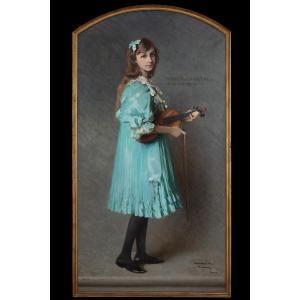


Vittorio Matteo Corcos (1859 – 1933), “portrait Of Vivien Chartres With Her Violin"
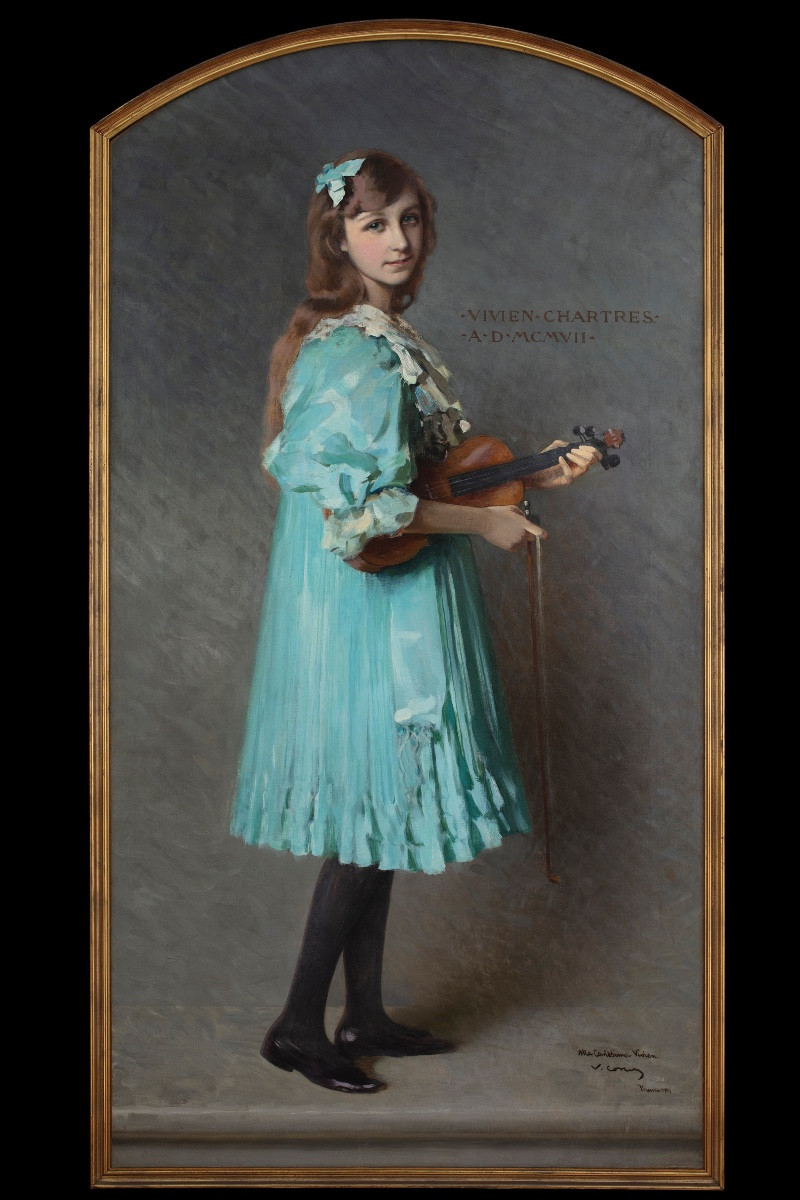
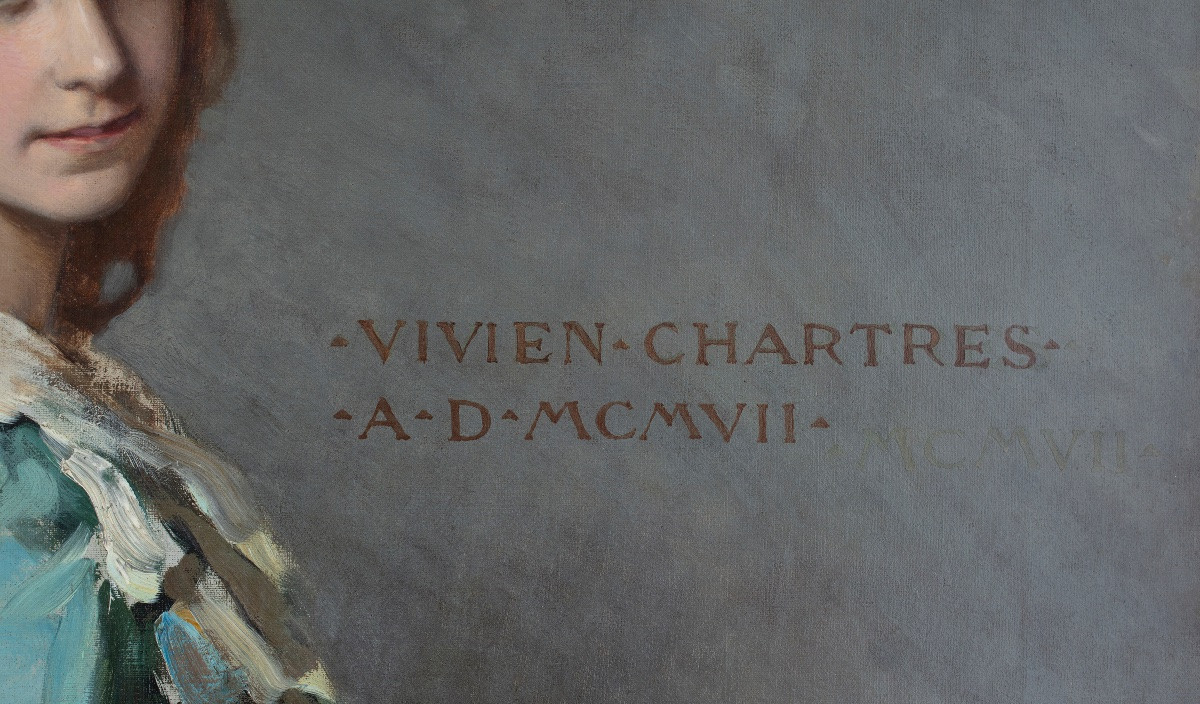
Vittorio Matteo Corcos (Livorno 1859 – 1933), “Portrait of Vivien Chartres with her Violin,” 1907.
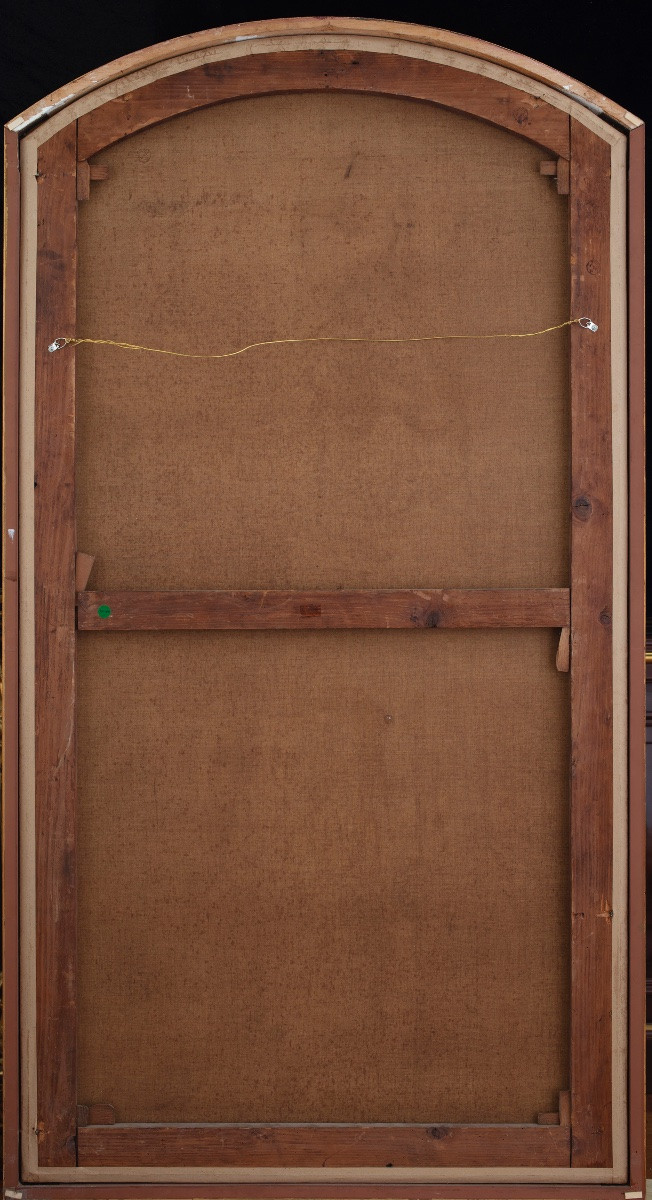
Oil on canvas, 170.4 x 90 cm.
Signed and dated “To Dearest Vivien V. Corcos Florence 1907”
The young girl in this delightful portrait is Vivien Chartres, a violinist and child prodigy, painted at the age of thirteen.
Vivien was born in Turin in 1893 into a very wealthy family: her father was John Smith Chartres (1862–1927), an Anglo-Irish lawyer and journalist, an activist with the Sinn Féin political party for Irish independence from the British Crown, and a close friend of the revolutionary Michael Collins. Her mother, the prolific writer of Italian-German origins Anna Emilia "Annie" Vivanti (1866-1942), was the daughter of a wealthy silk merchant and the writer Anna Lindau, sister of the playwright and novelist Paul Lindau and the diplomat Rudolph Lindau.
In this wealthy family, little Vivien grew up full of intellectual stimulation, fueled by her enterprising mother Annie, who pushed her toward a musical career. The little girl demonstrated a precocious and exceptional talent for the violin, so much so that at just ten years old she moved to Prague to continue her studies under the guidance of the most prestigious violin teacher of the time, the Czech Otakar Ševčík.
In 1904, she made her debut at the Queen's Hall, one of London's most famous concert halls, at the same time as other young violinists, including her peer Misha Elman (1891-1967) and the already well-known Marie Hall (1884-1956).
The girl's fame even reached the royal courts, and within a short time, she was giving private concerts for Queen Margherita of Savoy and King Edward VII of England.
It was at the height of Vivien's career that Corcos painted this work: the girl wears a dress typical of Belle Époque children's fashion, loose at the waist and flowing, with a lace collar and puffed sleeves; similar styles are also found in photographs of her.
Although her pose is firm and composed, the fruit of the rigor imparted by her musical training, her gaze expresses an inner maturity that does not give in to complacency but appears at times shy and humble. The barely sketched smile reflects a typically adolescent candor and grace. In her hands, she holds a bow and violin: not mere accessories but instruments with emblematic value, the cornerstone of the child prodigy's existence and identity.
Stylistically, the work is part of the artist's mature phase, characterized by compositional balance and a subtle emotional and psychological exploration. The figure is idealized without losing its physiognomic veracity and is placed in a sober space that allows for no distractions or superfluous narrative elements.
In Corcos's work, the oil paint is applied uniformly and lucidly, giving the surface an almost enameled effect; the diffused light gently shapes the volumes, free of accentuated contrasts, contributing to an intimate atmosphere suspended in time. The rendering of the material is treated with equal delicacy and attention to detail: the fine, slightly wavy hair falls gracefully over the shoulders, the silk of the dress ruffles in the folds, and the shiny leather loafers reflect the light.
The palette is dominated by cool, luminous tones: the dress and the aquamarine bow, a shade much loved by the painter and often used in his most famous works, are further highlighted by the use of a neutral, sophisticated background.
Here, the painter manages to combine formal elegance and psychological depth, conveying the image of a very young artist at a crucial moment of growth, suspended between childhood and adulthood.
BIOGRAPHY
Vittorio Matteo Corcos was born in Livorno on October 4, 1859, to a middle-class Jewish family.
His father, Isach, was a merchant, while his mother, Giuditta Baquis, came from a cultured background. Vittorio demonstrated a strong aptitude for drawing from an early age, which his parents encouraged, allowing the young man to attend Giuseppe Baldini's classes in his hometown. In 1875, he enrolled at the Academy of Fine Arts in Florence to continue his studies, winning a silver medal for merit.
To complete his education, Corcos felt the need to study with Domenico Morelli; so, thanks to a scholarship from the Municipality of Livorno, he moved to Naples, where he was admitted to the Academy of Fine Arts. The work "Arab in Prayer" (1880) dates back to this period, purchased by King Umberto I from the Promotrice Salvator Rosa and now in the collection of the Capodimonte Museum.
After graduating in the fall of 1880, he moved to Paris, where he initially made ends meet by painting fans and musical scores for the publisher Heugel. A chance meeting with Giuseppe de Nittis introduced him to the Maison Goupil, where he met Degas, Manet, Zola, and the writer he most admired, Daudet.
In Paris, he studied with Léon Bonnat, embodying his formal rigor and high level of psychological rendering in portraiture.
In 1881, he signed a fifteen-year contract with the art dealer Adolphe Goupil, which brought him international success.
Five years later, he returned to Italy and settled in Florence, where he met Emma Ciabatti, widow of the Rotigliano family, a cultured and refined woman with a lively literary career.
The two married, forming a close-knit couple both in their private lives and in the cultural world: Emma introduced Corcos to Florentine literary salons, strengthening his contacts with the intellectual world of the time; over the years, the couple hosted artists and writers such as Carducci, Pascoli, and D’Annunzio in their home.
Their marriage produced three children.
Among his best-known works is Dreams (1896), now at the Galleria Nazionale d’Arte Moderna in Rome: a female portrait expressing introspection and modernity, recurring elements in the artist's oeuvre.
The model was Elena Vecchi, daughter of the writer and naval officer Augusto Vecchi, known by the pseudonym Jack La Bolina. Raised in a cultured and progressive environment, Elena represented for Corcos an ideal of modern and independent femininity. Their intense artistic and personal bond resulted in a work that became a symbol of the new woman of the Belle Époque: emancipated, thoughtful, and self-aware.
The celebrated Ugo Ojetti commented on his poetics: "Corcos does not paint women, but the idea that women have of themselves. He does not portray, he interprets."
He died in Florence on November 8, 1933, and his wife Emma followed him a few days later, on November 24 of the same year.
Although most of his works are held in private collections, some of his paintings can be seen at the Uffizi, the GAM in Florence, the Galleria Nazionale d'Arte Moderna in Rome, and the Museo Civico in Livorno. Corcos's painting, so refined, ethereal, and sensual, is today among the most sought-after among collectors.
Period: 20th century
Style: Art Nouveau
Condition: Excellent condition
Material: Oil painting
Length: 90
Height: 170,4
Reference (ID): 1715910
Availability: In stock