THIS OBJECT WAS SOLD
Apulian Miniature Olpe In Xenon Ceramic — With Certificate Of Authenticity
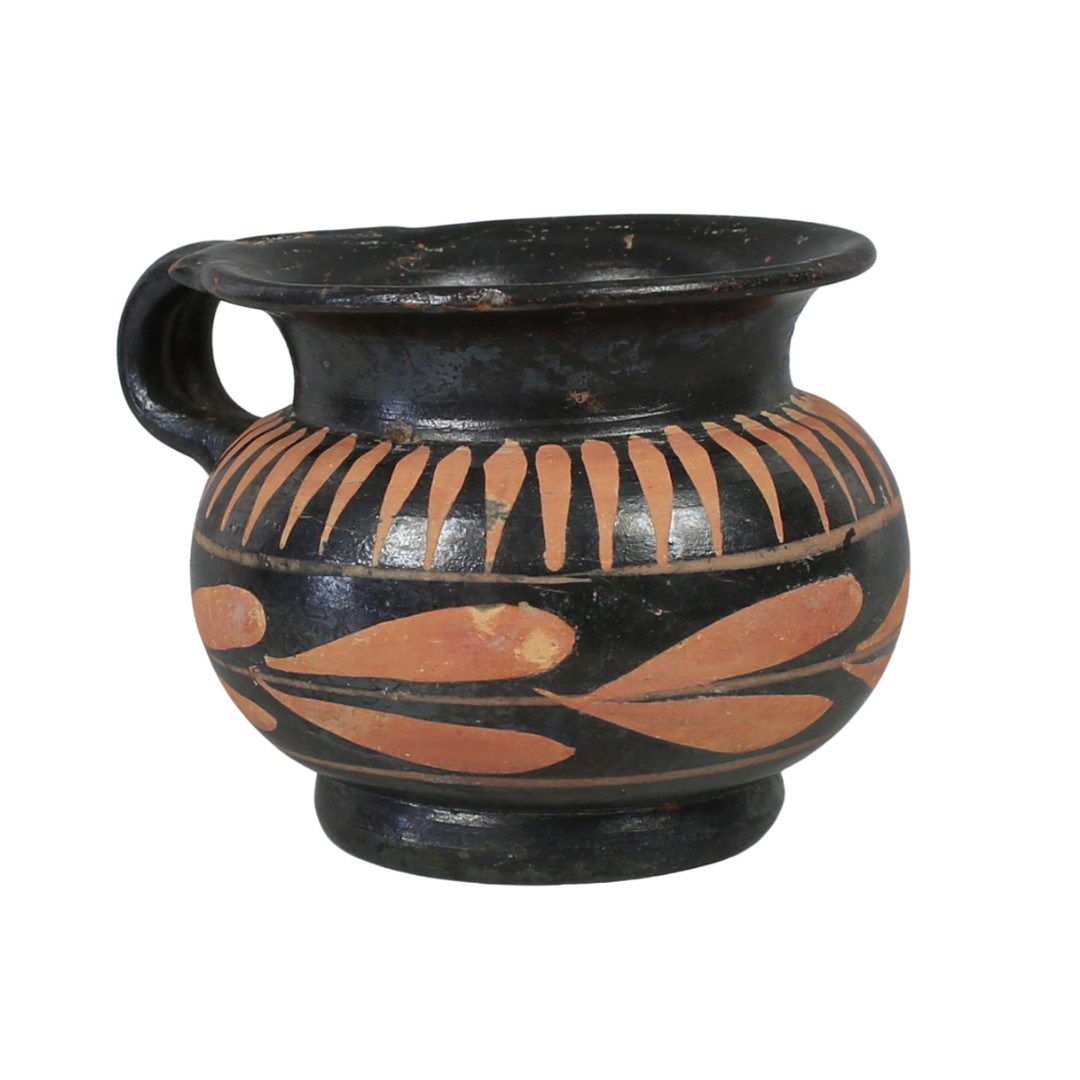

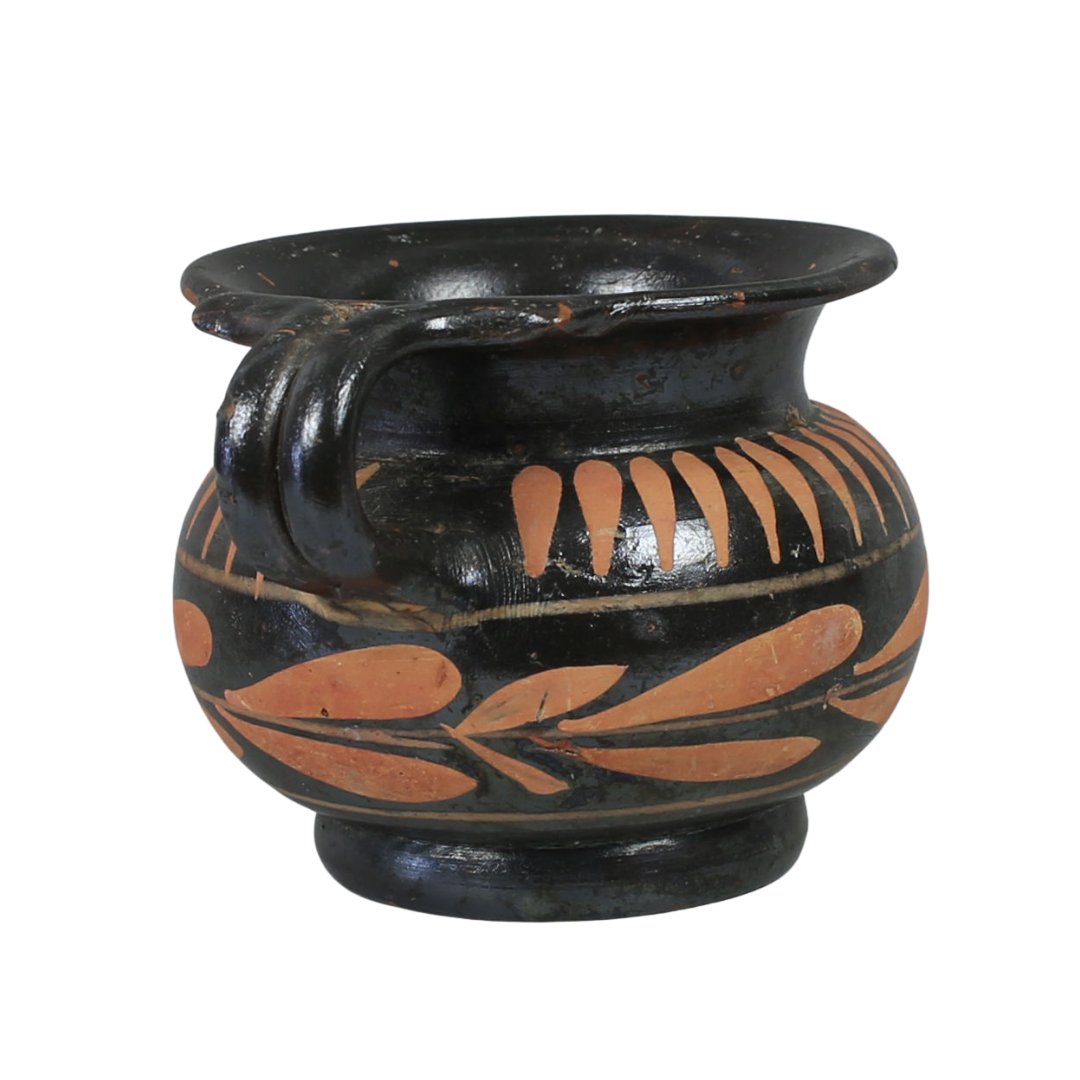


Originating from a former private Dutch collection (acquired between 1970 and 2000), this miniature olpe displays a rare precision of plastic presence: a harmoniously globular body, a flared neck without break of profile, a widely open lip, and a vertically ribbed and elevated handle — all attesting to a structural balance of exemplary harmony. The deep black glaze, still lustrous in places, is adorned with a ferruginous ochre decoration typical of Xenon ceramics: a radial frieze of stylized “tongues” on the shoulder, and a garland of lanceolate leaves and berries around the body. The lateral views reveal the rigor of the wheelwork — regular concentric striations, a perfectly centered ring foot — along with discreet workshop traces: minute chippings, light abrasions, and natural micro-iridescences that, far from diminishing its value, affirm the material truth of an authentic ancient piece.
Technical Characteristics
– Object: Miniature olpe (jug with vertical handle)
– Culture: Greek, Apulian tradition (Southern Italy), Xenon ware
– Period: 4th century B.C.
– Material: Fine pottery with lustrous black glaze, added ferruginous ochre decoration; ancient patina with subtle metallic reflections
– Dimensions: Height approx. 65 mm; maximum length approx. 92 mm (including handle)
– Condition: Good overall condition; minute chippings at the lip and foot, fine abrasions on the glaze, perfectly stable structure; no visible restoration
– Provenance: Former private Dutch collection, acquired between 1970 and 2000
– Authenticity: Certified; typological concordance, homogeneous patina, natural mineral deposits, and internal micro-fissures visible under ×10 magnification; ferruginous clay consistent with Apulian production of the 4th century B.C.
– Sale: Acquired through an authorized professional network of the European art market, in compliance with museum standards of traceability and expertise.
Historical Context
In the Greek world of the 4th century B.C., the olpe was an elegant jug used for serving wine or water during banquets (symposia). Originating from the Apulian workshops of Southern Italy, this type of Xenon ware — named after a vase preserved in Berlin bearing that inscription — is distinguished by its glossy black glaze and decorations added in red, yellow, or white. In contrast to red-figure pottery, Xenon ceramics pursued a more restrained and refined aesthetic, emphasizing volumetric geometry and the delicacy of execution. These vessels, sometimes votive, symbolized both conviviality and offering: the perfection of the curve, the clarity of the motifs, and the density of the glaze reflected the Greek ideal of metron — measure and balance.
Formal and Material Analysis of the Specimen
– Profile and proportions: Fully rounded body, short and widely open neck, continuous profile without rupture; precise ratio between height and width.
– Handle: Thick vertical ribbon, cleanly anchored on the neck and shoulder; no structural weakness.
– Decoration: Radiating tongue frieze on the shoulder, stylized vegetal garland on the body; fluid tracing, homogeneous ferruginous pigments, slight variations in tone indicating an ancient manual gesture.
– Glaze and patina: Deep black glaze with localized micro-wear and iridescence; continuous, unified patina, surface gently polished by time.
– Workshop technique: Regular wheelwork with visible concentric striations; crisp reserved lines; low annular foot ensuring firm stability.
– Firing and clay: Light beige clay with dense core, stable ferromanganic slip; controlled oxidizing firing.
– Votive function: Miniature format suitable for ritual deposition or symbolic libation; portable and harmonious conception.
– Scientific observation: Examination under raking light and ×10 magnification; chromatic consistency, micro-calcareous deposits, and absence of modern retouching.
Cultural Value
This miniature olpe, accompanied by its certificate of authenticity, perfectly embodies Apulian pottery of the 4th century B.C.: elegance of form, precision of decoration, depth of glaze, and harmony between utility and sanctity. Every trace of time, every micro-wear, every nuance of slip narrates the endurance of an object conceived to last. It stands as a work both historical, aesthetic, and symbolic — a fragment of Greek culture preserved in its purest form.
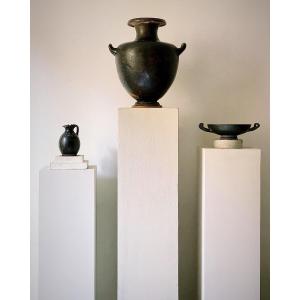
NB: The bases, frames, and presentation elements visible in the photographs are intended solely for display purposes and are not included in the sale.
Explore similar pieces and discover your ideal find:
archeology