THIS OBJECT WAS SOLD
Liturgical Silver Censer, Flemish Work From The 18th Century


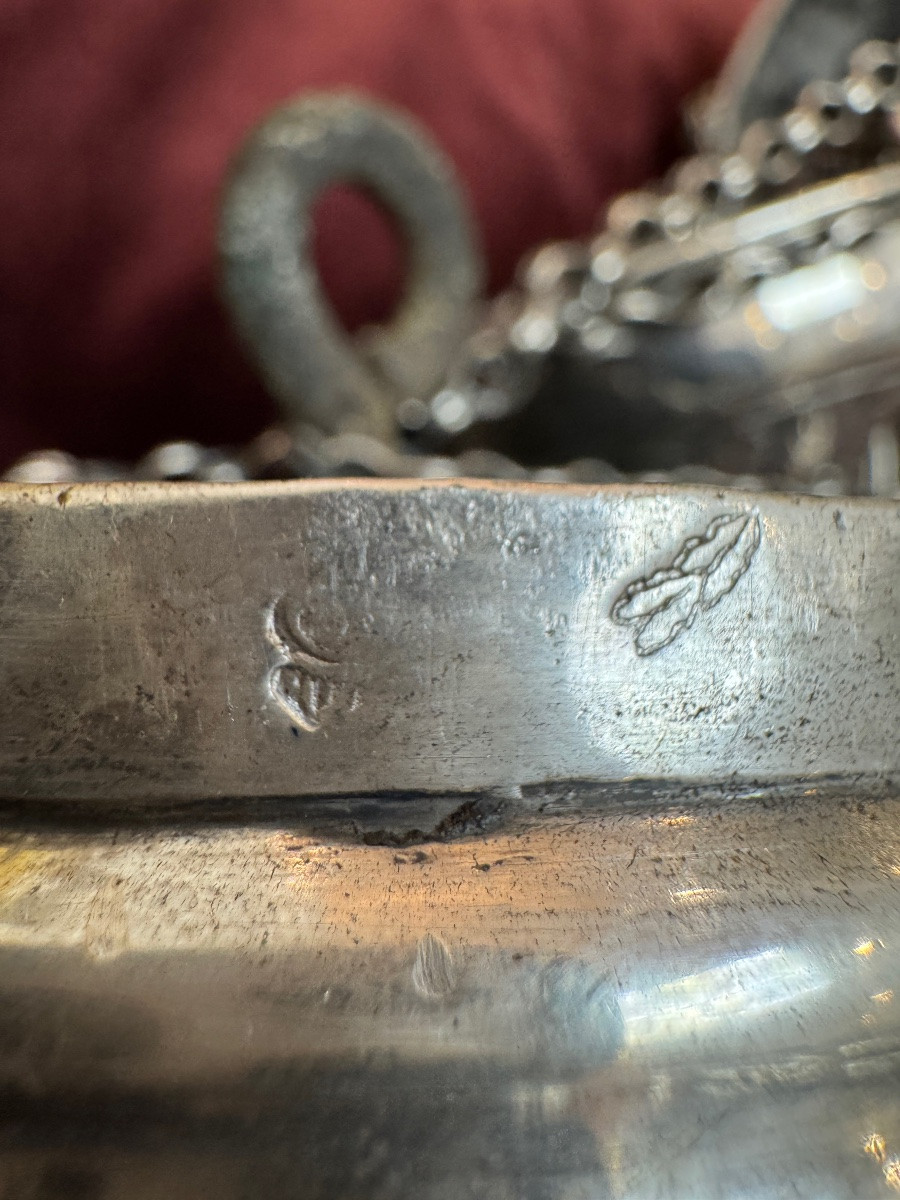


Liturgical silver censer, Flemish work from the 18th century Superb suspended censer in embossed and chased silver, baluster-shaped, resting on a flared foot decorated with acanthus and foliage motifs. The body, richly decorated with plant and floral garlands, is adorned with four medallions with finely executed cherub figures, in the late Baroque style of Flemish or Brussels goldsmiths. The openwork upper part is surmounted by a flame-shaped cover, holding the original chains, all present. The set is complete, including the suspension chains, the top ring, as well as the interior copper tray used to collect the embers, preserved in its used condition. Several silver hallmarks are struck on the body of the object, including a difficult-to-read maker's mark (probably “LEC” or “ES”), a zoomorphic hallmark (probably a bird's head facing left), and two secondary hallmarks of uncertain identification. These marks do not correspond to standard French or Dutch registers, and strongly suggest a Flemish or German-Belgian origin, before the hallmark reform of 1814. Note: an old striche (file line or touchstone test), visible under the foot, was made in the 18th century to verify the quality of the metal. This practice is typical of Flemish and German silversmithing of the period and constitutes material proof of the antiquity and authenticity of the piece. The censer also bears a later engraving “1846” under the base, probably added during a liturgical donation or a church inventory. Two small copper rings were previously added to the upper attachment to reinforce the suspension: these are old and stable restorations. Very good general condition, rare in this completeness. Characteristics: Period: mid-18th century (circa 1740–1760) Origin: probably Flanders (Brussels, Ghent) or southern Germany Material: solid silver (body), copper (inner bowl) Decoration: repoussé, chased, cherub figures, floral garlands Dimensions: 30 cm high (censer alone), approx. 1 meter with chains Total gross weight: 890 g (excluding inner bowl) Hallmarks: several, including one master's mark, one zoomorphic, two secondary Special feature: old striche visible under the foot, authentic technical use Condition: excellent, with two small copper reinforcement rings (old restoration
Explore similar pieces and discover your ideal find:
Christian Art