THIS OBJECT WAS SOLD
Kabuto And Menpo In Samurai Armor


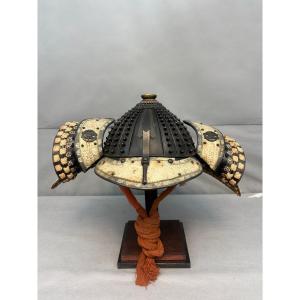
Helmet and mask type ressei early Edo periodKabuto (helmet) Sujibachi with six lamellas in natural raw iron.Shikoro (neck protection) in hineno style, composed of four lamellas in black lacquered iron.Blue and white lacing.Fukigaeshi (side fins) decorated with gold lacquer.Maedate (forehead ornament) decorated with garlands of leaves painted in red.Menpo (mask) Type Ressei (fierce), in brown lacquered iron, decorated with a moustache in white boar hair (Sus scrofa japonica).Inside of the mask red lacquered.Yodarekake (throat protection) consisting of four lamellas in black lacquered iron with blue and white lacing.Some lacquer loss visible in places.Functions of masks for samurai:Masks worn by samurai, such as menpo, had a dual function, both practical and Symbolic. On a utilitarian level, these masks provided additional protection to the face, nose, and chin during combat. They served as a support for the kabuto (helmet) thanks to reinforced fasteners. In addition, their often red-lacquered interior helped reduce glare from sunlight or the flames of nighttime battles. However, their appeal went far beyond functionality. The masks' exaggerated and frightening features, such as furrowed brows, menacing teeth, or imposing mustaches, were intended to impress and destabilize the opponent. By adopting a terrifying appearance, the samurai embodied an invincible and elusive force, which reinforced their prestige and psychological power on the battlefield. These frightening masks also symbolized the samurai's transcendence beyond their humanity. By concealing their features, they effaced themselves as individuals to become avatars of their clan, their honor, and their martial ideals. Some masks were even adorned with religious or spiritual motifs. Thus, the wearer was protected by higher powers or guided by ancestral spirits. Thus, samurai masks represented a careful balance between functionality, intimidation, and symbolism, playing a vital role in the warrior iconography of medieval Japan.
Explore similar pieces and discover your ideal find:
Uniforms, Armors