

Fine Verdure Tapestry, 17th Century, Royal Beauvais Manufactory 1667-1669 After Jacques Fouquiè
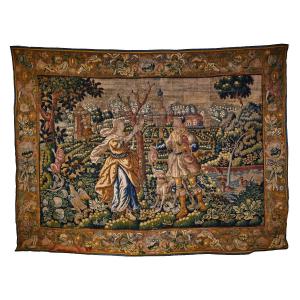
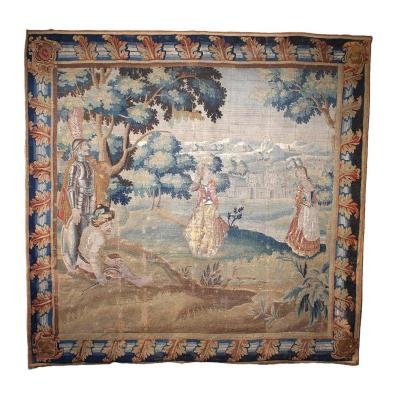
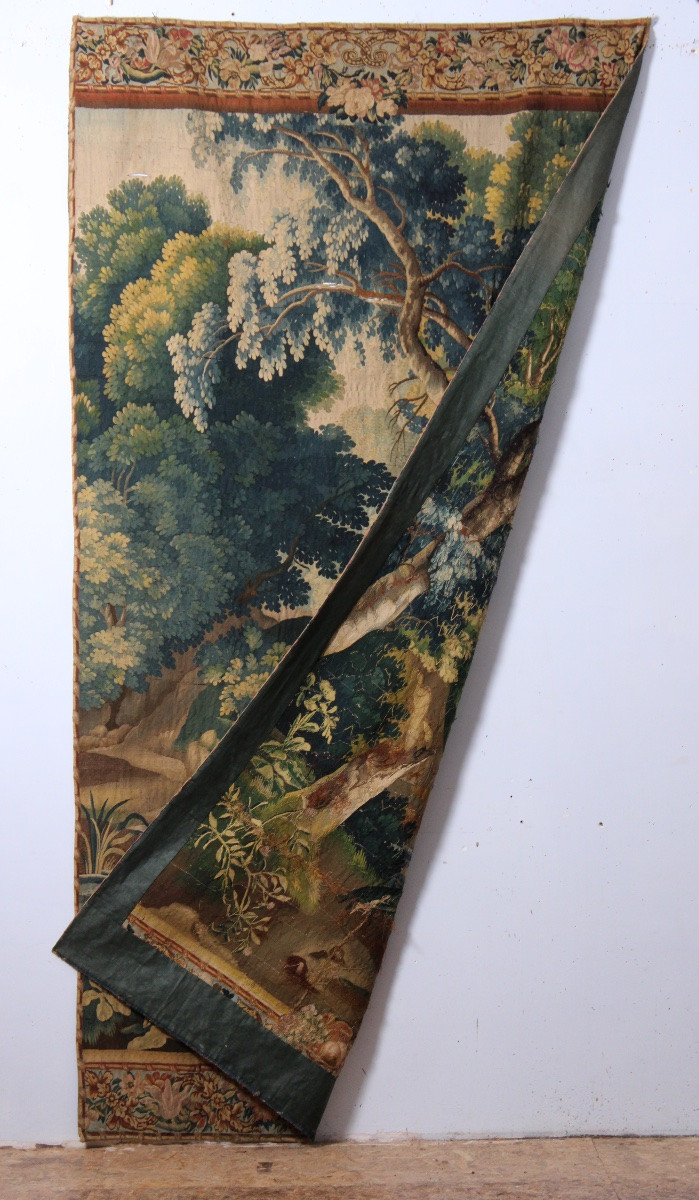
- Fine verdure tapestry woven between 1667 and 1669 at the Royal Beauvais Manufactory. This tapestry, typical of the verdure genre, offers us a glimpse into a lush landscape adorned with a body of water near which stands what appears to be a Barbary cane with its two ducklings. The flora is depicted with great vibrancy, as evidenced by the sinuous tree trunks and the perceptible movement of the foliage.
- This verdure tapestry is distinguished by its fine weave (8 threads/cm), which allowed the weavers to meticulously reproduce the details of the design. For example, one notices that the weavers took great care to reproduce the design with a focus on creating depth, thanks to the subtle background where the foliage gradually fades to create perspective.
Furthermore, the volumes have been finely rendered through the juxtaposition of light and darker hues, as well as through touches of light introduced by the use of golden-yellow silk at the tips of the leaves and on the gnarled trunks. These touches of light also guide the viewer's eye; the sun's rays enter the greenery from the left.
- The remarkably well-preserved colors offer pleasing shades of blue and green. The rich greens and blues contrast with the numerous uses of silk in the weave, creating an exceptionally luminous whole.
- This tapestry is similar to the tapestries that were part of the very first delivery to the Royal Furniture Repository, beginning in 1667, by Louis Hinart (Master of the Royal Low-Warp Tapestry Manufactory established in Beauvais in 1664 and founded by Colbert). The tapestry that interests us is the one woven after Jacques Fouquières (c. 1580-1659), described in the royal inventory as "A tapestry of wool and silk, fine Beauvais manufacture, depicting verdure and some animals, within a guilloche-style border, festoons of naturalistic flowers and gilt-bronze-colored scrolls intertwined in naturalistic patterns on a blue background, in the middle of the upper border, a festoon of roses and in the middle of the lower border, a dish of peaches and grapes..." (Vittet (Jean) and Brejon de Lavernée (Arnauld), La Collection de tapisseries de Louis XIV, Dijon, 2010, p. 10) 342
- This attribution explains the beautiful quality and fineness of the weave (8 threads/cm), which provides a supple textile and an impeccable reverse, the materials used (wool and silk), and the colors, whose freshness suggests the use of fast-dyeing agents.
- The original (not added) border testifies to its use as a window curtain. The border is composed of garlands of flowers echoing the vegetation in the central scene.
- Tapestry partially lined (reinforced ends), cord for hanging.
- Condition: good overall condition, some wear is present (see photos)
- Dimensions: height: 285 cm, width: 152 cm
- This verdure tapestry is distinguished by its fine weave (8 threads/cm), which allowed the weavers to meticulously reproduce the details of the design. For example, one notices that the weavers took great care to reproduce the design with a focus on creating depth, thanks to the subtle background where the foliage gradually fades to create perspective.
Furthermore, the volumes have been finely rendered through the juxtaposition of light and darker hues, as well as through touches of light introduced by the use of golden-yellow silk at the tips of the leaves and on the gnarled trunks. These touches of light also guide the viewer's eye; the sun's rays enter the greenery from the left.
- The remarkably well-preserved colors offer pleasing shades of blue and green. The rich greens and blues contrast with the numerous uses of silk in the weave, creating an exceptionally luminous whole.
- This tapestry is similar to the tapestries that were part of the very first delivery to the Royal Furniture Repository, beginning in 1667, by Louis Hinart (Master of the Royal Low-Warp Tapestry Manufactory established in Beauvais in 1664 and founded by Colbert). The tapestry that interests us is the one woven after Jacques Fouquières (c. 1580-1659), described in the royal inventory as "A tapestry of wool and silk, fine Beauvais manufacture, depicting verdure and some animals, within a guilloche-style border, festoons of naturalistic flowers and gilt-bronze-colored scrolls intertwined in naturalistic patterns on a blue background, in the middle of the upper border, a festoon of roses and in the middle of the lower border, a dish of peaches and grapes..." (Vittet (Jean) and Brejon de Lavernée (Arnauld), La Collection de tapisseries de Louis XIV, Dijon, 2010, p. 10) 342
- This attribution explains the beautiful quality and fineness of the weave (8 threads/cm), which provides a supple textile and an impeccable reverse, the materials used (wool and silk), and the colors, whose freshness suggests the use of fast-dyeing agents.
- The original (not added) border testifies to its use as a window curtain. The border is composed of garlands of flowers echoing the vegetation in the central scene.
- Tapestry partially lined (reinforced ends), cord for hanging.
- Condition: good overall condition, some wear is present (see photos)
- Dimensions: height: 285 cm, width: 152 cm
14 000 €
Period: 18th century
Style: Louis 14th, Regency
Condition: Good condition
Material: Wool
Width: 152 cm
Height: 285 cm
Reference (ID): 1522415
Availability: In stock
Print