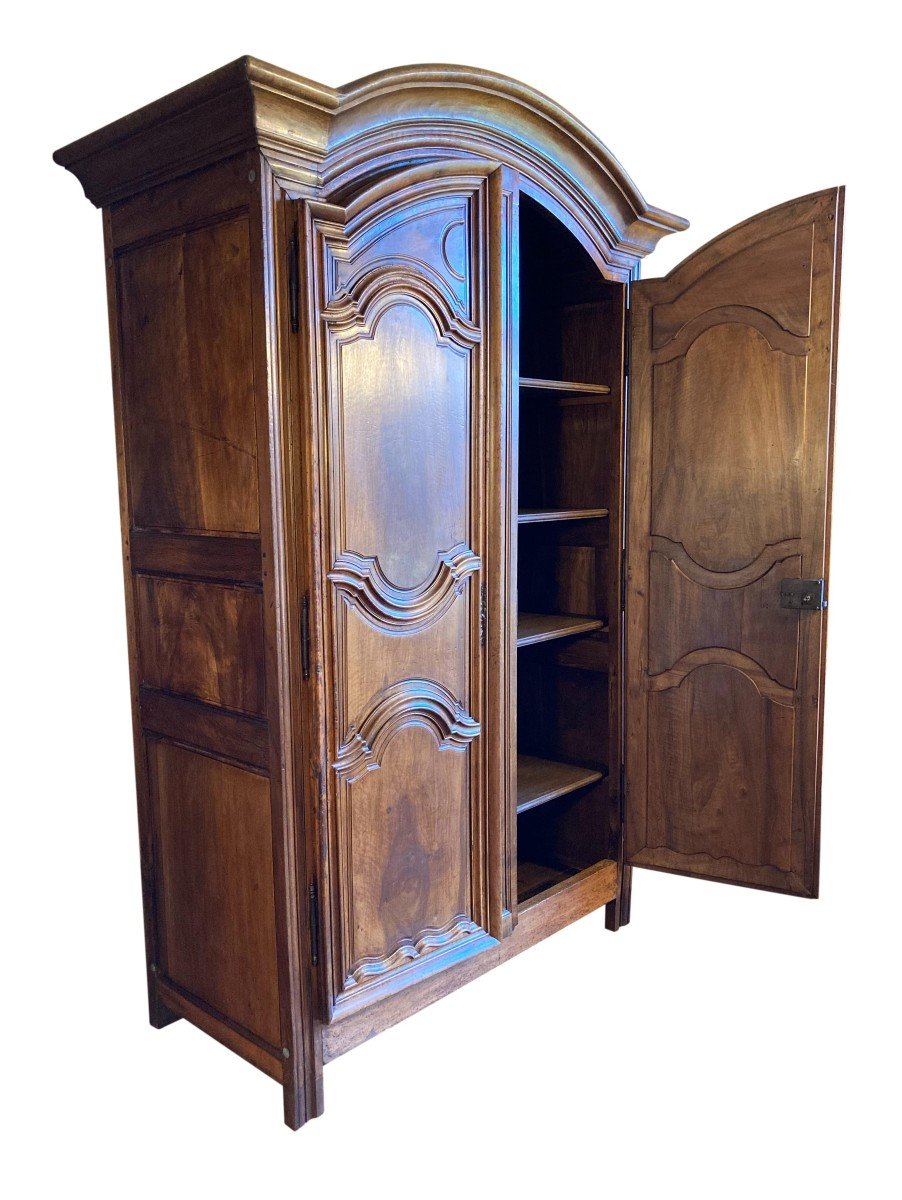


"île-de-france Walnut Wardrobe Stamped I. Martiny – Early 18th Century"
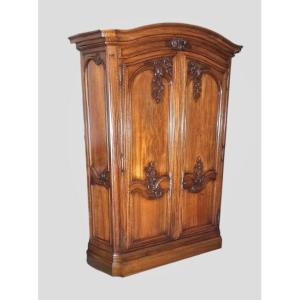
Île-de-France wardrobe in carved walnut, wrought iron fittings, stamped I. Martiny (unlisted cabinetmaker). Early 18th century. Provenance: Morbihan manor, listed as a Historic Monument.This extremely elegant walnut armoire illustrates the refinement of early 18th-century cabinetmaking in the Île-de-France region. The front, with two molded and arched doors, is enhanced by a set of raised panels whose curved curvatures harmoniously punctuate the surface. The sides, with recessed molded crossbars and panels, reflect the care taken over the entire structure.
The gendarme hat-shaped cornice, with its curved and molded profile, crowns the composition with a noble grandeur. The interior, divided into four shelves and a hanging space (a later oak addition), demonstrates functional use and gradual adaptation to domestic needs.
The piece of furniture bears two "I. Martiny" stamps, affixed to the upper and lower crosspieces of the front. This craftsman, not listed in known 18th-century cabinetmaker and joiner registers, may have belonged to a local workshop in the Île-de-France region, active in the first half of the century.
Attribution and Hypothesis on the Cabinetmaker
The "I. Martiny" stamp, although undocumented, invites reflection on regional production at the time.
Several hypotheses can be considered:
- an independent cabinetmaker from the Île-de-France region, not a master craftsman but working for an approved workshop;
- a rural furniture joiner who adopted the use of the stamp after 1743 (regulations of the cabinetmaker-joiners' corps), a rare practice but attested in certain provincial workshops;
- or even a craftsman of the court or noble household, whose signature served as a guarantee of quality without affiliation with the Parisian guild.
Whatever its origin, the quality of the workmanship, the precision of the joints, the balance of the proportions, the regularity of the moldings, testify to mastered craftsmanship and production intended for a high-ranking residence.
The original hardware, cremone bolt, lock, key, and turned hinges, are made of finely cut and hammered wrought iron. Their quality and antique patina confirm the authenticity of the piece.
The lag screw assembly, known as the Versailles system, allows for easy disassembly, a practice used at the time for transporting items in homes with narrow staircases, particularly stately homes.
The entire piece, with a beautiful blond patina, exhibits old restorations and is distinguished by its excellent condition. The work is in keeping with the tradition of the great regional workshops influenced by the court of Versailles, combining balanced volumes, quality moldings, and mastery of understated yet expressive decoration.
Dimensions: Height: 246 cm - Length: 165 cm - Depth: 75 cm
Certificate of Authenticity – Customized delivery















 Le Magazine de PROANTIC
 TRÉSORS Magazine
 Rivista Artiquariato