THIS OBJECT WAS SOLD
"gare La Bombe" - Consulate Period Gilt Bronze Clock Signed Bastien


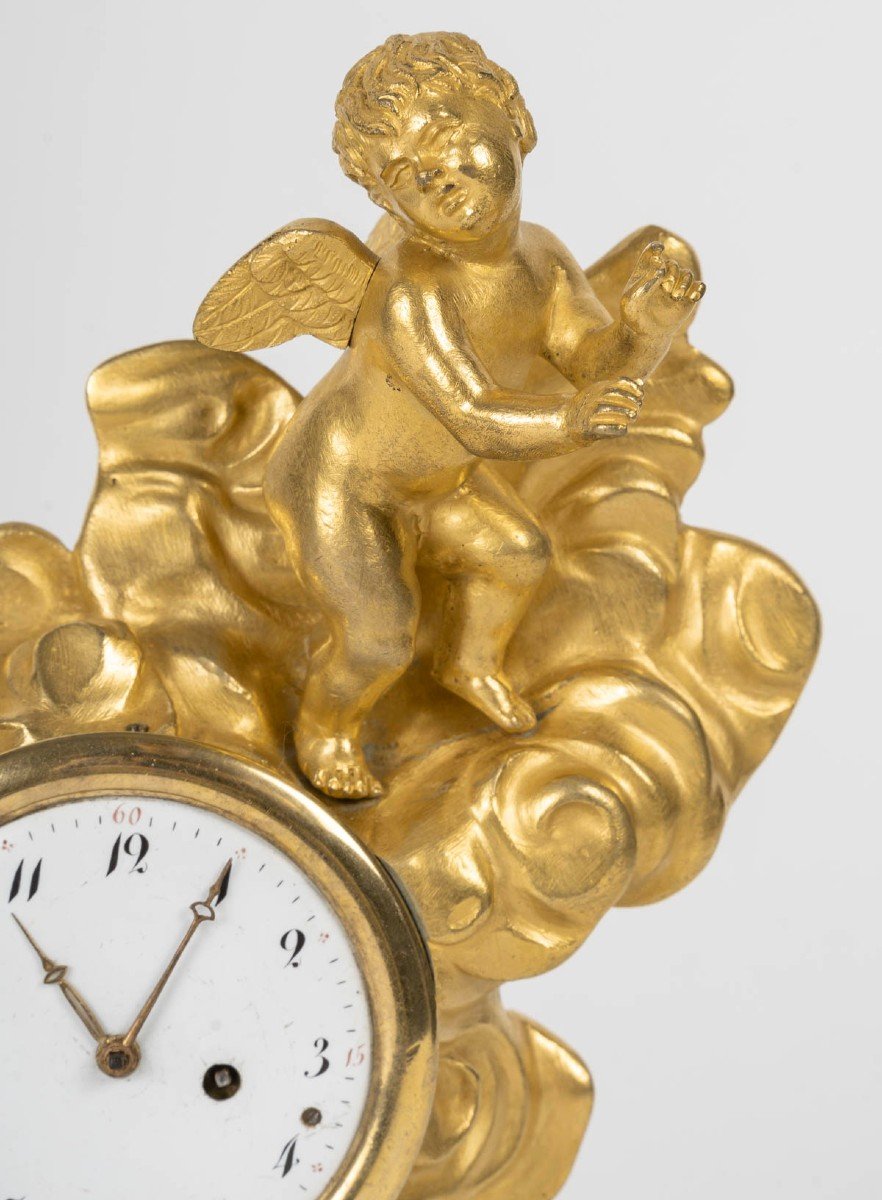


BASTIEN, Watchmaker in Paris-Titled within a scrolled bottom scroll framed with rose buds "GARE.LA BOMBE", this singular portable clock made of matt or polished gilded bronze features, not without mischief, on its base ovalized, a cherub propelled from the muzzle of an offensive bombard. Positioned on a stepped mount, the latter is adorned on its body with rings with a fine guilloché decoration of leafy imbrications of grained myrtle, diamond grid and small scraps.
At the heart of swirling fumaroles prettily chiselled in half-relief of stylized scrolls takes place the white enameled dial of this small watch piece with harmonious lines. Set with a generous disc unequivocally evoking the circular shape of the firing projectile, the latter shows the hours and minutes in Arabic numerals painted in black and red by two pierced metal hands with a dart pattern. It is equipped on its reverse side with a so-called "Coq" movement equipped on its plate with two wheels in silver and gold tones respectively. One, full, with engraved decoration of centered waves of a radiating foliage motif; the other, with gold-worked openwork of fanciful winged chimeras, delicate scrolls of leafy acanthus enclosed in half-discs carved with masks of leafy grotesques, flowering tigelles and florets. The refined ornamentation of the mechanism of this clock is the work of the Parisian "watchmaker-engraver" Bastien, whose signature is inscribed in cursive letters on the plate. Listed by Tardy in his Dictionary of French Watchmakers (1971, p.34) as exercising his profession in the capital "rue Phillippeau in Year IX" of the Republican Calendar, i.e. in 1800-1801, these biographical lines, although succinct, allow us to establish the dating of the watch piece presented.
Finally, four spinning tops ringed with a corded frieze carry this atypical clock revealing in view of its slender silhouette, its weighted ornamentation and, even more, its iconography illuminated by a motto equally surprising aesthetic inclinations as well as concerns and aspirations of a brief historical period - the Consulate (1799-1804) - still under the influence of post-revolutionary internal struggles or the recent feats of arms of Napoleon Bonaparte (1769-1821).
A rare and unique model
We cannot fully appreciate this rare little watch piece without remembering the desire for political and military pacification which, under the diligent rule of its main hero - Napoleon Bonaparte - animated the young and fragile Republic. Thus, from his coup d'état of 18 Brumaire Year VIII (November 9, 1799) until his proclamation of the Consulate for life on 16 Thermidor Year X (August 4, 1802), strategic agreements were promulgated - Concordat of 1801, Treaty of 'Amiens of March 25, 1802, Amnesty of Emigrants of April 26, 1802 - which, in the whirlwinds of the implacable and fulminant wildfires of the past and future, allowed the reconstruction and reorganization on a peaceful soil of the country, of the French nation.
Deliciously juicy, our clock is an inventive artistic echo of these times faced with many diplomatic and political dilemmas. The presence of the little Angelot fluttering naked, devoid of any amorous (bow, arrows) or military attributes (helmet, shield, sword) above the clouds generated by the explosion of the bomb which, might seem incongruous at first glance, illustrates the complex dynamic which then plays out between war and peace. In these transitional years preceding the advent of the First Empire (1804-1814), the victory of arms (cannon) and Peace (cherub) prevailed, not without ambivalence, over War. This is what this watch piece with the title – “Gare. La Bombe” – which is as intriguing as it is truculent, tends to tacitly illustrate.
A fine example of the creative verve of the bronze craftsmen and watchmakers of the time whose concerns, wishes or fantasies they translate, this "spiritual" portable clock will not fail to arouse the interest of the amateur, the collector keen on Napoleonic epic.
---------------------
Materials: Gilded bronze; enamel and steel
Dimensions: H.: 21 cm;-L.: 14.8 cm;-Dr.: 6.8 cm.
Parisian work from the end of the 18th-early 19th century, Consulate period, circa 1800-1802.
Beautiful condition - original gilding. Note micro-scratches from use. Beautiful cock mechanism complete with its winding key.
At the heart of swirling fumaroles prettily chiselled in half-relief of stylized scrolls takes place the white enameled dial of this small watch piece with harmonious lines. Set with a generous disc unequivocally evoking the circular shape of the firing projectile, the latter shows the hours and minutes in Arabic numerals painted in black and red by two pierced metal hands with a dart pattern. It is equipped on its reverse side with a so-called "Coq" movement equipped on its plate with two wheels in silver and gold tones respectively. One, full, with engraved decoration of centered waves of a radiating foliage motif; the other, with gold-worked openwork of fanciful winged chimeras, delicate scrolls of leafy acanthus enclosed in half-discs carved with masks of leafy grotesques, flowering tigelles and florets. The refined ornamentation of the mechanism of this clock is the work of the Parisian "watchmaker-engraver" Bastien, whose signature is inscribed in cursive letters on the plate. Listed by Tardy in his Dictionary of French Watchmakers (1971, p.34) as exercising his profession in the capital "rue Phillippeau in Year IX" of the Republican Calendar, i.e. in 1800-1801, these biographical lines, although succinct, allow us to establish the dating of the watch piece presented.
Finally, four spinning tops ringed with a corded frieze carry this atypical clock revealing in view of its slender silhouette, its weighted ornamentation and, even more, its iconography illuminated by a motto equally surprising aesthetic inclinations as well as concerns and aspirations of a brief historical period - the Consulate (1799-1804) - still under the influence of post-revolutionary internal struggles or the recent feats of arms of Napoleon Bonaparte (1769-1821).
A rare and unique model
We cannot fully appreciate this rare little watch piece without remembering the desire for political and military pacification which, under the diligent rule of its main hero - Napoleon Bonaparte - animated the young and fragile Republic. Thus, from his coup d'état of 18 Brumaire Year VIII (November 9, 1799) until his proclamation of the Consulate for life on 16 Thermidor Year X (August 4, 1802), strategic agreements were promulgated - Concordat of 1801, Treaty of 'Amiens of March 25, 1802, Amnesty of Emigrants of April 26, 1802 - which, in the whirlwinds of the implacable and fulminant wildfires of the past and future, allowed the reconstruction and reorganization on a peaceful soil of the country, of the French nation.
Deliciously juicy, our clock is an inventive artistic echo of these times faced with many diplomatic and political dilemmas. The presence of the little Angelot fluttering naked, devoid of any amorous (bow, arrows) or military attributes (helmet, shield, sword) above the clouds generated by the explosion of the bomb which, might seem incongruous at first glance, illustrates the complex dynamic which then plays out between war and peace. In these transitional years preceding the advent of the First Empire (1804-1814), the victory of arms (cannon) and Peace (cherub) prevailed, not without ambivalence, over War. This is what this watch piece with the title – “Gare. La Bombe” – which is as intriguing as it is truculent, tends to tacitly illustrate.
A fine example of the creative verve of the bronze craftsmen and watchmakers of the time whose concerns, wishes or fantasies they translate, this "spiritual" portable clock will not fail to arouse the interest of the amateur, the collector keen on Napoleonic epic.
---------------------
Materials: Gilded bronze; enamel and steel
Dimensions: H.: 21 cm;-L.: 14.8 cm;-Dr.: 6.8 cm.
Parisian work from the end of the 18th-early 19th century, Consulate period, circa 1800-1802.
Beautiful condition - original gilding. Note micro-scratches from use. Beautiful cock mechanism complete with its winding key.
Explore similar pieces and discover your ideal find:
Mantel Clocks