Weekly Cabinet In Molded Mahogany Opening With Seven Drawers, Stamped By Conrad Mauter, (1742-1810)
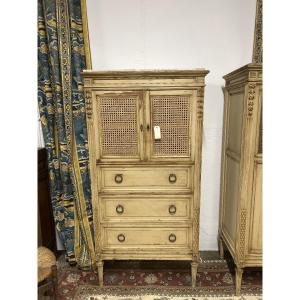
Molded mahogany *semainier* (seven-drawer chest) featuring seven drawers and resting on fluted, canted uprights. Stamped by Conrad Mauter (1742–1810), a cabinetmaker who became a master craftsman in 1777. Topped with Languedoc red marble. Includes key. Louis XVI period. H: 176 cm, W: 128 cm, D: 55 cm. Price: €3,800. Biography of Conrad Mauter: He began his career as an independent artisan (*ouvrier libre*) on the Rue du Faubourg Saint-Antoine in 1768 and attained master status on September 10, 1777. His business flourished rapidly. By 1782, he had become a regular supplier to the Count of Artois—the King's brother and future Charles X. Consequently, leading up to the French Revolution, he supplied furniture to the Palais du Temple, the Château de Bagatelle, the Château de Saint-Germain-en-Laye, and the Château de Maisons, and even delivered commodes to the Château de Saint-Cloud in 1791. He was one of the most prolific furniture makers of the late 18th century. Despite this, many of his works located in these châteaux were destroyed or lost during the French Revolution. Under the Directory and subsequently the Consulate, Mauter continued his production, particularly of tables of all kinds (writing, dining, and gaming tables, including some with mechanical features). He weathered the numerous bankruptcies affecting his trade without suffering significant damage; he was a creditor in the bankruptcy cases of cabinetmaker Trintzius (1803) and upholsterers Brunet (1804) and Quedeville (1807). Throughout this period, alongside furniture in the Directoire or Consulate styles, he continued to produce Louis XVI-style pieces, as evidenced by the inventory of his estate drawn up by Palmer and Eyring in 1810. At the time of his death, his business remained highly prosperous: he employed eight cabinetmakers, and his stock—comprising veneers, mahogany, amaranth, and yellowwood—was substantial (valued at over 22,000 francs). Following his death, his business was acquired by Nicolas-Louis Sandrin. Bibliography: Pierre Kjellberg, *Le mobilier français du XVIIIe siècle*, Éditions de l'Amateur, Paris, 1989; J. Nicolay, *L’art et la manière des maîtres ébénistes français au XVIIIe siècle*, Paris, 1976; François de Salverte (1872–1929), *Les ébénistes du XVIIIe siècle*; Guillaume Janneau, *Les ateliers parisiens d'ébénistes et de menuisiers aux XVIIe et XVIIIe siècles*, Éditions S.E.R.G., 1975, p. 220; Denise Ledoux-Lebard, *Dictionnaire des ébénistes et des menuisiers du XIXe siècle*. Workshop condition report: "This seven-drawer chest (*semainier*) is constructed on an oak carcass. It features pegged joinery and traditional dovetail joints, visible on the top and the drawers. The carcass is clad in veneer, with a thin layer of mahogany on the canted corners, which are embellished with carved fluting. This chest shows signs of earlier restoration." On this weekly planner, we first proceeded to repair the frame. Indeed, the piece had some structural issues caused by humidity fluctuations (creating cracks along the sides as the wood settled). Some mahogany sections had come loose because the animal glue (likely bone glue) had failed; this was replaced, and the parts were re-glued. Additionally, the chest of drawers showed minor nicks and dings from daily use and various moves between owners. I raised the wood where possible and touched up the areas that could not be repaired in that way. Significant work went into stabilizing and reinforcing the drawer structures, as well as improving the sliding mechanisms and runners. We also completely refinished the piece using a traditional French polish with a satin sheen, applying fine orange shellac rather than cherry shellac, and worked to even out the color. All locks have been serviced and are fully functional. In conclusion: a high-quality piece by a renowned cabinetmaker. It is in excellent condition, complete with its marble top, locks, and keys. A superb example of Louis XVI furniture—classic, understated, and elegant. Did you know? In September 1777, Marie-Antoinette challenged her brother-in-law, the Count of Artois (the future Charles X and brother of Louis XVI), to build a château in under 100 days. The Count raised the stakes by wagering 100,000 livres! The Count of Artois in front of Bagatelle, by Jean-Démosthène Dugourc. Without a moment's hesitation, the Count threw himself wholeheartedly into the challenge, enlisting the architect Bélanger, who had just returned from England with sketches of Neo-Palladian style houses. In just a few days, the... The plans are drawn up and approved. It is a mad undertaking: 900 workers toil day and night on the site, and to meet the deadline, work on certain Parisian projects is even halted and materials requisitioned. Ultimately, the Château de Bagatelle is completed in just 64 days! A remarkable feat.
2 800 €
Period: 18th century
Style: Louis 16th, Directory
Condition: Fully restored in our whorkshop
Material: Mahogany
Width: 128
Height: 176
Depth: 55
Reference (ID): 1306352
Availability: In stock
Print