

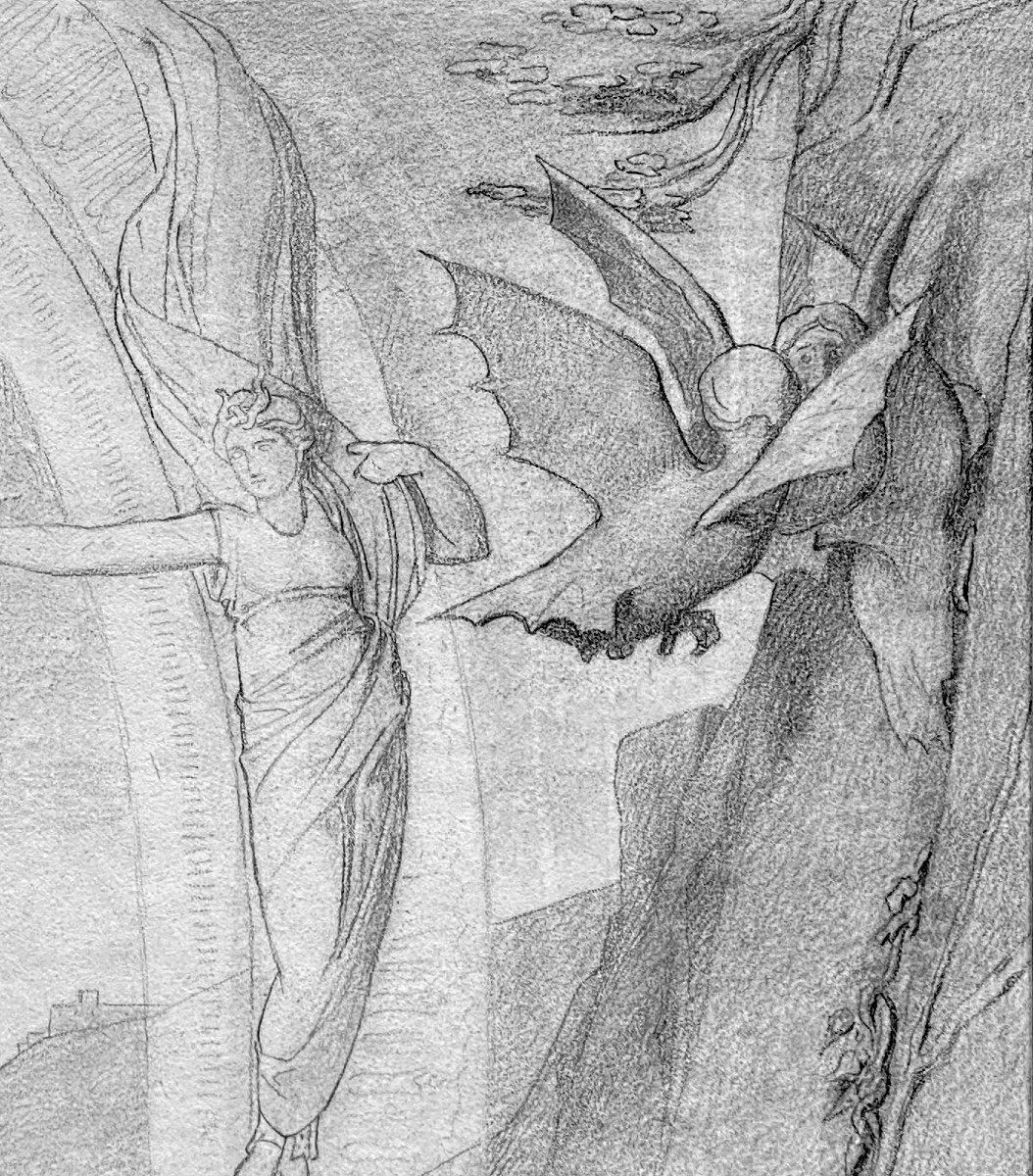


Follower Of Heinrich Füssli - Calais And Zétès Chasing The Harpies
Artist: Suiveur D’heinrich Füssli (zürich, 1741 – Londres, 1825) Anonyme Suisse Du Xixème
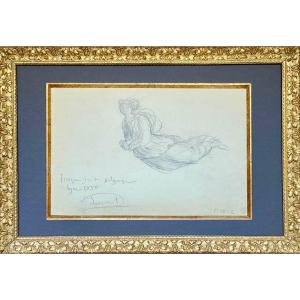
Black pencil Biedermeier style frame, 32.5 x 48.3 cm – brown conservation pass
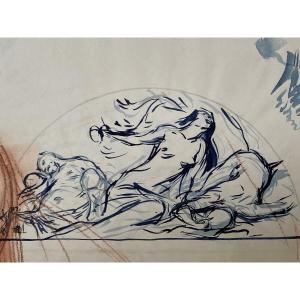
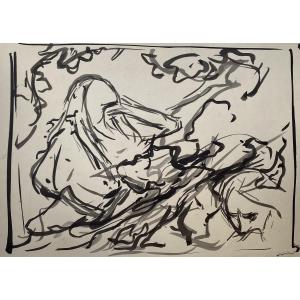
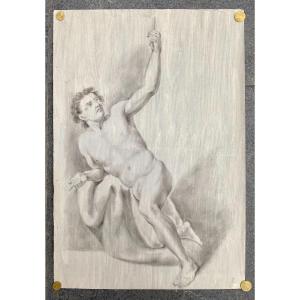
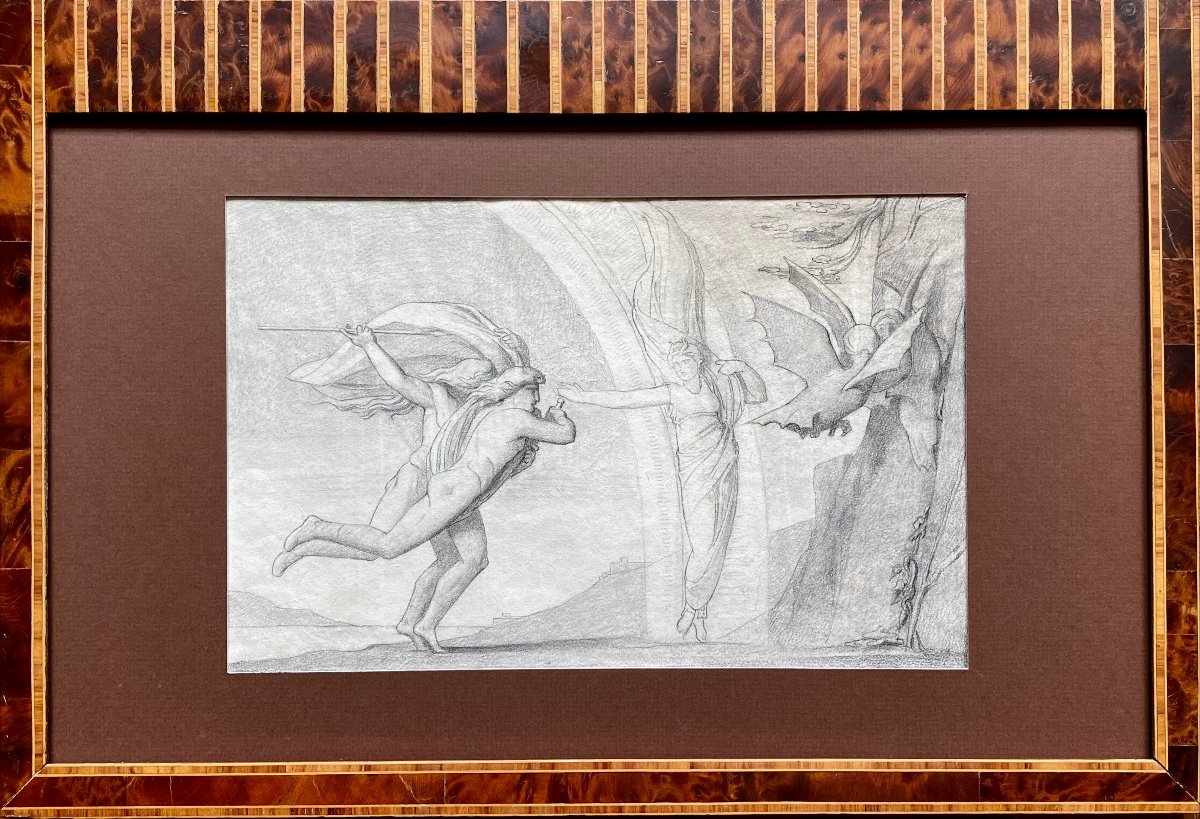
The two twins who never separated, were born in Thrace and represent the genies of the wind: Calais means “the one who blows gently” and Zetes, “the one who blows hard”. They are represented as aerial beings, often with wings attached to the heels or at shoulder level. In the story of the Argonautics, Calais and Zétès rescue their brother-in-law, husband of their sister Cleopatra, victim of divine punishment for having revealed the future too precisely. If they manage to free him from the yoke of the Harpies, it is in vain and endlessly that the twins launch out in pursuit: “Zétès and Calais, throwing themselves very close to them, constantly failed to seize them at the end fingers. (…) These sank into a cave in Crete on the island of Minos, and carried from the earth by their rapid wings, rose towards Olympus” The Argonautics, Apollonius of Rhodes. 3rd century AD. p. 57-59. Our drawing with a fantastic atmosphere in the Fuselian vein, well represents this fateful and theatrical passage of the Hellenistic story: the harpies, before disappearing, metamorphose here before our eyes into winged nocturnal creatures resembling anthropomorphic bats.
The two twins who never separated, were born in Thrace and represent the genies of the wind: Calais means “the one who blows gently” and Zetes, “the one who blows hard”. They are represented as aerial beings, often with wings attached to the heels or at shoulder level. In the story of the Argonautics, Calais and Zétès rescue their brother-in-law, husband of their sister Cleopatra, victim of divine punishment for having revealed the future too precisely. If they manage to free him from the yoke of the Harpies, it is in vain and endlessly that the twins launch out in pursuit: “Zétès and Calais, throwing themselves very close to them, constantly failed to seize them at the end fingers. (…) These sank into a cave in Crete on the island of Minos, and carried from the earth by their rapid wings, rose towards Olympus” The Argonautics, Apollonius of Rhodes. 3rd century AD. p. 57-59. Our drawing with a fantastic atmosphere in the Fuselian vein, well represents this fateful and theatrical passage of the Hellenistic story: the harpies, before disappearing, metamorphose here before our eyes into winged nocturnal creatures resembling anthropomorphic bats.
700 €
Period: 19th century
Style: Consulat, Empire
Condition: Excellent condition
Material: Paper
Length: 247 x 275 mm
Reference (ID): 1211933
Availability: In stock
Print