THIS OBJECT WAS SOLD
Radulescu Campigli Magdalena (1902-1983):


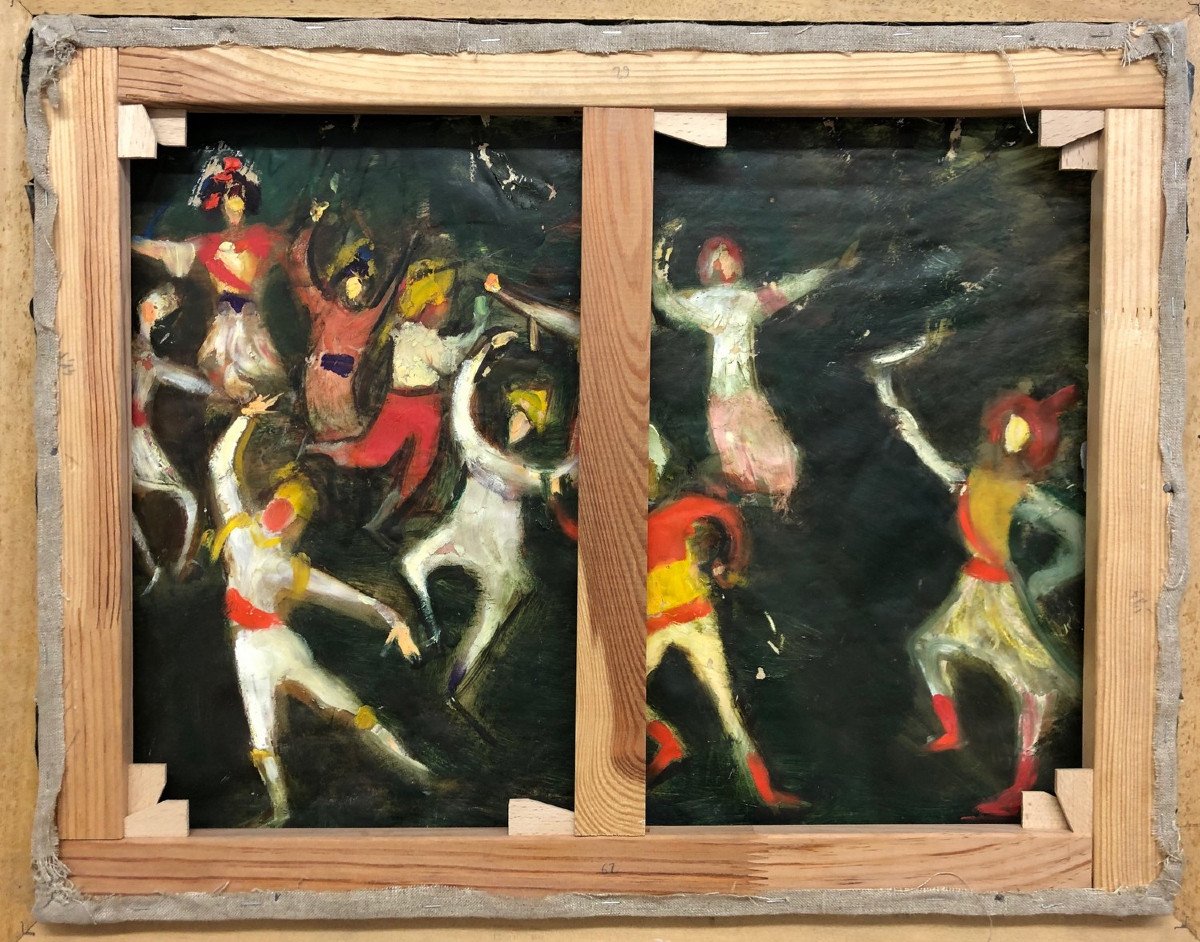

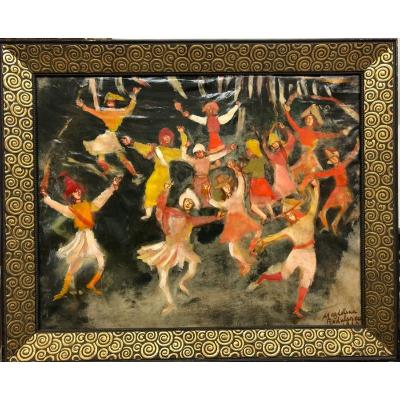
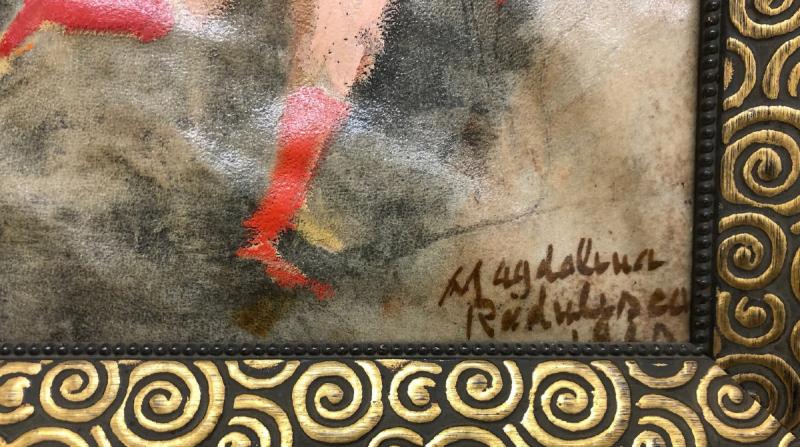


Radulescu Campigli Magdalena (1902-1983): "Romanian folk dance; In folcloric Romanesc"; Oil on leather signed lower right, dated 1960; 49 x 62.5 cm. On the back is painted another composition of the artist. Magdalena Radulescu was born in 1902 in Rimnicu Vâlcea in Romania. She studied art in Munich, 2 years with Angerer, as well as in Paris, at the Grande Chaumière, with Prinet and Boutet de Montvel. It is there that she meets Massimo Campigli, her future husband. His first exhibitions took place in 1929 and 1933 at the Salon des Indépendants in Paris. With Campigli she rubbed shoulders in Montparnasse with the great artists of the twentieth century such as Brancusi and Giacometti. Like these giants, she will develop her own repertoire of highly original and personal forms. Like other of her unclassifiable contemporaries, Chagall, Klee and Miro, she draws her inspiration from her childhood. Constantza, where she grew up, gave it forever a Byzantine, oriental tone ... Her paintings often refer to Romanian culture but with a hieratic treatment which excludes any folkloric dimension. The subject, the initial pretext, fades away by a nostalgic distancing then submits when form, color and rhythm seize the signifier of the work. It is then that Magdalena's magic is revealed, offering us, as with Frida Kahlo, gateways to a timeless universe where the figure is no more than a sign. In the heights of the soul of his nation, the mystical and the absurd distort the agreed image of reality. The rejection of a social condition dictated by trivial laws pushes her towards the sacralization of the plastic gesture. From this stems the proximity to symbolism and surrealism. The quest for a primitivist writing stems from a secular popular tradition which finds its roots in the beliefs and superstitions of an agrarian society. It is thus advisable to note in the iconography of the artist, the repeated use of the cross of Saint Andrew who is none other than the founder of the Romanian Orthodox Church, cross still present in many houses where the inhabitants practice religion again. Among other things, the Scythian heritage provided him with a taste for the representation of horses. The seriousness of his portraits further demonstrates the ambition of the artist's project. The figure comes alive with intentions and offers us an intimate dialogue. The artist describes the nights to be painted by the light of twelve candles, in the castle of Count Coconato, where the shadows dispute him with the intuition of unreal presences. It is the dreamlike writing of childhood, mastered by the depth of its spiritual reflection, which assigns its work the rank it deserves. His figurative pictorial style is close to expressionism by the power of his colors, the message of his poetic, humanist work. The originality of his creation gives him a major rank among his contemporaries. The place that awaits it in the history of Romanian art is not yet specified. Her geographically fragmented production has not, for the moment, made it possible to define the importance of her work.Petra Giacomelli describes the last days of Magdalena Radulescu living on the steps of a fantastic world that she joins with brush in hand , symbolic key to the door of eternity. She died in Paris on March 3, 1983. Her works are kept in several museums including Constanta and Bucharest. http://magdalena-radulescu.com/
Explore similar pieces and discover your ideal find:
Genre Scenes, Nudes