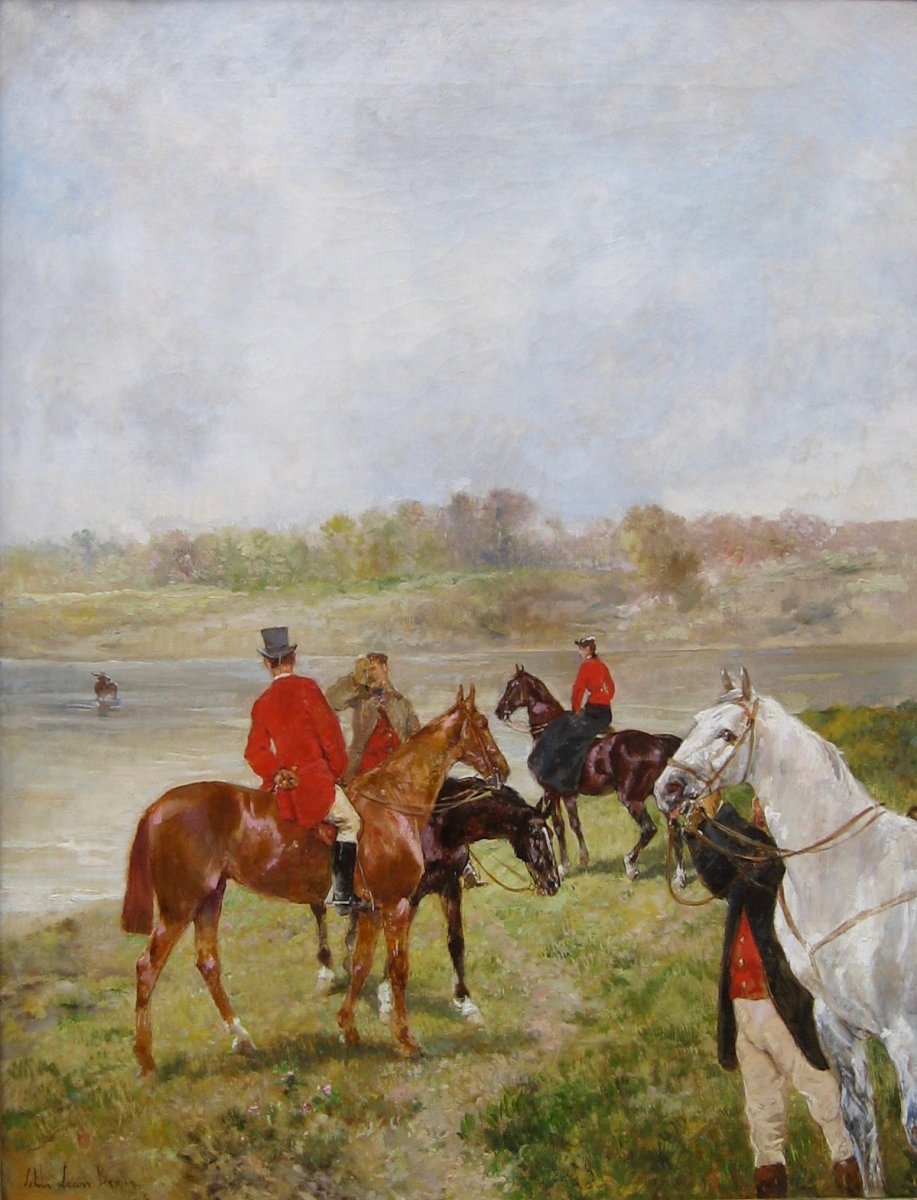
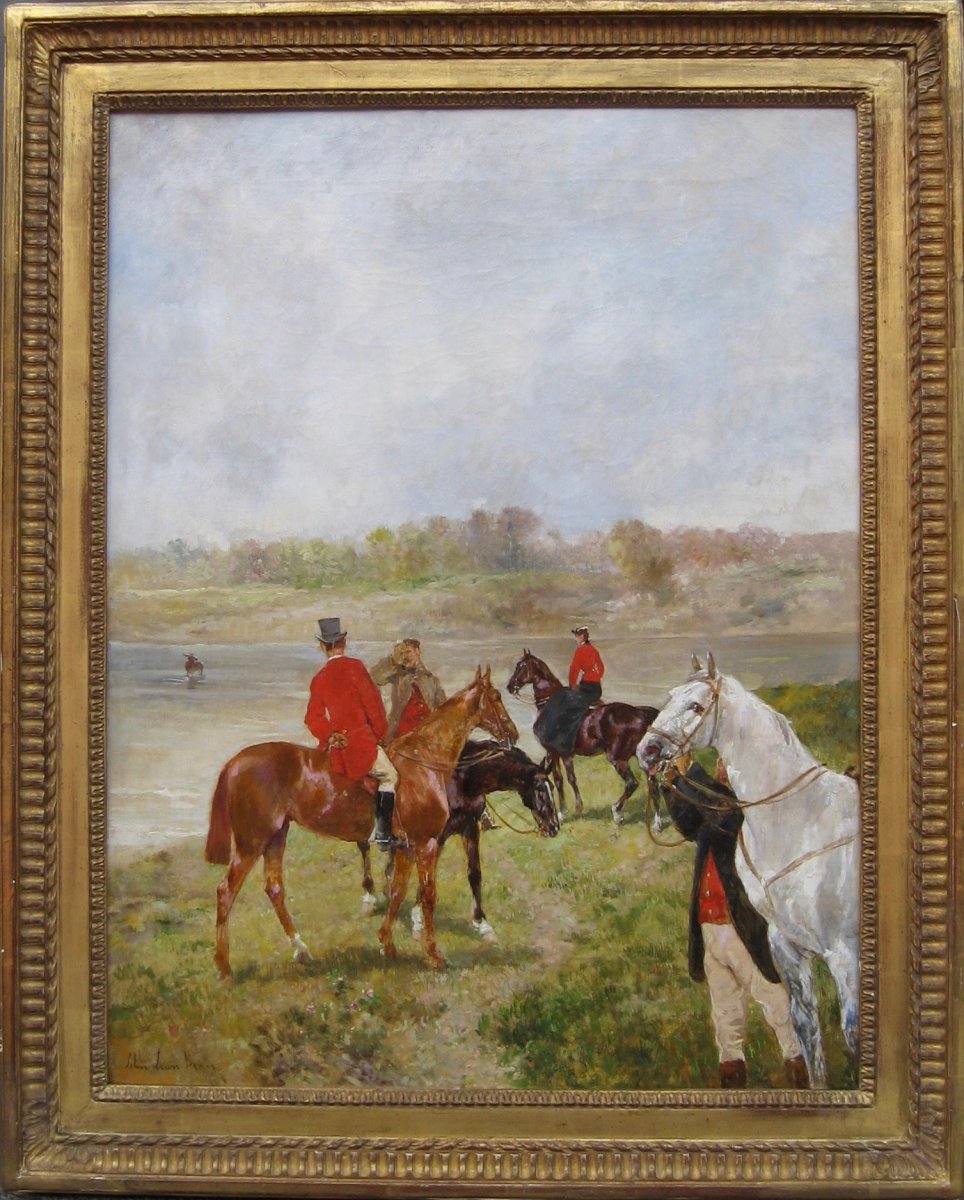
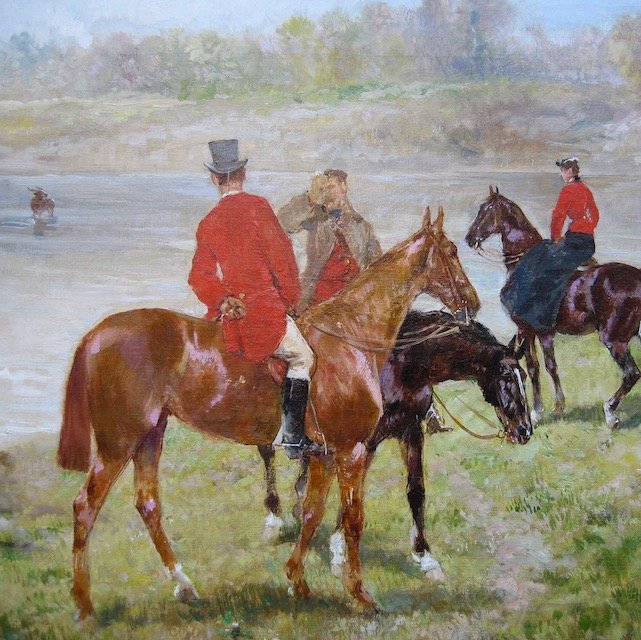
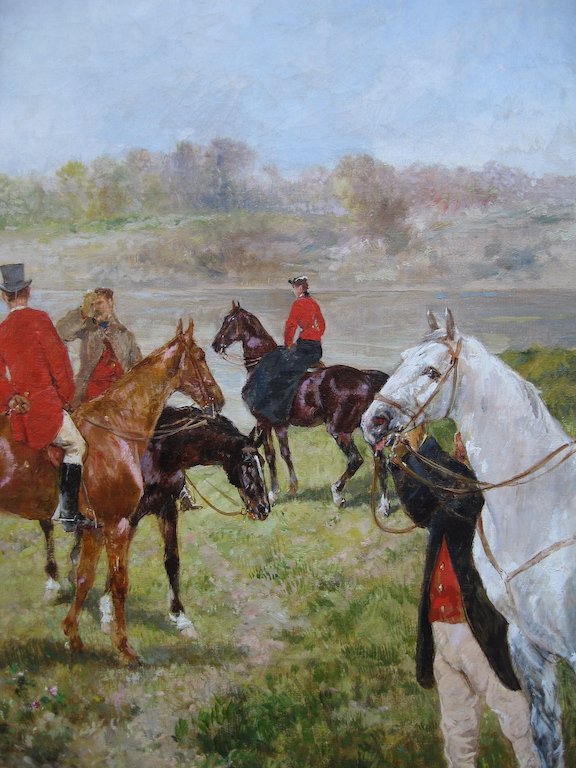

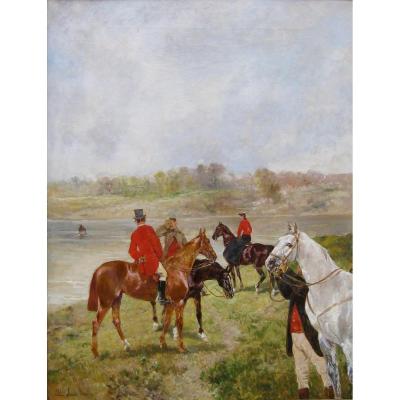
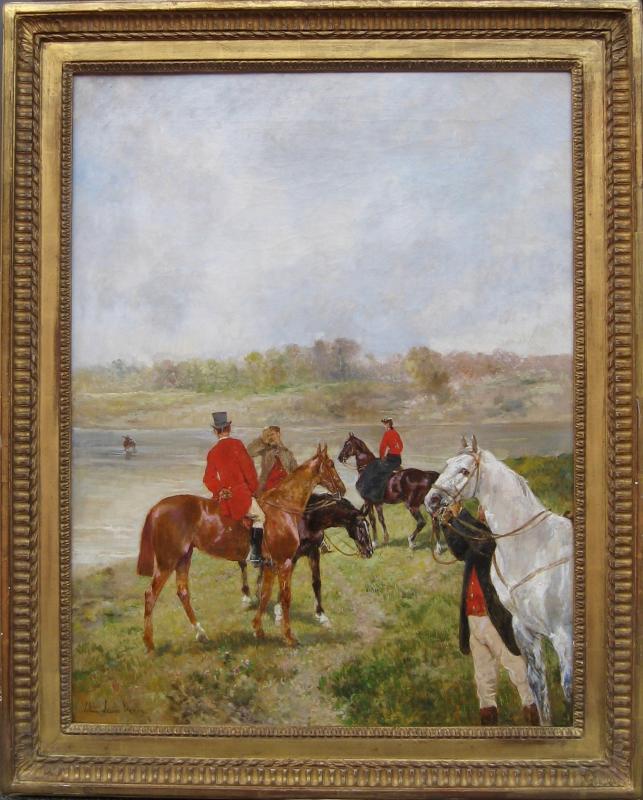

Brown John , Lewis (bordeaux 1829, Paris 1890)- Bat-l’eau, Scène De Chasse à Courre.
Artist: Brown John , Lewis
Oil on canvas
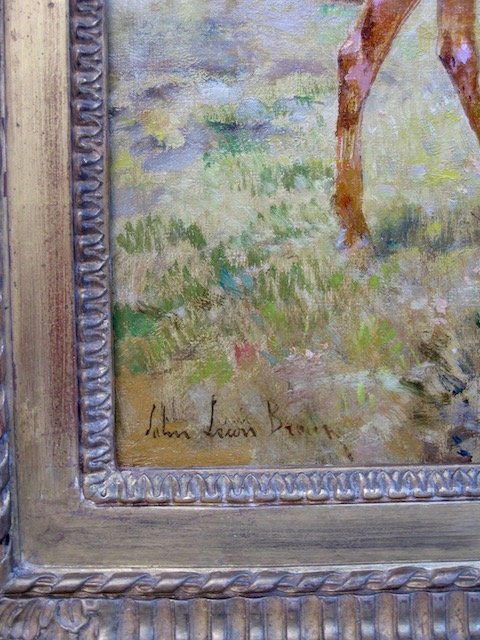
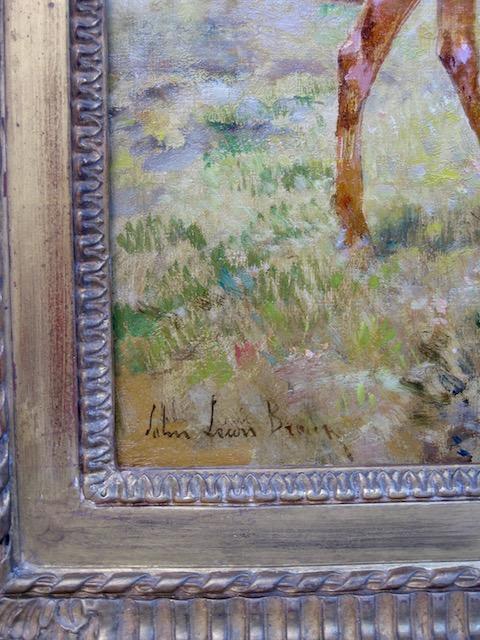
Signed lower left
Dimensions: 65 x 50 cm, with frame: 78 x 62 cm
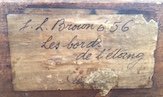
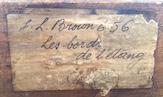
Old exhibition label on the back with the artist's name, exhibition number 656, and the title "The Edge of the Pond"
John Lewis Brown was born in Bordeaux to a family of 18th-century English dignitaries. Originally from Scotland, the Browns are said to have introduced the English Thoroughbred breed to France.
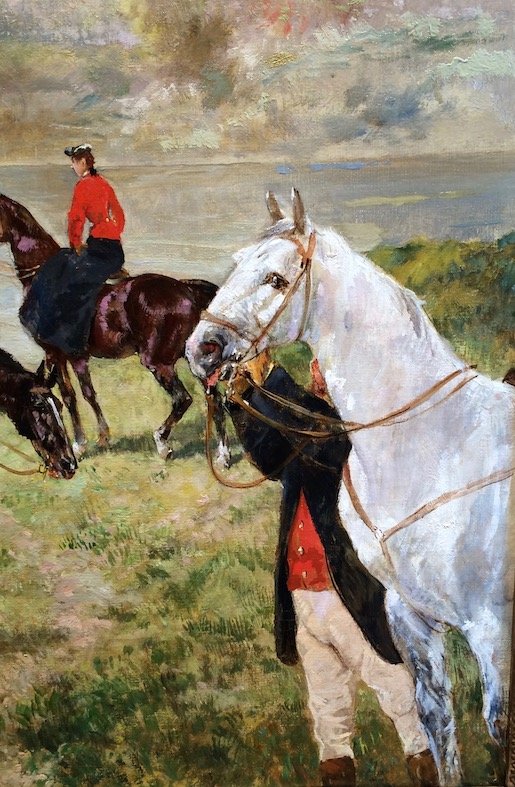
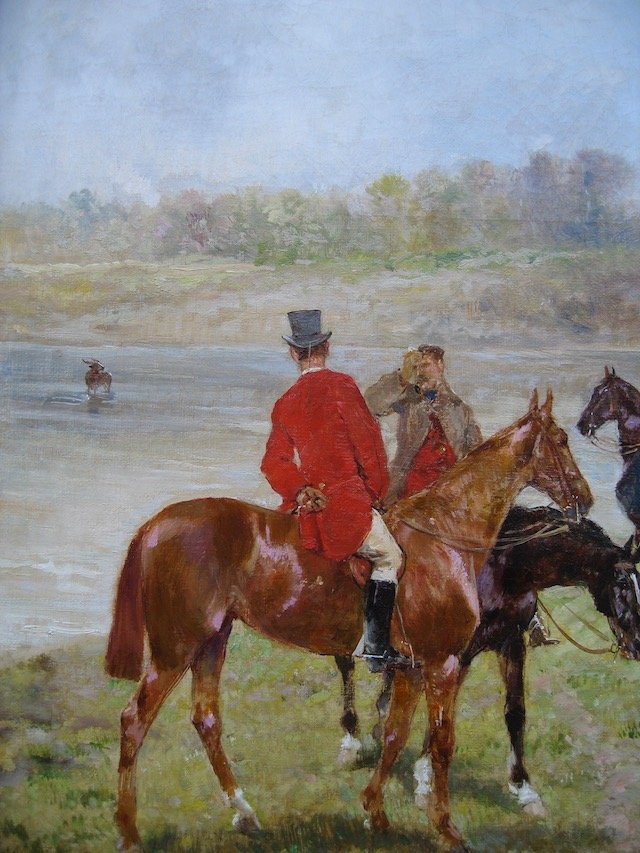
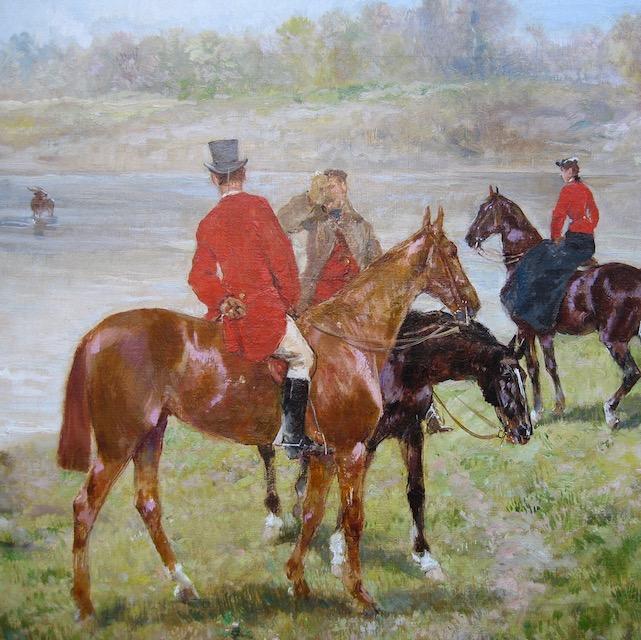
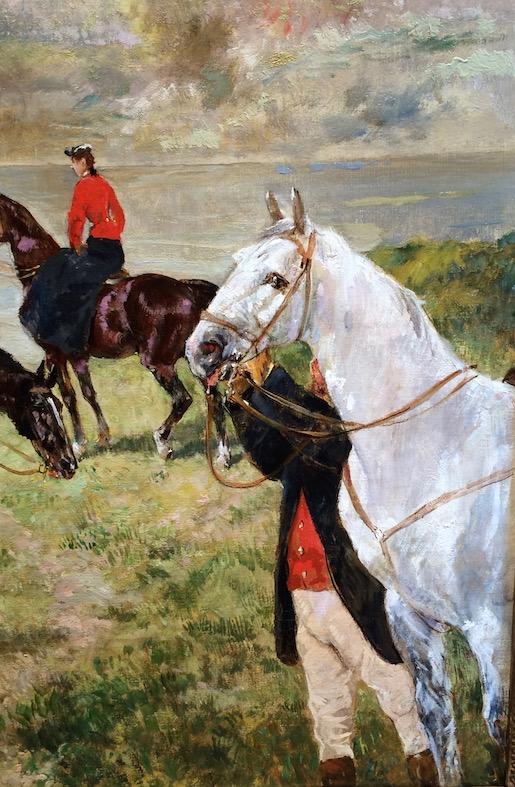
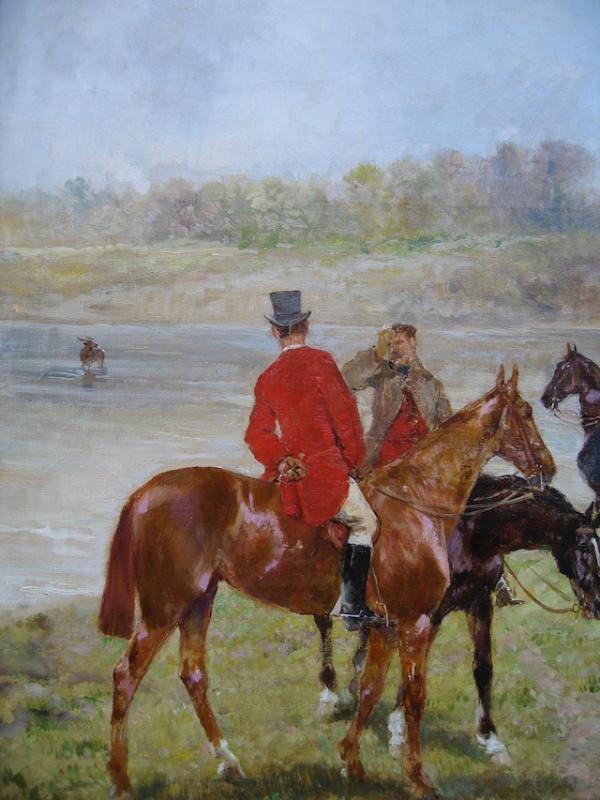
This painting depicts a hunt. The scene illustrates the "bat-l'eau," the moment in the hunt when the pursued animal takes refuge in the water.
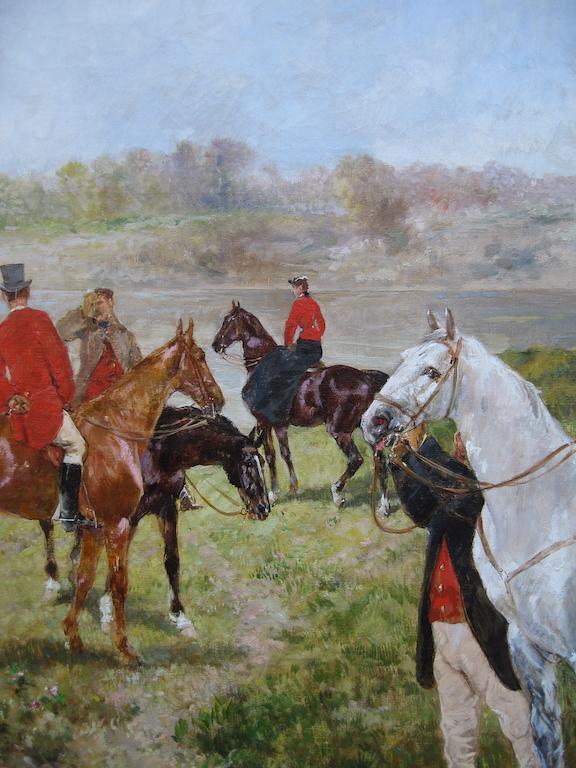
The horses and men are at a standstill; the hunters abandon the chase. With humor, the painter gives the man in the foreground the head of his white horse.
The painter focuses all his pictorial attention on the animal; the man is merely a colorful detail. The brushstrokes are free and precise, the colors vibrant, and the palette limited. He paints with a clear, assertive style. The artist rejects both academicism and the romantic humanization of the animal; he is only interested in the tamed horse. which he studies in the course of his duties.
At the beginning of the century, the interest in Lewis Brown was more related to his late embrace of Impressionism than to his early style. During this second artistic surge, he corresponded with Pissarro, Manet, Degas, Sisley, and Isabey. His palette brightened when he joined the Impressionists in Paris.
During his lifetime, John Lewis Brown distanced himself from the politics of the Salons and institutional events. In 1848, he made his debut at the Salon with Tambour, and did not exhibit again until 1859. The artist wanted to know only the joy of painting: he intended to be nothing more than his own painter, his own analyst, his own psychologist, a poet of his attitudes and preferences.
His ambition was to adore horses and to paint them up close. While the painter acknowledged his mentors, Géricault surpassed them all. He admired him for having "taken pleasure" in them. in the real stables, amidst pride, brutality, and all that is most equine in the horse.”
His father owned a château in the Bordeaux region; a wine estate still in operation today. The stud farm he owned was his son’s first step toward equine painting: he tirelessly copied and drew horses. The painter was self-taught; he worked for two years at the Haras des Pins stud farm and studied the work of Bonington, a distant precursor of Impressionism, toward whom he felt a deep affinity.
He copied Cuyp, Karel, and Philips Wouverman, and toured Italy twice. In 1852, he spent a long period in Copenhagen to fulfill a commission from the French state: to copy Rembrandt’s The Pilgrims at Emmaus. The painter achieved success through exhibitions in the provinces and received a gold medal in Limoges. His birth lent him legitimacy in the eyes of the aristocracy, whom he portrayed. for a time.
Bibliography: Most of the biographical information about the painter comes from his brother, Ralf Brown, Inspector of Fine Arts in Paris. He spoke directly with Léonce Bénédicte, curator of the Musée du Luxembourg and editor of the artist's exhibition catalogue.
Léonce Bénédicte, John Lewis Brown, biographical and critical study, catalogue of the artist's engraved and lithographed work, Paris, Librairie de l’Art Ancien et Moderne, 1903.
Exhibitions:
exh. cat. Gilberte Martin-Méry, Jacques Chaban-Delmas, Pierre Schommer, John Lewis Brown, 1829-1890, [exhibition: Bordeaux, Galerie des Beaux-Arts, October 19 to November 9, 1953] Bordeaux, Delmas, 1953.
Museums: held at the Musée d’Orsay, Paris and the National Gallery, London.
Signed lower left
Dimensions: 65 x 50 cm, with frame: 78 x 62 cm
Old exhibition label on the back with the artist's name, exhibition number 656, and the title "The Edge of the Pond"
John Lewis Brown was born in Bordeaux to a family of 18th-century English dignitaries. Originally from Scotland, the Browns are said to have introduced the English Thoroughbred breed to France.
This painting depicts a hunt. The scene illustrates the "bat-l'eau," the moment in the hunt when the pursued animal takes refuge in the water.
The horses and men are at a standstill; the hunters abandon the chase. With humor, the painter gives the man in the foreground the head of his white horse.
The painter focuses all his pictorial attention on the animal; the man is merely a colorful detail. The brushstrokes are free and precise, the colors vibrant, and the palette limited. He paints with a clear, assertive style. The artist rejects both academicism and the romantic humanization of the animal; he is only interested in the tamed horse. which he studies in the course of his duties.
At the beginning of the century, the interest in Lewis Brown was more related to his late embrace of Impressionism than to his early style. During this second artistic surge, he corresponded with Pissarro, Manet, Degas, Sisley, and Isabey. His palette brightened when he joined the Impressionists in Paris.
During his lifetime, John Lewis Brown distanced himself from the politics of the Salons and institutional events. In 1848, he made his debut at the Salon with Tambour, and did not exhibit again until 1859. The artist wanted to know only the joy of painting: he intended to be nothing more than his own painter, his own analyst, his own psychologist, a poet of his attitudes and preferences.
His ambition was to adore horses and to paint them up close. While the painter acknowledged his mentors, Géricault surpassed them all. He admired him for having "taken pleasure" in them. in the real stables, amidst pride, brutality, and all that is most equine in the horse.”
His father owned a château in the Bordeaux region; a wine estate still in operation today. The stud farm he owned was his son’s first step toward equine painting: he tirelessly copied and drew horses. The painter was self-taught; he worked for two years at the Haras des Pins stud farm and studied the work of Bonington, a distant precursor of Impressionism, toward whom he felt a deep affinity.
He copied Cuyp, Karel, and Philips Wouverman, and toured Italy twice. In 1852, he spent a long period in Copenhagen to fulfill a commission from the French state: to copy Rembrandt’s The Pilgrims at Emmaus. The painter achieved success through exhibitions in the provinces and received a gold medal in Limoges. His birth lent him legitimacy in the eyes of the aristocracy, whom he portrayed. for a time.
Bibliography: Most of the biographical information about the painter comes from his brother, Ralf Brown, Inspector of Fine Arts in Paris. He spoke directly with Léonce Bénédicte, curator of the Musée du Luxembourg and editor of the artist's exhibition catalogue.
Léonce Bénédicte, John Lewis Brown, biographical and critical study, catalogue of the artist's engraved and lithographed work, Paris, Librairie de l’Art Ancien et Moderne, 1903.
Exhibitions:
exh. cat. Gilberte Martin-Méry, Jacques Chaban-Delmas, Pierre Schommer, John Lewis Brown, 1829-1890, [exhibition: Bordeaux, Galerie des Beaux-Arts, October 19 to November 9, 1953] Bordeaux, Delmas, 1953.
Museums: held at the Musée d’Orsay, Paris and the National Gallery, London.
6 500 €
Period: 19th century
Style: Other Style
Condition: Excellent condition
Material: Oil painting
Width: 50 cm
Height: 65 cm
Reference (ID): 623437
Availability: In stock
Print