Josep De Togores (1893 - 1970) Female Nude
Artist: Josep De Togores (1893 - 1970)
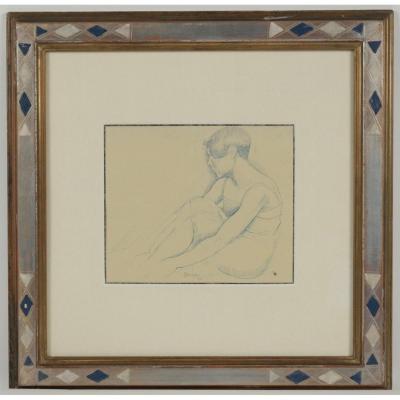
A fresh, sensual watercolor by Josep de Togores depicting a reclining nude woman.
Watercolor on paper.
Signed and dated 1920 in the upper right corner.
Dimensions: 18 x 23 cm. Framed: 32.5 x 37.5 cm.
Josep Togores i Llach, known as Josep De Togores, was a Catalan painter.
Josep de Togores created a body of work highly emblematic of the figurative movement in interwar Europe, and more specifically of Noucentisme—a distinctly Catalan movement.
The female nude was a favorite subject for Josep de Togores.
A clear framing of the body, a velvety and pearly terracotta modeling, a line that defines the form, and the serene placidity of the faces characterize the artist's work.
Biography
A figurative painter who evolved towards Surrealism, this Catalan painter, too little known in France, had his moment of glory in the 1920s. Thirty. He became deaf very early following meningitis. The silence that haunted Togores was an even firmer shield because it had initially been perceived as magical. Togores received a neoclassical training in Barcelona before settling in Paris in 1919. In Paris, he discovered Raphael, Ingres, Courbet, and Cézanne at the Louvre. He then created works in an incisive and powerful style very close to the hallucinatory realism of a Derain, which caught the attention of the famous art dealer Kahnweiler. When Kahnweiler provided him with the necessary income, Togores continued his work, softening his style, notably under the influence of his friend Maillol. In the sculptor's studio, Togores shared the same models and produced numerous female nudes, which were appreciated as far away as Germany. Drawn to the experiments of Masson and the automatic style, he was also encouraged by Kahnweiler to experiment with a more allusive figuration, which was part of a distinctly Spanish expression of Surrealism. Togores left Paris in 1932 and settled permanently in Barcelona. Numerous artistic influences—the Noucentista movement of the early 20th century in Catalonia, the New Objectivity of Germanic origin, post-Cubist debates in post-war Paris, and the emerging Surrealism—contributed to the development of his style. In 1929, under the pretext of a "global crisis," Kahnweiler, the legendary art dealer of the Cubists, abandoned him: "I took on Togores penniless and unknown eleven years ago. I'm leaving him now, but with money and a reputation." Togores, torn between abstraction—via Surrealist automatism—and the structuring need for a model, retreated to Barcelona, accepted commissions, and painted portraits of high society. In 1916, the influence of Cézanne is evident in his "Landscapes." Picasso noticed his painting "Joan and La Pepeta" as early as 1917. Later, from 1924-1925, figurative art moved towards Surrealism. For a long time, unmotivated arabesques could be seen in the hair. From 1928 to 1930, not a single figurative canvas was produced. Pressed by Despite the automatism of his writing, he avoids the orthodoxy of the Surrealists. Not unlike Masson's drawings, the canvases, nervous and fibrillating, ripple with white movements; an atomistic explosion of flesh from bygone eras. These works have been disconcerting, striving for the impossible synthesis between classicism and abstract art, with Cubism as its escort. The work of the young curator of the Châteauroux museums, Cécile Debray, who conceived the beautiful catalogue raisonné, deserves praise. Among other works, it includes previously unseen canvases, absent from the recent retrospective in Barcelona. Muriel Steinmetz (1998, Châteauroux exhibition).
Museums
Paris, Centre Pompidou; Barcelona, Museo Nacional Centro de Arte Reina Sofía; Andorra, Museu Carmen Thyssen
Source
https://www.cercledart.com/livres/togores-du-realisme-magique-au-surrealisme/
https://leblogabonnel.over-blog.com/2019/05/togores-peintre-catalan-du-realisme-magique-au-surrealisme.html
Watercolor on paper.
Signed and dated 1920 in the upper right corner.
Dimensions: 18 x 23 cm. Framed: 32.5 x 37.5 cm.
Josep Togores i Llach, known as Josep De Togores, was a Catalan painter.
Josep de Togores created a body of work highly emblematic of the figurative movement in interwar Europe, and more specifically of Noucentisme—a distinctly Catalan movement.
The female nude was a favorite subject for Josep de Togores.
A clear framing of the body, a velvety and pearly terracotta modeling, a line that defines the form, and the serene placidity of the faces characterize the artist's work.
Biography
A figurative painter who evolved towards Surrealism, this Catalan painter, too little known in France, had his moment of glory in the 1920s. Thirty. He became deaf very early following meningitis. The silence that haunted Togores was an even firmer shield because it had initially been perceived as magical. Togores received a neoclassical training in Barcelona before settling in Paris in 1919. In Paris, he discovered Raphael, Ingres, Courbet, and Cézanne at the Louvre. He then created works in an incisive and powerful style very close to the hallucinatory realism of a Derain, which caught the attention of the famous art dealer Kahnweiler. When Kahnweiler provided him with the necessary income, Togores continued his work, softening his style, notably under the influence of his friend Maillol. In the sculptor's studio, Togores shared the same models and produced numerous female nudes, which were appreciated as far away as Germany. Drawn to the experiments of Masson and the automatic style, he was also encouraged by Kahnweiler to experiment with a more allusive figuration, which was part of a distinctly Spanish expression of Surrealism. Togores left Paris in 1932 and settled permanently in Barcelona. Numerous artistic influences—the Noucentista movement of the early 20th century in Catalonia, the New Objectivity of Germanic origin, post-Cubist debates in post-war Paris, and the emerging Surrealism—contributed to the development of his style. In 1929, under the pretext of a "global crisis," Kahnweiler, the legendary art dealer of the Cubists, abandoned him: "I took on Togores penniless and unknown eleven years ago. I'm leaving him now, but with money and a reputation." Togores, torn between abstraction—via Surrealist automatism—and the structuring need for a model, retreated to Barcelona, accepted commissions, and painted portraits of high society. In 1916, the influence of Cézanne is evident in his "Landscapes." Picasso noticed his painting "Joan and La Pepeta" as early as 1917. Later, from 1924-1925, figurative art moved towards Surrealism. For a long time, unmotivated arabesques could be seen in the hair. From 1928 to 1930, not a single figurative canvas was produced. Pressed by Despite the automatism of his writing, he avoids the orthodoxy of the Surrealists. Not unlike Masson's drawings, the canvases, nervous and fibrillating, ripple with white movements; an atomistic explosion of flesh from bygone eras. These works have been disconcerting, striving for the impossible synthesis between classicism and abstract art, with Cubism as its escort. The work of the young curator of the Châteauroux museums, Cécile Debray, who conceived the beautiful catalogue raisonné, deserves praise. Among other works, it includes previously unseen canvases, absent from the recent retrospective in Barcelona. Muriel Steinmetz (1998, Châteauroux exhibition).
Museums
Paris, Centre Pompidou; Barcelona, Museo Nacional Centro de Arte Reina Sofía; Andorra, Museu Carmen Thyssen
Source
https://www.cercledart.com/livres/togores-du-realisme-magique-au-surrealisme/
https://leblogabonnel.over-blog.com/2019/05/togores-peintre-catalan-du-realisme-magique-au-surrealisme.html
3 500 €
Period: 20th century
Style: Art Deco
Condition: Excellent condition
Material: Water color
Width: 23 cm
Height: 18 cm
Reference (ID): 1682444
Availability: In stock
Print