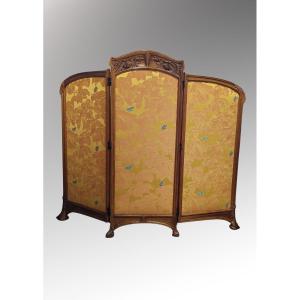
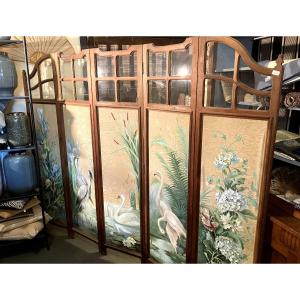
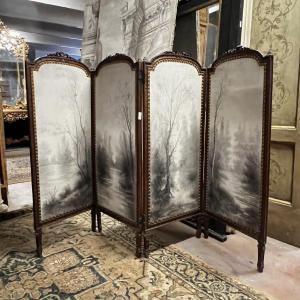
An Important And Rare Art Nouveau Three-panel Folding Screen, Decorated By Hans Christiansen (1866–1945)
Height: 160 cm | Width: 170 cm
Embossed leather, decorated with colours and gold.
Maple wood frame.
The reverse is finished in gold-coloured paint and lacquer.
A comparable folding screen is held in the collection of the Bröhan Museum in Berlin.
Georg Hulbe und Hans Christiansen
Paravent, Hamburg um 1900
Hans Christiansen (1866–1945) An Important and Rare Three-Panel Art Nouveau Screen with Water Lilies
Germany, circa 1897–1900
Design: Attributed to Hans Christiansen
Execution: Attributed to the workshop of Georg Hulbe, Hamburg
Materials: Embossed and polychrome-decorated leather with gilt highlights; maplewood frame. Reverse finished in gold-coloured lacquer.
Dimensions: Height 160 cm; width 170 cm
Reference No.: 2857
This exceptional three-panel screen represents a remarkable example of the early German Art Nouveau movement, embodying its ambition to unite fine art and craftsmanship within a harmonious aesthetic whole.
The elaborately decorated leather panels display a luxuriant, highly stylised aquatic landscape dominated by large water lilies rendered in delicate shades of cream, rose and gold. Slender, gracefully curving stems and sinuous tendrils rise across the composition, visually uniting the three panels into a continuous decorative ensemble.
Of particular artistic distinction is the rhythmic treatment of line. The elongated, flowing plant stems exemplify the characteristic whiplash curves that became one of the defining ornamental features of international Art Nouveau.
Rather than presenting a purely naturalistic interpretation of botanical forms, the artist transforms the flowers and foliage into an intricate ornamental structure. The apparently spontaneous growth of the vegetation is governed by a carefully balanced composition in which organic movement and decorative order achieve a sophisticated equilibrium.
The rich blue, green and reddish-brown tones of the background provide a striking contrast to the luminous blossoms and gilded stems. The finely embossed leather lends the surface a subtle sculptural quality, allowing the floral motifs to acquire remarkable vitality under changing light.
The composition also reveals the influence of East Asian art, particularly Japanese decorative traditions. The deliberate suppression of conventional perspective, the asymmetrical arrangement of botanical elements and the emphasis on the ornamental qualities of the picture plane reflect the profound impact of Japonisme on the development of European Art Nouveau.
Hans Christiansen and the Art Nouveau Reform MovementHans Christiansen ranks among the most versatile and distinctive figures of German Jugendstil.
Working as a painter, graphic artist and designer of decorative objects, he embraced the ideal of the Gesamtkunstwerk, or total work of art, in which architecture, furniture, textiles and interior decoration were conceived as an integrated artistic whole.
Following formative periods in Hamburg and Paris, Christiansen was invited in 1899 to become one of the founding members of the Darmstadt Artists’ Colony at Mathildenhöhe. Alongside artists such as Joseph Maria Olbrich and Peter Behrens, he contributed to the emergence of a new and distinctly modern artistic vocabulary, consciously rejecting the historicist styles of the nineteenth century.
His designs are distinguished by an unmistakable combination of floral ornament, vibrant colour and a highly sophisticated understanding of decorative surface composition.
The present screen exemplifies this artistic philosophy, reflecting the transformation of Art Nouveau into a comprehensive movement for the reform of the decorative arts.
The Leatherwork of Georg Hulbe’s WorkshopThe sophisticated execution in embossed, polychrome and gilt-decorated leather recalls the distinguished tradition of artistic leatherworking that flourished around 1900, particularly through the achievements of the Hamburg master craftsman Georg Hulbe (1851–1917).
Hulbe was among the leading German leather artists of his generation. His workshop was renowned for technically accomplished work combining traditional methods of leather cutting, embossing and tooling with innovative contemporary designs.
The combination of ambitious artistic conception and exceptionally refined leatherworking gives screens of this type a distinctive position within the decorative arts of the turn of the twentieth century.
Museum Comparison and Art Historical SignificanceOf particular importance is a comparable leather screen in the collection of the Bröhan Museum, Berlin.
This example, dated circa 1897, has been documented in connection with an exhibition devoted to Hans Christiansen, with the design tentatively attributed to Christiansen and the execution associated with Georg Hulbe.
It therefore provides an important art historical point of reference for the attribution and classification of the present screen.
Combining the artistic ideals of early Jugendstil with an exceptionally decorative treatment of materials, the present work occupies a position between functional furniture and autonomous artistic creation. It eloquently illustrates the deliberate dissolution of traditional boundaries between fine art and the applied arts.
Its expressive floral composition, richly coloured and gilt-accented leather decoration, and significant association with the artistic oeuvre of Hans Christiansen distinguish this screen as a remarkable example of German Art Nouveau craftsmanship at the turn of the twentieth century.
Paravent, Hamburg um 1900
Embossed leather, decorated with paint and gold. Wooden frame. The reverse side features gold-painted lines. A comparable folding screen is held in the collection of the Bröhan Museum in Berlin and is based on a design by Hans Christiansen. Georg Hulbe (born September 27, 1851, in Kiel; died November 16, 1917, in Hamburg; full name: Georg Ernst Friedrich Hulbe) was a German bookbinder and leather artisan active in Hamburg during the periods of Historicism and Art Nouveau (Jugendstil). Life and Work: Following the completion of major commissions for the Reichstag building in Berlin and the Hamburg City Hall, he relocated his workshops in 1889 to his own properties in Hamburg. From 1894 to 1911, he also operated a retail shop at Jungfernstieg 26 (Hamburger Hof), prior to the completion of his own building at Mönckebergstraße 21, known as the “Hulbe-Haus.” Between 1887 and 1911, he maintained a branch or retail outlet in Berlin at Leipziger Straße 121. His branch in Frankfurt am Main was also situated in an exclusive location (Goethestraße 19). Hulbe produced high-end, premium-priced leather goods, including writing portfolios, folding screens, caskets, furniture, wall coverings, and more. A distinctive feature of his work was the high level of artistry and quality in his punching and embossing—a technique also known as “gauffering” when applied to leather. Among his notable projects, he created the leather furnishings for the Hamburg City Hall and the Reichstag in Berlin. For the inauguration of the Hamburg City Hall in 1897, he crafted the city’s “Golden Book.” He also produced a genealogical chart in leather for the House of Bismarck-Schönhausen. Height: 160 cm
Period: 20th century
Style: Art Nouveau
Condition: Excellent condition
Material: Leather
Width: 170 cm
Height: 160 cm
Reference (ID): 1864658
Availability: In stock