Oscar Rex (graz, 1857 – Prague, 1929) - The Little Painter In The Studio
Artist: Oscar Rex
Oscar REX
(Graz, 1857 – Prague, 1929)
The Little Painter in the Studio
(Cupid as Painter, a Playful Allegory of Painting)
Circa 1890-1895
Watercolour en grisaille on board
Signed lower right O.Rex
77 × 62.5 cm (30 ⅜ × 24 ⅝ in.)
On the reverse, an autograph dedication by the artist’s widow: “À mes chers amis, Monsieur et Madame B[rest], en souvenir des jolis instants passés ensemble à notre Exposition de Clam Gallas du 17 Mars au 3 Avril 1933. — Marie Nora Rex née Eudes de Longchamps. Prague le 3 Avril 1933.” (“To my dear friends Monsieur and Madame B[rest], in memory of the delightful moments spent together at our Clam-Gallas exhibition, 17 March to 3 April 1933.”) The reverse also bears a typed label in German giving the artist’s name and the technique.
Provenance:
Marie Nora Rex, née Eudes de Longchamps, the artist’s widow, Prague;
given by her to M. and Mme B[rest], Prague, 3 April 1933, at the close of the exhibition at the Clam-Gallas Palace;
Exhibited (probably): Prague, Clam-Gallas Palace, 17 March – 3 April 1933.
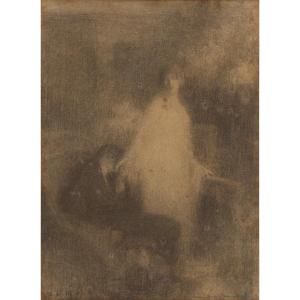
In the corner of a cluttered studio, a naked little boy, a drapery thrown over one shoulder, stands on a Louis XV armchair to reach a large canvas on an easel. Palette in hand, he uses a long brush to paint a childish jumble: a tree laden with pears and grapes, soap bubbles, a grotesque head with bristling hair, a laughing cherub’s face and a bottle floating on the sea. On the left, a plaster cast of the Venus de Milo on its pedestal, the staple model of academic training, looks on impassively. Frames propped on the floor and scribbles on the wall complete the studio setting.
The artist revisits, with humour, an old motif dear to eighteenth-century French art: putti trying their hand at the liberal arts. He gives it a twist, however. The child turns his back on the classical ideal embodied by the Venus in favour of caricature and fancy. His soap bubbles, a traditional emblem of vanity, are an ironic reminder of how fragile a painter’s ambitions can be. The monochrome handling, in shades of brown, isolates the scene in a soft interior light and adds to its character as a witty sketch on the painter’s craft.
Born in Graz in 1857 and dying in Prague in 1929, Oscar Rex grew up in Prague. He entered the Munich Academy in 1878, then completed his training in Paris under Mihály Munkácsy, Gustave Boulanger and Jules Lefebvre. He kept close ties with France, which supplied many of his subjects, from the Jardin des Tuileries to Picardy¹. He married a Frenchwoman, Marie Nora Eudes de Longchamps.
From early on, Rex conceived much of his work with publication in mind. In 1893 a portfolio of forty phototypes after his paintings was published in Prague. His Napoleonic cycle, several paintings of which are now in the Château de Malmaison, was shown at Eduard Schulte’s gallery in Berlin in 1898; there, nineteen pictures were exhibited, and critics judged them plainly intended for colour reproduction².
Alongside this, Rex cultivated a satirical vein in his works on paper. In 1894, at the annual exhibition of the Kunstverein für Böhmen in Prague, he showed a series of thirty ink drawings entitled Großstadtluft (“City Air”). Their parodic titles, one of them a pastiche of Goethe, drew the sarcasm of the Kunstchronik³. Our work belongs to this production of the 1890s, both through its humour and through its grisaille technique, particularly well suited to photomechanical reproduction.
After the artist’s death, his widow looked after his work. In the spring of 1933 she organised an exhibition at the Clam-Gallas Palace in Prague, at the close of which she gave our work to friends, as the dedication on the reverse records.
¹ Rudolf Bangel sale, Frankfurt am Main, no. 609, 8-10 December 1903, p. 21.
² Kunstchronik, N.F. 9, 1897-1898, no. 16, 24 February 1898, col. 263 (review signed A. R.).
³ Kunstchronik, N.F. 5, 1893-1894, cols. 387-388 (review signed H. W. S.).
Reference
Élisabeth Caude and Rémi Cariel, Regard sur Oscar Rex (1857-1929), peintre de la légende napoléonienne, Rueil-Malmaison, Musée national des châteaux de Malmaison et Bois-Préau, 2021.
2 000 €
Period: 20th century
Style: Art Nouveau
Condition: Perfect condition
Width: 62,5 cm
Height: 77 cm
Reference (ID): 1859772
Availability: In stock
Print