

Albert Kornek (breslau, 1813 – Charlottenburg, 1905) - A Young Crossbowman
Artist: Albert Kornek
Albert KORNEK (Breslau, 1813 – Charlottenburg, 1905)
A Young Crossbowman.
1880.
Oil on canvas.
Estate stamp of the artist on the stretcher.
H. 78.5 × W. 65.5 cm.
Provenance: the artist’s estate sale, Berlin, Rudolph Lepke, 20 February 1906, lot 47.
Born in 1813 in Breslau, in Prussian Silesia, Albert Kornek was originally intended for the clergy, but his precocious gift for painting was noticed as early as the 1830s. He accordingly entered the Berlin Academy in 1833 and trained under von Klöber before joining the studio of Karl Sohn in Düsseldorf. He belongs to the generation of nineteenth-century German artists who, in the wake of late Romanticism and the Realist movements, sought to combine naturalistic precision with heroic idealisation. Both a portraitist and a painter of Romantic subjects drawn from Goethe and folk tales, he became a teacher in Berlin in the 1840s, where he worked as a portraitist and as a painter of religious subjects for the Prussian court.
Active in the second half of the century, he produced a body of work that remains little known today, yet is well documented by reliable sources: his name appears in Friedrich von Boetticher’s directory, the standard reference work for the study of German painting of the period. The Junger Schütze (literally “Young Marksman”) is listed there among his works [1].
His work belongs to the great academic tradition of unified Germany, attentive to accuracy of representation, rigour of pictorial construction and a striving for moral elevation through subject matter. Kornek was part of this movement, which placed the human figure at the heart of narratives, whether historical, allegorical or genre.
Our painting, executed in 1880 and identified at the artist’s estate sale under the title Junger Schütze [2], demonstrates Kornek’s mastery of portraiture, poised between genre scene and heroic figuration.
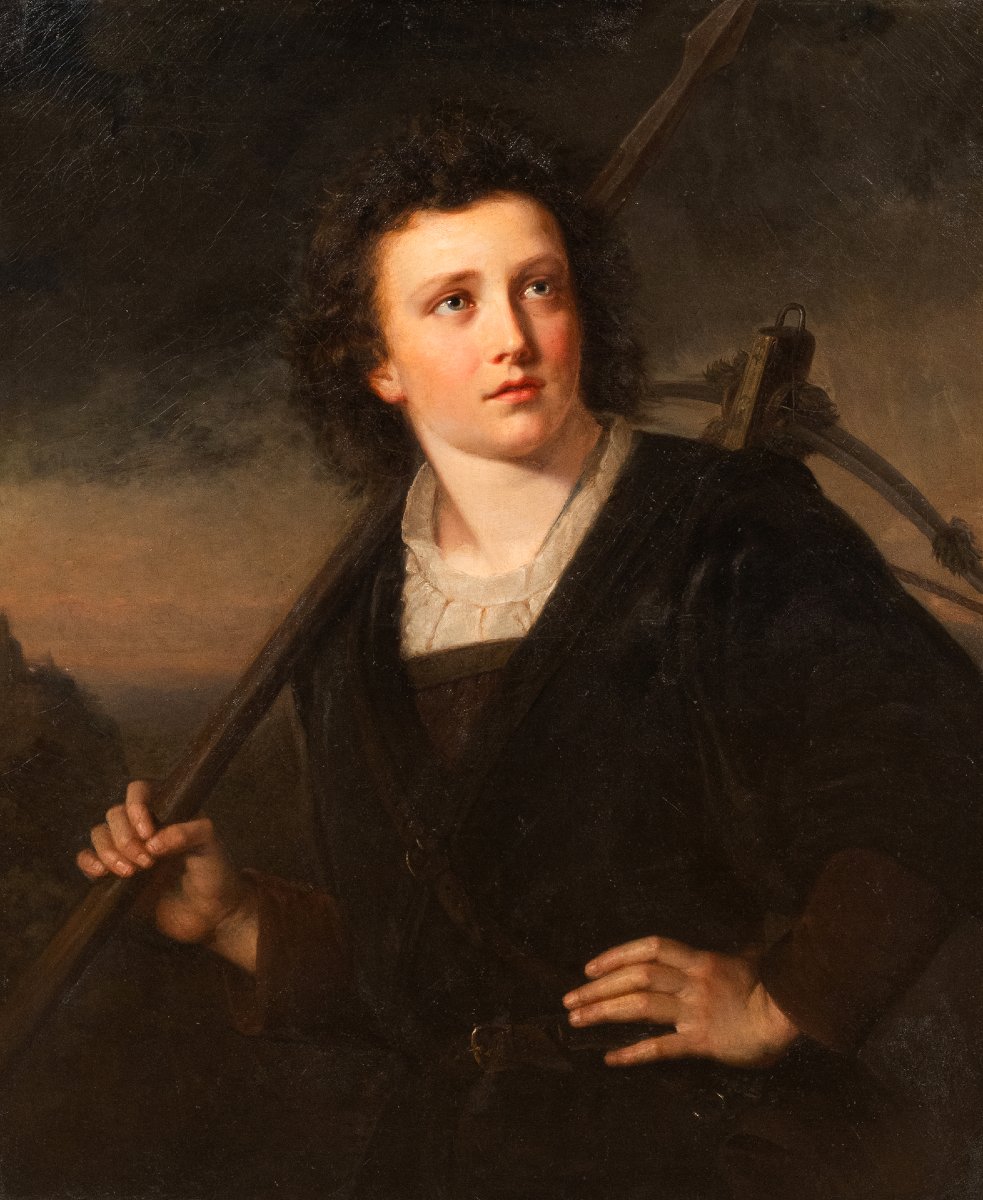
The work depicts a young crossbowman with a youthful, luminous face, captured in an attitude of pride and momentum. Posed in three-quarter view, the sitter carries his weapon slung across his shoulder, one hand resting on his hip, his gaze turned towards an unseen horizon. His expression, at once grave and dreamy, lends the composition a dramatic intensity, as though the figure stood on the threshold of his destiny.
The palette, dominated by deep browns and blacks, sets off the radiance of the face and hands, heightening the contrast between light and shadow. The brushwork, precise without being stiff, reveals a solid academic training. The figure stands out against a dark background, subtly enlivened by a twilight sky, which heightens the theatrical effect.
More than a mere portrait, the Junger Schütze belongs to a lineage of depictions of heroic youth dear to the nineteenth century. The figure of the crossbowman, weapon slung across his shoulder, evokes Germanic traditions as much as the Romantic notion of a privileged bond between man, nature and national history. The painting thus reflects a twofold aspiration: to render a face and a costume truthfully, but also to offer a universal image of courage and hope.
The fact that it remained in the artist’s possession until his death, as indicated by his estate stamp, and that it is recorded in Boetticher’s directory, gives this painting a distinguished provenance and a secure place in the history of nineteenth-century German painting.
Through this figure, Kornek engages with a whole nineteenth-century iconography in which armed youth embodies the vitality and future of the nation. Defregger had celebrated the young mountain folk of the Tyrol, Menzel the Prussian recruits, Feuerbach the heroes of antiquity. Kornek chose a more intimate path: by isolating his crossbowman from any specific historical context, he turned him into a universal symbol, at once realistic and idealised.
[1] Friedrichvon Boetticher (1895), Malerwerke des neunzehnten Jahrhunderts,Boetticher’s Verlag, Dresden, pp. 744–745.
[2] Gemäldemoderner Meister. Nachlässe: Professor Albert Kornek, Berlin (I. Teil),Direktor Lamm, München (I. Teil) u. a., sale catalogue no. 1440, Berlin,Rudolph Lepke’s Kunst-Auctions-Haus, 20 February 1906, p. 7, lot 47.https://doi.org/10.11588/diglit.30842#0017
15 000 €
Period: 19th century
Style: Napoleon 3rd
Condition: Excellent condition
Material: Oil painting
Width: 65,5 cm
Height: 78,5 cm
Reference (ID): 1851535
Availability: In stock
Print