

Fernand Nadal & A. Roquin Layout For A Promotional Brochure For The Champlain C.g.t. Ocean Liner Cruise, Ca. 1930
Artist: Fernand Nadal & A. Roquin
Layout for a C.G.T. tourism brochure.
Fernand NADAL & A. ROQUIN – Layout for a promotional brochure for a Mediterranean cruise aboard the Champlain (Compagnie Générale Transatlantique).
No place [Paris], Publimp-Nadal, undated (late 1930s).
Pins holes in the corners; overall in very good condition.
Set of 7 cardboard-backed sheets (ranging from 197 x 490 mm for the smallest to 330 x 490 mm for the largest) featuring photographic montages by Fernand Nadal and original gouaches by A. Roquin, with page borders and marginal annotations in pencil.
The set consists of:
Sheet 1: a large photo of the Champlain on the left and a gouache depicting a fully veiled woman
Sheet 2: Stopover in Smyrna – Santonin’s Stopover: a signed gouache on the left depicting a map with two views and two photomontages of cacti and banana trees, with a gouache map of the Mediterranean in the center on the right
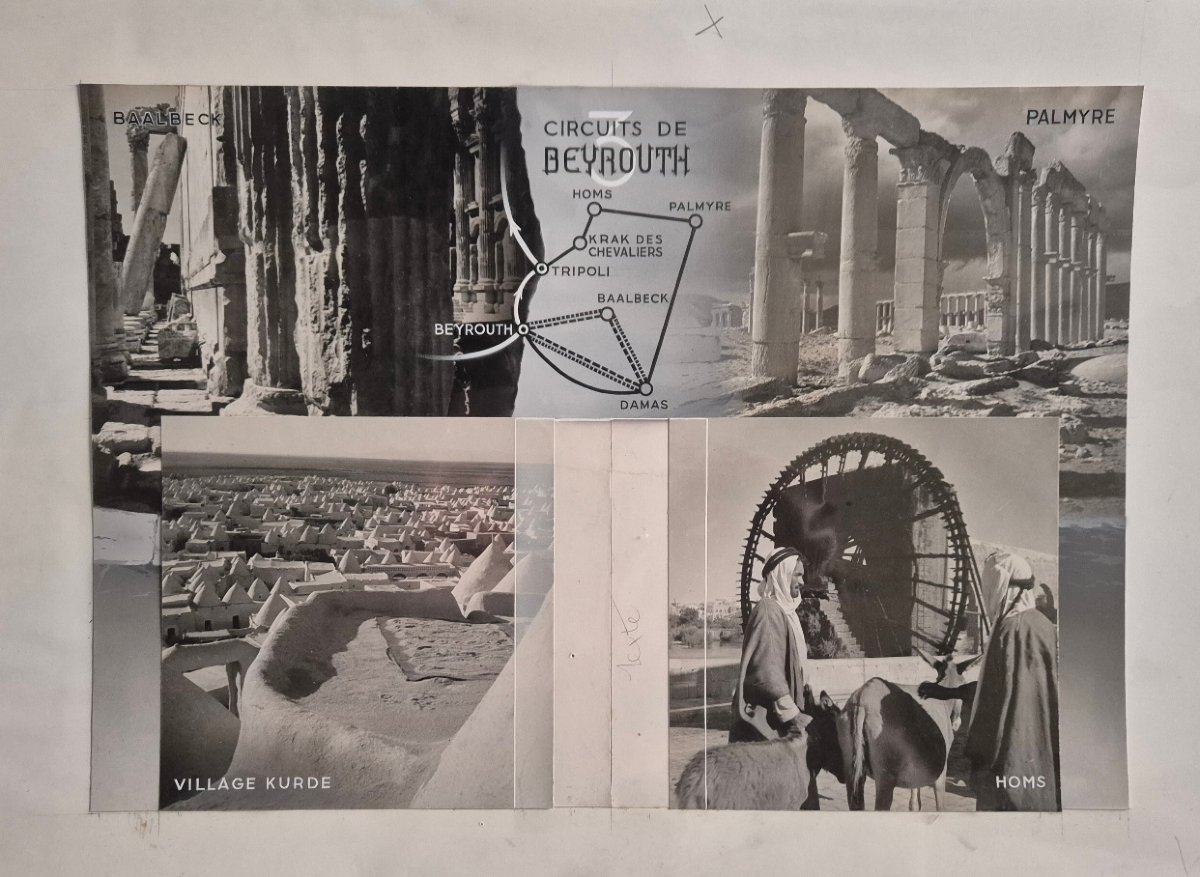
Plate 3: A medley of four original photographs depicting Baalbeck, Palmyra, a Kurdish village, and Homs, along with a gouache map of the Beirut circuit
Plate 4: A collage of 8 original photographs, including a woman of the Foula ethnic group
Plate 5: A collage of 8 original photographs, including a veiled woman and a Berber man (their clothing heavily retouched with gouache)
Plate 6: A collage of 8 original photographs, including a snake charmer
Plate 7: 1 photograph of the Hassan Tower in Rabat, with the inscription “Publimp-Nadal” at the bottom left, and an original gouache depicting a Bedouin praying in the desert, with his dromedary at his side.
Fernand Nadal, born in Algeria (in Hussein-Dey in 1898? or in El Affroun in 1902?), photographer and advertising designer. He arrived in Indochina in the early 1920s; in 1921, he settled at 150 Rue Catinat in Saigon. Some of his photographs were published in *Le Monde colonial illustré* between 1929 and 1931, and were also used by the General Government. He produced numerous official photo reports: on the 11th Colonial Infantry Regiment and on the monuments of Saigon. His advertisement in the *Adresses commerciales de Saigon* stated in 1922: “photography studio; sale of photographic supplies and products.” He employed one European and six Vietnamese. He worked for the General Government, for the owners of the grand hotels built at tourist sites such as Angkor, and for Saigonese merchants, for whom he produced advertising campaigns. He published printed photo albums and postcards and owned a branch in Phnom Penh. He produced photo reports for major local companies; for example, in 1923–1924, he produced a report on the La Bien-Hoa Industrielle Forestry Company, which at the time held a monopoly on the export of Indochinese timber. In 1930, he covered the official visit of the governor of the Philippines, Dwight Davis, to Hanoi. In 1935, his postcards indicated that his studio was located at 120 Catinat Street in Saigon. They were still being published in the 1950s. (Sources: Marie-Hélène Degroise, *Photographers of Asia (1840–1944)*).
Upon his return to France in the late 1930s, he became an advertising designer; his agency was named Publimp-Nadal. The splendid 1937 Bugatti brochure, *Le pur-sang de l’automobile*, is one of his most famous publications from that era. He also produced a beautiful poster illustrated by Roquin for Cunard White Star (ca. 1939).
We know very little about A. Roquin, aside from posters signed with his name for the French State Railways, Air Afrique, and Cunard White Star.
450 €
Period: 20th century
Style: Art Deco
Condition: Good condition
Material: Cardboard
Reference (ID): 1859088
Availability: In stock
Print