THIS OBJECT WAS SOLD
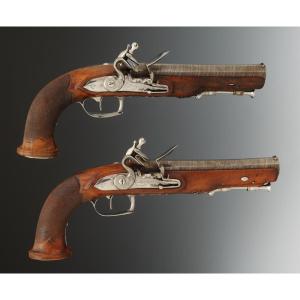
Pair Of Saddle Pistols By Johann Jacob Behr, Circa 1720.


PAIR OF SADDLE PISTOLS BY JOHANN JACOB BEHR, circa 1720. 34625
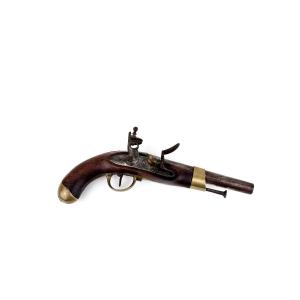
Handles carved from fruitwood featuring various foliage motifs and scrollwork, with the butt end made of black wood (ebony?), and a cross-shaped mark stamped near the trigger guard: “S-O-N?” inscribed within a triangle. All fittings are of polished brass: butt caps shaped like a lion’s muzzle and accented with intricate plant motifs, ornate openwork trigger guards, grooved trigger guards with the ends chiseled with plant-inspired palmette motifs, and “No. 37” engraved on the inside of the trigger guard, repeated on each pistol. Grooved barrel lugs. Square lock plates engraved with the name of the arquebusier Johann Jacob Behr “J.J.BEHR,” originally from Würzburg in Bavaria, known for his work in Liège and Maastricht, and primarily active from 1720 to 1740. Fluted barrel with a brass sight band; small hallmark stamps are struck beneath the breech: “Z-L and P.”
Total length of the pistols: 50 cm; barrel length: 33.6 cm; caliber: 1.6 cm; weight: 1.250 kg.
Germany
18th century, reign of Charles VI of Habsburg, Holy Roman Emperor, circa 1720.
Very good condition, modern stocks.
PROVENANCE:
Former PM collection.
BIOGRAPHY:
Johann Jacob Behr (also known as Johann Jakob Behr, J. J. Behr, I. I. Behr, or II. Behr) was an arquebusier / Büchsenmacher active in the first half of the 18th century, particularly notable for his association with several major arms-making centers in the German-speaking world and the Southern Netherlands.
Birth: 1679, probably before April 6.
Death: December 30, 1746, in Liège.
Origin: Würzburg (Wurtzbourg), in Franconia, now in Bavaria. He is documented as a gunsmith, cannon maker, and lock engraver. His career is notably linked to Würzburg, Wallerstein, Darmstadt, Maastricht, and Liège.
Behr was not officially a member of the Würzburg gunsmiths’ guild, but had nevertheless obtained permission to practice there under certain conditions. Two of his children were born there in 1709 and 1713. After 1713, there are no further records of him in Würzburg.
On August 21, 1726, he was granted citizenship in Liège. He remained there until his death in 1746.
Behr produced pistols, rifles, carbines, and rampart guns, primarily flintlock models. His work is generally dated to the first third and second quarter of the 18th century. The Rijksmuseum in Amsterdam holds, among other items, a flintlock pistol attributed to Johann Jacob Behr, made in Liège around 1720–1740. The lock plate bears the signature “II. BEHR.” The weapon features highly ornate copper/brass fittings, engraved decorations, and bronze components. The Rijksmuseum also attributes to him a flintlock rampart musket, dated 1700–1710, which is interesting because it may indicate that Behr was active relatively early in his career. There are also known pairs of luxury pistols bearing the signature I.I. BEHR. Christie’s, for example, described a pair from around 1730, with decorated rifled barrels, gilded brass mountings, and carved walnut stocks. The lot description notes that Behr also worked in Maastricht and Liège and that his firearms are preserved in several historic German collections.
His work in Liège was particularly significant. Behr was part of the great tradition of Liège gunsmiths who, in the early 18th century, supplied weapons to various European powers.
A particularly interesting example concerns the Prussia of Frederick William I. Orders for weapons were placed in Liège in 1718 and 1720, and Behr appears to have been among the suppliers. One or more pairs of military pistols from his production are associated with purchases intended for the Prussian army. In particular, a 1713 cavalry pistol bearing Behr’s signature features the monogram FWR, standing for Friedrich Wilhelm Rex (Frederick William I), as well as a regimental mark.
He was not merely a craftsman producing luxury civilian firearms, but also a gunsmith capable of fulfilling major military commissions.
Explore similar pieces and discover your ideal find:
Antique Firearms