

Abel And Cain: Oil On Wood Panel — Spanish School, 17th Century
Artist: Ecole Espagnole
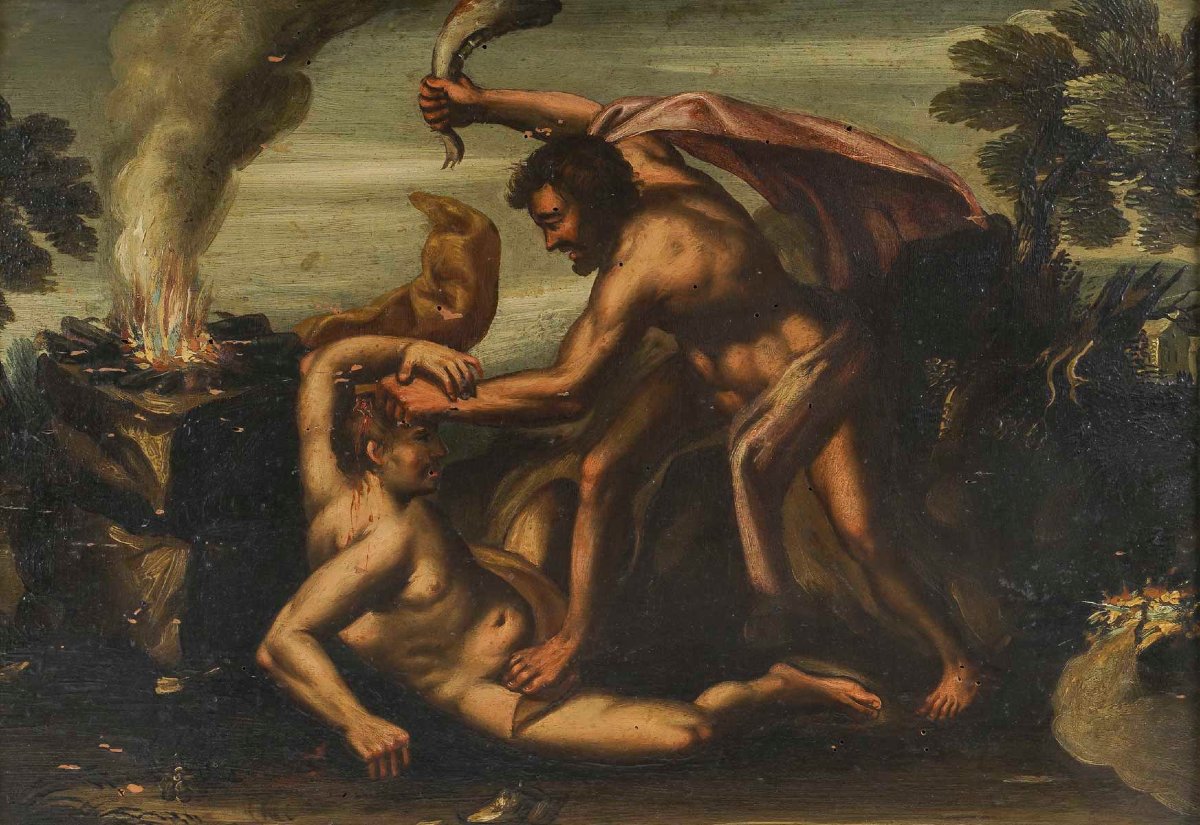
The scene illustrates Genesis chapter 4: the first homicide in human history. Cain, a farmer, and Abel, a shepherd, each offer a sacrifice to God; Abel's offering is accepted, Cain's is not. Consumed by jealousy, Cain lures his brother to the fields and kills him. The composition captures the very moment of the murder, in a tight format that focuses the action on the two brothers and eliminates any superfluous narrative background.
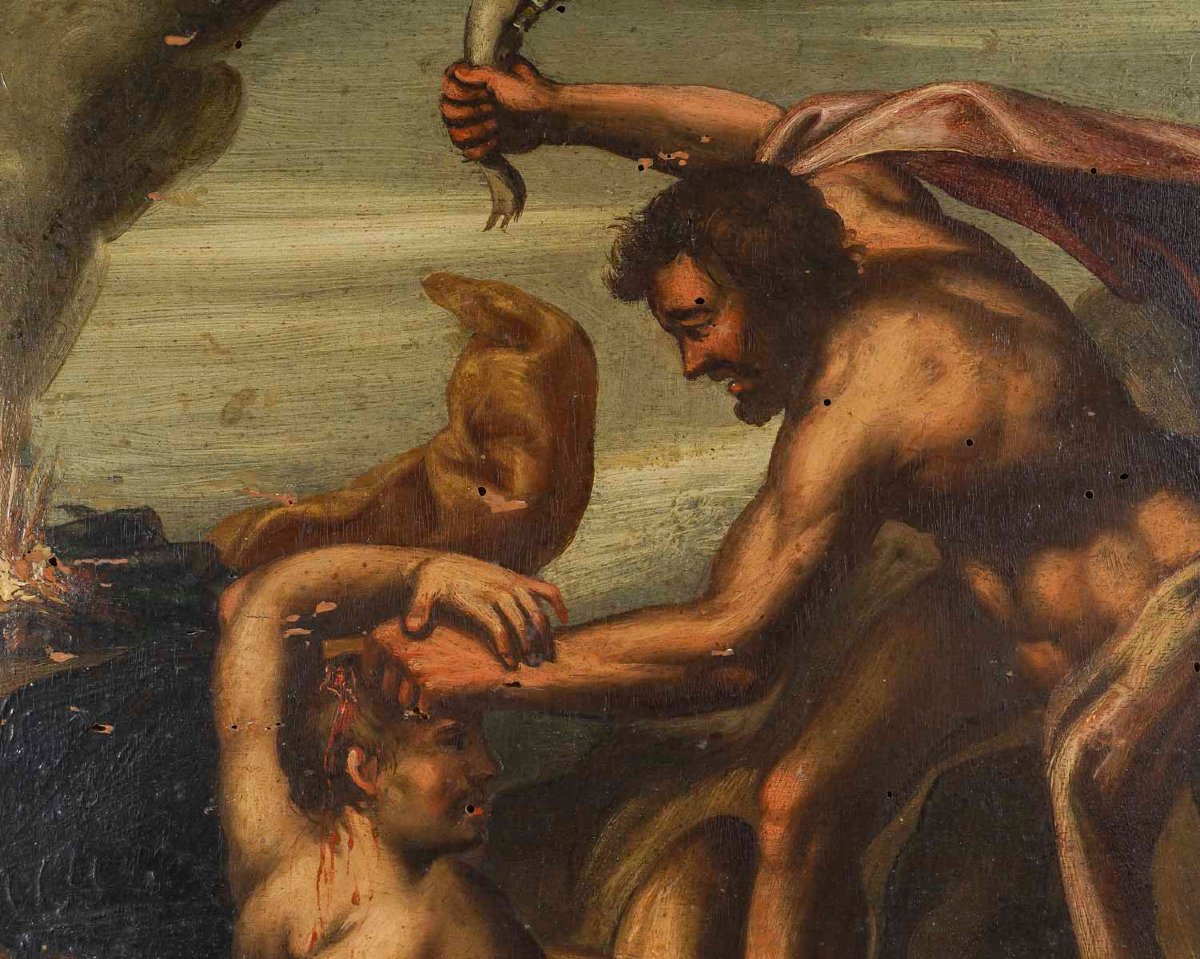
Cain, standing, brandishes in his right hand a donkey's jawbone, grasped by the joint and turned to strike. The bone is unambiguously identifiable: the lower jaw is wide open, the row of molars is visible beneath the closed hand, the ascending ramus is clearly defined, and the articular surface faces downward. This is the canonical attribute of the first homicide, attested from the earliest Christian cycles and fixed in the iconography of Genesis: the donkey's jawbone identifies Cain and allows us to name the scene.
Interpretation of the figures:
• Cain, standing naked, draped in a pink cloak, in a dominant and elevated position. His right hand brandishes the jawbone; his left hand, placed flat on Abel's skull, pins his victim's head to the ground to immobilize him before the blow. The gesture is one of calculated coldness, not blind fury: the muscular anatomy and fair complexion give the murderer the appearance of an athlete, not a peasant.
• Abel, naked, lying on the ground, half-raised on his left arm, his right leg extended. His head is held firmly in place, his face turned towards the viewer, already showing a wound on his forehead from which blood is oozing. The gaze directed at the viewer, rather than at the murderer, is a distinctive feature of Spanish Golden Age painting, which seeks emotion in the confrontation rather than in the unfolding of the narrative.
The stone altar and its column of smoke, on the left, are the motif of the Offering of Cain and Abel: the painter condenses two moments of the chapter—the refused sacrifice, then the murder—into a single scene, a common technique in Old Testament painting.
The peacock, in the shadows in the foreground on the right, functions as a moral commentary: the bird is associated with pride and the fall in exegetical tradition. It symbolizes paradise lost and the sin that has just been committed. Its discreet, almost hidden presence is the most sophisticated detail of the composition.
In the background, a rocky mass, a tree on the right, and a simple landscape beneath a low sky streaked with greenish clouds close off the composition and isolate the two brothers from the world.
Style and Dating
The following characteristics place the work within 17th-century Spanish painting, specifically its naturalist current with Caravaggesque influences:
Extensive and contrasting modeling of the flesh, chiaroscuro inherited from Roman Caravaggism, transmitted to Spain via Naples and Rome in the early decades of the century.
Mute tones, predominantly olive-brown and ochre, enhanced with pink and thick whites applied in visible strokes—the Iberian taste for rich impasto.
Broad, swirling draperies, executed quickly, almost sketchily, focusing on Cain's cloak.
Warm, rosy complexions of the two figures, lit from the front against a dark background. The support—a wooden panel—is consistent with this attribution: Spain retained the use of panel for small devotional and cabinet works longer than Italy, where canvas became the preferred medium earlier. The modest size and the concentrated nature of the composition suggest a cabinet work, intended for a private collector or for domestic devotion.
Inscription on the reverse:
"ARCAYOS," in ink, in cursive script on the panel. This inscription was probably added after the work's execution and may refer to a locality or a family of landowners.
Arcayos is a Spanish toponym: a hamlet in the municipality of Villaselán, province of León (Castile and León), where Villaverde de Arcayos also exists. The spelling agrees with the Spanish attribution adopted here and points to the north of the peninsula—a region with a strong Caravaggesque tradition due to its ties with Italy and Flanders.
• Owner's surname (the forms Arcay, Arcaya, and Arcayos exist in Spain): used to record family property during an inventory or inheritance division.
Condition and dimensions: Painted wooden panel in good visual condition. Antique panel depicting galleries of old wood-boring insects.
Visible dimensions: 28 x 40 cm
Molded gilt frame decorated with foliage and scrolls. 18th-century association. 33 x 45.5 cm
1 900 €
Period: 17th century
Style: Other Style
Condition: Good condition
Material: Oil painting on wood
Width: 45,5 cm
Height: 33 cm
Reference (ID): 1856267
Availability: In stock
Print