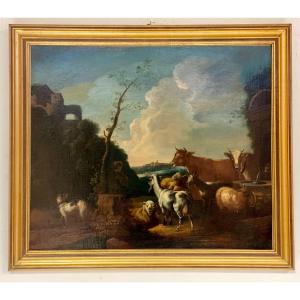
Giuseppe Tassone (rome, 1653 – Naples, 1737), Landscape With Herds
Giuseppe Tassone (Rome, 1653 – Naples, 1737)
Landscape with Herds
Oil on canvas, 150 x 202 cm
Artistic analysis by Prof. Alberto Crispo
Giuseppe Tassone was born in Rome in 1653 and, around the age of thirty, moved to Naples, where he is documented from 1678 onward and where he lived and worked for the rest of his life. Information about his life is scarce, but the Neapolitan biographer Bernardo De Dominici recalls him as a talented painter of animals and landscapes, whose canvases adorned the major Neapolitan galleries and whom Paolo De Matteis held in such high esteem that he commissioned him to paint many works. His success among collectors is confirmed by the presence of his works in the inventories of noble families, ranging from the Marquis of Valle Siciliana, Geronimo Ferdinando Alarcón de Mendoza (1703), to Giovanni Montoya de Cardona (1718), from the Duchess of Terranova, Giovanna Battista d’Aragona Pignatelli (1723), to Isabella Coppola, Duchess of Canzano (1724), and on to Alvaro della Quadra, Duke of Limatola (1725), and Antonio Maria Lumaga (1743). Yet, despite such a rich lineage, his paintings appear on the market very rarely, making each new appearance a precious opportunity to expand the catalog.
The canvas depicts a sweeping landscape in which a young shepherd, seated beside a fountain basin, leads his flock to drink, while a stream flows a little further down among rocks and small waterfalls. Sheep, goats, and a cow crowd the foreground, rendered with a soft brushstroke that captures their fluffy fleece and warm, delicate hues. In the background, a second shepherd watches over goats, sheep, and a cow, while the vegetation fades into a golden light and the mountains disappear into a distant mist.
The strongest comparison for this attribution is found in *Caravan of Shepherds with Their Herds*, in a private collection, where we see the same style of rendering the animals. Also extremely useful are the two landscapes with figures and animals from the Castello Sforzesco in Milan, dating from between 1696 and 1702, which offer a rendering of the natural setting that is entirely similar, with subtle transparencies in the foliage in the foreground and in the mist enveloping the hills. It is precisely these paintings—unknown to art history until recently—that today serve as the primary clues for defining the artist’s aesthetic.
As for his predecessors, the most plausible reference point is Salvator Rosa, whose *Landscape*, now at the Cleveland Museum of Art, can be examined; however, Tassone’s atmosphere is more modern, serene, and Arcadian, and it is difficult to identify a specific model. Comparisons with Nicola Viso or other Neapolitan and Roman artists are of little value. Rosa da Tivoli—that is, Philipp Peter Roos—and Domenico Brandi, whose *Pastoral Scene* is in the Galleria Estense in Modena, remain tied to a naturalism still rooted in the seventeenth century and to contrasting tones. Compared to Dughet or Van Bloemen, moreover, Tassone embraces a more independent style, with a classicism that favors idyllic themes. His merit lay in renewing the pastoral genre by aligning it with the Barocchetto style and the poetics of Arcadia, using light colors and evoking atmospheres of tranquil rural life, in harmony with the mythical world longed for by the Arcadian poets.
Period: 17th century
Style: Other Style
Condition: Good condition
Material: Oil painting
Width: 202
Height: 150
Reference (ID): 1855090
Availability: In stock