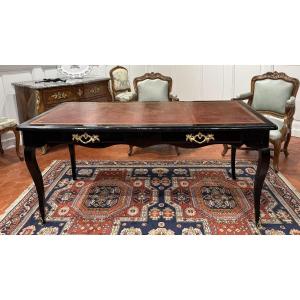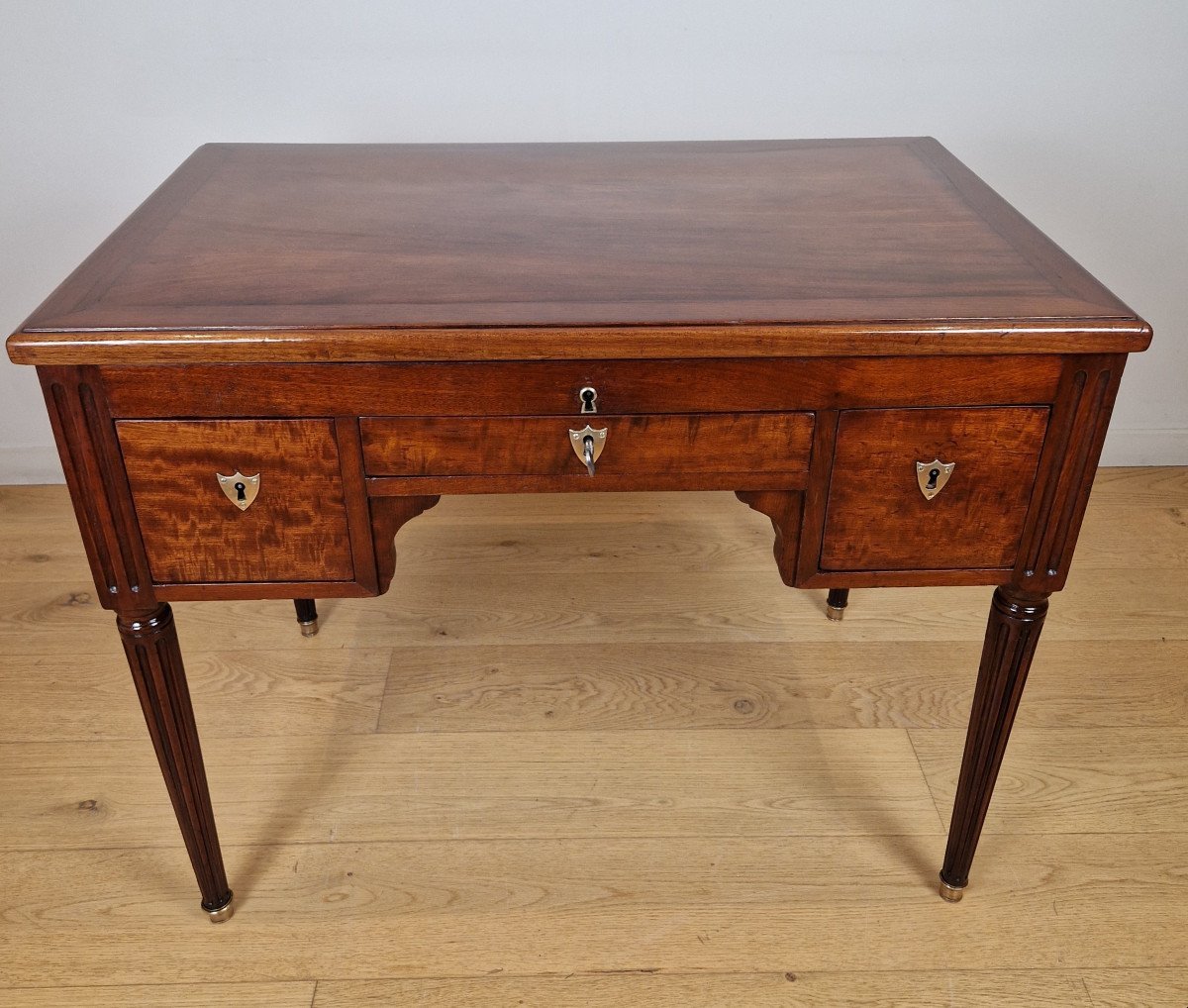
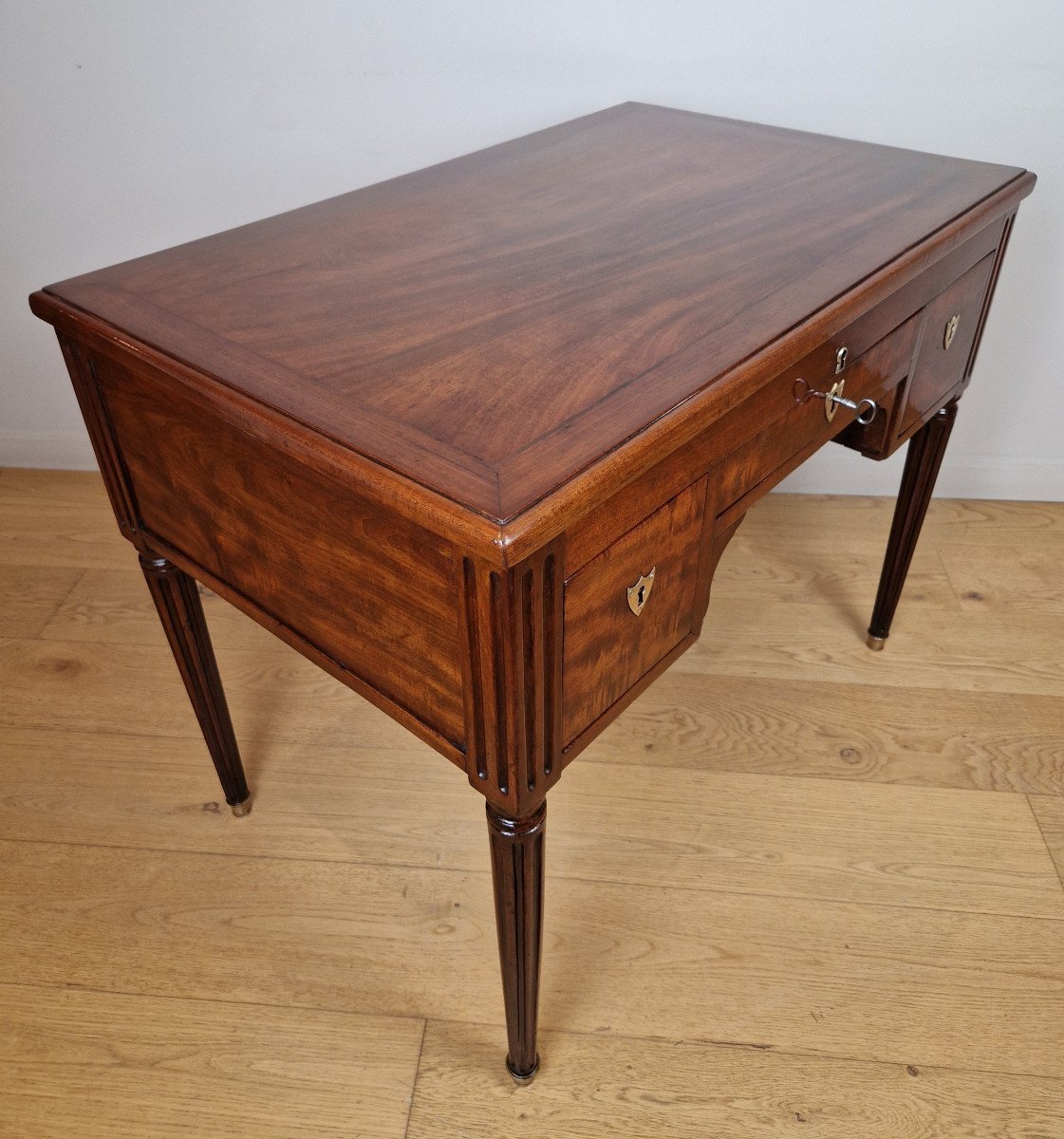
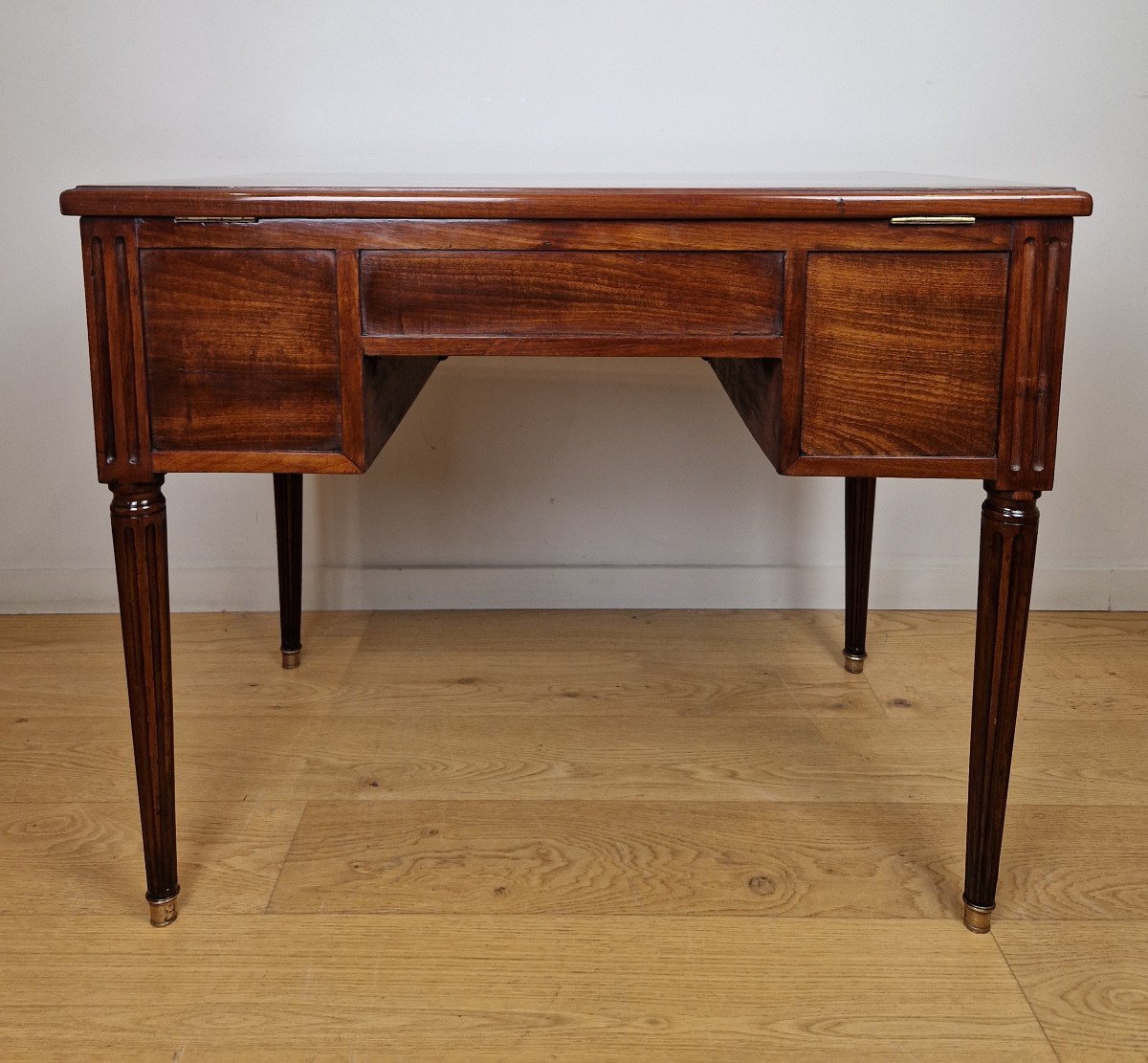
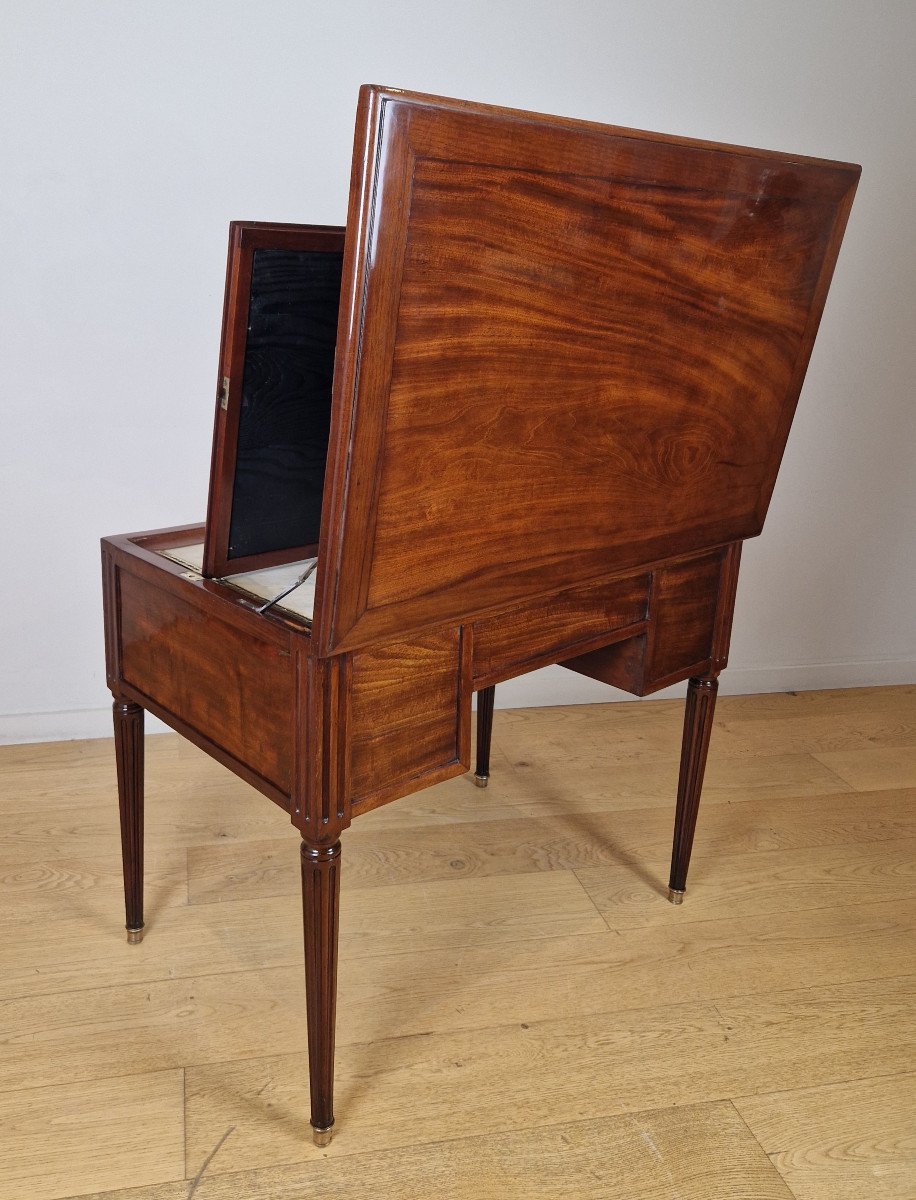
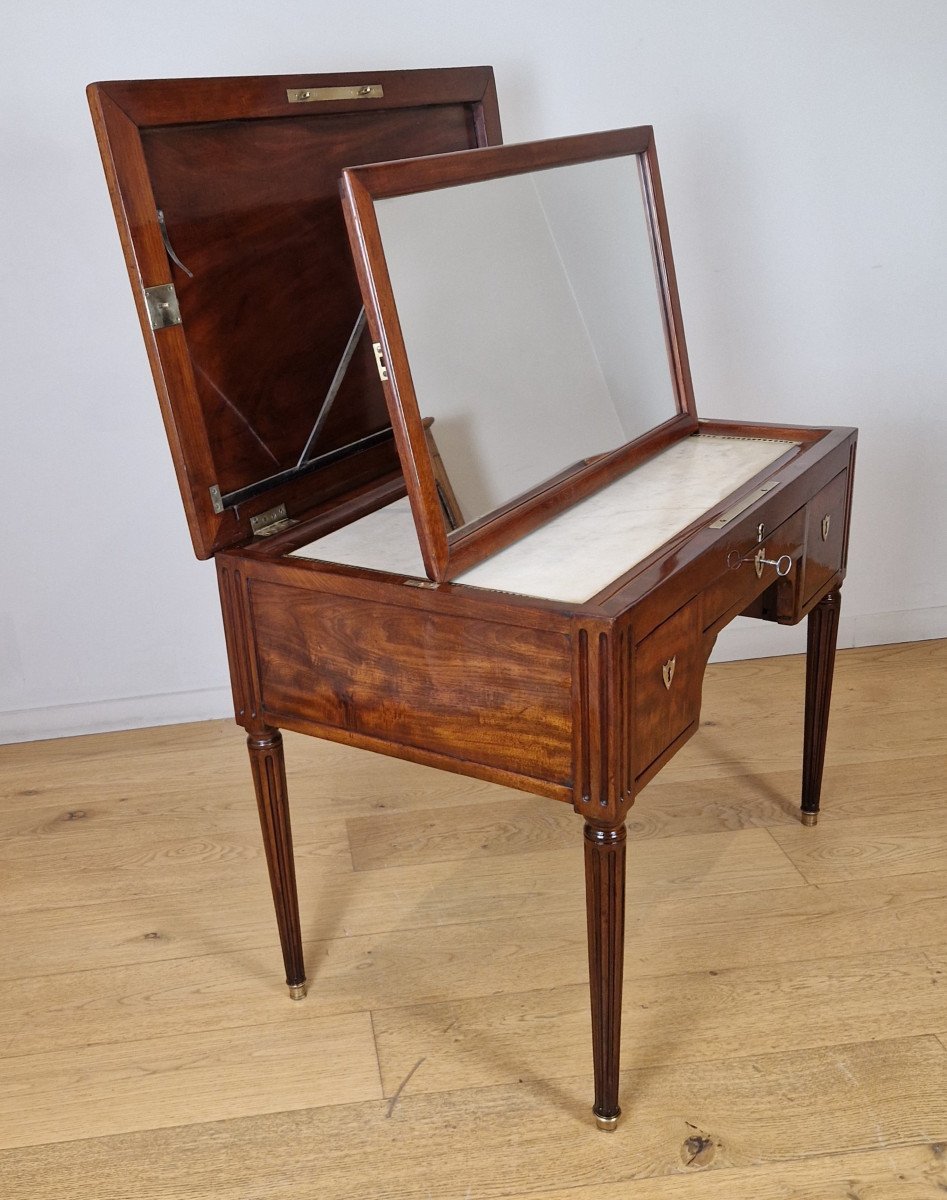
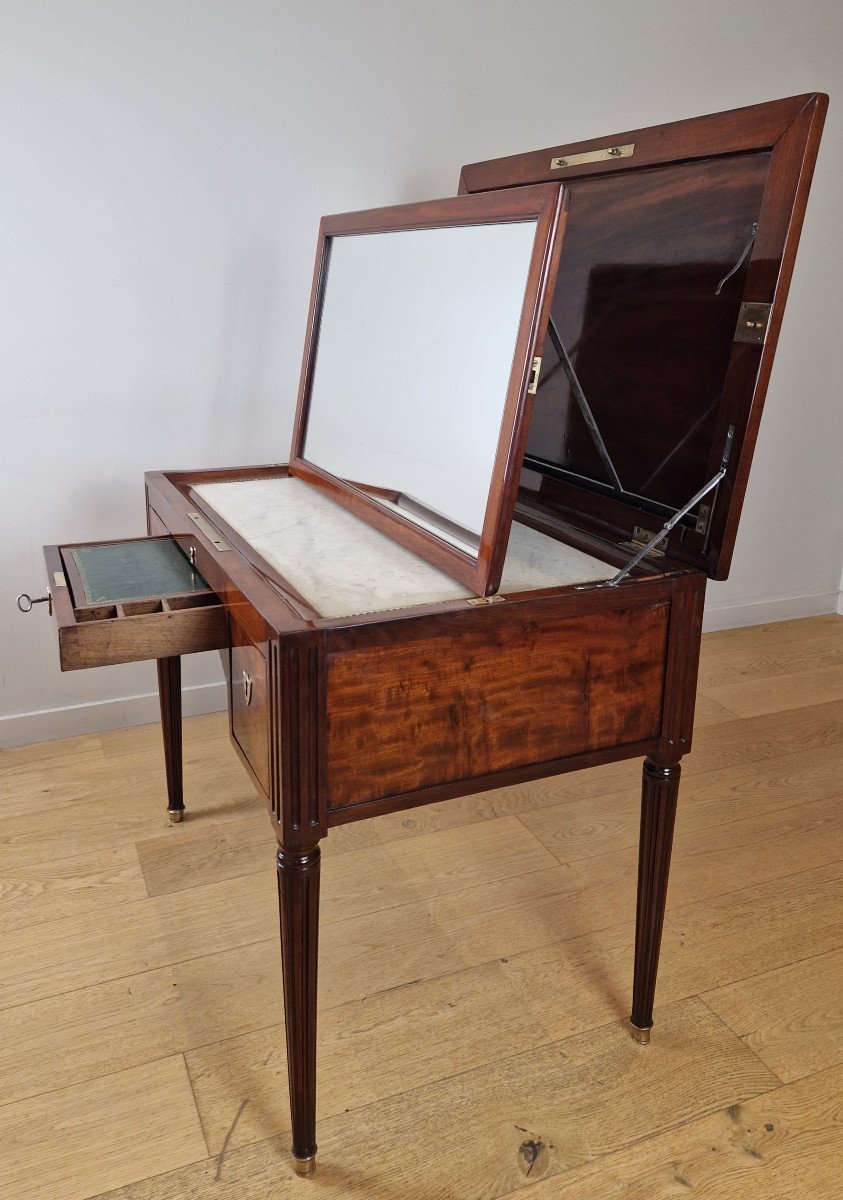


A Louis XVI-style Writing Desk With A Mechanical Mechanism Attributed To Caspar Schneider.
Artist: Attribué à Caspar Schneider.
Louis XVI-period mechanism desk attributed to Caspar Schneider.
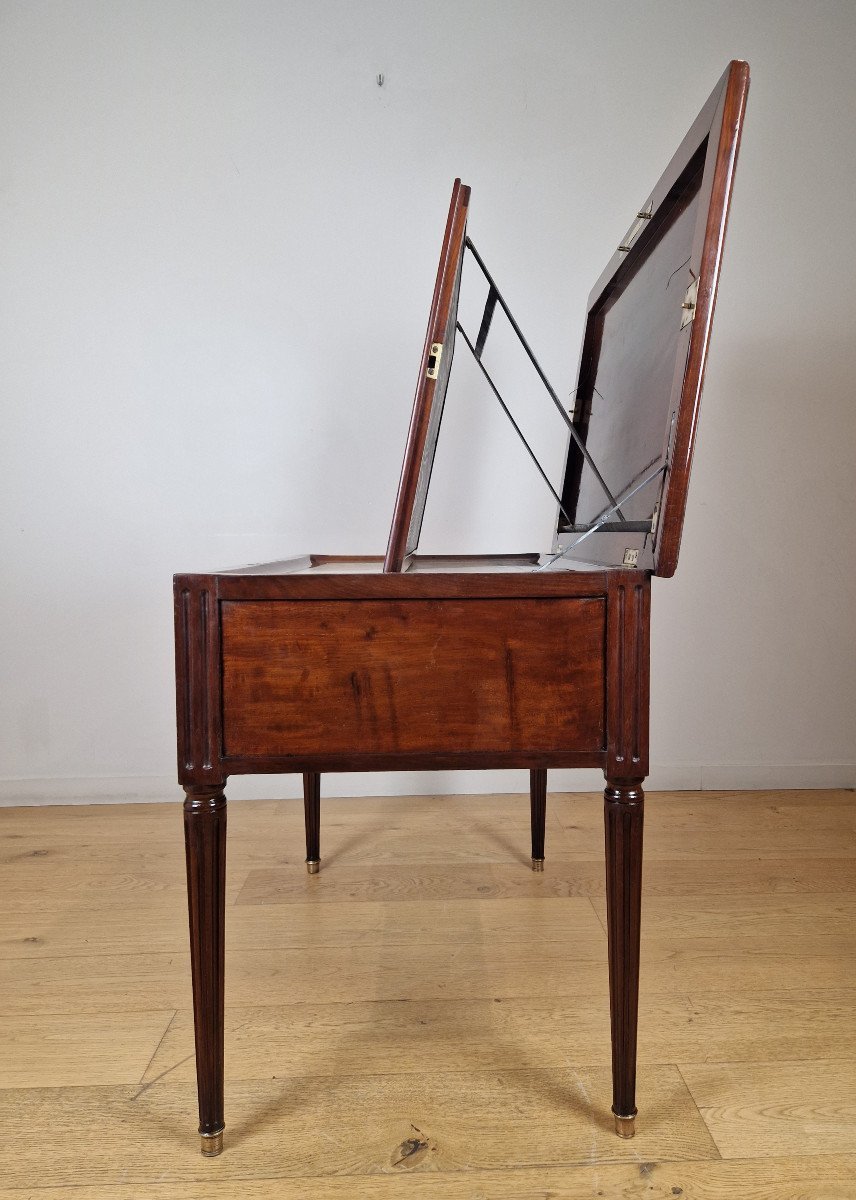
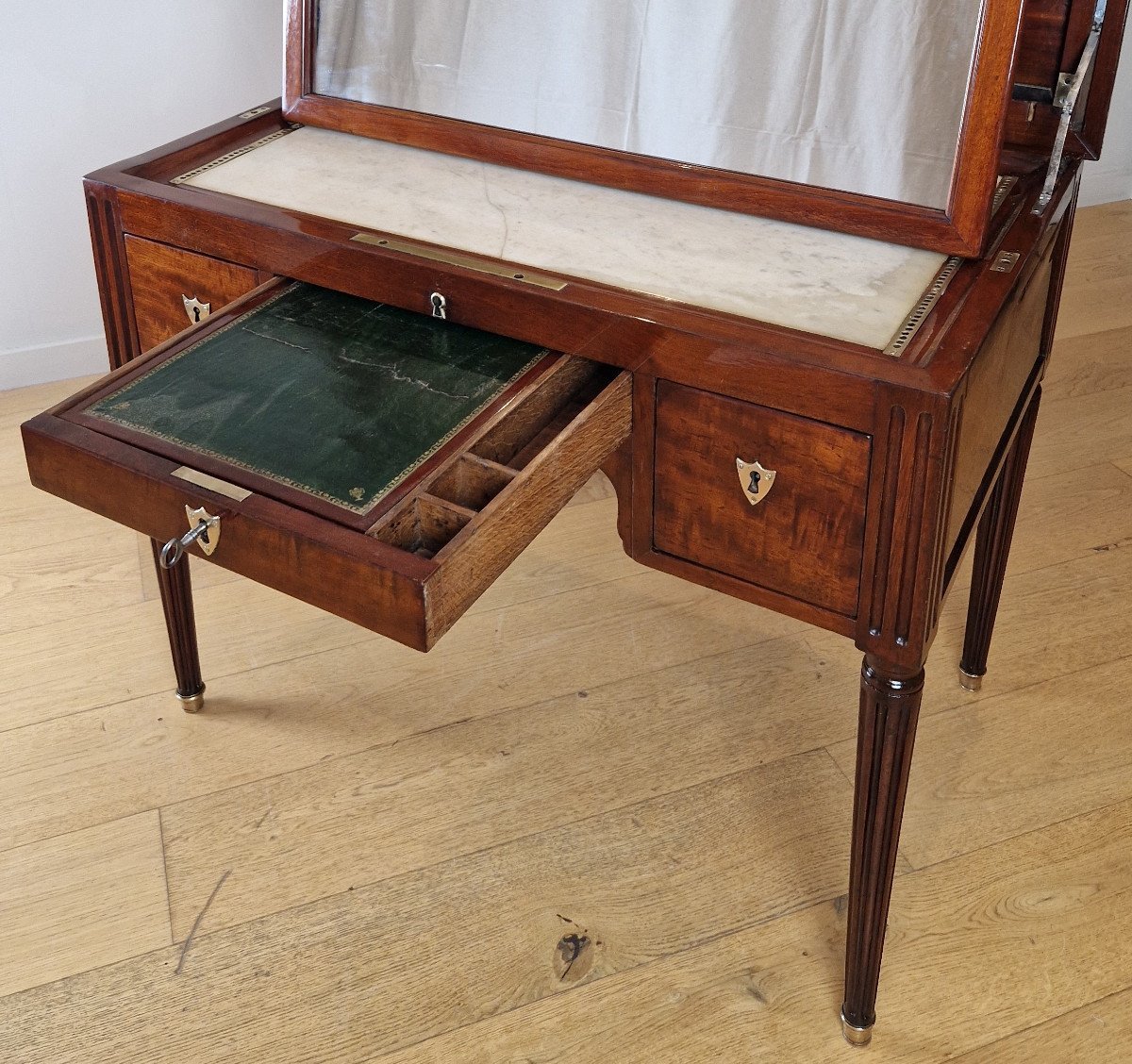
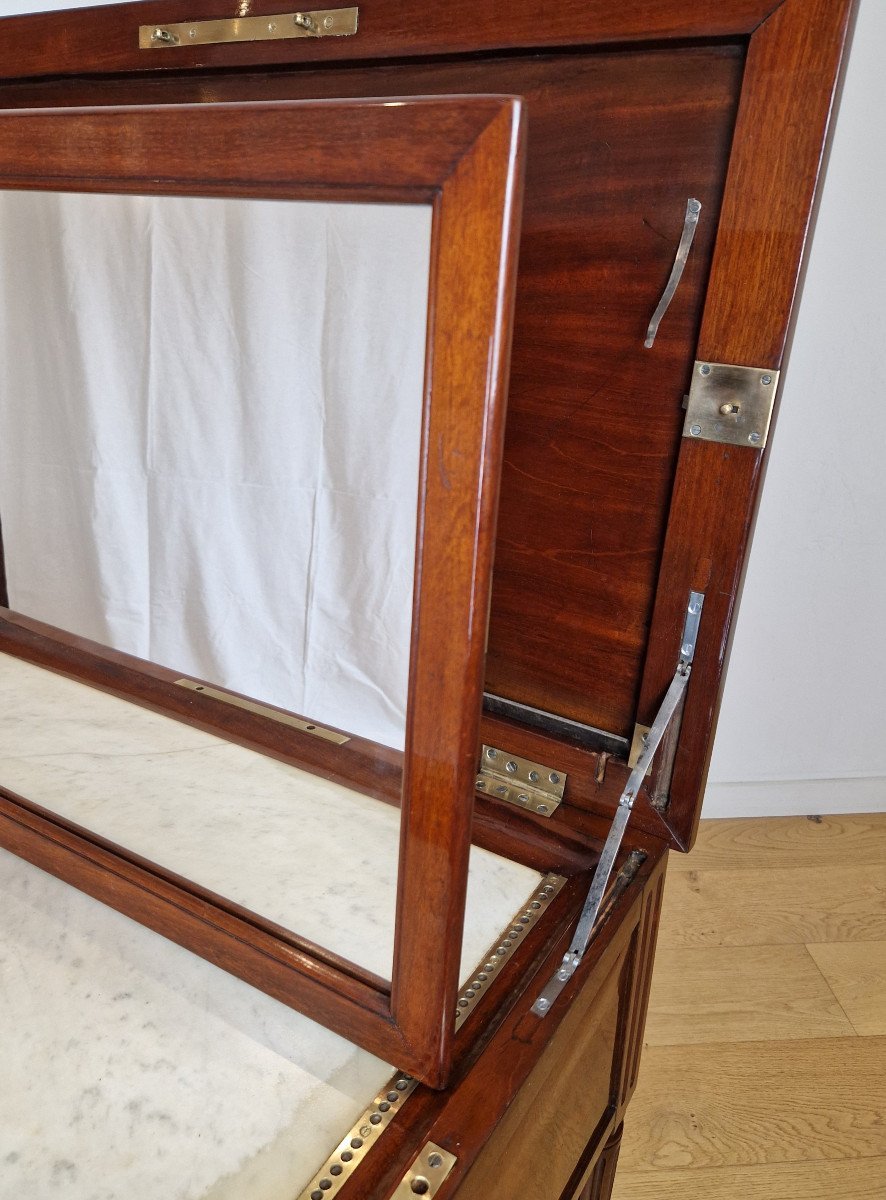
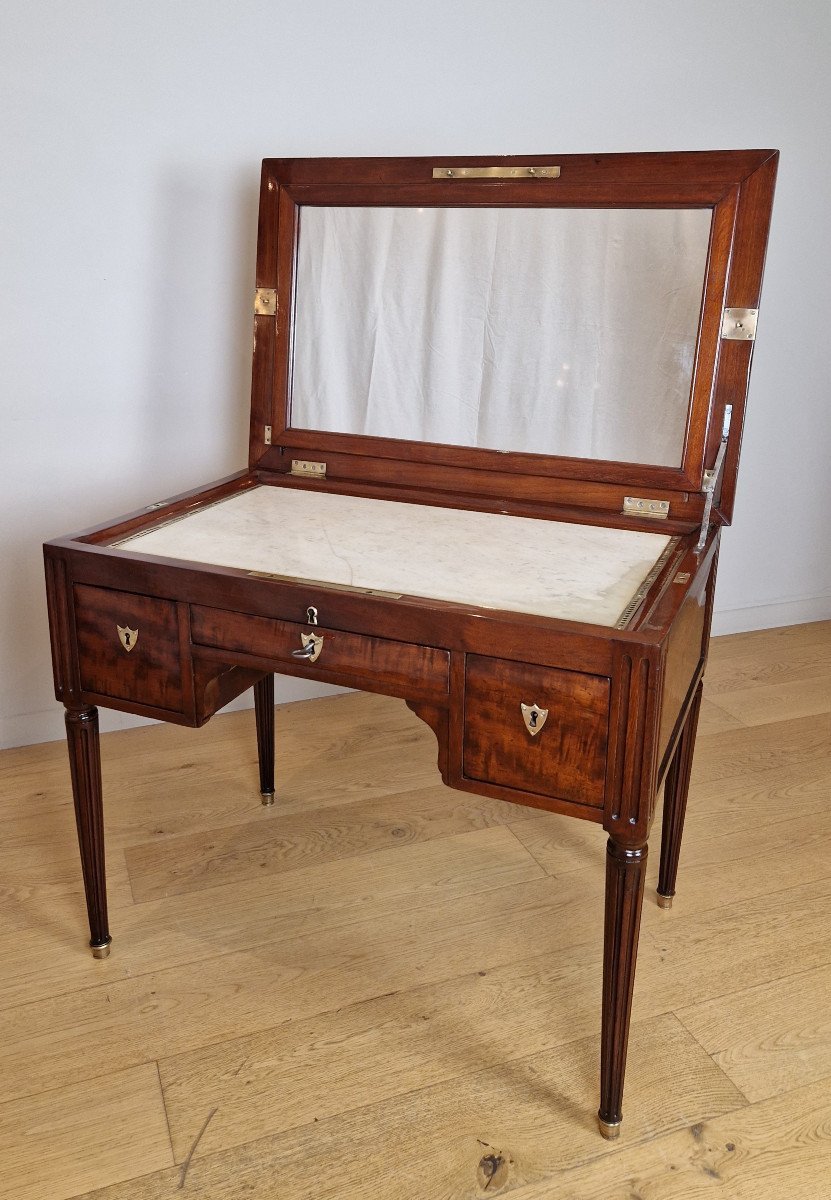
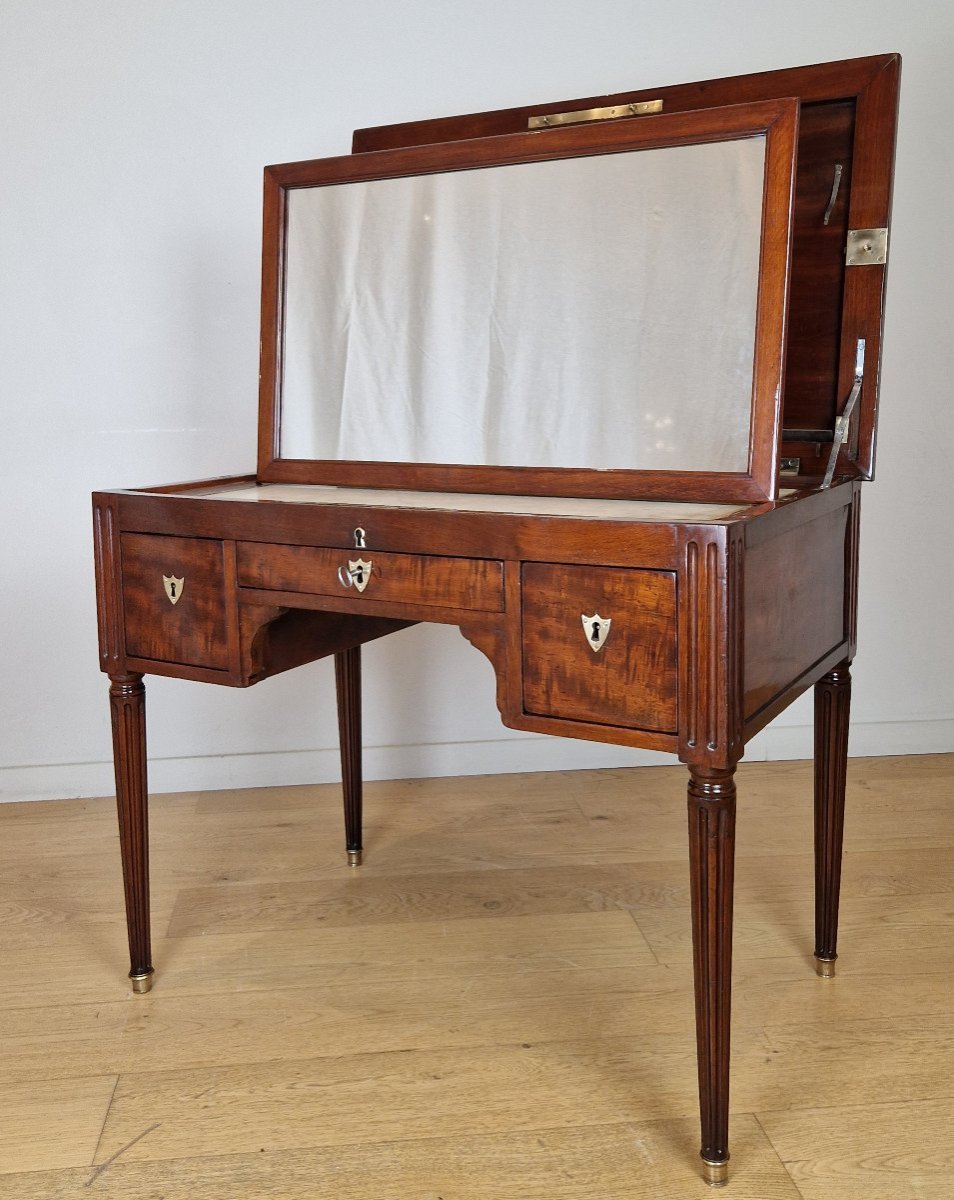
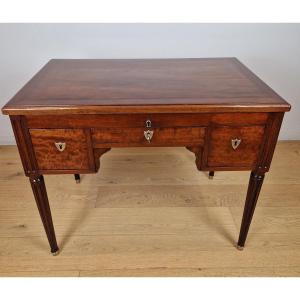
A rare mechanism desk with an ejector mechanism that doubles as a dressing table, made of solid Cuban mahogany and Cuban mahogany veneer on all sides. The coffered lower section opens to reveal three quadrangular drawers: two square ones on the sides and a rectangular one in the center. The right-hand drawer is divided into three equal compartments. The middle drawer contains a shelf that slides to its full depth, framed in veneer and covered in golden havana morocco leather with small ironwork; on its right side, this shelf features three compartments designed for an inkwell, a powder box, and a sponge box. The top lifts up on two brass hinges with a pivot lock, revealing a flap lined with a mirror. This freestanding mirror is not, as is usually the case, simply attached to the flap, but is held in place by a metal mechanism mounted on a sliding frame. This mechanism features two circular rack plates that allow for depth adjustment of the mirror. These are inserted into a sheet of veined white marble; which is itself bordered by a rim with a profile inverted relative to the mirror’s frame so that it fits snugly against the mirror once the panel is lowered. The mirror is held securely in place within the panel by a complex dual-sided ejector system with lateral latches and bolts. This ingenious system allows the mirror’s projection to be easily adjusted to suit the user’s specific vision needs without having to worry about the excessive weight of a conventional wooden tabletop lined with a mirror. The entire piece rests on a base with four tapered legs featuring deep fluting, constricted at their tops and tapered at their bases. Beautiful ornamentation includes lock plates, footings, and a locking mechanism made of gilded copper and bronze. A single key secures the three locks on the drawers and the one on the top. Gaspard Schneider, a disciple of the ingenious Riesener and the genius Oeben, transformed, among other things, the traditional box-style desk into a piece of furniture with multiple configurations and combinations. This piece is attributed to Gaspard Schneider based on a similar model with identical dimensions that was sold at Drouot in March 2009.
Dimensions: Closed: height 73.3 cm, width 89.6 cm, depth 56.8 cm. Open: height 125.8 cm.
In perfect condition with no repairs; only the buff-finish varnish has been redone.
SCHNEIDER (Caspar), originally from Germany, worked in the Faubourg Saint-Antoine around the middle of Louis XVI’s reign.
He was commonly known simply by his first name, Gaspard.
In 1785, he is mentioned in the royal accounts in connection with the payment for a veneered wooden secretary desk, for which he had done the cabinetmaking and Thomire the bronze work. Shortly thereafter, on March 15, 1786, he obtained his master’s certificate. This skilled craftsman continued to supply works to the Crown and also received commissions for the Queen’s private use. At the time, he lived on the Grande rue du Faubourg Saint-Antoine. Ruined by the Revolution, he was forced to close his workshop and retired to the rue Beautreillis. In December 1799, he lost his wife, Marie-Catherine Oeben. To sign his works, the master used a stamp bearing his first name spelled out in full, in the German style: CASPAR SCHNEIDER.
His mark was discovered, among other places, on a precious pedestal table from Marie-Antoinette’s furnishings at Saint-Cloud, which once adorned the Petit Trianon.
Bibliography: *Les ébénistes du XVIIIe siècle* by Count François de Salverte.
4 900 €
Period: 18th century
Style: Louis 16th, Directory
Condition: Perfect condition
Material: Mahogany
Width: 89.6
Height: 73.3
Depth: 56.8
Reference (ID): 1853028
Availability: In stock
Print