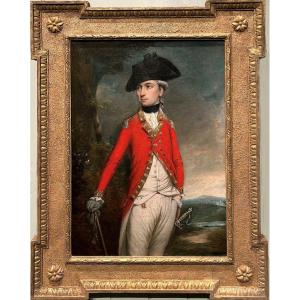
Portrait Of A Gentleman - Arthur Devis (1712–1787)
Ian Douglas Leonard Cochrane, 14th Earl of Dundonald
Christie's London, June 16, 1961, lot 56, to Leggatt for 5,200 Guineas
The Viscountess Rothermere (1929-1992) Anonymous sale ('The Property of a Lady'), London, Christie's, July 16, 1982, lot 60
Private collection, U.K
Sotheby's London, December 14, 2021, lot 52
Private Collection
Literature:
E.G. D'Oench, Arthur Devis: Master of the Georgian Conversation Piece, unpublished PhD thesis, 1979, p. 469, cat. no. 222
E.G. D'Oench, The Conversation Piece, Arthur Devis and his contemporaries, New Haven 1980, p. 91, cat. no. 222
Exhibited:
Bath, Holbourne Museum, on loan from 1988-2006
In this portrait, a well-dressed gentleman leans nonchalantly on a chair, the book clasped in his hand operating as a symbol of his education. His posture, with one hand on his hip brushing away his overcoat, has allowed for Devis to masterfully depict a range of different fabric textures - for example, the lace cuffs, the satin waistcoat, and the velvet lapels of his overcoat. Whilst the focus of the portrait is firmly on the powerful presence of its central figure, the beauty of the landscape in the background pays testament to Devis’ early training as a landscape artist. The river and rolling hills recede into the background and create a sense of scale, whilst the Church behind the figure’s shoulder provides an aspect of potential realism - perhaps this was a local church associated with the lands, titles or heritage of the sitter.
Arthur Devis
Arthur Devis was born in Preston, Lancashire in 1712, the son of a carpenter and councillor. He moved to London and was trained by Pieter Tillemans, who was known for his sporting and topographical scenes. He produced a number of Italianate landscapes during this time, but soon diverted from landscape painting into portraiture, becoming well-known for his conversation pieces and small-scale works. Devis moved between London and Lancashire, taking commissions and earning acclaim in both locations - he used his father’s position as a town councillor in Lancashire to earn commissions from local noble families. In 1745, he opened a studio in Lincoln’s Inn Fields.
Devis is well-known for his conversation pieces, which depict one or more full-length figures within interiors or small-scale landscapes, surrounded by a few identifying or prized possessions. This genre, started by Hogarth, was immensely popular in the 18th century and Devis has been immortalised as one of the most prolific conversation piece artists. He worked largely for the gentry and has become recognisable for his doll-like figures. The uncanny quality of his figures is due to their references being mannequins that Devis would dress and pose for the bodies of his portrait sitters to save their constant attendance at his studio. Devis had little familiarity with human anatomy, having trained under a sporting and topographical artist. For this reason, some of Devis’ works have a clear visual format, with recycled poses and costumes. His interiors and landscape backgrounds were also often imagined.
From 1761, Devis exhibited at the Free Society of Artists and became its president in 1780. Although he is best known for his portrait of the landed gentry, Devis also painted in class. He was commissioned to restore paintings for Sir Roger Newdigate, and to clean and repair the Painted Hall at the Royal Naval Hospital, Greenwich. After the founding of the Royal Academy, however, Devis’ reputation began to decline in the face of a younger generation of increasingly innovative artists.
Devis sold his estates in 1783 and moved to Brighton, where he would pass away in 1787. Both of his sons, his half-brother, and his son-in-law were respected artists in their own right. His works have taken on a new significance as they represent the social hierarchies between families in the 18th century, through the positioning and posing of the figures.
Period: 18th century
Style: English Style
Condition: Excellent condition
Material: Oil painting
Width: 62cm
Height: 75cm
Reference (ID): 1850231
Availability: In stock