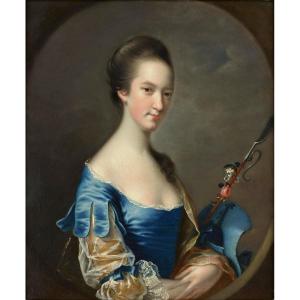

Portrait Of Lady Frances Hends – William Wissing (1656–1687)
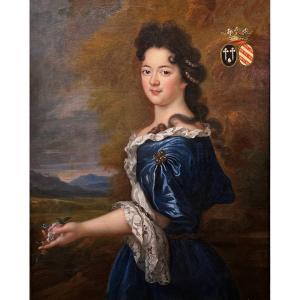
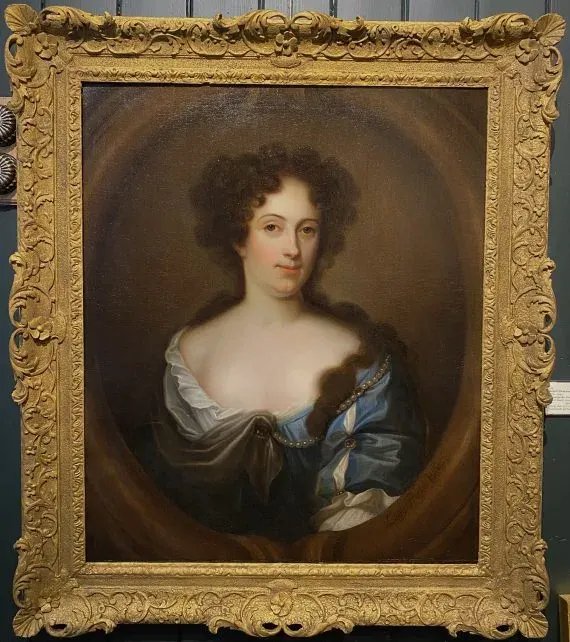
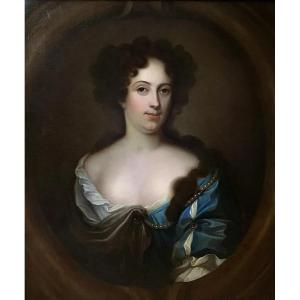
This is a head and shoulders portrait of a young woman painted with a plain background and cartouche. The sitter wears a blue coloured dress with exposed blouse, additional decorative draped material and a plethora of lavish pearls and buttons. The quality of the painting is superb and the sensitive treatment gives us a feeling of insight into the sitter’s character. The artist has placed emphasis here on the alluring femininity of the sitter which is enhanced by the loose drapery and falling hair around her shoulders.
The fine work reveals the intimacy of the artist’s approach to court beauties, as can be seen in the sitter’s delicately rendered features and her captivating eyes. Indeed, the delicate painting and expressive head of this sitter is characteristic of the studio of William Wissing. In addition, the colours used by the artist in the drapery of the dress and the virtuoso brush strokes are both remarkably well preserved.
William WissingWillem Wissing, known in England as William Wissing (1656 – 10 September 1687), was a Dutch portrait artist who worked in England.
He was born in either Amsterdam or The Hague, and studied at The Hague under Willem Doudijns (1630–97) and Arnoldus van Ravestyn (1615–90). In 1676, he moved to England, where he studied with and assisted Peter Lely. After Lely’s death in 1680, Wissing emerged as his most important pupil. Godfrey Kneller was the only contemporary portrait artist in England to rival Wissing. Wissing’s royal sitters include Charles II of England, Catherine of Braganza, George of Denmark and James Scott, 1st Duke of Monmouth.
In 1685, James II of England sent Wissing to the Netherlands to paint portraits of his Dutch son-in-law and daughter, the future William III of England and the future Mary II of England. The portraits were often repeated; versions are on display in the Great Hall of the Wren building at the College of William and Mary in Williamsburg, Virginia.
Wissing died in 1687 at the peak of his fame as a portrait painter, at Burghley House, the home of John Cecil, 5th Earl of Exeter near Stamford in Lincolnshire. Some suspected he was poisoned out of jealousy of his success. According to Arnold Houbraken his epitaph was Immodicis brevis est aetas, meaning Brief is the life of the outstanding. He was buried in St Martin’s Church, Stamford, Lincolnshire.
Fellow Dutch immigrant Jan van der Vaart worked in his workshop and added the draperies and landscapes in the portraits painted by Wissing. After Wissing’s death in 1687, van der Vaart continued Wissing’s workshop.
Many of Wissing’s portraits of prominent sitters and his self-portrait were disseminated in mezzotint.
Period: 17th century
Style: Other Style
Condition: Excellent condition
Material: Oil painting
Width: 64cm
Height: 77cm
Reference (ID): 1818474
Availability: In stock