Scene Of A Massacre - Jean-joseph Benjamin-constant (1845–1902)
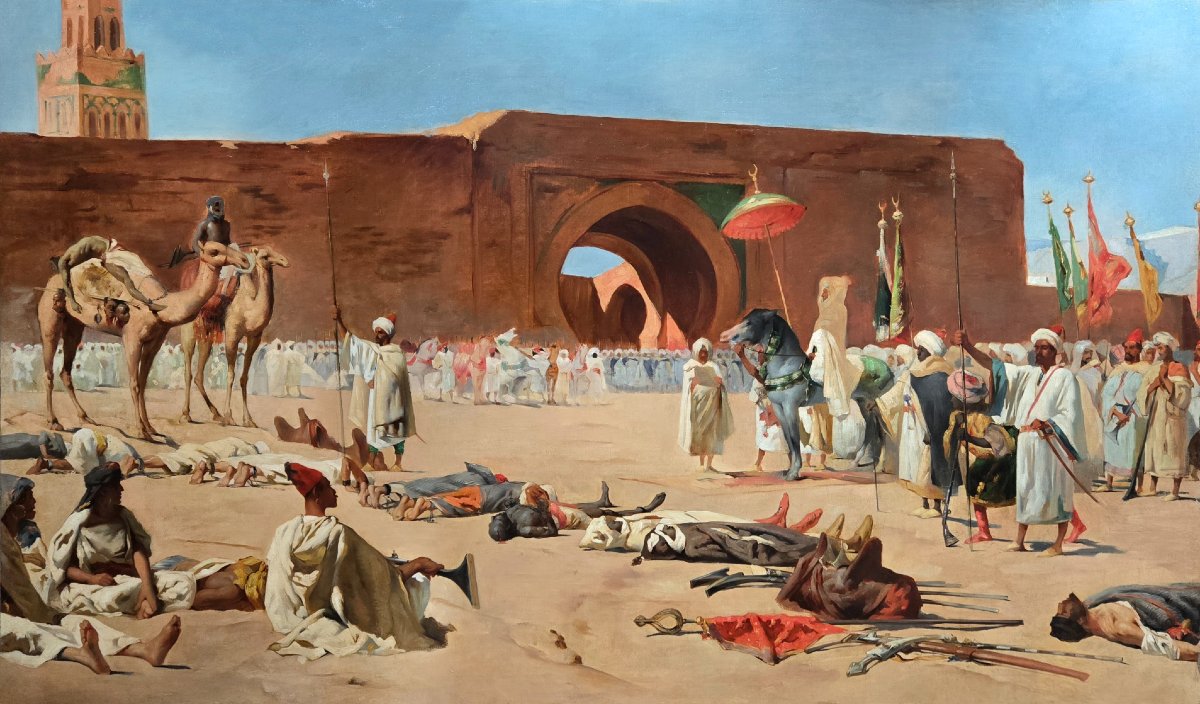
The French School of Orientalists are best known for their sensational, exoticised and fantastical scenes of the Middle East and North Africa. Whilst their attention to detail is astonishing, the scenes that they depict are often imagined. This painting by Benjamin-Constant is one such imagined work, full of popular motifs amongst Orientalist artists. The scene presents a victorious Sultan - indicated by the parasol - surveying the bodies of rebels after an unsuccessful uprising. Dramatic war scenes such as this were immensely popular amongst French consumers of Orientalist art, and Benjamin-Constant would have been familiar with war as a subject matter due to his early studies of history painting. Paintings that depicted the ‘Orient’ as a violence region awash with conflict also served a secondary purpose, helping to promote colonialism and French involvement in the region as a civilising mission.
This study for Benjamin-Constant’s later painting Les Derniers Rebellesis full of popular Orientalist visual motifs - the intense sun, camels, Middle Eastern costume, lacquered guns and, most importantly, the chamsiya parasol. The chamsiya was used by the Sultan of Morocco to shield himself from the beating sun, and became a symbol of political and regal authority. Despite the imagined narrative of the scene, Benjamin-Constant’s attention to cultural details with the costume, the chamsiya and the minaret in the background indicate a deep appreciation for and understanding of Moroccan culture. The saturated palette indicates intense sunshine, accentuated by the short length of the shadows. The earthen tones are remarkable, ensuring that the Sultan’s chamsiya and the flags of his entourage provide distinct bursts of colour within this painting.
Jean-Joseph Benjamin-Constant
Benjamin-Constant was born in Paris in 1845 and began his formal artistic education under Garipuy at the École des Beaux-Arts in Toulouse. His studies in Toulouse focused predominantly on history paintings, from which he learned anatomy, drawing, and composition. Benjamin-Constant then attended the École des Beaux-Arts in Paris and worked under Alexandre, producing paintings inspired by ancient history and utilising the colours and styles of Rubens, Delacroix, and Watteau. In the late 1860s, Benjamin-Constant exhibited at the Paris Salon, where his prowess as an artist was quickly noted - in 1867, the French state even purchased one of his paintings, depicting a scene from Hamlet.
In 1870, Benjamin-Constant made the first of two long trips to Spain and Morocco, with his style veering away from history paintings and towards Orientalism. The second trip occurred in 1871, where he spent a year and a half in Morocco, collecting a trove of North African artefacts to use in his paintings. The architecture and whitewashed terraces that feature in his paintings is reminiscent of Tangiers, which Benjamin-Constant would have inevitably stayed in during his travels through Spain and Morocco.
Once he had returned to Paris, Benjamin-Constant exhibited his Orientalist works at the Paris Salon and was met with great success. He received two gold medals, a silver medal, and a bronze medal for his Orientalist compositions. In the mid to late 1870s, museums around France purchased his works to adorn their walls. Benjamin-Constant also helped to found the Society of French Orientalist Painters and exhibited their 1893 inaugural exhibition.
As well as Orientalist paintings, Benjamin-Constant was a talented muralist and portraitist with clients as far away as the United States of America and Canada. He worked on wall decorations for the City Hall of Paris and the Sorbonne, and produced a remarkable portrait of Queen Victoria in 1899, only a few years before she passed away. Benjamin-Constant was also an accomplished art critic and wrote studies on a number of his contemporaries, as well as teaching at the Académie Julian. He died in Paris in 1902.
Period: 19th century
Style: Orientalism
Condition: Excellent condition
Material: Oil painting
Width: 170.5cm
Height: 118.5cm
Reference (ID): 1818376
Availability: In stock