

Still Life – Harmen Loeding (c. 1637 – C. 1673)
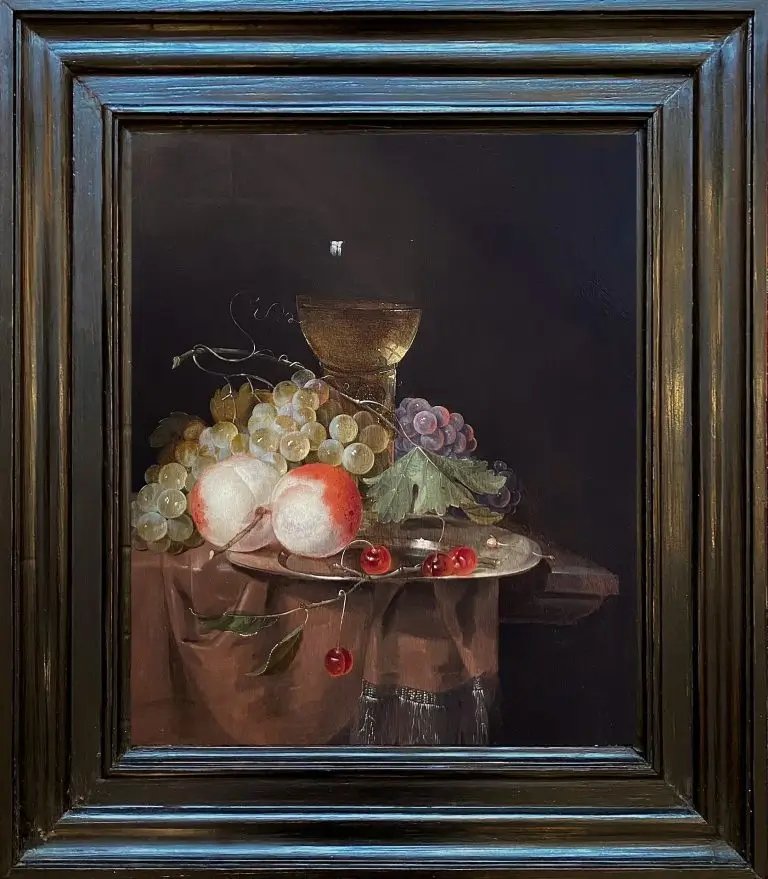
In this very beautiful still life, Loeding presents a table partially covered with a brown cloth edged with silver fringes, upon which cascade translucent red cherries, apples, grapes and intertwined vines. In the centre stands a large glass of wine, known as a ‘Roemer’, which has the window of the room reflected on its edge. Powerful lighting is used to to create an atmosphere, entering from the left and casting a subtle play of light on the textures of the fruits.
Loeding has gone to great lengths to demonstrate his mastery in rendering a rich diversity of materials and textures, as well as his ability to capture reflected light in a variety of objects. He often used a vertical format and pyramidical structure of tightly packed objects in his still lifes, as is the case here. Fruits are some of the most ubiquitous subjects in still-life paintings over the centuries. Not only does a selection of fruit offer the artist a variety of colours and textures to utilise, they also offered a variety of symbols – grapes symbolising the themes of pleasure and lust associated with Bacchus, the Roman god of wine.
The inclusion of precious metals in still-life paintings certainly showcased an artist’s skill at accurately depicting reflective textures. However, in this vanitas painting the golden plate, balancing precariously off of the table ledge, also evokes the tension that lies between materialism and morality. Glass was also pricey during this period, which made its symbolism all the more delicious to buyers: a half empty glass was a great stand-in for the brittle ephemerality of lived existence.
Harmen LoedingLoeding was born in Leiden in around 1637 and was admitted into the Leiden Guild of St Luke in 1664. Like other Dutch cities, Leiden required membership in the guilds in order to sell wares falling under the various specifications. There is no record of his artistic training or influences, but he likely belonged to the circle of artists including Pieter de Ring and Gerrit Dou, who founded and maintained the Guild. Loeding is last registered as a member in 1673.
One of the most versatile genres that emerged from Dutch 17th Century artistic specialisms is that of ‘pronkstilleven’; a laden table with a variety of rich textures, like ornate glassware, gilded goblets, exquisite nautilus cups, silver dishes, exclusive Chinese porcelains and costly fruits and other delicacies. Harmen Loeding was one of the virtuoso painters of these ensembles, who followed the famous ‘pronk’ still lifes of Jan Davidsz de Heem.
Museums
Amsterdam, Stadel - Frankfurt, Glasgow, Hamburg, Karlsruhe, Kassel, Munich, Schwerin and Lichenstein - Vienna.
Period: 17th century
Style: Other Style
Condition: Excellent condition
Material: Oil painting on wood
Width: 31cm
Height: 38cm
Reference (ID): 1850065
Availability: In stock