

Roman School, 17th Century, Holy Family
Roman School, 17th century
Holy Family
Oil on onyx, 16 x 10 cm – With frame, 35 x 30 cm
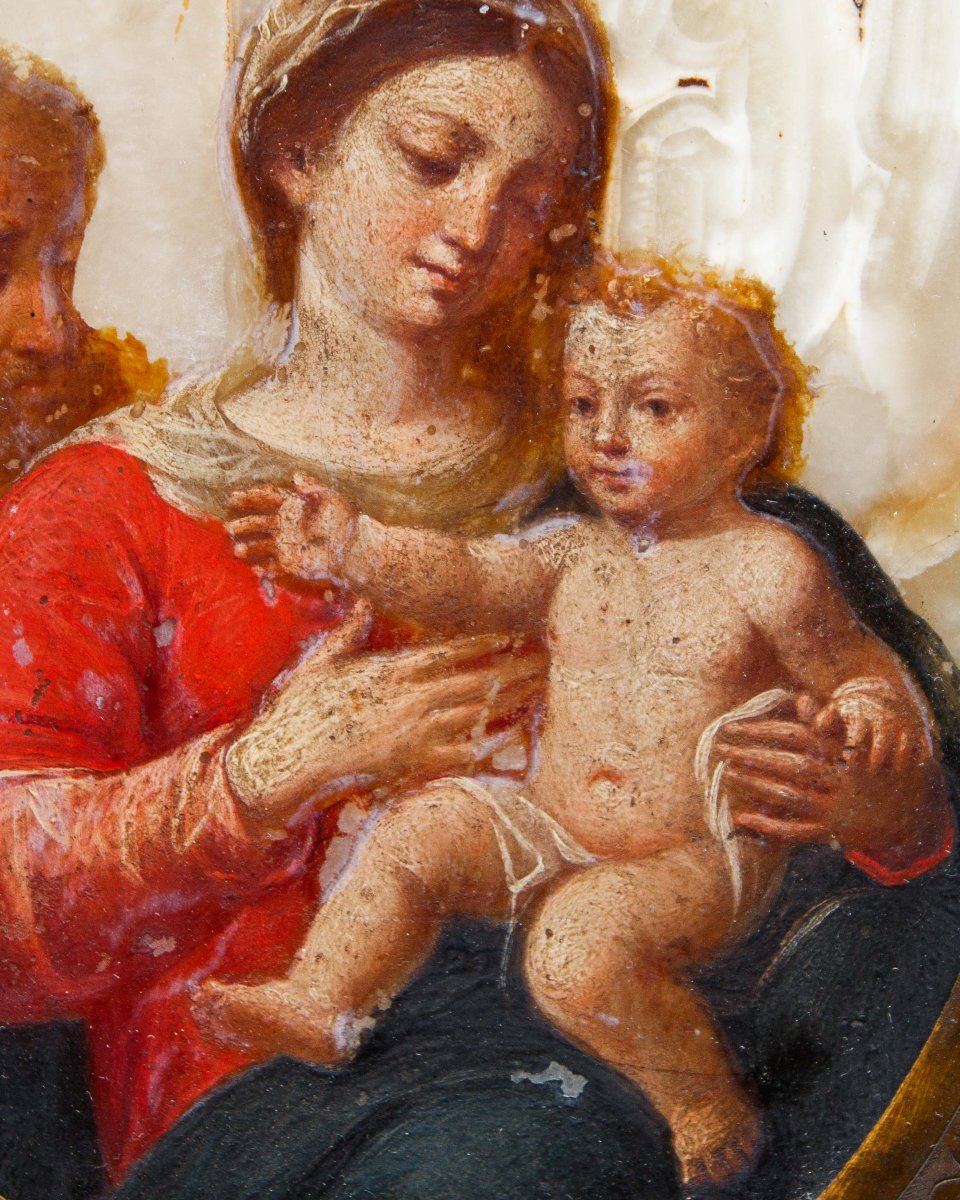
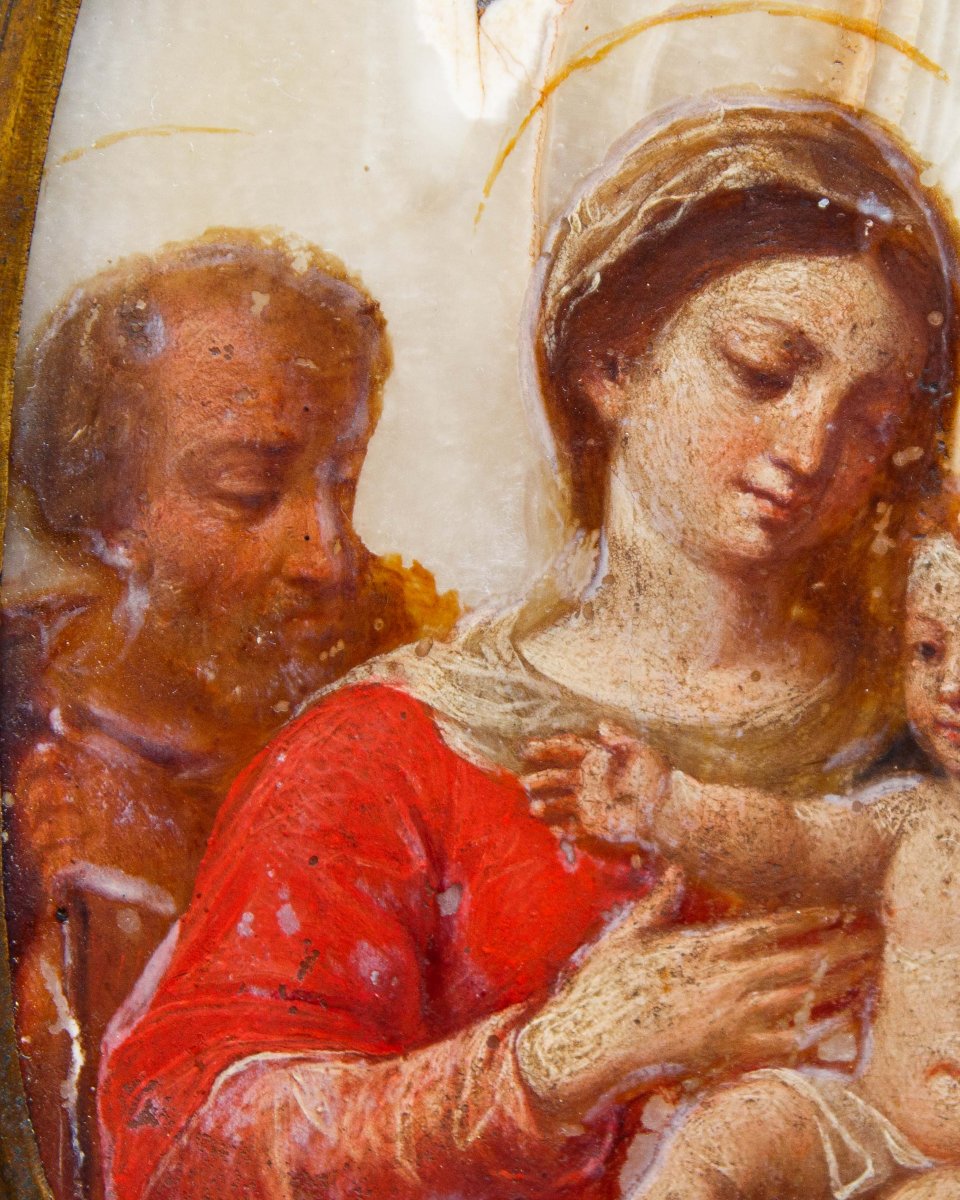
The painting in question, attributable to the 17th-century Roman school, consists of an elegant onyx panel set within a wooden frame, richly gilded and decorated with plant motifs, surmounted by a small cornice bearing the face of a cherub. This Holy Family, in fact, embodies the distinctive traits of the capital’s artistic production during the 17th century, a period in which the use of hard and semiprecious stones as a painting surface reached its technical and aesthetic peak. The masterful integration of natural material and figurative elements is evident in the way the artist utilizes the vertical veins and milky translucencies of the onyx not only as a neutral background, but as an intrinsic architectural and atmospheric element, transforming the stone’s layers into a sort of divine light or a scenic backdrop that envelops the figures. Stylistically, the composition is influenced by Carracci-style classicism filtered through the grace of Guido Reni and the teachings of Carlo Maratta, indispensable models for the 17th-century Roman school. The gentleness of the Virgin’s face, the soft complexion of the Child, and the composed figure of Saint Joseph reflect a quest for balance and decorum typical of private Roman commissions of the time, which favored small objects of domestic devotion capable of combining the prestige of the material with the clarity of the sacred message. The painting technique reveals a careful application of color that avoids completely covering the support, allowing the underlying mineral luster to contribute to the chromatic rendering, especially in the chiaroscuro passages and the highlights on the fabrics. The metal frame with chiseled ornamentation—which features plant motifs and volutes typical of Baroque goldsmithing—also confirms its place within that sphere of luxury production that flourished in Roman workshops, where painting, sculpture, and the applied arts merged to create objects of extraordinary value intended for great aristocratic families or prelates of the papal court. In line with the taste for “Mirabilia” and “Wunderkammer,” starting in the 17th century, interest also began to spread in painting on stone slabs, whose natural veining was exploited by artists as a base for oil illustrations of sacred scenes, as in this case, but also, at times, landscapes and seascapes: indeed, it was not uncommon at the time to find, in the most prestigious residences, intact decorated stone surfaces set within large frames or incorporated into objects of high artistic value, much like paintings.
Period: 17th century
Style: Other Style
Condition: Good condition
Material: Stone
Width: 10
Height: 16
Reference (ID): 1849784
Availability: In stock