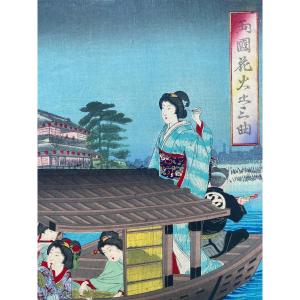
Japanese Woodblock Print By Yoshitoshi: Dawn Moon Over The Theater District
Shibaimachi no Akatsuki
1886
Woodblock print (Nishiki-e, 328 x 223 mm (sheet: 371 x 252 mm), Oban.
Print no. 43 from the series: Tsuki No hyakushi (The Hundred Aspects of the Moon).
Engraver: Enkatsu; seal: Taiso.
Short tear in the lower margin, previously restored.
“This print offers a snapshot of the early morning in Shibaimachi, the ‘theater district.’
In addition to its three kabuki theaters, the area was teeming with restaurants and ochaya, tea houses where theatergoers would go after the play to seek a different kind of entertainment.
In 1841, one of Edo’s two theater districts burned down, and a puritanical city official banned its reconstruction—this was also the time when restrictions were imposed on ukiyo-e regarding subjects and colors. All of the city’s theaters—including the puppet theaters—were eventually relocated to Asakusa, a district on the northern outskirts.
Theaters and teahouses now lined both sides of a wide alley, about three hundred meters long. Although not enclosed by walls like Yoshiwara or other pleasure districts, the area had its own special gate and formed a world quite apart from the rest.
The two cubic structures crowning the background are yagura, cage-like turrets built above the entrance to each of the neighborhood’s three kabuki theaters. They were originally used to advertise performances to the sound of a drum. Around 1818, they became purely architectural ornaments, decorated with the theaters’ emblems.
Erecting a yagura was tantamount to establishing a new theater.
This beauty’s hairstyle and her black-stained teeth suggest that she is married. Her fashionable attire, her gesture, and her slightly parted lips exude coquetry. Her lower lip is painted with “sasairobeni” green or “stilt grass” red, so named because it replicates the two-tone appearance of this Asian plant: initially green when in its pot, the pigment yields a deep red when applied in one or two coats and develops a green iridescence with each successive layer. This effect was highly sought after, likened to the iridescence of a magnificent beetle called the tamamushi, or “gem insect.” Undoubtedly, the contrast between the dark green and the vivid red was prized, reflecting Japan’s fascination with light and shadow.
This bijin stands out against a mauve dawn sky, where the gibbous moon lingers alongside a few bats flying toward their daytime roost.iạii
In: ONE HUNDRED ASPECTS OF THE MOON, John STEVENSON, 2018, Editions Citadelles et MAZENOD
The “One Hundred Aspects of the Moon” series, inspired by historical and legendary tales from China and Japan, is Yoshitoshi’s most famous series, begun in 1885 and completed just before his death in 1892. Even back then, the release of each new print was a major event, with editions often selling out by the morning of their release.
Dimensions in Millimeters (mm) Print (Subject) 328 × 223 mm Height 12.9 in • Width 8.8 in
Sheet (Paper) 371 × 252 mm Height 14.6 in • Width 9.9 in
Period: 19th century
Style: Asian art
Condition: Good condition
Material: Paper
Width: 252 mm
Height: 371 mm
Reference (ID): 1849658
Availability: In stock