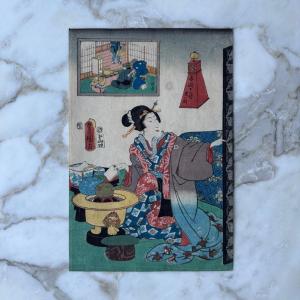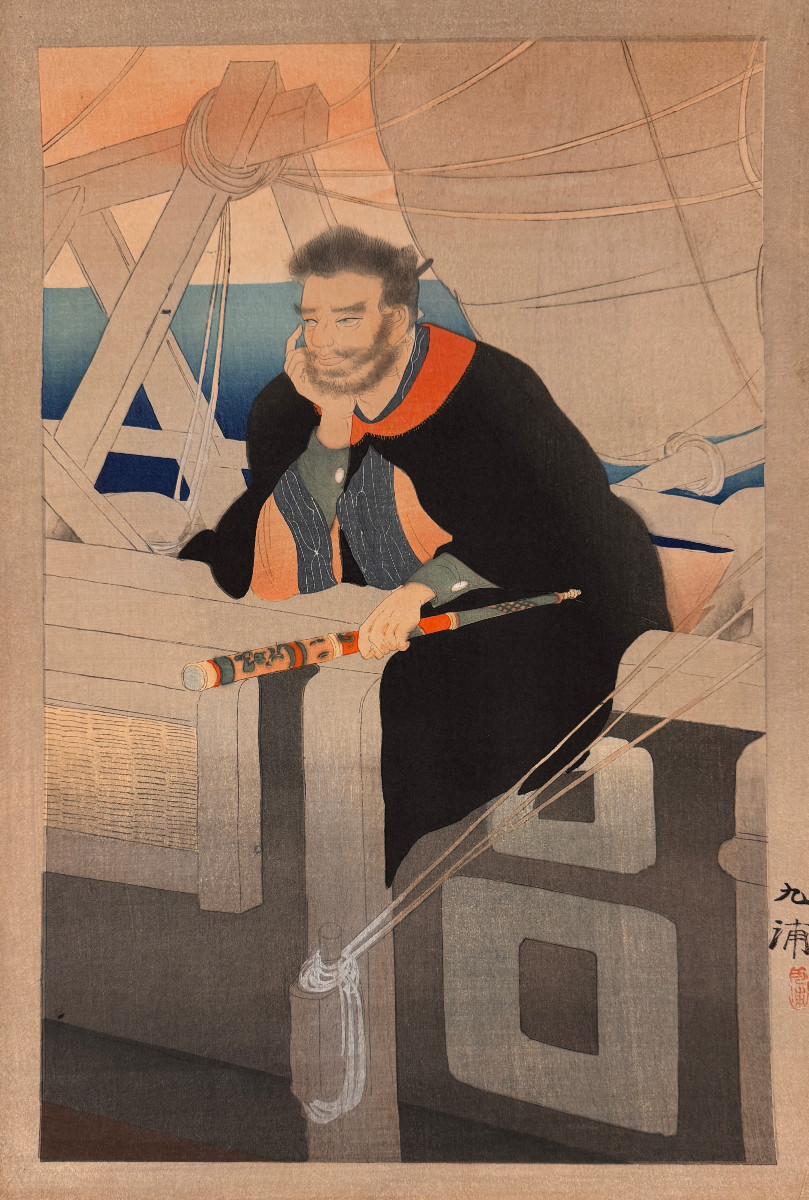
Japanese Woodblock Print By Kyuho: Kezori
Artist: Kyuho Noda ( 1879-1971 )
Beautiful colors, handling creases, lower right corner repaired, small tear in the right margin.
Nishiki-e
Oban
Ca. 1922-1923
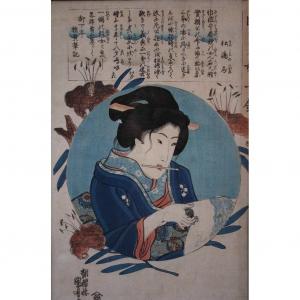
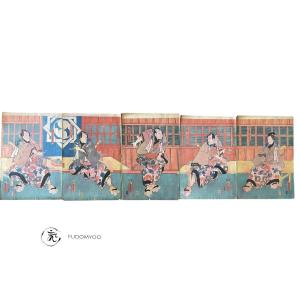
This print is part of a series published between 1922 and 1923 commemorating the bicentenary of the death of Chikamatsu Manzaemon (1623-1724), arguably the greatest playwright in the history of Japanese theater. Each print illustrates a scene or character from one of his most famous works.
The story of Kezori Kuemon and his gang is inspired by a real event: seven smugglers, arrested in Nagasaki, were mutilated and put in the stocks for three days in Osaka in October 1718. Chikamatsu Monzaemon immediately adapted this event for the puppet theater, writing the play "Hakata Kojorō Nami Makura", performed at the Takemotoza in November 1718. Noda was born in Tokyo and studied under the "Nihonga" style painter Terazaki Kogyo (1866-1919), then for a year from 1896 at the Tokyo School of Fine Arts. This final training allowed him to perfect his drawing skills and earn a living as an illustrator for the Osaka newspaper "Asahi Shimbun," which he joined in 1907. In Osaka, he created book illustrations and met the publisher Kanao Tanejiro. During this period, he became a major figure in the city's artistic life. He returned to Tokyo in 1917. Later, he devoted himself more to pure "Nihonga" painting, specializing in religious and historical subjects from China and Japan. After the Pacific War, he continued to live in the Tokyo area and was highly regarded in official Japanese artistic circles.
Nishiki-e
Oban
Ca. 1922-1923
This print is part of a series published between 1922 and 1923 commemorating the bicentenary of the death of Chikamatsu Manzaemon (1623-1724), arguably the greatest playwright in the history of Japanese theater. Each print illustrates a scene or character from one of his most famous works.
The story of Kezori Kuemon and his gang is inspired by a real event: seven smugglers, arrested in Nagasaki, were mutilated and put in the stocks for three days in Osaka in October 1718. Chikamatsu Monzaemon immediately adapted this event for the puppet theater, writing the play "Hakata Kojorō Nami Makura", performed at the Takemotoza in November 1718. Noda was born in Tokyo and studied under the "Nihonga" style painter Terazaki Kogyo (1866-1919), then for a year from 1896 at the Tokyo School of Fine Arts. This final training allowed him to perfect his drawing skills and earn a living as an illustrator for the Osaka newspaper "Asahi Shimbun," which he joined in 1907. In Osaka, he created book illustrations and met the publisher Kanao Tanejiro. During this period, he became a major figure in the city's artistic life. He returned to Tokyo in 1917. Later, he devoted himself more to pure "Nihonga" painting, specializing in religious and historical subjects from China and Japan. After the Pacific War, he continued to live in the Tokyo area and was highly regarded in official Japanese artistic circles.
130 €
Period: 20th century
Style: Asian art
Condition: Condition of use
Material: Paper
Width: 270 mm
Height: 395 mm
Reference (ID): 1709600
Availability: In stock
Print