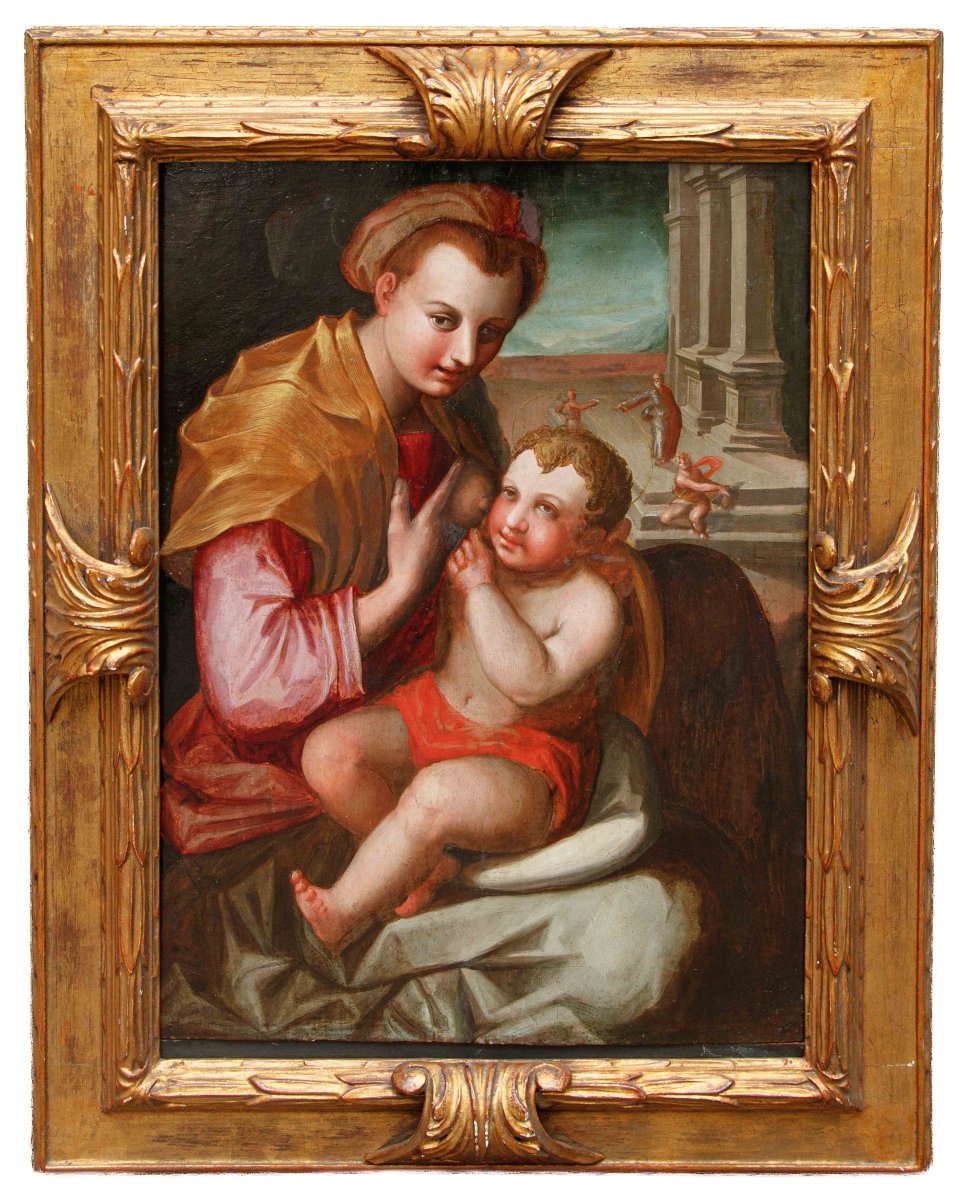







Tuscan School, 16th Century, Madonna And Child
Tuscan School, 16th century
Madonna and Child
Oil on panel, 48 x 66
With frame, 88 x 68 cm
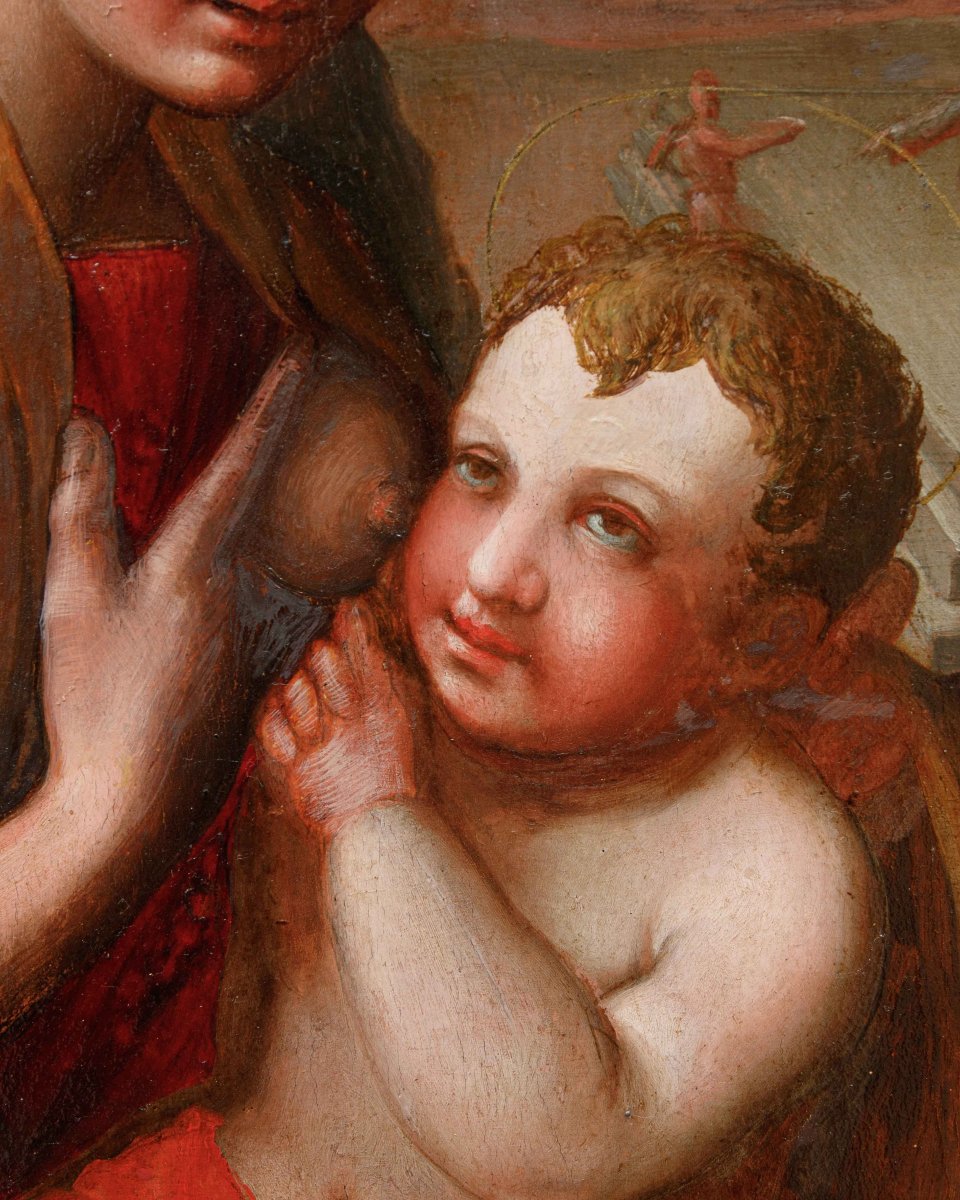
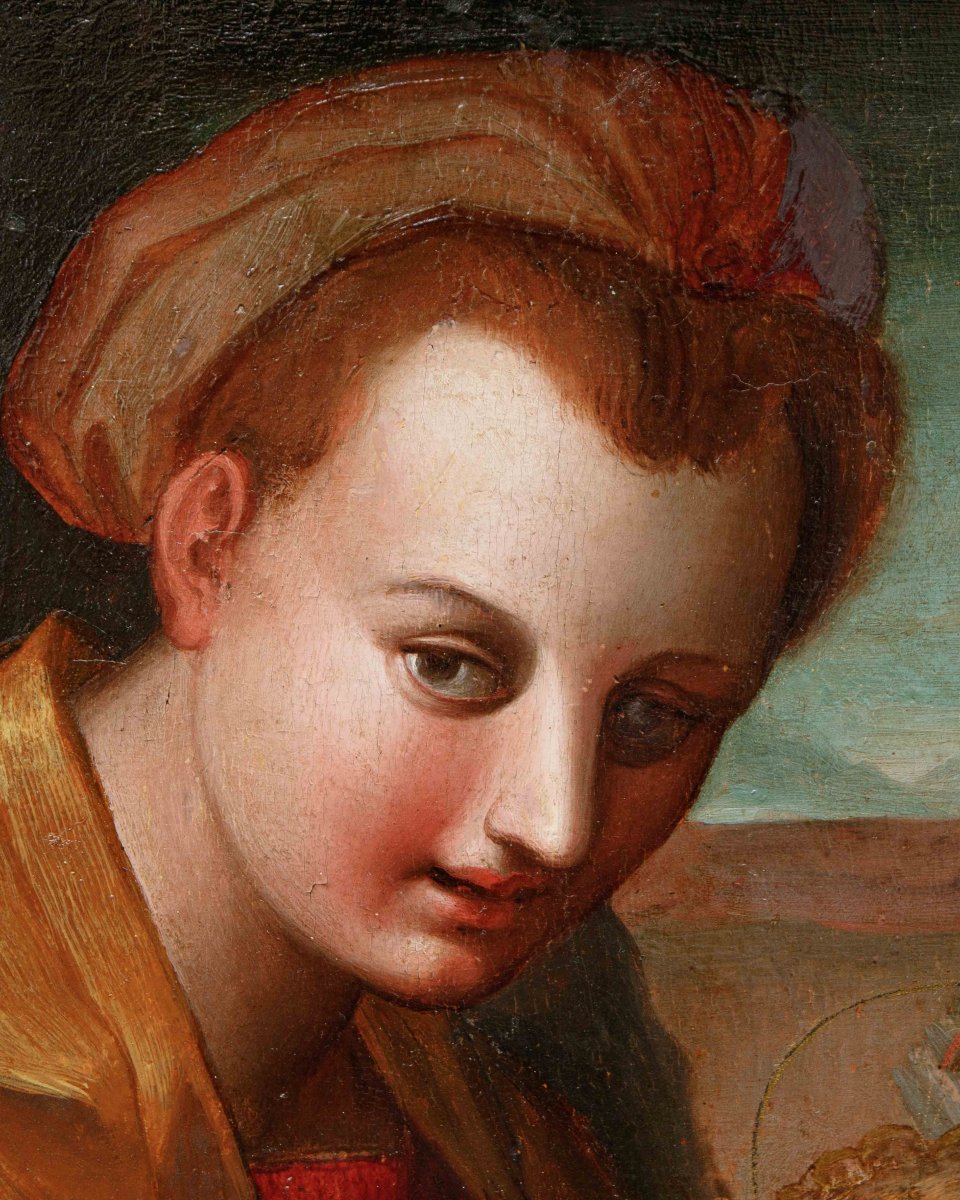
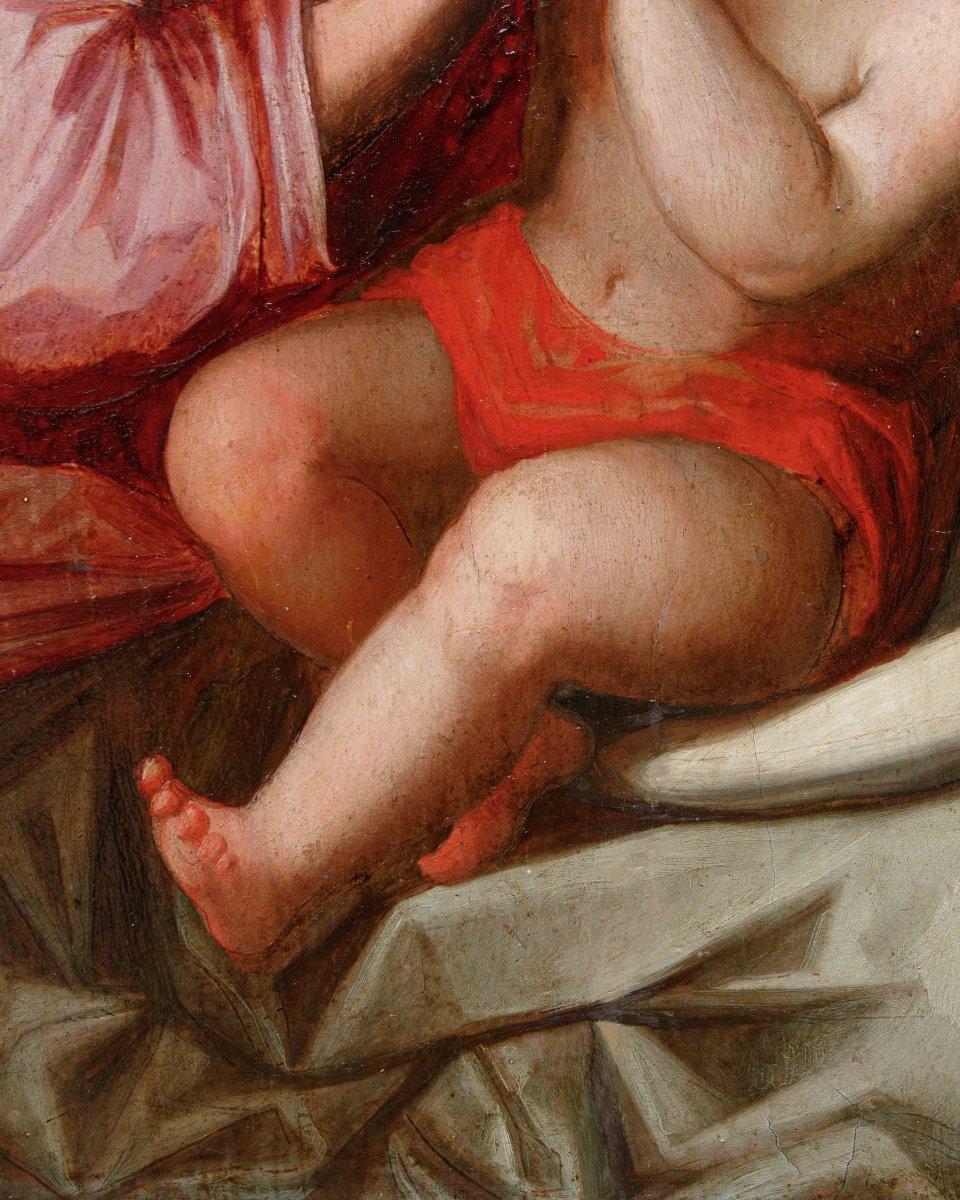
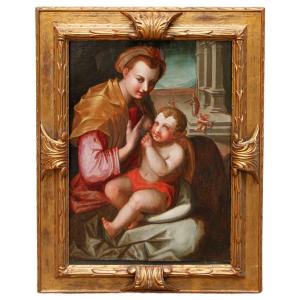
On a vertical panel, a Tuscan painter from the mid-16th century depicted the Madonna nursing the Child, in the tradition of the Madonna lactans. The Virgin, seated in the foreground, bows her head toward her son with a tender gaze and wears a pinkish turban on her head that lends her face a secular grace. The Child, naked and with curly hair, wrapped in a vermilion-red cloth, clings to his mother’s breast, while a slender golden halo signifies his divine nature. The group, arranged in a pyramidal composition, emerges from a dark background on the left and opens to the right onto a landscape where an ancient-style architectural backdrop rises, featuring columns on tall bases and broad staircases.
The painting is part of the Florentine figurative tradition and clearly draws on the work of Andrea del Sarto, the “painter without errors,” whose gentle use of color and harmonious compositions were praised by Vasari. From his master, the artist seems to have inherited above all the treatment of drapery: the pink sleeve with its broad folds and iridescent sheen, the golden-yellow cloak that unfolds in large, luminous planes, and the gray-green cloth on which the Child sits are rendered with soft shadows and gradual tonal transitions, so that the fabric acquires weight and texture. Even the physical features—the Madonna’s oval face and the chubby Child—echo the “Sartesque” Madonnas, which were widely replicated in Florentine workshops by students and followers even after the artist’s death in 1530.
The small scene in the background, populated by tiny figures set against classical-style architecture, instead refers to the tradition of the so-called eccentric Florentine painters. Francesco Granacci, who died as early as 1543, offers the clearest precedent: in his scenes, such as those depicting Joseph painted for Pier Francesco Borgherini’s chamber, small, animated figures move through architectural settings in an antiquarian style. In the height of the sixteenth century, among Pontormo, Bronzino, and the leading figures of the “second manner,” this style survived as a cultured allusion, and here the unknown painter grafts it onto the Sartesque model, creating a contrast between the monumentality of the foreground and the almost narrative dimension of the background. The result is a work of private devotion that bears witness to the enduring popularity of early-century models in Medici-era Florence.
Period: 16th century
Style: Other Style
Condition: Good condition
Material: Oil painting on wood
Width: 66
Height: 48
Reference (ID): 1847443
Availability: In stock